
Home / Shipping to Wallis and Futuna / How to ship from China to Wallis and Futuna
How to ship from China to Wallis and Futuna
Wallis and Futuna sits in the middle of the South Pacific, roughly between Fiji and Samoa, and it is one of those destinations where the hardest part is not the ocean crossing. It is the last leg. The territory has a small population, one working commercial port on the main island, an air service that runs through New Caledonia, and a tax system that does not copy metropolitan France. If you are importing from China for the first time, the rules that apply to a shipment to Los Angeles or Rotterdam will not help you here.
This page explains how a shipment actually reaches Wallis and Futuna, what the port can and cannot handle, how the import charges are stacked on top of each other, and which documents need to be right before the goods leave China. It is written for a buyer or a small business that has found a Chinese supplier and now has to work out how to get the goods landed.
At a glance
French overseas collectivity, not part of the European Union. One commercial port at Mata-Utu on Wallis with a secondary anchorage at Leava on Futuna. A container vessel calls roughly every three weeks. Air freight comes in through Nouméa on a single airline. Imports for business use face an entry tax, customs duties and proportional fees layered together. No home postal delivery, no cold chain, no dangerous-goods store.
How your cargo moves: China to Wallis and Futuna
Eight steps from your supplier's door to yours. The last four are the ones shaped by local rules.
- Pickup from your supplierWe collect the goods anywhere in China and bring them to our consolidation point.
- Export clearanceChina customs declaration filed and released before the goods move to the port.
- Loading and departureContainer loaded, sealed and handed to the carrier at the Chinese port.
- Main carriageOcean, air or rail movement booked on the route agreed for your cargo.
- Arrival at the gatewayDischarge at the port or airport of entry, recorded on the carrier's manifest.
- Import clearanceCustoms declaration filed locally, with duty and tax assessed on the declared value.
- Customs releaseGoods released into free circulation once duty and tax are settled.
- Final deliveryOnward movement to your delivery address, warehouse or nominated depot.
Duty rates, VAT rates and clearance times move, and the figure that applies to your goods is the one set for your commodity code on the day of clearance. We check the current position against your code before your goods sail and confirm it to you in writing — ask for that check when you request a quote.
What kind of place Wallis and Futuna is, before you plan a shipment
The territory is made up of three main islands. Wallis, also called Uvea, holds the administrative centre at Mata-Utu and most of the population. Futuna and the much smaller Alofi lie to the south-west. The total population is small, measured in low tens of thousands, and almost everything sold in the shops arrives by sea. There is no manufacturing base worth mentioning, which means your shipment is competing for space with the general supply of the islands rather than with other industrial importers.
Its legal status matters for customs. Wallis and Futuna is a French overseas collectivity, not an overseas department like Réunion or Guadeloupe, and it is not part of the European Union. French customs law and the French VAT code do not simply apply by default. The territory runs its own import tax system, and the rates and the procedure are locally set. That single fact is the reason so much general advice about shipping to France is wrong for this destination.
The currency is the CFP franc (XPF), which is pegged to the euro. Your supplier in China will still want to be paid in US dollars or RMB, so the currency question sits with you rather than with the factory, but any customs declaration on arrival will be made in local currency terms. There is a local bank on the islands, and payments to local agents move more slowly than a European buyer would expect.
Where cargo lands: the Mata-Utu wharf and the Leava anchorage
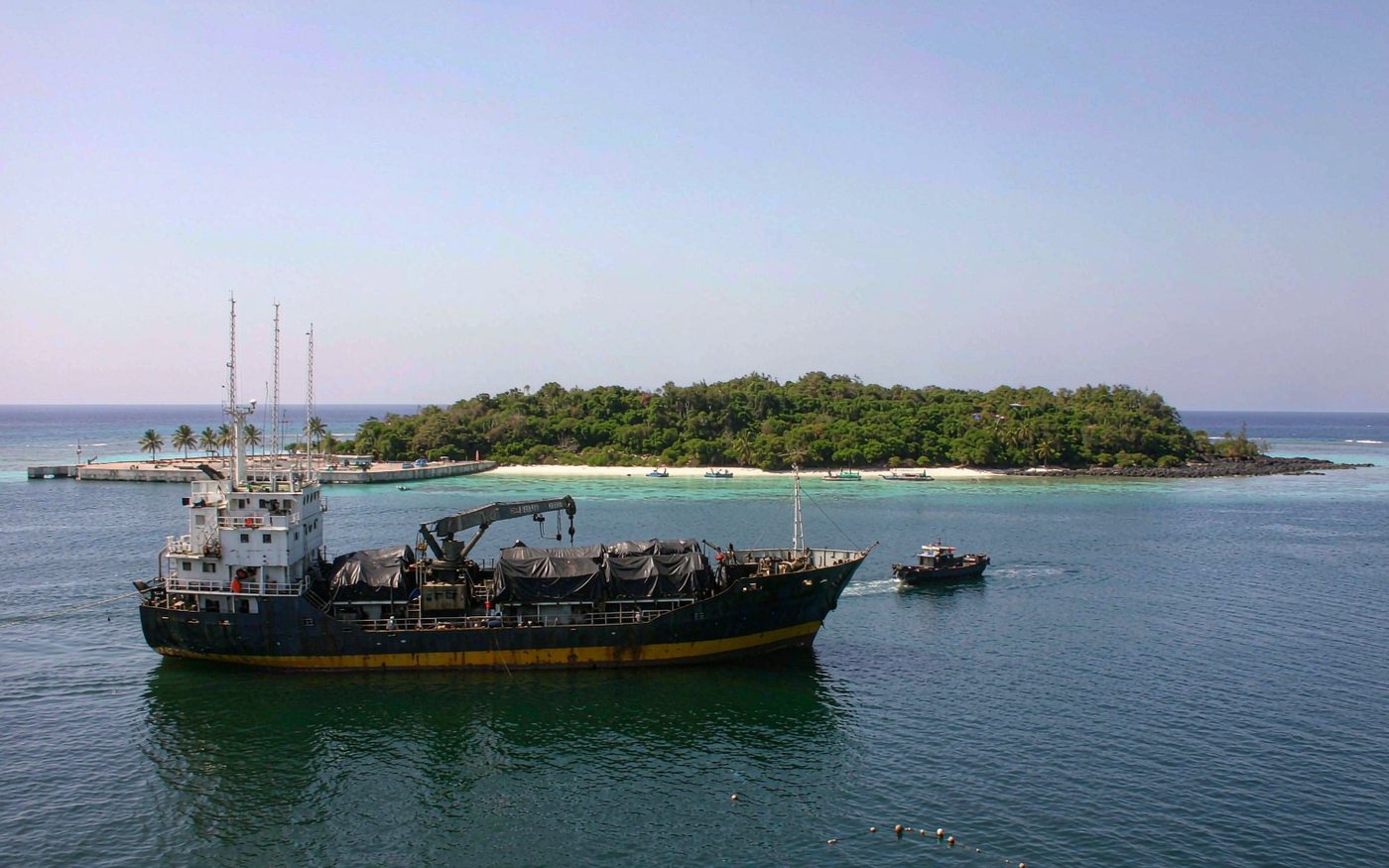
On Wallis, cargo comes in through the port at Mata-Utu. Treat it as a working general-cargo wharf rather than a container terminal. The berth takes vessels up to roughly 120 metres in length, with a secondary anchorage used when the berth is occupied or the weather does not cooperate. Discharge is done with mobile cranes and manual labour. There is no gantry crane, no container yard with reefer plugs, and no bonded warehouse in the sense a European importer would use the term.
That has three practical consequences. Heavy lifts need to be agreed in advance, because the lifting capacity on the quay is limited and a single heavy piece can hold up the discharge of everything behind it. Refrigerated cargo has nowhere to be plugged in, so anything temperature-controlled is effectively off the table. Dangerous goods cannot be stored, so a shipment classed as hazardous will not find a home on the quay.
Futuna is served separately, through the small landing point at Leava, and capacity there is even tighter. In practice a lot of cargo for Futuna is discharged on Wallis and moved across on the inter-island service, which adds another leg and another handling. If your consignee is on Futuna, say so at the very beginning, because the routing and the packing both change.
| Facility | Island | What it handles |
|---|---|---|
| Mata-Utu port | Wallis (Uvea) | Main commercial wharf, general cargo, break-bulk and containers discharged by mobile crane |
| Leava landing | Futuna | Small landing point, very limited capacity, weather sensitive |
| Hihifo airport | Wallis | Paved runway, small volumes, regional connections only |
| Pointe Vele airport | Futuna | Short runway, light aircraft volumes |
One container sailing roughly every three weeks
There is no direct service from China. Your container travels from a Chinese port to a regional hub, and then waits for a connecting vessel that calls at Wallis. The connecting service runs roughly every three weeks, and the interval moves with the carrier's commercial decisions rather than with a published timetable you can rely on a year out.
The important thing for a first-time importer is what a three-weekly service does to a mistake. If your documents are wrong, or a certificate is missing, or the consignee does not collect on time, the next opportunity is not a week away. It is roughly three weeks away, and the storage clock starts running as soon as the cargo touches the quay. Missing a sailing is the single most expensive thing that can happen on this route.
Because of that structure, plan the purchase order backwards from a sailing date rather than forwards from a production date. Ask the forwarder for the next two or three planned calls, then set the factory completion date so the goods reach the Chinese port with enough margin to make the main leg. Two weeks of slack in China costs far less than three weeks of waiting on the islands.
Air freight comes in through New Caledonia, on a single airline
Air service to the islands is thin. Wallis has Hihifo airport and Futuna has Pointe Vele, and the airline serving the territory operates through Nouméa in New Caledonia. That means a Chinese air shipment does not fly direct to the islands; it flies to a hub, connects to Nouméa, and then takes the final sector to Wallis or Futuna. Each connection is another place where cargo can be rolled.
Belly capacity on the final sector is small, and the aircraft are not freighters. Air freight here suits a specific and narrow set of shipments: urgently needed spare parts, medical supplies, documents that must arrive as originals, and small high-value items where the cost of delay exceeds the cost of the air freight itself. It does not suit a commercial restock, and it does not suit anything bulky.
One point that catches people out: an air shipment still has to clear the same customs and biosecurity process on arrival. Flying goods in does not skip the queue at the port. If the paperwork is not right, an air shipment can sit at the airport longer than the flight took to get there. See our page on air freight from China for how the first leg works, and treat the Nouméa connection as a separate booking that needs its own confirmation.
Three charges stacked on goods imported for business use
Goods brought in for professional or commercial use attract more than one charge, and they are assessed on top of each other rather than as a single rate. Published figures for the territory describe an entry tax of roughly 20 per cent, customs duties of roughly 10 per cent, and proportional fees around 2 per cent. Treat all three as indicative and confirm the current bands with a local broker before you quote a landed cost to anybody.
The mistake to avoid is assuming one headline rate. A buyer who budgets for a single 10 per cent charge and then meets an entry tax on top of it has not just mispriced the shipment, they have mispriced the whole order. Ask for the three components separately, in writing, against your actual HS codes.
The classification of the goods drives everything. A machine for a workshop, stock for a shop, and materials for a construction project are not treated identically, and the same product imported by a business and by an individual can end up on different footing. Send your HS codes and a clear description to the broker early rather than after the vessel sails.
Household effects moving with a person relocating can qualify for relief, but vehicles are commonly excluded from that relief. If the shipment is a relocation rather than a commercial purchase, say so at the booking stage, because the declaration route is different from the start.
Whether VAT applies here, and why sources disagree
Here is a genuine unresolved point, and it is better to flag it than to pretend otherwise. Some reference sources describe an 8.5 per cent VAT on the territory, applying the rate used in the French overseas departments. Other sources state that VAT does not apply in Wallis and Futuna at all, on the basis that the French VAT code is not in force here. Both statements circulate widely, and we have not been able to reconcile them from a primary source.
What this means in practice: do not build a landed-cost model on either figure. Ask the customs broker handling the entry to state, in writing, whether TVA is assessed on your commodity and at what rate, and get that answer before you commit to a purchase order. The same caution applies to the tax figures in the previous section.
This is also why a generic French import guide is dangerous here. Wallis and Futuna is not Guadeloupe, and the rates that apply in an overseas department do not carry over automatically to a collectivity with its own tax code.
Biosecurity clearance runs through BIVAP
The veterinary, food and plant inspection service, known locally by its French acronym BIVAP, screens foodstuffs, plant material, animal products and anything that might carry pests. On a small island with a fragile agriculture, this is taken seriously, and a container can be held while an inspector decides what happens to it.
The categories that cause trouble are familiar: seeds, soil, fresh food, meat and dairy, untreated wood, and anything of animal origin. Wooden pallets and crates need to meet the ISPM 15 standard and carry the mark, and it is worth specifying treated wood to the Chinese supplier in writing rather than assuming the packing crew knows. If a crate shows up without the mark, the whole shipment can be held rather than the offending piece.
Where a permit is required, apply for it before the goods ship, not after they land. Permits issued on arrival take time, and time on this route is measured in sailings. Our quarantine inspection page covers the general process for exports from China.
There is no home delivery: the post office box is the address
Mail and parcels are not delivered to homes here. The address is a post office box, at Mata-Utu on Wallis or at Leava on Futuna, and the recipient collects. That has a direct effect on how you write the consignee details on the bill of lading and on the commercial invoice.
Give the forwarder a named local contact with a working telephone number, and put that number on the shipping documents. Carriers and agents in the Pacific do not reliably reach people by email, and a container that cannot be contacted about will sit on the quay. The consignee also has to be able to get to the port, which in practice means having transport arranged for the discharge day.
For a first-time importer this is worth stating plainly: door-to-door delivery is not a normal part of this route. Your responsibility runs to the port, and the consignee's responsibility starts there. If you need delivery beyond the quay, it has to be arranged locally and quoted separately.
Packing for a landing ramp instead of a container terminal
Pack for the handling the cargo will actually receive. Goods discharged by mobile crane and moved by hand across an open quay take more punishment than goods moved through a terminal with proper equipment, and they may wait outdoors before collection in a hot, humid, salt-laden climate.
- Keep individual pieces to a weight and size that the quay equipment and the local transport can manage, and confirm the limit before the supplier builds the crate.
- Palletise wherever possible, so the cargo can be moved as units rather than piece by piece.
- Use waterproof wrapping and desiccant inside the crate. Humidity and salt air are constant here, and a long wait on the quay is normal rather than exceptional.
- Avoid untreated wood entirely, and keep the ISPM 15 mark visible on the outside of the crate.
- Do not ship lithium batteries, chemicals or anything classed as dangerous goods without checking first. There is no dangerous-goods store and no cold chain at the port.
If the shipment is fragile, say so at booking rather than in the packing list. Crating standards can be raised cheaply in China and cannot be fixed at all once the goods are on the quay at Mata-Utu.
Documents that keep a small shipment moving once
On a route with a three-week gap between sailings, a document error is not a small problem. Get these right before the goods leave the factory.
- Commercial invoice with a specific description of each item, quantity, unit and total value, HS code, country of origin, and the Incoterm used.
- Packing list showing piece count, net and gross weight, and dimensions, matching the invoice line by line.
- Bill of lading or air waybill, with the consignee and the notify party both carrying a working telephone number.
- Certificate of origin where the classification or a preferential claim depends on it.
- Permits and certificates for food, plant or animal-origin goods, applied for before sailing.
- Insurance policy, which on this route is not optional. See cargo insurance.
Writing "spare parts" or "accessories" on an invoice is the fastest way to be asked for a supplementary declaration, and on this route a supplementary declaration costs a sailing. Describe the goods as if the customs officer has never seen them, because they probably have not. The shipping documents page lists what we normally ask a supplier for.
Who this route works for
Be honest about whether this route suits your shipment. It is a good fit for some cargo and a poor one for the rest.
- Planned restocking on a known cycle, where a two or three month lead time is acceptable
- Institutional, government, church or school supply, where the volume is predictable
- Spare parts and equipment for a known installation programme
- Non-perishable, non-hazardous goods that tolerate a long outdoor wait
- Anything needed by a fixed date, such as a seasonal retail window
- Perishables, temperature-controlled goods, or dangerous goods
- Small trial orders, where the fixed local costs dominate the invoice
- Anything that might need to be returned, because reverse logistics barely exists here
If you decide to go ahead, consolidate. Because so many of the local costs are fixed per shipment rather than per cubic metre, one larger shipment every quarter usually costs less than four small ones, and it removes three opportunities to miss a sailing.
Why importers use Goodhope on this lane
Six things that are different about working with us on China to Wallis and Futuna shipments.
Getting a quote for Wallis and Futuna
Send us the commodity, the HS codes if you have them, the dimensions and weight, and the island the goods are going to. We will tell you which sailing is realistic, what the local charges are likely to be, and what has to be confirmed in writing before you commit.
Get a quote Talk to usRelated pages
Frequently asked questions
Is there a direct sailing from China to Wallis and Futuna?
No. Cargo moves from a Chinese port to a regional hub and then connects to the service that calls at Mata-Utu. The connection is the least predictable part of the journey, so plan around sailing dates rather than production dates.
How often does the container vessel call?
Roughly every three weeks. The interval is set by the carrier and can change, so ask for the next two or three planned calls before you finalise a purchase order rather than assuming a fixed timetable.
Which port should my supplier ship to?
Mata-Utu on Wallis is the working commercial port. If the consignee is on Futuna, say so at the start, because cargo for Futuna is often discharged at Mata-Utu and moved across on the inter-island service.
Can I ship by air instead?
Yes, but understand the limits. The service runs through Nouméa in New Caledonia on a single airline, with small belly capacity and no freighter aircraft. It suits urgent spare parts, medical supplies and small high-value items, not commercial restocking.
Does VAT apply on imports into Wallis and Futuna?
Sources conflict. Some references give an 8.5 per cent rate, others state that VAT does not apply because the French VAT code is not in force here. Do not budget on either figure; get the answer in writing from the broker handling your entry before you commit to the order.
What taxes apply to goods imported for business use?
More than one charge, applied on top of each other: an entry tax, customs duties and proportional fees. Published indicative figures are around 20 per cent, 10 per cent and 2 per cent respectively. Confirm the current bands against your own HS codes.
Can I ship lithium batteries or dangerous goods?
Not without checking first. The port has no dangerous-goods store and no cold chain, so hazardous cargo has nowhere to be held on arrival. Contact us with the classification before you book.
Is door-to-door delivery available?
Not as a standard part of this route. Responsibility runs to the port, and the consignee collects. There is no home postal delivery, so the address on your documents should be a post office box with a named contact and a working phone number.
Can my personal effects come in duty-free when I relocate?
Relief for household effects may be available, but vehicles are commonly excluded. Tell the forwarder at the booking stage that this is a relocation, because the declaration route is different from a commercial import.
What currency is used, and does my supplier care?
The local currency is the CFP franc (XPF), pegged to the euro. Your Chinese supplier will still want US dollars or RMB, so the currency question sits with you, but the customs declaration is made in local currency terms. Local banking moves slowly, so allow time for payments to agents and brokers.