China's Fruit Wholesale Markets: A Practical Guide for First-Time Buyers
Container doors opening at 2 a.m., cartons stacked three meters high on a pallet, a price board that changes twice a day: China's fruit wholesale market is not a bigger version of a fruit stand. It is a distribution system where growing regions, ports, primary consolidation markets, secondary wholesalers and cold-chain warehouses sit within a few dozen kilometers of each other. This guide is written for two readers: overseas importers buying fruit from China for the first time, and first-time visitors who cannot yet tell a carton from a pallet or a container.
5.03 million tFruit and vegetable volume traded at Guangzhou Jiangnan in 2025 — No. 1 in China by single-market fruit and vegetable volume for 22 consecutive years
RMB 29.12 bnJiangnan's 2025 turnover; more than half the fruit sold in Guangdong is distributed from this market cluster
Over 60%Share of China's imported fruit consolidated through Guangzhou Jiangnonghui; imported cherries alone represent roughly 60% of national circulation
RMB 62.10 bn2025 turnover at Zhejiang Jiaxing Fruit Market, ranked No. 1 nationally among specialized fruit wholesale markets
Note: this is an objective market overview and buying-method guide. It represents no individual merchant and contains no pricing or sales offer. Volumes, opening hours, stall structures and regulatory practice change; confirm with the market operator and Customs before travelling.
Market Structure
What Makes China's Fruit Wholesale Markets Different
Most first-time visitors expect an oversized fruit shop. What they walk into is closer to a commodity exchange built around containers and cold chain — and that structure, not the sheer scale, is what changes how you buy.
The way business is done here differs from the Dutch auction clock, the Japanese central wholesale market and Thailand's Talad Thai. The difference is not scale; it is structure. The six features below decide what you can buy, in what form, and which links in the chain you have to watch.
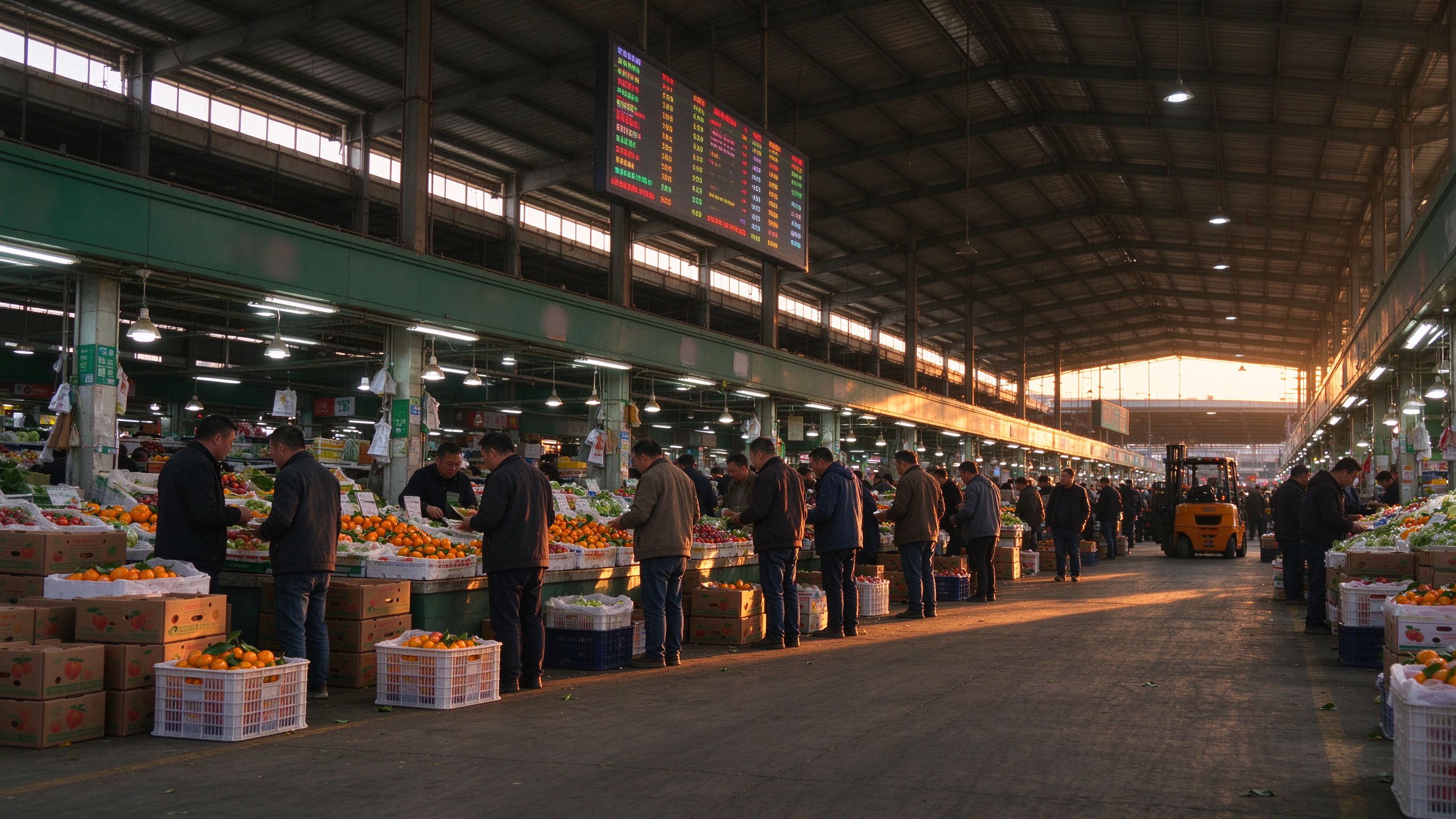
A typical fruit wholesale trading hall: stalls in a single long row, a live price board overhead, and quiet only after dusk.
Two price windows a day — fruit is live stock
Before dawn, imported containers are opened and secondary wholesalers take stock; during the day, domestic arrivals and supermarket replenishment dominate. The same carton of cherries can carry one price in the morning and another in the afternoon; leave it one day and soft fruit or dropped stems force a markdown. That is why every quote here comes with conditions: grade, which day's stock, minimum cartons, and whether unloading is included.
Imported and domestic fruit bid in the same hall
Jiangnan in Guangzhou moves roughly 6,000 t of fruit a day — about 1,500 t domestic and 4,000 t imported, with imports overtaking domestic volume in peak season. Cherries, durians and coconuts are the three long-running pillars; Chilean cherries once accounted for about 80% of the market's imported fruit and nearly 3,000 t a day.
Sold by carton, pallet and container — not by the kilo
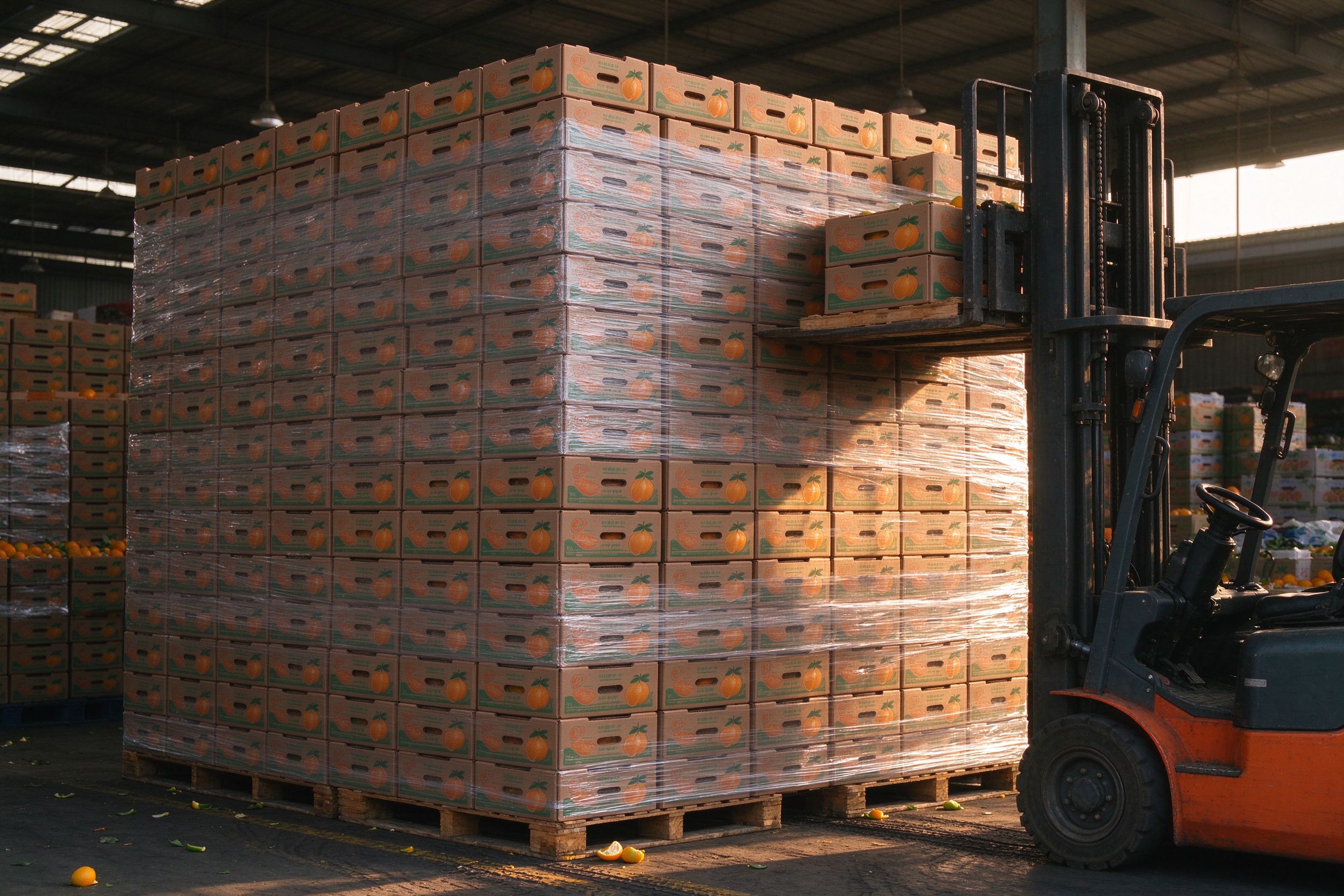
The trade units are the carton (one box), the pallet (a built-up stack) and the container (one 40-foot reefer). Imported cherries usually run 10 jin (5 kg / 11 lb) per carton; a pallet is commonly 22–24 layers of 8 cartons, i.e. 176–192 cartons or about 1 tonne; a container is roughly 20 pallets, about 3,500 cartons and close to 20 tonnes. Agree the unit before the price, or the numbers never reconcile.
Primary consolidation and secondary wholesale are separate tiers
Jiangnonghui is the national primary consolidation point for imported fruit; Jiangnan handles mixed fruit and vegetables; Jiaxing is the Yangtze Delta distribution hub and publishes its own fruit price index; Changsha Hongxing and Beijing Xinfadi serve their regions; Pingxiang Youyiguan is a land border port rather than a market. The same consignment may reach a primary market first and then be marked up by a secondary one.
Ports feed stalls directly
Nansha port runs advance declaration and ship-side direct pickup for imported fruit — 12 hours to cover South China, 32 hours to Shenyang, and as little as one day from berth to store. The smart gate at Pingxiang Youyiguan clears a truck in under 15 seconds: seven hours east to Jiangnan, thirty hours north to Xinfadi. That chain determines how many days of shelf life you actually receive.
Direct-from-origin supply is reshaping the old markets
Live-stream selling at origin, orchard-direct supply and newly built markets are diverting volume. Jiaxing describes itself as "a market that grew without growing fruit", and its own pressure is visible: a 403-mu fruit market opened in Chuzhou in May 2026, and in April 2026 Jiaxing opened the 773-mu Haiguangxing market in Kunming, forming a Jiaxing–Kunming dual hub that claims 12-hour coverage nationally and 48-hour reach into ASEAN.
This is not a cheap fruit stand. It is a distribution system that runs on containers and cold chain. Whether you pay well or badly comes down to three variables: which tier the cargo sits at (primary consolidation or secondary wholesale), what the packing unit actually means (carton, pallet, container, and tare), and how settlement is structured (cash on the spot or consignment sale).
The built pallet is the market's standard unit: stretch-wrapped, layered by count, handled by forklift. Buyers usually sample the top, middle and bottom layers.
Trading & Distribution Hubs
Which Tier Should You Be Buying At?
Do not start by picking "the most famous market". Decide first whether you need a first-hand imported container or regional replenishment stock — buying at the wrong tier adds an entire layer of margin and still leaves you short of the volume you wanted.
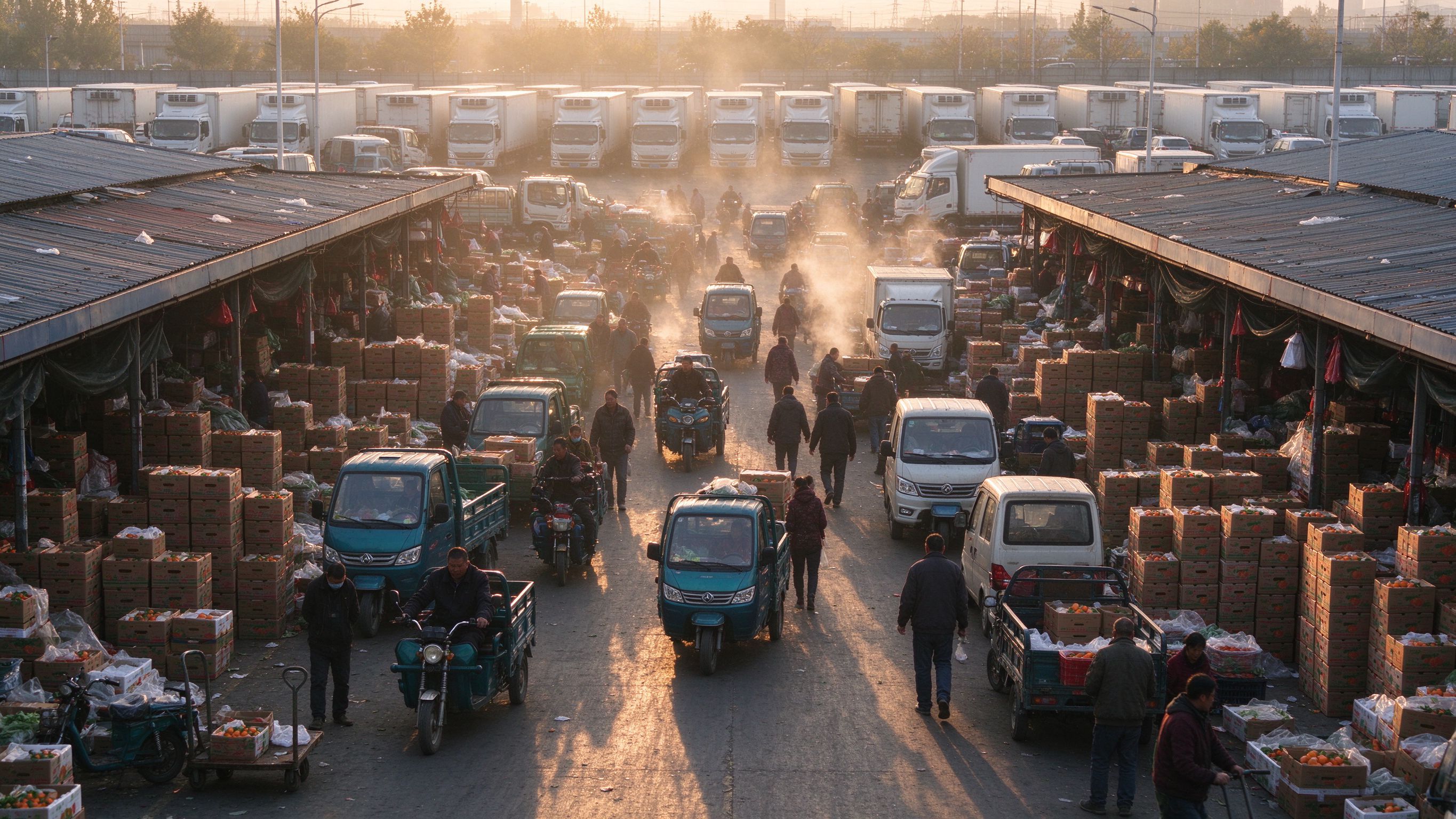
The gate at dawn: tricycles, light trucks and hand carts queuing to enter. The busiest two hours of the day start here.
Major consolidation points and border ports (figures from public 2025–2026 reporting; use them to judge tier, not to set a price)
Market / port
Type and positioning
Key figures
Best suited to
Guangzhou Jiangnan Fruit & Vegetable Market Baiyun DistrictFounded 1994
Comprehensive primary fruit and vegetable wholesale; about 400,000 m² (99 acres) with 8 gates; roughly 80% of Guangzhou's fruit and vegetable volume
2025: 5.0285 million t traded, RMB 29.118 bn turnover; about 15,000 t of produce a day (6,000 t fruit); No. 1 nationally by single-market fruit and vegetable volume for 22 years
Buyers who want every category in one place and a direct imported-versus-domestic comparison
Guangzhou Jiangnonghui Market Songzhou StreetNext to Jiangnan
Primary consolidation point for imported fruit; deals are struck by the pallet
Over 60% of China's imported fruit is consolidated here; imported cherries about 60% of national circulation; up to four trading rounds a day in peak, a 300-container peak per round and 700 containers in a single day
Buyers taking first-hand imported containers, by the pallet or by the container
Zhejiang Jiaxing Fruit Market Founded 1992540 mu · 681 merchants
Yangtze Delta fruit distribution hub; publisher of the Jiaxing China Fruit Index
2025: RMB 62.101 bn turnover (+6.9%), 4.0727 million t; imports RMB 30.020 bn, domestic RMB 32.081 bn; No. 1 nationally in jackfruit, No. 1 in East China in durian, dragon fruit and longan
Small and mid-size wholesalers supplying East China who need steady repeat volume
Changsha Hongxing Global Agricultural Wholesale Center About 800 muBuilt 2021
Regional primary wholesale center, known for its tare-weight enforcement; about 880 operators
About 10,000 t of fruit a day, 20,000 t at peak; imported durian over 800 t a day; mango volume up from 80,000 t in 2022 to about 120,000 t in 2024
Central China buyers, especially those who care about honest weighing
Beijing Xinfadi
One of North China's largest agricultural distribution centers
2025: 425,600 t of imported fruit and RMB 13.582 bn turnover, about 85% of it ASEAN fruit; 200-plus imported varieties from 46 countries sold each year
Distribution and supermarket supply into North and Northeast China
Pingxiang Youyiguan Border Port, Guangxi
Land border port — the main ASEAN fruit corridor (a port, not a wholesale market)
One in three imported durians enters China here; January–July 2026: 1.7335 million t of ASEAN fruit worth RMB 26.025 bn through Guangxi ports; smart-gate clearance under 15 seconds
Buyers sourcing direct from ASEAN origin who want to cut out the primary tier
Other coordinates worth remembering: the Nanning Jiangnan International Fruit Trading Market is a major durian consolidation point, and the Chongqing Jiangjin Shuangfu International Agricultural Trade City is the secondary distribution node for Southwest China, shipping up to 3,000 cartons a day. Buyers running the whole chain usually keep one contact at each tier — port, primary market, secondary market — instead of relying on a single market.
A field test for tier: ask the seller "did you open this container yourself, or did you split it off someone else's pallet?" If they cannot name the container number, the sailing date or the packing house at origin, you are probably two or three steps downstream.
First Purchase
Your First Buying Trip, Step by Step
New buyers rarely lose money because they cannot negotiate. They lose it because they walk in unprepared: no volume target, no idea what the packing unit means, no idea when to arrive, and no idea who to talk to. These eight steps follow the real rhythm of a buying trip.
In a Chinese fruit wholesale market, asking the right question is worth more than shaving the price. The same carton of mangoes quoted two cents lower may simply carry two jin more tare; the same container of cherries may differ by ten days of sailing.
1
Put your requirement on one sheet of paper
3–7 days before departure
Write down five things: category, grade, packing unit, delivery window, acceptable price range. For example: "Monthong durian, grade A, 5–6 pieces per carton, 4–5 jin per piece, delivery within one week, landed cost not above X". Without that sheet you will simply be quoted at whatever the stall feels like. Also decide now whether you are exporting: if so, the registration status of the orchard and packing house and the destination country's quarantine requirements must be checked in advance (see the export section below).
2
Pick the tier and the market — not the most expensive one
1–2 days before departure
For first-hand imported cargo, go to a primary consolidation point such as Jiangnonghui. To compare every category at once, go to a comprehensive market such as Jiangnan. For regional distribution, go to a hub such as Jiaxing or Hongxing. Call ahead or check the market's official account for opening hours, whether entry needs a booking and whether heavy trucks are allowed in — many markets ban large trucks during the day and run fixed loading windows.
3
Arrive for container opening and the morning market
02:00–06:00 on arrival day
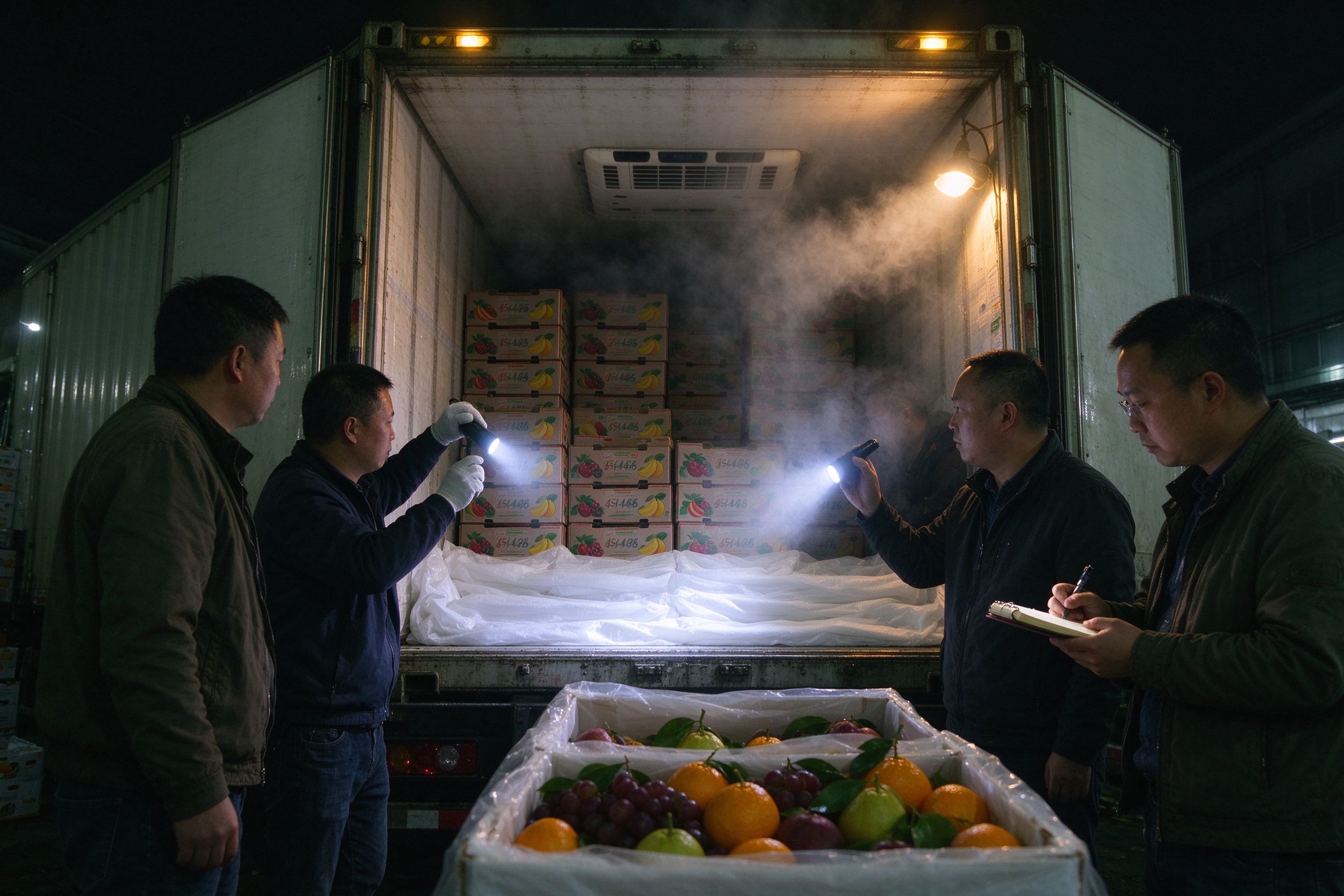
The core event for imported fruit is container opening: the reefer doors swing open, cold white mist spills out, and buyers check fruit, stems and firmness with flashlights. On a peak day Jiangnonghui can run four trading rounds, and the best pallets are usually gone in the first two. Domestic fruit tends to arrive during the day and be replenished toward evening. For a first trip, go two days in a row: day one to look and record prices and stalls, day two to buy.
4
Choose a stall by what you can see, not by what you hear
First hour on site
Look for three things. First, whether the stall advertises a "original pallet, original carton, original label" policy — traders at markets such as Jinan Dikou do, and "original label" means the origin label is intact, i.e. the carton was never opened and relabelled. Second, whether it has its own cold room: stalls with cold storage can hold stock and usually protect freshness better. Third, whether the position and the supply source are fixed and long-standing. Anyone who chases you across the hall with a price far below everyone else should be left for later.
5
Inspect by sampling three layers, not the top carton
20–40 minutes of inspection
On a pallet, ask for one carton from the top, one from the middle and one from the bottom to be opened; inside each carton, check the surface, middle and bottom layers. Look at whether sizing is uniform, whether stems are green, whether there is softening or water damage, and whether the liner, fruit sleeves and ice packs are intact. For cherries, check bloom and firmness; for durian, check the number of chambers and the split; for grapes, check for dropped berries. Film the inspection and note the carton numbers — that is your only evidence if a dispute starts later.
6
Ask six questions at once, not just "how much"
10–20 minutes of negotiation
The standard set: price, packing unit (how many cartons per pallet, how many jin per carton), tare weight, minimum order, whether unloading is included, and which day's stock it is. Buyers who only ask the unit price usually pay it back through tare, unloading charges and minimum-order top-ups. On larger volumes you can negotiate a pallet price or a container price, but have every condition written onto the document.
7
Weigh, deduct tare, and write it all down
30–60 minutes to close
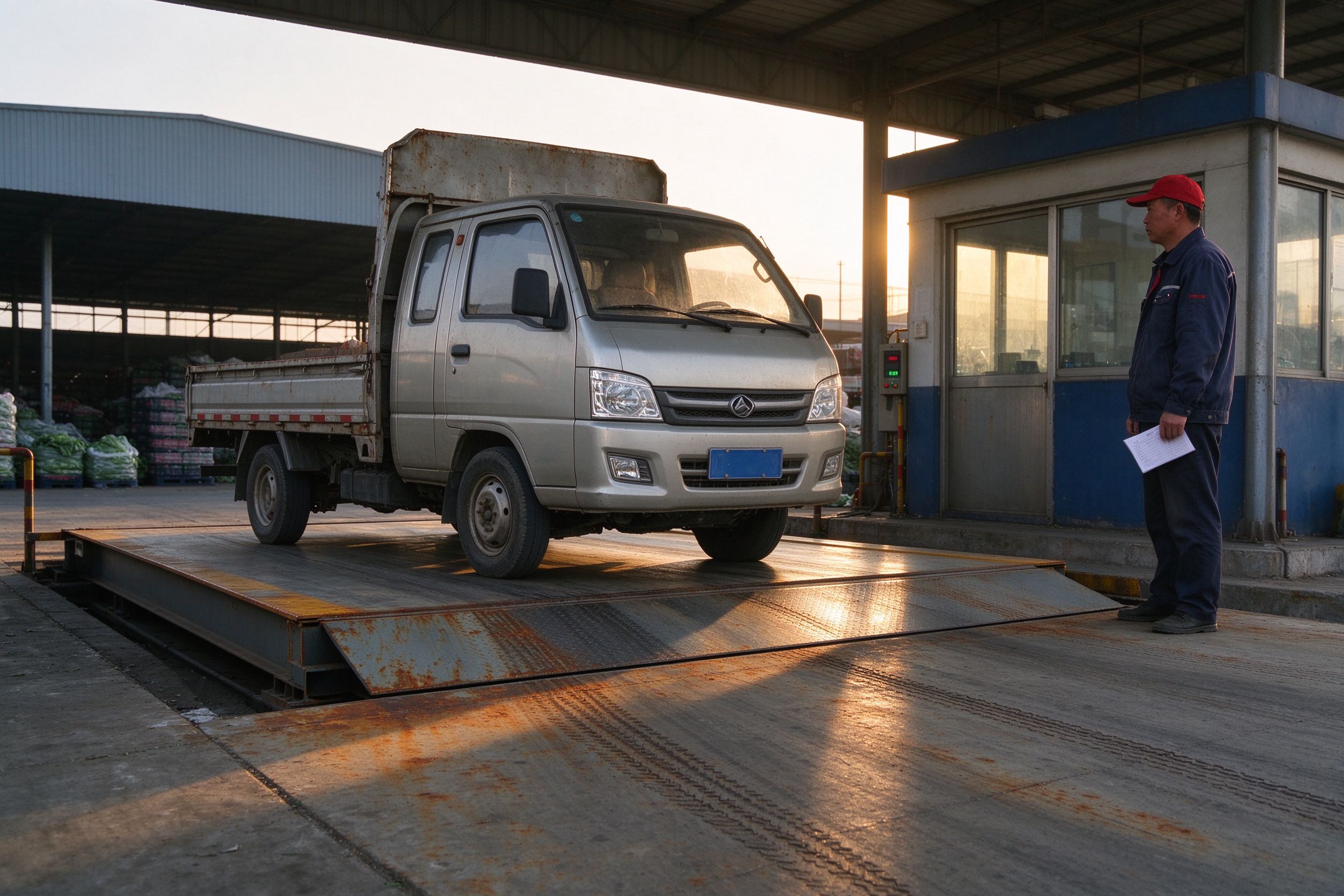
Bulk deals go over the market weighbridge, and you keep the weighbridge ticket. Net weight must be stated as "gross minus tare equals net", together with the tare basis (a fixed deduction per carton, or the actual measured weight of the empty box). The document should carry at minimum: product name, origin, grade, carton count, gross weight, tare, net weight, unit price, total, settlement method, and delivery time and place.
8
Settle payment and fix the logistics before the truck moves
Same day to 3 days after closing
Three settlement models: cash on the spot (paid same day, usually the best price), deposit plus balance (balance before dispatch), and consignment sale (the stall sells on your behalf and settles afterwards). For consignment, the fee basis, the list of ancillary charges, the settlement cycle and the loss-sharing rule must all be in writing. On the logistics side, short hauls go by refrigerated truck, long domestic hauls by LCL cold chain or air, and exports by reefer container or air freight with inspection and customs declaration in parallel.
The market weighbridge: bulk deals settle on weight, and the ticket is your basis for reconciliation and claims.Night container opening: cold mist, flashlight inspection — the most important fifteen minutes of an imported consignment.
Quality Control
Turning "Looks Fresh" into a Checklist
Beginners judge fruit by feel. Experienced buyers judge it by measurable items: sizing, firmness, Brix, stem color, skin condition and the environment inside the carton. Print this list and take it with you.
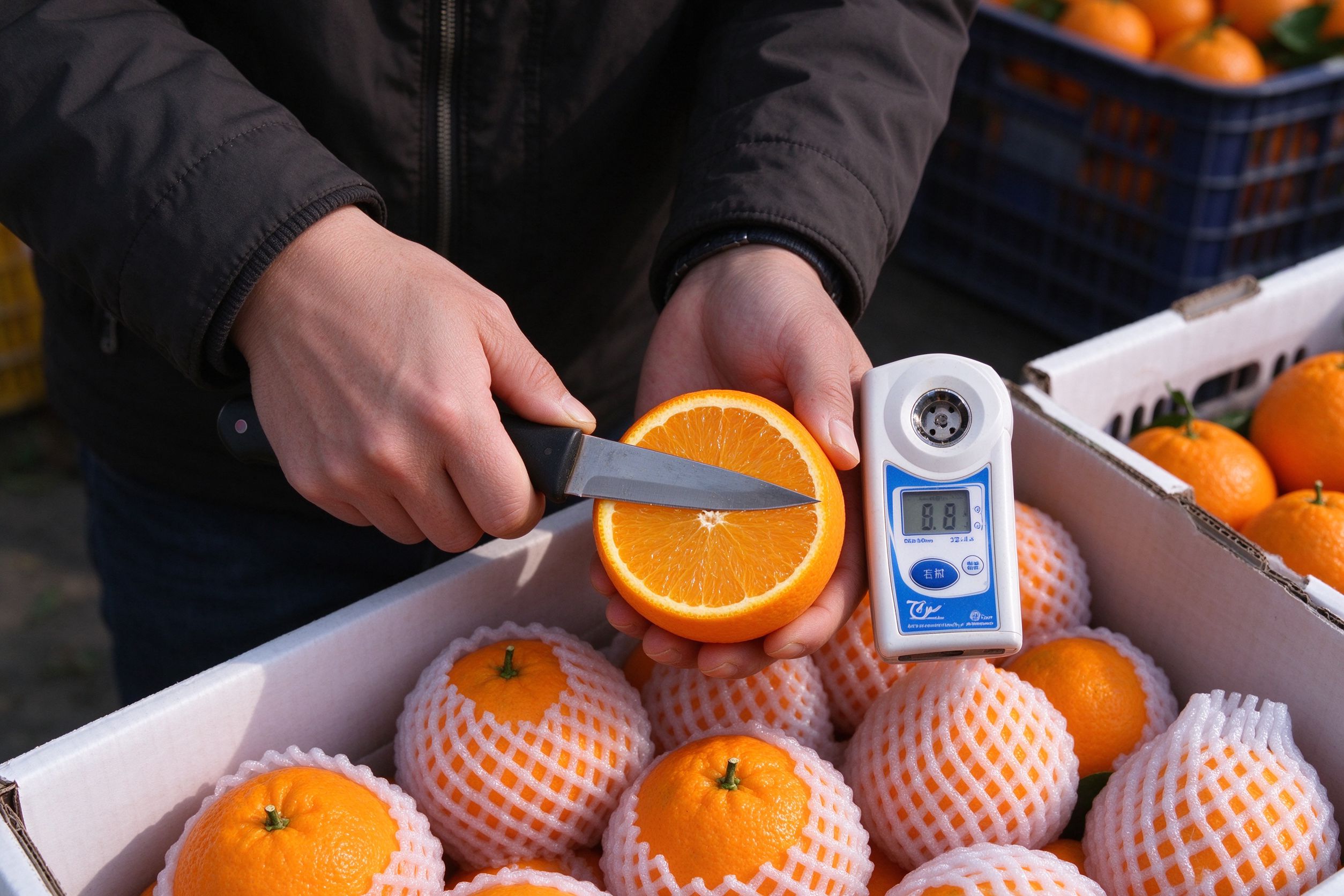
The standard on-site check: cut and taste, measure Brix with a portable refractometer, then confirm sleeves and padding inside the carton.
On-site inspection checklist (12 items)
What to check, by category
Inspection priorities and packing conventions by category (ranges reflect common trade practice; the agreed specification governs)
Category
What to check
Common packing
Where it usually goes wrong
Imported cherries
Size grade (single J through 5J), firmness, green stems, bloom on the skin, water damage and splits
1 carton = 10 jin (5 kg / 11 lb); about 176–192 cartons per pallet; about 20 pallets per container
Soft fruit, dropped stems, compression damage at the bottom; different sailing dates mixed on one pallet
Durian (Monthong, Musang King)
Variety confirmation, grade A or B, chamber count and flesh yield, degree of split, smell, insect holes
By carton (5–6 pieces typical), by pallet, by container; imported containers are priced by the pallet
Dead or unripe "blind" fruit, over-ripe fruit; full-looking shells with poor flesh yield
Dropped berries, sunburn, transit bruising; water pooling at the bottom of the box
Citrus (Shatang mandarin, Ogan, orange)
Skin thickness, sugar-acid ratio, segment texture, puffiness and green fruit
Plastic crate or carton, by weight or by carton; crates commonly 20–30 jin
Green fruit mixed in, puffiness, crushed fruit at the bottom of the crate
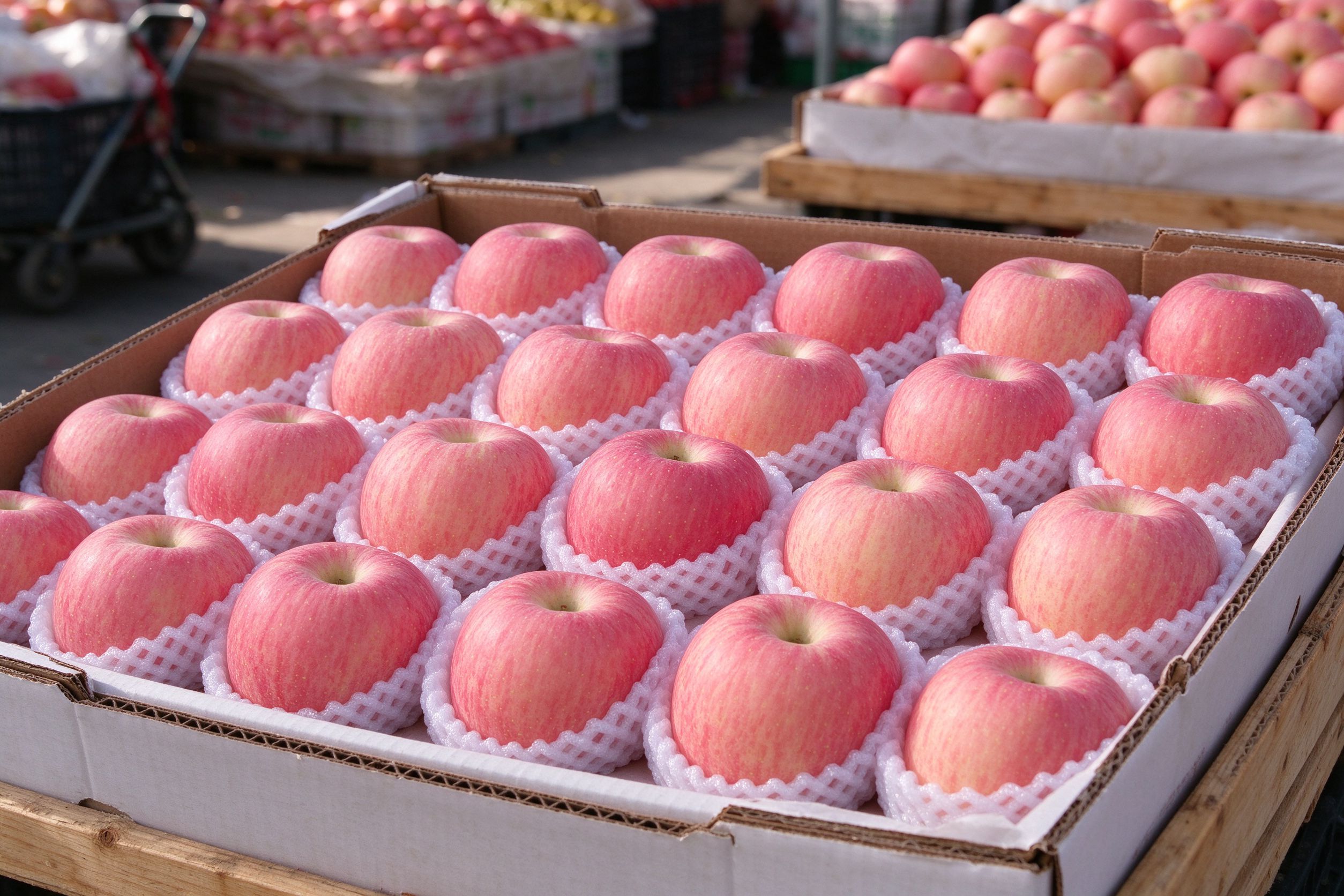
Apples (Fuji and others)
Size (80/85/90 counts), firmness, ground color and blush, bitter pit, bruising
Carton with fruit sleeves, commonly 10–20 jin; uniform export cartons for shipping orders
Bruising, bitter pit, chilling injury; top and bottom layers of different grade
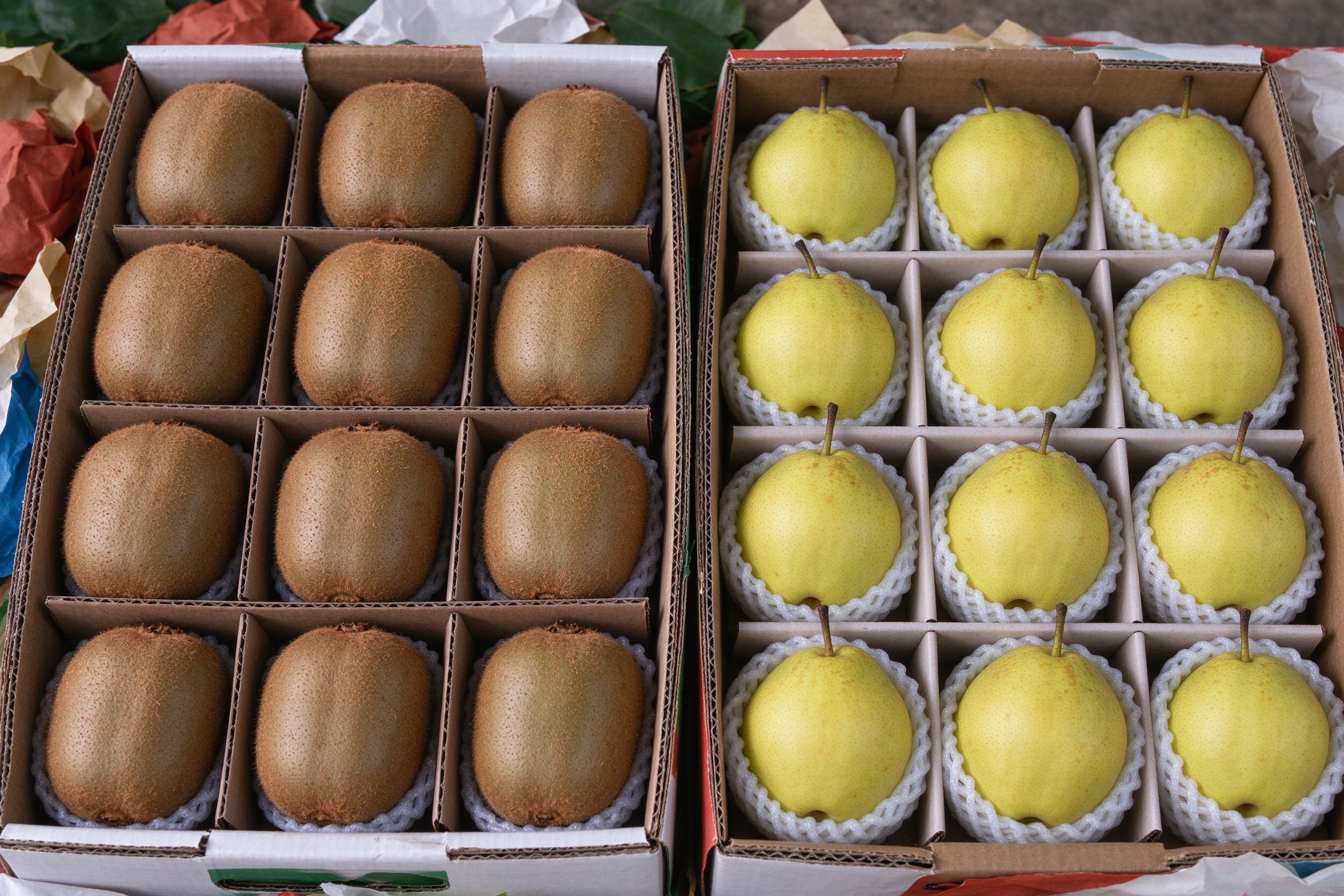
Pears and kiwifruit
Size, firmness at ripening stage, soft spots and chilling injury; for kiwifruit, whether it has already softened
Carton with paper dividers and fruit sleeves; priced by the carton
Soft spots that are invisible on the outside and rot after arrival; ripening curve out of step with your selling window
One trade habit worth copying: look at the bottom and the walls of the carton. Many problems live in the packaging rather than the fruit — water at the bottom means the cold chain broke, damp walls mean the stack was rained on, a re-sealed carton means it was opened. Experienced buyers check the box before they check the fruit.
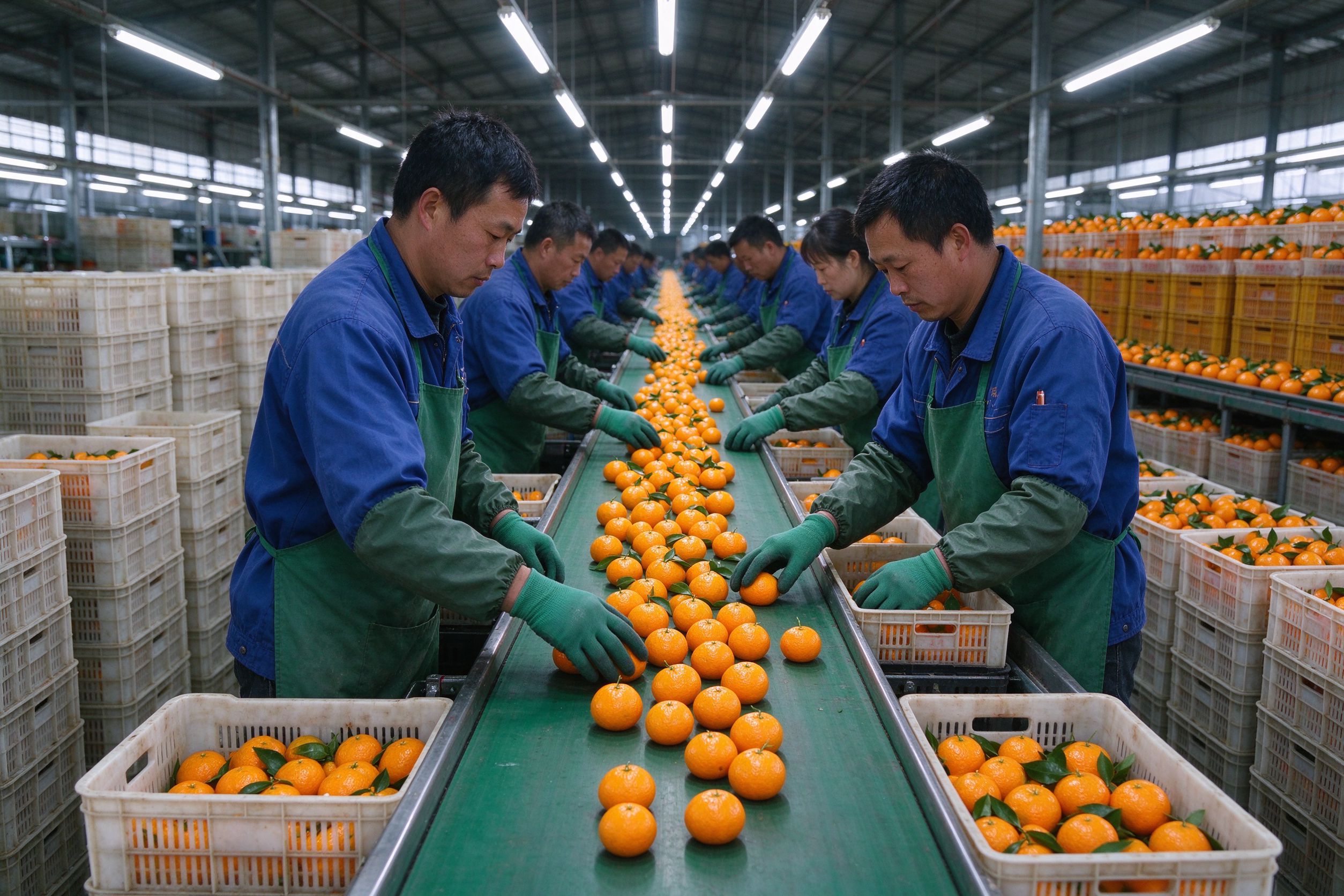
Some stalls and cooperatives run grading lines: fruit is sorted by size, color and defects, and only graded lots can honestly be sold as a uniform specification.
Core Categories
What These Markets Actually Sell
Variety is almost unlimited, but the volume is carried by a handful of categories that are in stock year-round, standardized in packing and shippable by the pallet or the container. First-time importers should start here.
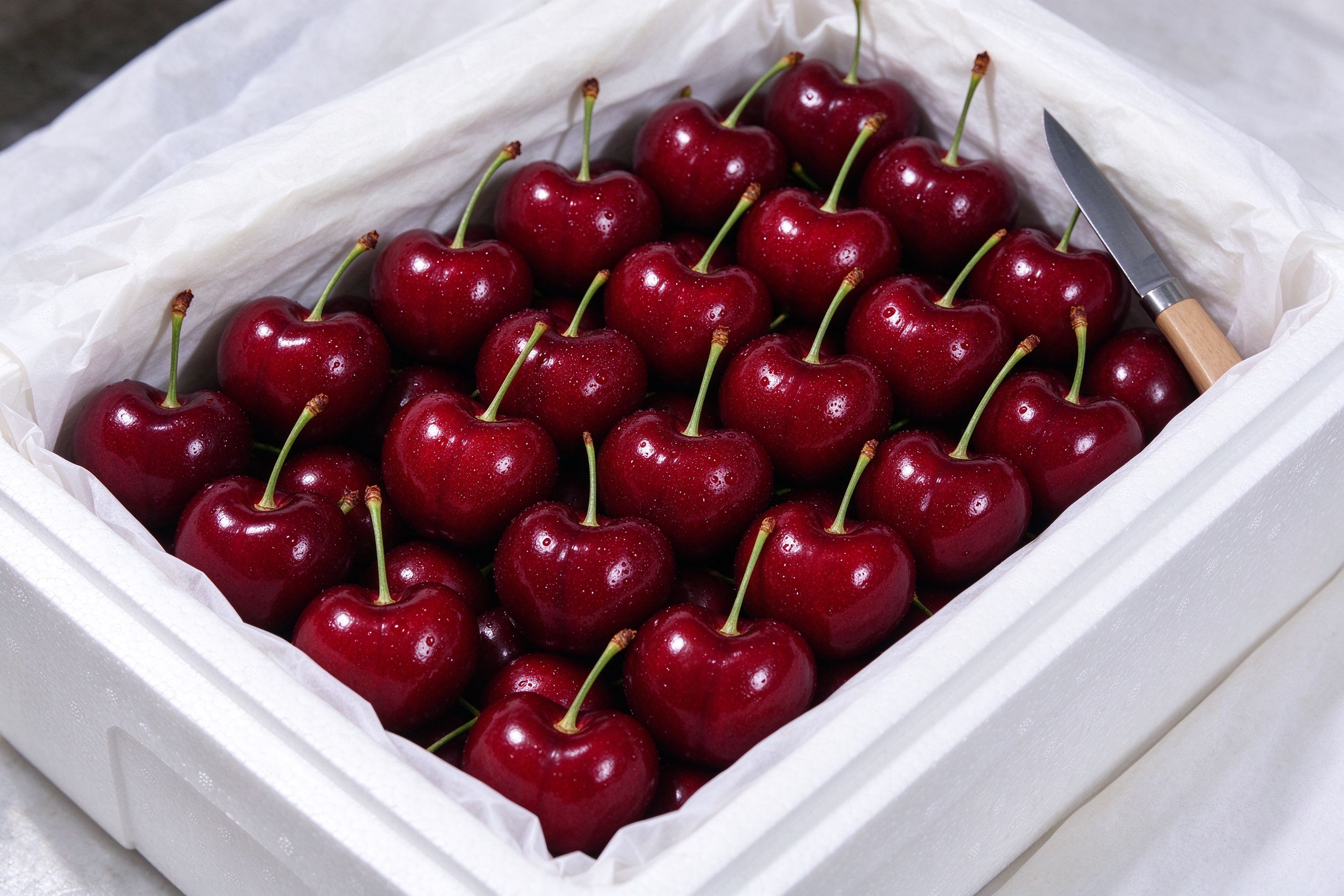
Imported Cherries PRUNUS AVIUM
The bellwether of China's imported fruit trade. Chilean cherries have been the backbone of Jiangnan's imported volume — about 80% of that market's imports and nearly 3,000 t a day — with 32 sailings on the Chile cherry express in season and as little as 23 days from branch to shelf. Grading runs from single J to 5J, and the price gap widens sharply with size.
Origins: Chile, New Zealand, USA; domestic Dalian and Shandong Season: November–February is the import peak Packing: single J to 5J, 10 jin (5 kg) per carton Buying point: confirm sailing and arrival date first, then check firmness and stem color
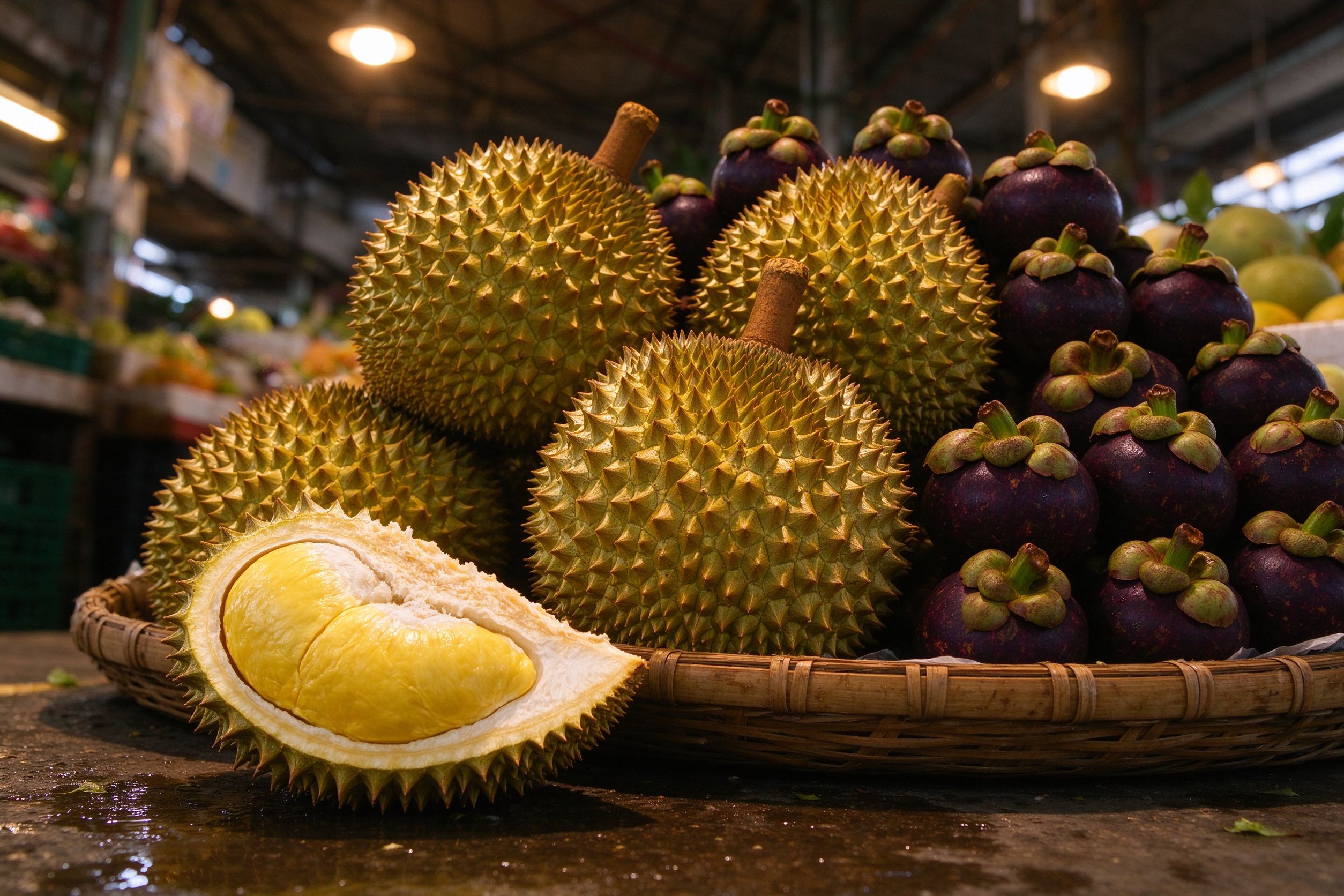
Durian DURIO
One of the fastest-growing categories by volume. One in three imported durians enters China through Pingxiang Youyiguan in Guangxi, and Changsha Hongxing moves over 800 t of imported durian a day. Thai Monthong dominates circulation; Malaysian Musang King runs on a separate line of frozen pulp and whole fruit. Chamber count, flesh yield and degree of split drive the value.
Origins: Thailand, Vietnam, Malaysia Season: April–August peak, available year-round Packing: by carton (5–6 pieces typical), by pallet, by container Buying point: confirm variety and A/B grade, and agree how dead and unripe fruit are counted
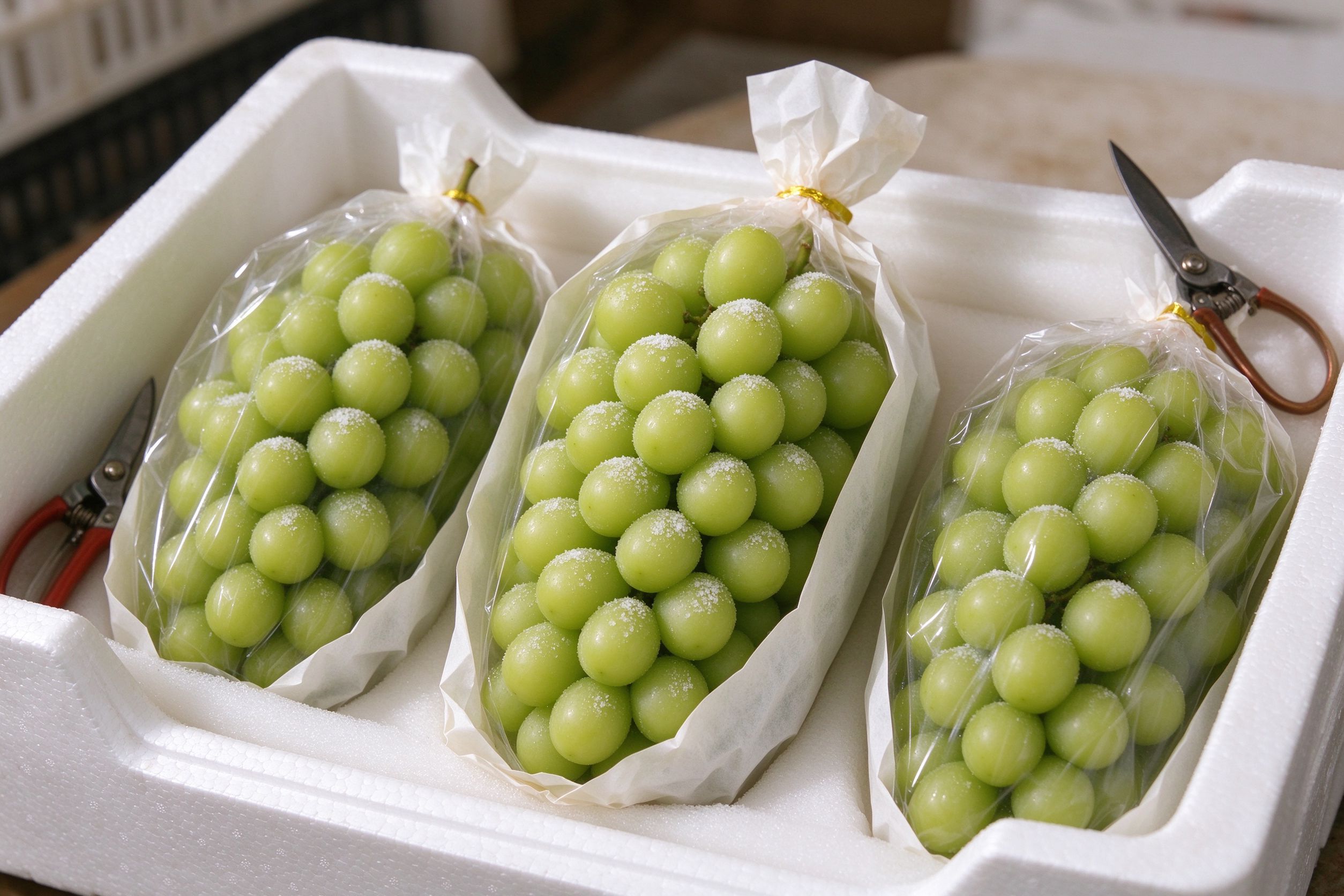
Shine Muscat Grapes VITIS
The most standardized of China's premium domestic fruits: bunch weight, berry weight, Brix and seedlessness can all be measured on the spot. Intact bloom, green stems and no dropped berries are the three hard criteria. Because unit value is high and the fruit is fragile, packing and cold chain deserve more attention than the price.
Origins: Yunnan, Shaanxi, Shandong, Liaoning Season: May–October; Yunnan's early crop leads Packing: foam box with 3–4 bunches, priced by the carton Buying point: measure Brix on site; turn the box over to check dropped berries and standing water
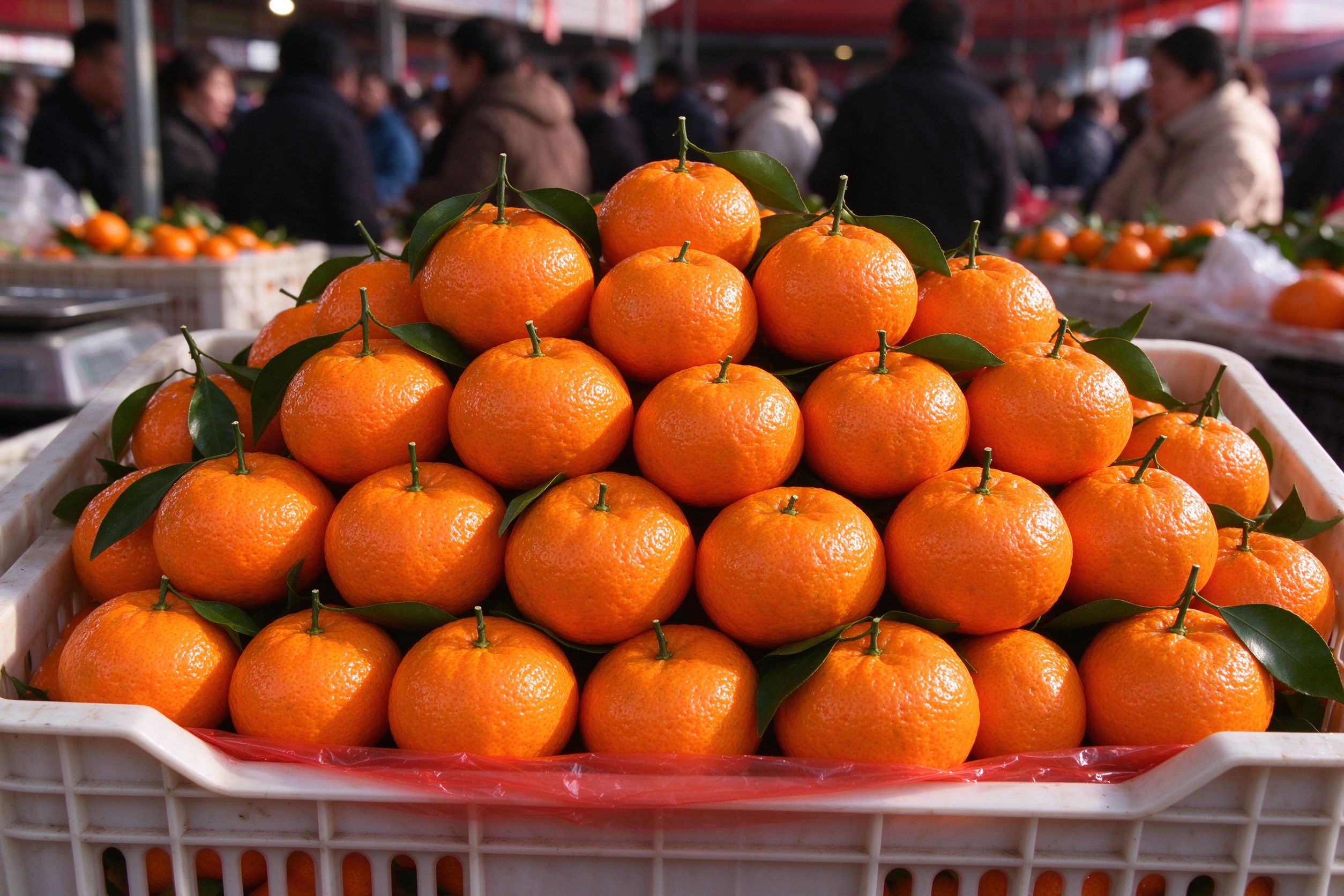
Citrus: Shatang Mandarin, Ogan, Orange CITRUS
China's largest domestic fruit family by volume — and one of the categories where tare is most contested. Shatang mandarin is judged on sugar-acid balance and segment texture; Ogan on skin quality and storability; summer and blood oranges run a separate dual line of fresh and processing use. Crate and carton tare conventions differ a lot.
Origins: Guangxi, Hunan, Jiangxi, Hubei, Sichuan Season: November–March mainly Packing: crates of 20–30 jin or cartons, priced by weight or by carton Buying point: settle the tare deduction before you discuss the unit price
Apples: Fuji, Gala, Huaniu MALUS
The most transport-tolerant category and one of China's largest fruit exports. Size is graded by count (80/85/90), while firmness and ground color determine shelf life. Cold-store and new-crop fruit differ noticeably in price, and export orders usually require uniform sizing and uniform carton specifications.
Origins: Shandong, Shaanxi, Gansu, Xinjiang Season: September–May (cold-store stock runs into summer) Packing: carton with sleeves, 10–20 jin, graded by size Buying point: confirm new crop versus cold store, and check whether top and bottom layers match
Pears & Kiwifruit PYRUS / ACTINIDIA
Two categories that look durable and fail most often: pears are exposed to chilling injury and bitter pit, while kiwifruit are exposed to a ripening curve that runs out of step with your selling window. Fruit that is firm on arrival and softens all at once two or three weeks later is the classic risk here.
Origins: Shaanxi (kiwifruit); Hebei, Shandong, Anhui (pears) Season: August–March Packing: carton with paper dividers and sleeves, priced by the carton Buying point: ask about the ripening stage and the recommended selling window
Beyond these six, several low-profile categories carry serious volume: jackfruit (Jiaxing ranks first nationally in this single item), dragon fruit and longan (East China's main sellers), coconuts (one of the three pillars of South China imports alongside cherries and durian) and mangoes (Hongxing's mango volume rose from 80,000 t in 2022 to about 120,000 t in 2024, and mangoes are also the archetypal tare category). When building a mixed container, the steadier formula is "transport-tolerant (apples, pears) + high-margin (cherries, durian) + high-volume (citrus, bananas)" rather than a single category.
Read this section twice. Every item below is a documented industry practice backed by public reporting or a stated regulatory position. New buyers lose far more money here than they ever lose by overpaying a few cents a jin.
01
Tare: the carton can be worth more than the fruit
This is the classic open secret of the fruit trade. In one media test, a carton of mangoes labelled 25 jin carried 9.2 jin of carton and padding — a 4.5 yuan/jin gross price became roughly 7 yuan/jin on net weight. Mango packaging commonly weighs 8–10 jin per 25–30 jin carton, sometimes 12 jin. Loquats packed at 28 jin carry about 3 jin of packaging; an 80-jin summer-orange carton can be negotiated down to a 5-jin deduction; imported mangoes at 60 jin usually stay under 4 jin of tare. Changsha Hongxing set the benchmark: mango packaging for a 20–24 jin carton may not exceed 4 jin, breaches draw a RMB 2,000–10,000 integrity penalty, a short weight is compensated threefold, and a third breach ends the tenancy — over three years the market investigated 161 operators, fined 72 and removed 89.
What to do: negotiate only on net weight. Either weigh an empty carton on the spot, or agree a fixed deduction — "X jin of tare per carton" — and write it onto the document.
02
Cartons opened, relabelled and pallets rebuilt
Opening the origin carton, picking out the good fruit, then re-closing it in a box printed with the origin label is the most common way cargo stops matching the sample. Traders at Jinan Dikou market hang banners reading "only original pallets, original cartons, original labels" — original label means the origin sticker is intact — a direct response to exactly this: once the box has been touched, it cannot be trusted.
What to do: check whether the sealing tape has been applied twice and whether the lot number matches the container number. Pay a little more for original pallets and cartons instead of chasing a cheaper "repacked" lot. Put "original carton, original label, no opening or relabelling" into the contract.
03
Top and bottom layers do not match
The top layer is arranged beautifully; the middle and bottom are another grade, sometimes another variety. Pallets are the worst case — inspecting only the surface layer means you have inspected nothing.
What to do: open one carton from the top, middle and bottom of every pallet, then turn each carton to its bottom layer. Mark the cartons you opened and keep them as they are when the truck is loaded.
04
Mixed units: carton, pallet, container, jin, kilo
One "carton" of imported cherries is 10 jin (5 kg), not 1 kg. One pallet is commonly 22–24 layers of 8 cartons — 176–192 cartons, about 1 tonne. One container is about 20 pallets, roughly 3,500 cartons and close to 20 tonnes. Quote without a unit and somebody always loses.
What to do: confirm at the start whether the quote is per carton or per jin, how many jin per carton, how many cartons per pallet, how many pallets per container — and write all of it down.
05
Consignment sale: fees and "sold out" are both grey zones
Handing cargo to a stall to sell on your behalf is the route beginners pick most often, and the one that loses the most money. There is no standard consignment fee; the market uses two models — a charge per jin or a percentage of sales. Pick one, and put it in writing. Beyond the fee there is a stack of ancillary charges: entry, unloading, sorting and repacking, cold storage (unloading and repacking a 9.6 m truck commonly runs several hundred to over a thousand yuan, cold storage is charged by the day). Worse is the settlement period: what exactly counts as "sold out"?
What to do: settle by batch, never by season; define "sold out" (cleared that day, or deemed sold when the agreed number of days expires); demand a daily ledger recording at least carton count, unit price, defects and shrinkage; keep weighbridge tickets, container-opening videos and site photos. Anyone promising a guaranteed floor price or full buy-out while asking for a deposit or a franchise fee can be set aside.
06
Loss sharing left unwritten
Fruit will spoil. The question is who owns the spoiled portion. Common practice is "weigh the culled fruit and split it at an agreed ratio", but if the ratio, the weighing method and who decides what counts as defective are not written down, you have no negotiating position at settlement.
What to do: write three things — the defect standard (for example, softened area above a stated size), the weighing method (culled fruit weighed separately), and the split ratio. Add a renegotiation trigger if a single batch exceeds X% loss.
07
Ripeness out of step with transit time
Fruit that looks perfect in a domestic market can arrive as jam after two or three weeks at sea. The seller sells "good to eat now"; you buy "saleable on arrival". Those are not the same standard.
What to do: work backwards from transit days. For sea freight aim for about 70% ripe at loading; air freight can take 80–90%. Ask the supplier to allocate fruit on the basis of "how many days it still holds after it reaches me" and state the required ripeness on the document.
08
The wrong truck or the wrong container
Sending a full trailer on the first order, or skipping the reefer to save money, is the classic "save a little, lose a lot". Overloaded trailers, poor ventilation and refrigeration switched off en route all multiply loss.
What to do: start with a 6.8 m or 9.6 m truck rather than a trailer. On the first run, travel with the truck if you can: watch the unloading, grading, display and selling, and understand where loss actually occurs before you scale up.
09
Quotes that exclude tax, unloading and freight
"That price" is usually a bare number: no tax, no unloading, no freight, no packaging. You only discover it costs more than the stall next door once you build the landed cost.
What to do: always ask "what is the total to my warehouse or to the port, all-in", and require the breakdown: goods, packaging, unloading, drayage, cold chain, tax.
10
Export registration not in place
Many buyers assume "if I can buy it, I can ship it". Under China Customs rules, for destinations that require registration, both the orchard and the packing house for exported fruit must apply to their local Customs office for registration; certificates run five years and renewal must be filed 30 days before expiry. Where a bilateral protocol or the destination requires it, GACC central recommendation and counterpart acceptance are also needed. Exported fruit must be declared for inspection at the Customs office where the packing house is located, and cargo of unclear origin is not accepted. The core reasons consignments are notified or returned are almost always failure to meet quarantine requirements or residue and contaminant limits.
What to do: confirm the destination country's requirements first, then work backwards to source from a registered orchard and packing house. Do not buy the cargo and then try to obtain the paperwork.
11
Treating the "market price" as your price
Turnover and average prices in public reporting describe the market as a whole, not your transaction. The same cargo differs by one tier between primary consolidation and secondary wholesale, by another between cash settlement and consignment, and by another between a full container and a single pallet. Quoting a public average at a first-tier stall will only get you politely shown the door.
What to do: map three prices first — the primary quote, the secondary quote and your target landed cost — then decide which tier to buy at. Trade volume for price, not "someone else is cheaper".
Note: the amounts, ratios and regulatory practice cited in this section come from public reporting and market operators' public statements. They illustrate common industry practice and countermeasures; they are not a judgment about any specific merchant. Every transaction should rest on a written agreement.
Export Compliance
Getting the Cargo Out of China
For an overseas buyer, buying well solves only half the problem. The other half is whether the cargo can legally leave. This sequence follows China Customs' published rules; do not reverse the order.
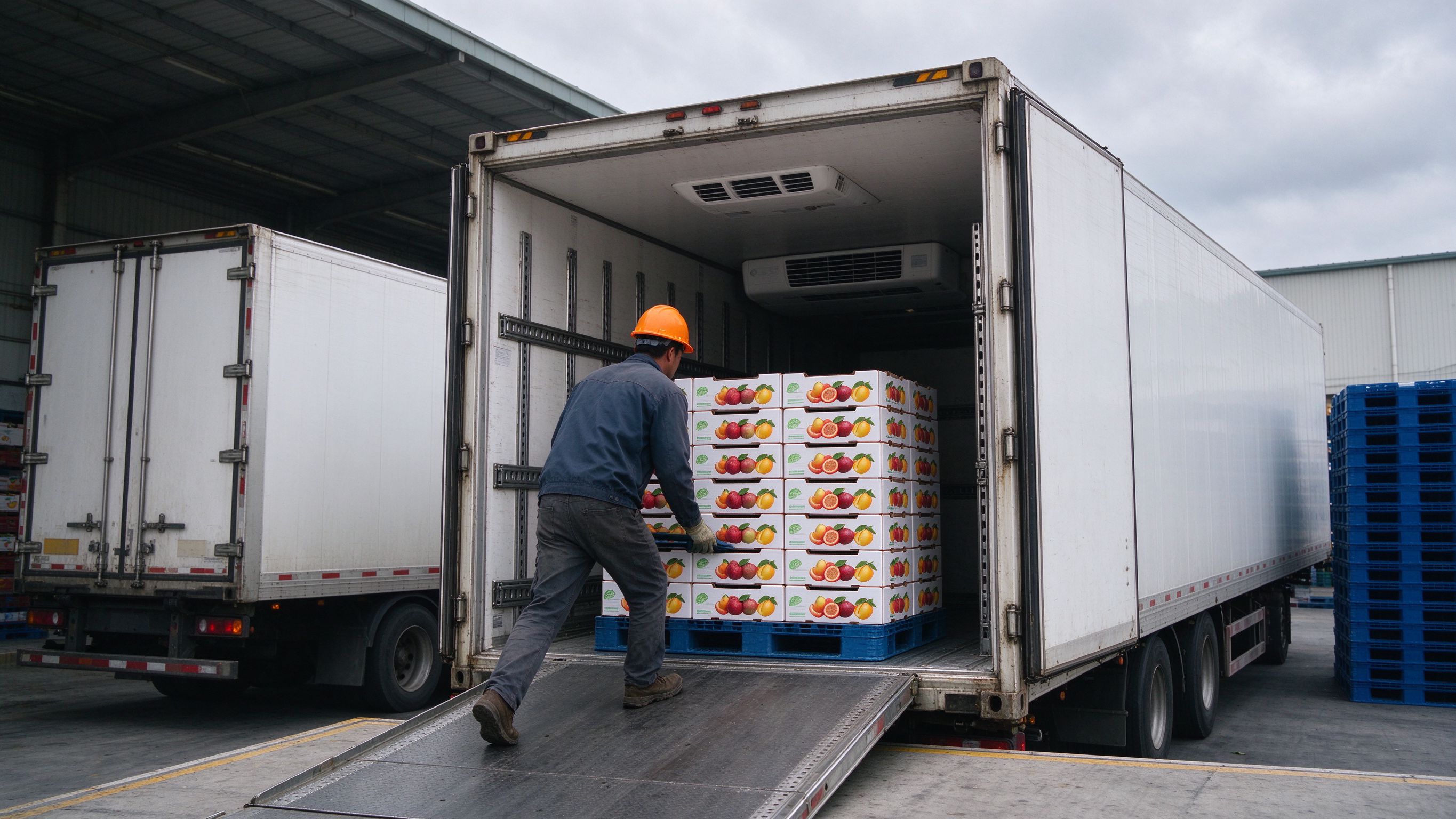
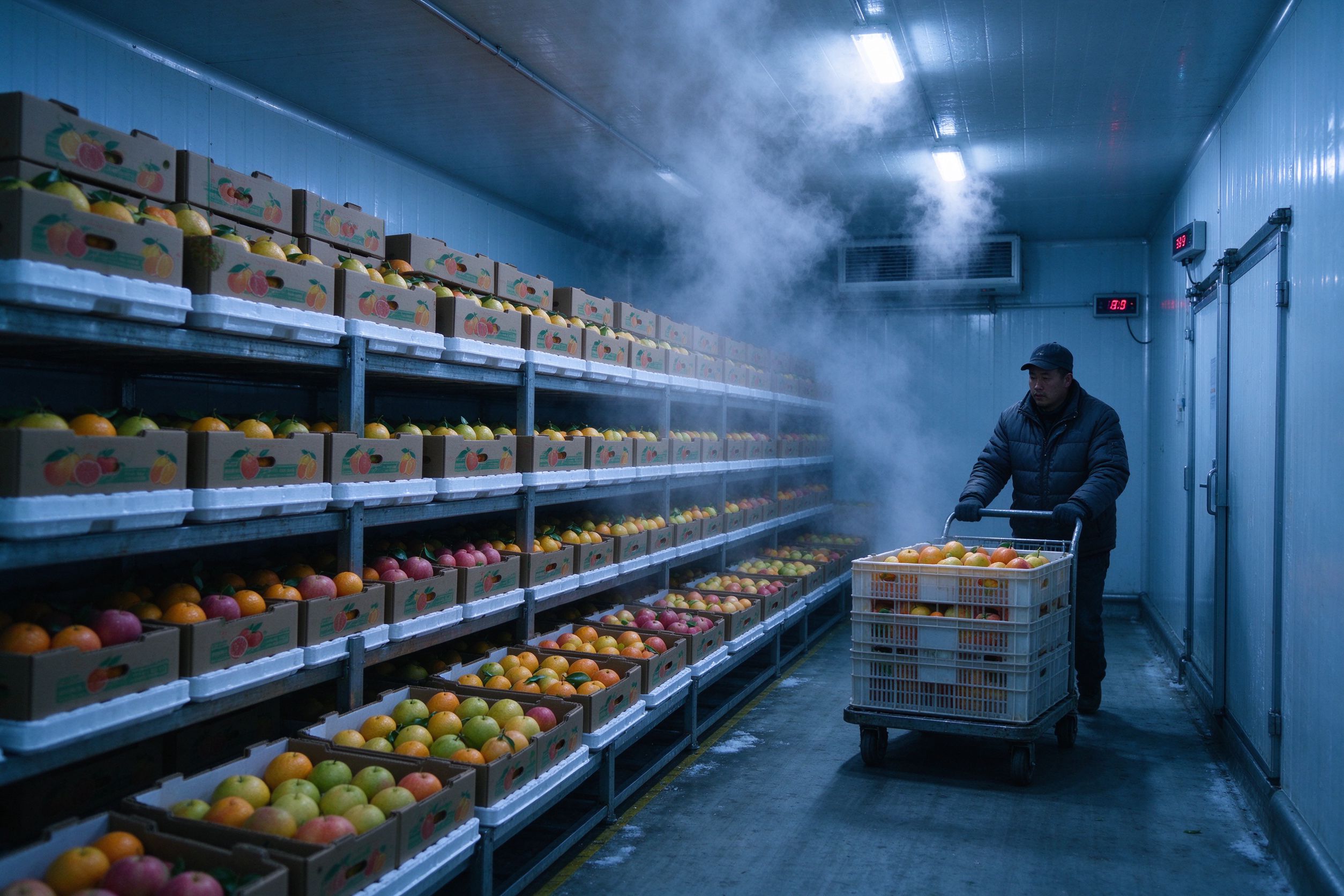
Loading: pallets into a reefer container. Temperature setting and ventilation are the critical parameters for long-haul sea freight.Cold storage: export cargo is usually pre-cooled, graded and palletized at the packing house before loading.
1
Registration and filing of the production enterprise
Step one · qualification
Export food enterprises must complete filing; fruit, seedlings and flowers destined for certain countries also require registration, and some categories need GACC recommendation to the destination authority. Orchards must be contiguous, free of pollution sources nearby, staffed with technical personnel and supported by a quality system (organization, training, pest monitoring and control, agrochemical management, GAP), with no major plant epidemic in the past two years. Packing houses must be clean, functionally zoned, equipped for washing, processing and pest elimination, compliant on water and agrochemical use, documented with a hygiene system and traceability records, and supplied by a stable orchard base. Customs generally decides within 20 working days of acceptance.
2
Declare to Customs before shipment
Step two · declaration
Prepare the contract, packing list, invoice and power of attorney. Exported fruit must be declared for inspection at the Customs office where the packing house is located, together with proof of origin supply; cargo of unclear origin is not accepted.
3
Obtain the electronic record or certificates
Step three · certification
Obtain a phytosanitary certificate and any other certificate the destination requires. The on-site inspection checks that goods match documents, that the phytosanitary certificate and carton markings meet the counterpart country's requirements, and that there are no insects, symptoms, leaves, twigs or soil. Compliant consignments are certified; non-compliant ones may not leave China.
4
Export declaration and timing
Step four · customs
Declaration is generally made 24 hours before loading; where cargo has arrived at a supervised venue, advance declaration is allowed within 7 days before arrival. Certificates of origin can be self-printed, and preference certificates under a free trade agreement should be chosen where the destination qualifies.
5
Post-shipment supervision and traceability
Step five · follow-up
When a consignment is notified or returned after export, there are usually only two root causes: quarantine requirements not met, or residue and contaminant limits not met. That is why "registered orchard plus registered packing house" cannot be skipped at step one — it is what gives you a traceable foundation.
This section follows the Measures for the Supervision and Inspection of Exported Fruit (as amended by GACC Decree No. 283) and Customs' public guidance, and is a process description only. Specific categories, destination requirements and document lists must follow the latest rules of the local Customs office and the destination authority. For clearance, inspection and documentation support, see our customs brokerage and quarantine inspection services.
First-Timer FAQ
Fifteen Questions First-Time Buyers Always Ask
These are the questions an outsider asks on their first visit to a fruit wholesale market. The answers describe how it is actually done, not how it is presented.
01I don't speak any Chinese. Can I visit the market on my own?
Yes, but you will be slow. There are three workable routes: hire a buying agent or interpreter inside the market (charged by cargo value or by carton — agree the fee and the limits of responsibility first); buy through a domestic trading company or freight forwarder (one more margin layer, but cleaner documentation and logistics); or bring your own interpreter and concentrate on a single market. Whichever you choose, a bilingual requirement sheet — category, grade, cartons, tare, delivery date — works far better than explaining on site.
02What is the minimum order on a first visit, and how much should I bring?
The practical threshold at most stalls is one pallet, especially for imported cargo; some categories can be bought by a few cartons, but the unit price rises noticeably. For a first trip, keep the budget at half a pallet to half a container — enough to see real quality and real loss without tying up too much capital. Whether you can buy by the carton depends on the category and that day's stock; not every stall will break a pallet.
03When should I go? What time should I arrive?
Imported cargo concentrates between 02:00 and 06:00 — container opening and the first trading rounds; domestic fruit generally arrives during the day and is replenished toward evening. The safest pattern for a beginner is two consecutive days: day one to record without buying, day two to buy in the morning market. Peak season comes earlier — imported cherries from November to February, durian and lychee from April to August — and prices and arrivals both spike in the two or three days before public holidays.
04Can I buy just one carton for myself or for a trial?
You can, but do not do it inside the market. The trading unit here is the carton, the pallet and the container; a single carton has little retail meaning and no price advantage. If you need samples for a trial, ask the stall for a sample carton and pay retail for it — that is easier to agree than forcing a pallet to be broken. For proper samples, send them by air instead.
05How do I pay? Can I use a card or a bank transfer?
On-site settlement dominates: WeChat Pay, Alipay or bank transfer, with corporate transfer for large sums; cash is now rare. Cross-border purchases normally settle through a trading company or agent in corporate accounts and foreign exchange — paying a stall directly in foreign currency is generally not workable. For a first cooperation, use "small amounts on the spot plus deposit and balance on larger orders", with the balance paid after inspection and loading, before dispatch, and the payment milestones written into the contract.
06How do cartons, pallets and containers convert?
Using publicly reported trade conventions: one carton is one box, commonly 10 jin (5 kg) for imported cherries; one pallet is 22–24 layers of 8 cartons, i.e. 176–192 cartons and about 1 tonne; one container is about 20 pallets, roughly 3,500 cartons and close to 20 tonnes. But actual specs differ by category and by stall — so always ask "how many cartons on your pallet, how many jin in your carton" instead of applying generic numbers.
07What is tare weight, and how do I avoid being short-weighted?
Tare is the weight of the packaging — carton, padding, sleeves, pallet. Because the trade quotes on gross weight, categories with heavy packaging (mango, citrus, loquat) see their real unit price inflated substantially. Three countermeasures: break down one carton and weigh the empty box to get the true tare; agree a fixed deduction — "X jin of tare per carton" — and write it on the document; and run bulk cargo over the market weighbridge, keeping the ticket. Hongxing's rule for mangoes (packaging under 4 jin for a 20–24 jin carton) is a useful reference when you negotiate.
08How much can I negotiate off the price?
Fruit is live stock: room to negotiate comes from timing, volume and settlement method, not from talking. The four situations with the most room are end-of-day stock, cargo close to its quality window, a full pallet or container, and cash settlement. Fresh arrivals, tight grades and broken pallets have almost none. Rather than grinding the unit price, negotiate the tare deduction, who pays unloading, and how defects are counted — those three usually save more than the price haggling.
09Can the stall apply my own brand label?
Technically yes — re-boxing, labelling and changing carton specifications can all be done at the packing house — but with two conditions: origin marks and mandatory label information may not be covered, and export labels must satisfy the destination country's rules; and labelling is charged separately, usually with a minimum quantity. Handle labelling and carton specs at the packing house, not at a market stall: ad-hoc re-boxing at a stall is exactly how cargo stops matching the sample.
10How do I ship it — air, sea or cold-chain express?
Decide on cargo value against shelf life. Air freight suits high-value, short-window fruit (cherries, strawberries, premium grapes): fast but costly. Reefer containers by sea suit volume and transport-tolerant fruit (apples, pears, citrus, coconuts): cheaper but slower, with container temperature and ventilation as the critical settings. Cold-chain LCL or full truck suits domestic legs and neighboring countries by road. Cross-border samples usually move on an international express perishables line. In every case, work backwards from transit days to set the ripeness at loading.
11What if the cargo spoils? Can I return it?
There is no "no-questions returns" in fresh produce. A claim stands on evidence plus agreement: evidence means container-opening video, weighbridge ticket, site photos, carton numbers and container numbers; agreement means the defect standard, loss-sharing ratio and claim deadline written into the contract. In practice, compensation is more often a price adjustment on the next shipment than a refund. Writing "how defects are handled" into the first order document is worth far more than arguing afterwards.
12What documents do I need to export to my country?
Three basics: exporter filing or registration (fruit for certain destinations requires orchard and packing-house registration), a phytosanitary certificate as required by the destination, and a certificate of origin (self-printable, with preference certificates used where an FTA applies). Add the destination's market-access list, residue limits and labelling rules. The order is always confirm destination requirements first, then select the source — never the reverse.
13Can I get samples first?
Yes, and you should. Send samples on an international express perishables line or by air, with 2–3 lots from different stalls or different origins for comparison. Two points to note: sample cost and freight are normally borne by the buyer; and samples are usually fresher than bulk cargo, so use them to judge variety, grade and taste, not arrival loss — that is solved by the shipping plan, not the sample.
14How do peak and off-season change price and choice?
In peak season (before holidays, during the import season) arrivals are heavy and varieties are complete, but good lots are contested and inspection time gets squeezed. In the off-season there is less stock and fewer grades, but more room to negotiate and more patient service. Beginners do better going in the half-month before peak season: volume is already building, the halls are not yet packed, and you can look properly.
15What exactly is consignment sale, and should I use it?
Consignment sale means you hand the cargo to a stall, the stall sells it in the market, and you settle once it is sold. The advantage is you do not have to build a sales channel; the disadvantage is that you lose control of price and pace. If you use it, put in writing: the fee basis (per jin or percentage — only one), the ancillary charge list (entry, unloading, sorting and repacking, cold storage), the settlement cycle and the definition of "sold out", the loss-sharing rule, and a daily ledger. Anyone guaranteeing a floor price or a full buy-out while charging a deposit or franchise fee is very likely unreliable.
These answers compile general experience and public information. They refer to no specific merchant. Actual transactions should follow the written contract, the market's operating rules and the requirements of the local Customs office.
On Location
From 2 a.m. to Daylight
What words cannot carry, footage can. The short film below records the two hours before the market opens: stacked cargo, truck traffic, cold mist and flashlight beams.
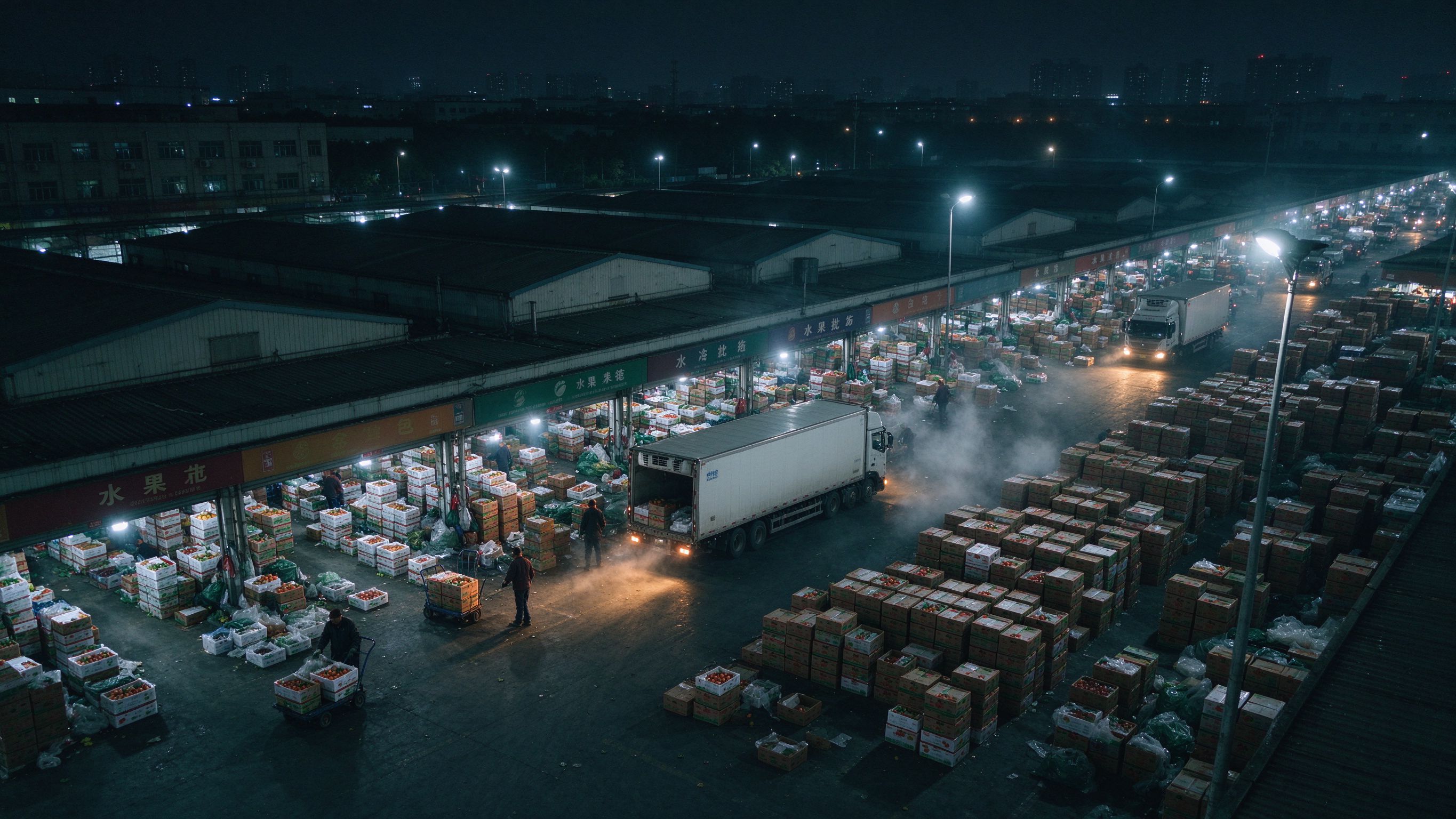
Fruit wholesale market before dawn (5-second film) — hands moving between stacks, tricycles weaving through, reefer tail lights, ground mist. This is where the trading day starts.
The market at 2 a.m. Stall rows, reefer trucks and stacked cartons — the day starts here.
Container opening The doors open, cold mist spills out, buyers check fruit by flashlight.
The trading hall Long stall rows under an information screen; quotes move with each arrival.
Grading line Fruit split by size, color and defects — only graded lots earn a uniform spec.
Cold room Pre-cooling and buffer storage decide how many days a lot can hold.
References
Public sources used to verify market scale, tier structure, tare governance and export rules.
Guangzhou Jiangnan Fruit & Vegetable Wholesale Market — public market information and 2025 trading data, as reported by Guangzhou Daily (Xinhuacheng) and Nanfang Plus.
Guangzhou Jiangnonghui Market — public reporting on imported fruit consolidation, pallet-based trading and container throughput.
Zhejiang Jiaxing Fruit Market — public information from the Zhejiang Federation of Supply and Marketing Cooperatives, the Jiaxing Economic Development Zone and Zhejiang Daily, including the Jiaxing China Fruit Index.
Changsha Hongxing Global Agricultural Wholesale Center — public reporting on volume, mango trade and tare-weight enforcement.
Beijing Xinfadi — public market information on imported fruit volume and ASEAN share.
Xinhua, People's Daily and China News Service — reporting on the Pingxiang Youyiguan border port, smart-gate clearance and China–Laos railway fruit trains.
General Administration of Customs of China — Measures for the Supervision and Inspection of Exported Fruit (as amended by GACC Decree No. 283) and public guidance on orchard and packing-house registration.
Jinan Dikou Fruit Wholesale Market and Changsha Hongxing — public reporting on "original pallet, original carton, original label" practice and tare governance.