
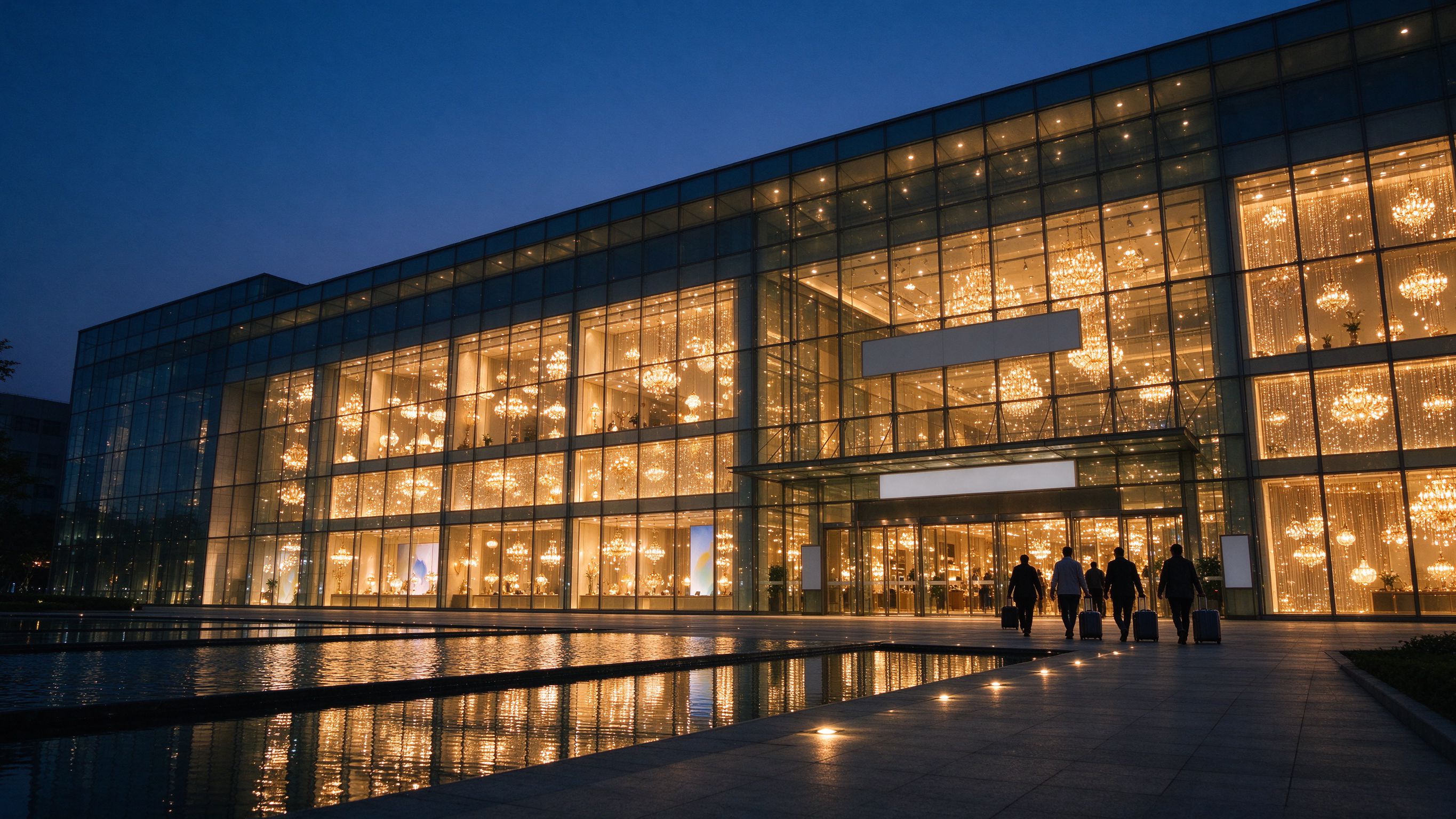
China's Lighting Wholesale Markets: A Practical Guide for First-Time Buyers
From the lighting streets of Guzhen to the lamp cities of Zouqu, Linyi and Beijing Shilihe, and on to the Canton Fair, GILE and the Guzhen Lighting Fair: this guide is written for overseas buyers who are coming to China for the first time to find lighting suppliers, new designs and factories they can rely on. It explains how the market is layered, how a lamp is actually quoted, what to check before you pay a deposit, and the mistakes that cost first-time buyers the most money.
Note: this is an objective overview of market structure, product categories and sourcing method. It contains no pricing, no offer and no recommendation of any specific market, showroom, factory or fair, and it is not investment, legal or certification advice. Stall layouts, fair dates and market statistics change every year; confirm with the local government, the fair organizer and the market operator before you book travel.
- Need a factory, custom specs or new designs? Start in Guzhen, Zhongshan — the only place where the whole lamp, from die-casting to driver to gift box, is made within a few kilometers.
- Need stock, fast replenishment and small quantities per model? Go to Zouqu in Changzhou or Linyi in Shandong.
- Need to meet many suppliers in one week? Canton Fair Phase 1 (April and October), GILE in June, and the Guzhen Lighting Fair in March and October.
- The number that decides your landed cost is not the unit price. It is the configuration (driver, chip, aluminum gauge, diffuser, packaging), the trade term (EXW, FOB or CIF) and the CBM.
What Makes China's Lighting Market Different
Most first-time visitors picture rows of shops that sell lamps. A real Chinese lighting cluster is closer to a complete industrial chain: showrooms and stalls at the front, mold making, die-casting, driver assembly, packaging and final assembly behind them. Once you see that structure, the way you buy changes completely.
The most common mistake a first-time buyer makes is to treat this like a building-materials market: spot a design you like, ask "how much for one piece," and compare by unit price. A lighting fixture is not a standard part. Take the same ceiling lamp and change the body thickness, the aluminum grade, the LED chip, the driver, the diffuser material or the packing method, and the cost can double while the outside looks almost identical.
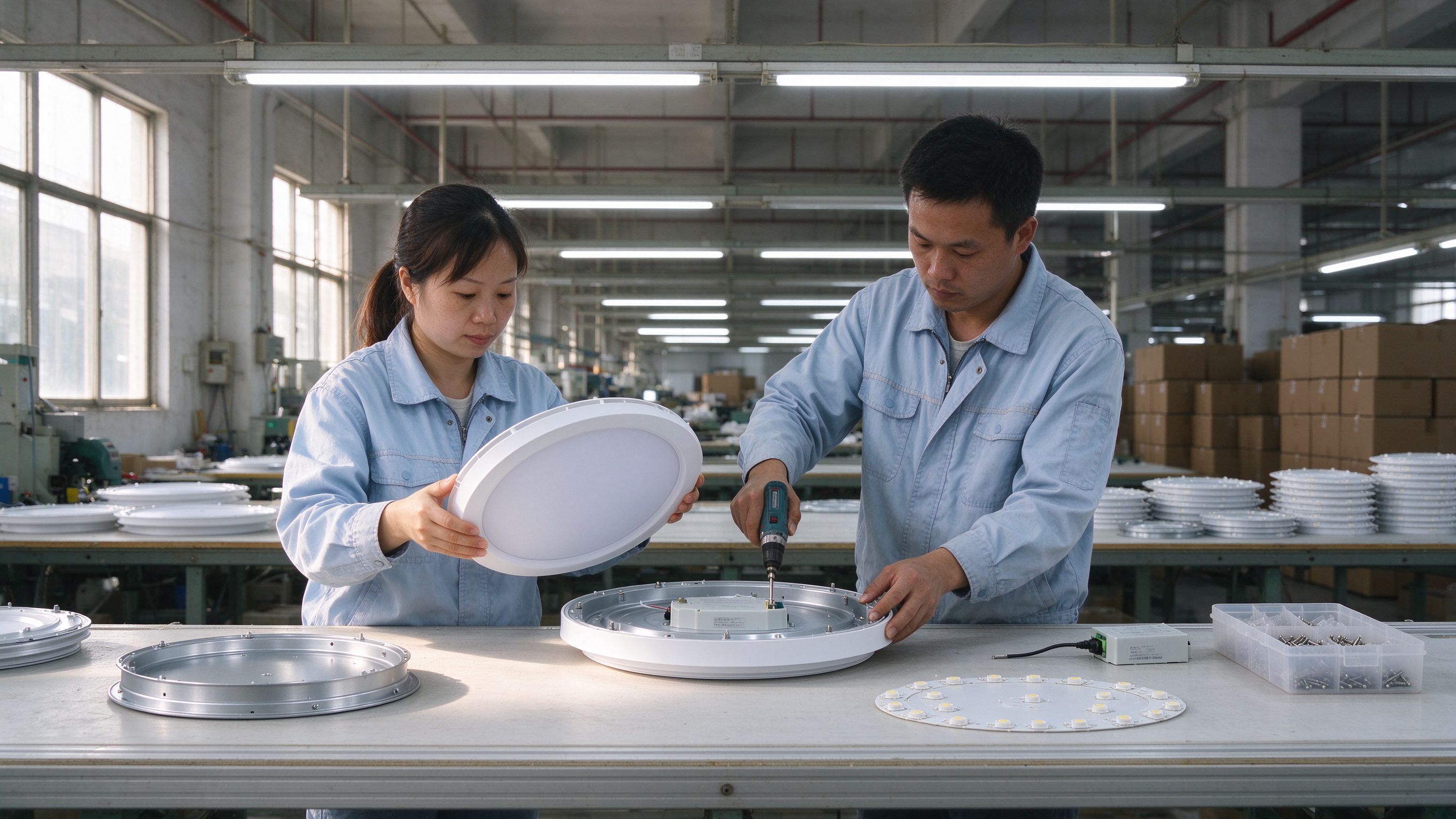
1. Showroom in front, factory behind: a whole lamp within five kilometers
Around Guzhen, you will find die-casting for lamp bodies, metal stamping, acrylic and glass, LED light sources, drivers, molds, electroplating and packaging printing. A design you see in a stall in the morning can have its body, driver and gift box sourced nearby by the afternoon. This "half-hour industrial circle" is the hardest part of Guzhen to copy, and it is why new designs ship every week and old ones can be modified on request.
For a buyer, the practical meaning is this: you can test a design in small quantities, and you can change the structure, voltage or packaging for one specific market. The flip side is that the finer the supply chain, the more precisely you have to write your specification. Ask only for "a cheaper ceiling light" and the factory will build to the lowest possible configuration.
2. Three tiers: trade malls, lighting streets, component markets
The same town is shopped three different ways. Trade malls such as Star Alliance, Lihe Lighting Expo Center and Huayi Plaza serve brand, project and designer channels: polished showrooms, full sample ranges, higher quotes, and factories able to take on project orders. The lighting streets around Zhongxing Avenue are wholesale and mixed stock: dense stalls, realistic prices, regular models and container consolidation. The component markets around Caosan and Gangnan sell lamp bodies, light sources, drivers, aluminum profiles and crystal parts for buyers who assemble or repair locally.
The efficient order is: walk a trade mall first to set a price anchor, then compare the same model on the lighting street, then check the component market to see what the key parts actually cost. That sequence lets you judge in half a day whether a quote reflects normal margin or a swapped configuration.
3. Quotes are per set and per piece — and exclude things by default
At least three quote conventions coexist: the set price (body + light source + driver + packaging), the body-only price (no light source, no driver), and the carton price (a fixed number of pieces per carton). Export quotes add EXW, FOB and CIF. On a first conversation, ask the supplier to break the price down: body, light source, driver, packaging, whether the mold or tooling fee is charged separately, and who pays for certification.
Watch especially for the phrase "driver included at no charge." The driver is the component most likely to fail over a lamp's life; a cheap one can cause flicker, dead lamps and slow starts within a year. Writing the driver brand, model, wattage and certification into the quotation matters far more than saving a few percentage points on the total.
4. Sold by model, and models turn over very fast
A large part of the competition is design. Guzhen can bring tens of thousands of new appearances to market in a year, particularly decorative fixtures, residential ceiling lights and linear commercial lighting. Stalls manage stock by model number, and the same model usually comes in several sizes, wattages, color temperatures and control options. The sample you see is not necessarily what will be produced: confirm that "bulk production will match this sample" and seal the sample before you pay.
5. Two tracks in one market: domestic and export versions of the same model
Chinese lighting suppliers serve domestic projects and export buyers at the same time. Factories are familiar with 110V and 220V, US, EU and UK plugs, CE, UL, ETL, RoHS and ERP requirements. But "we can do it" and "the certification is already in place" are two different claims. The first means changing a board or a wiring harness. The second means submitting samples, producing reports, filing paperwork, and paying fees and lead time that have to be quoted separately.
6. How it compares with other markets
The table below compares positioning, not prices. Strengths shift by year and by product category, and the final decision still rests on samples and a factory visit.
| Dimension | Guzhen, Zhongshan | Zouqu, Changzhou | Linyi | Yiwu | Overseas hub (e.g., Dubai) |
|---|---|---|---|---|---|
| Nature | Manufacturing + trade showrooms | Distribution | Distribution | General merchandise trade | Re-export and local wholesale |
| Supply base | Local factories + nearby component chain | Jiangsu and Zhejiang factories + Guangdong stock | Shandong, Guangdong and Zhejiang stock | National small commodities and finished lamps | Mostly Chinese goods, some local assembly |
| Strengths | Finding factories, tooling and customization, new designs, project packages | Deep stock, fast replenishment for East China | Stock for northern China, wide logistics reach | Holiday lights, small components, mixed cartons | Low MOQ, local pickup |
| Weaknesses | Not the lowest price; traders mixed in with factories | Weaker factory base, limited customization | Slower on new designs, uneven quality | Shallow industrial depth, quality varies | Higher prices, dated designs |
| Best for | Brand owners, contractors, buyers needing custom specs | Wholesalers and store replenishment | Northern wholesale, volume at low price points | Small mixed orders, seasonal goods | Small trial orders |
Positioning comparison only; no specific prices. Relative strength changes by year and category. Buy on samples and factory audits, not on this table.
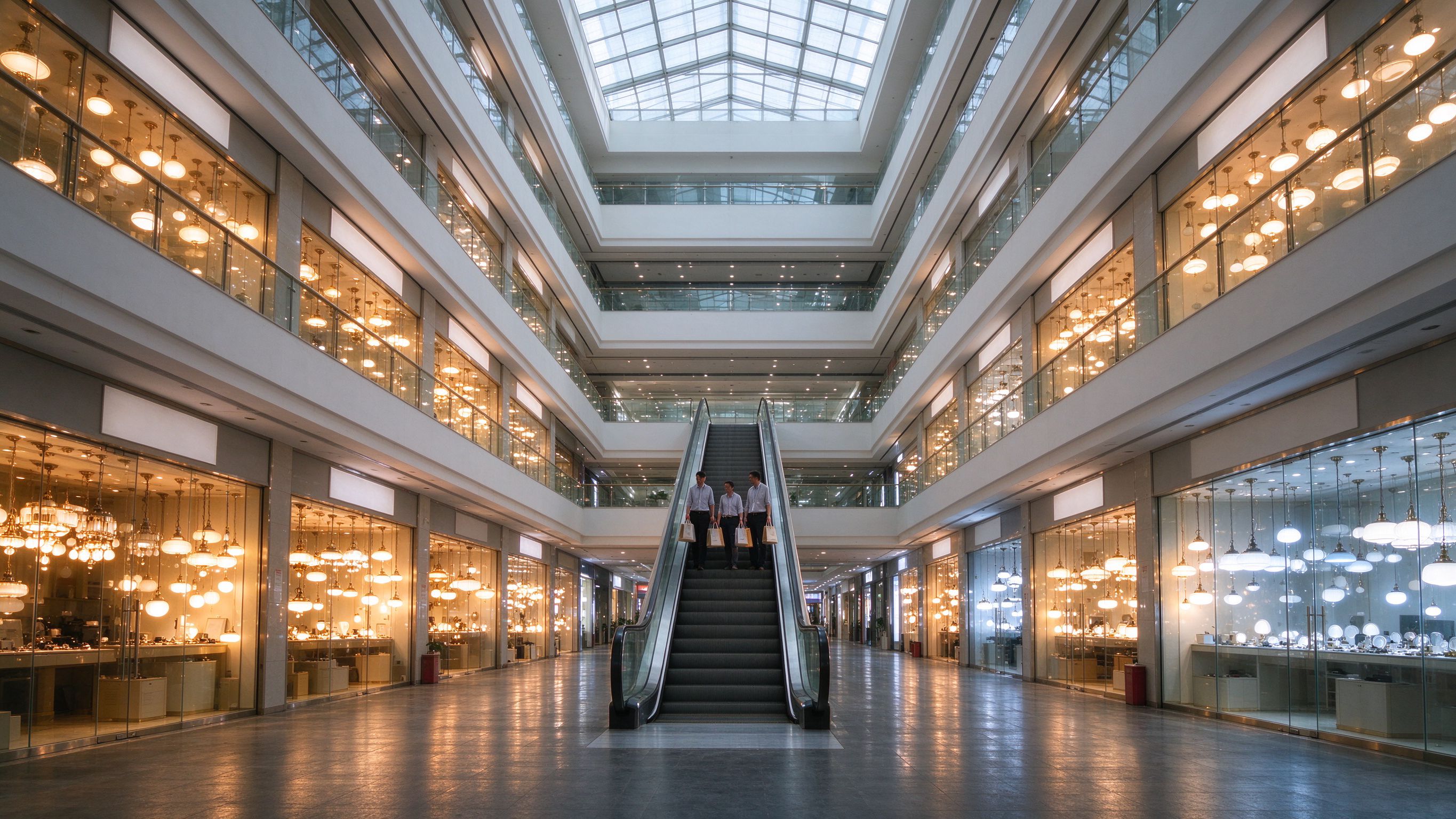
The Map of China's Main Lighting Wholesale Markets
A lighting cluster is not one market; it is several industrial belts. Use the table first to decide which city you need, then read the notes below on how each market is shopped and how to get there.
| Market / cluster | City and location | Positioning | Scale and character | Best for |
|---|---|---|---|---|
| Guzhen lighting cluster | Guzhen Town, Zhongshan, Guangdong | Manufacturing + trade | About 3 million m² of lighting showroom space; around 35,000 lighting and supporting companies; Star Alliance, Lihe Lighting Expo Center, Huayi Plaza, Zhongxing Avenue lighting street, Caosan/Gangnan component zone | Factories, custom work, new designs, project packages |
| Zouqu Lighting City | Zouqu Town, Zhonglou District, Changzhou, Jiangsu | East China distribution | About 600,000 m² and more than 5,000 merchants; China Lighting City, Guanghui Lighting Market and Fade Lighting Plaza form one contiguous cluster | Stock wholesale, store replenishment in East China |
| Linyi Lighting City / China Lighting City | Linyi, Shandong | Northern distribution | Dense merchants, many truck routes, price-sensitive, volume-driven | Northern wholesale, low-price regular models |
| Beijing Shilihe Lighting City | Shilihe, Chaoyang District, Beijing | North China retail + projects | Concentration of residential lighting brands and showroom-format stalls | North China projects, retail range selection |
| Zhengzhou Huafeng Lighting World | Zhengzhou, Henan | Central China wholesale | Covers the Central Plains; trucking reaches neighboring provinces | Central China wholesale and distribution |
| Chengdu Jinfu Lighting City | Chengdu, Sichuan | West China wholesale | One of the main lighting distribution points in Southwest China | Southwest wholesale and projects |
| Shanghai Lighting City (Liuying Road area) | Shanghai | Retail + project support | One of Shanghai's earlier dedicated lighting markets; now mainly brand retail and project supply | Sample selection for Shanghai and nearby projects |
| Yiwu International Trade City, lighting zone | Yiwu, Zhejiang | General trade distribution | Mixed small commodities, holiday lights, small components, finished lamps | Small mixed orders, seasonal goods |
Scale figures come from public reporting and market introductions. Statistical years and definitions differ, so treat them as order-of-magnitude references, not as a basis for pricing or leasing decisions.
Guzhen, Zhongshan: the lighting capital — trade malls first, streets second
Guzhen covers less than 50 square kilometers, yet concentrates the entire chain from lamp body and light source to driver and packaging. Its value is not that it is "cheap." Its value is that you can find factories willing to modify a mold, a configuration or a gift box for you. If you are building your own brand, supplying projects or developing differentiated designs, Guzhen is almost always the first stop.
Four zones you need to know
- Star Alliance Global Lighting Brand Center: brand, project and designer channels. Large showrooms, full sample ranges, and factories able to handle project orders. Quotes are usually not the lowest.
- Lihe Lighting Expo Center: finished-lamp trade, concentrated residential and decorative lighting; a good place to establish a price anchor.
- Huayi Plaza and the International Lighting City area: a mix of brand showrooms and export stalls; many export-oriented factories keep an office here.
- Zhongxing Avenue lighting street and the Caosan/Gangnan component zone: the first is dense wholesale stalls; the second is lamp bodies, light sources, drivers, aluminum profiles and crystal parts. To judge the real cost of a lamp, you have to look at the component zone.
How to get there. Fly into Guangzhou Baiyun or Shenzhen Bao'an, take a high-speed train to Guangzhou South, then the Guangzhou–Zhuhai intercity line to Guzhen Station, which opens directly into the lighting district. From Zhongshan North Station it is a 20–30 minute taxi ride. Inside the town, use taxis or ride-hailing: the distances between zones are not walkable, especially in summer heat.
A one-day route. Morning: Star Alliance and Lihe Lighting Expo Center, noting the configuration and quote of three to five benchmark products. Afternoon: Zhongxing Avenue lighting street, price-checking the same models. Late afternoon: Caosan or Gangnan component zone, verifying the real grade of body, driver and light source. Evening: organize photos and quotes. The next day, visit factories and see the lines.
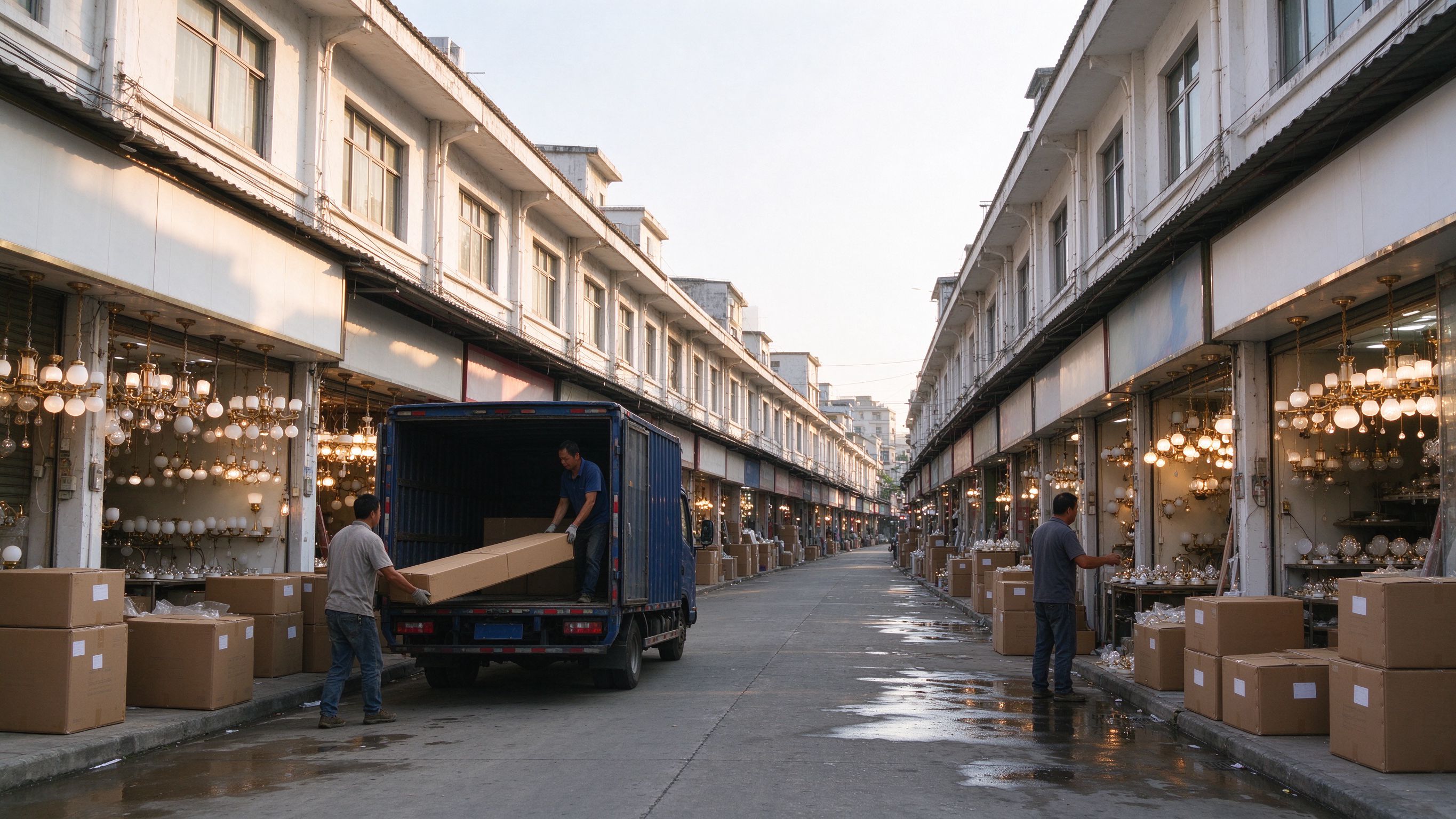
Zouqu, Changzhou: one of East China's largest lighting distribution hubs
Zouqu Lighting City sits in Zouqu Town, Zhonglou District, Changzhou. China Lighting City, Guanghui Lighting Market and Fade Lighting Plaza form one contiguous area of roughly 600,000 square meters with more than 5,000 merchants, making it one of the most important lighting distribution centers in East China. Its strength is deep stock, broad range and fast replenishment; many stores and contractors in Jiangsu, Zhejiang and the wider region buy here.
- Best for: stock purchasing of regular residential, commercial and project fixtures; orders with modest volume per model that need to ship quickly.
- Weaker at: local factory resources compared with Guzhen. Deep customization and tooling are limited, and much of the stock itself originates in Guangdong or Jiangsu and Zhejiang factories.
- How to get there: Changzhou Benniu Airport or Changzhou North high-speed rail station, then a 30–40 minute taxi; exit the Shanghai–Nanjing expressway at Zouqu and you are in the market cluster.
Linyi: northern distribution and low-price volume
Linyi Lighting City (China Lighting City) leverages Linyi's logistics strength to reach North China, the Northeast and the Central Plains, and is one of the most important lighting wholesale centers in the north. Prices here are highly competitive, with a high proportion of regular, project and distribution models. It suits buyers who care about unit price, do not need the newest designs and need to consolidate a container quickly.
- Best for: large runs of regular models, distribution into northern markets, and replenishment with tight deadlines.
- Watch out: new designs arrive more slowly than in Guzhen, and material differences between stalls on the same model are significant. Inspect and seal samples stall by stall.
- How to get there: Linyi Qiyang Airport or Linyi North Station, then a 20–40 minute taxi. The market cluster is in Lanshan District, with logistics parks around it.
Beijing Shilihe
One of North China's larger lighting distribution points, with many showroom-format stalls and a concentration of residential lighting and brand agencies. Good for project sample selection and retail range review in North China; not the best first stop for pure export customization.
Zhengzhou Huafeng Lighting World
A central wholesale market covering Henan and neighboring provinces, with wide trucking reach and a focus on regular residential and commercial lighting. Good for central-region distributors replenishing stock; prices and designs sit between Guzhen and Linyi.
Chengdu Jinfu Lighting City
One of the main lighting distribution points in Southwest China, covering Sichuan, Chongqing, Yunnan and Guizhou. Projects and residential lighting carry equal weight; suited to southwest project supply and regional wholesale.
Shanghai Lighting City / Yiwu
Shanghai is mainly brand retail and project supply, useful for sample selection and project coordination. Yiwu is strong in mixed small commodities, holiday lights and small components: one container can hold many categories, but depth in any single category is shallower than a dedicated lighting market.
The Fair Calendar: Which Shows Are Worth a Flight
A fair compresses factories scattered across several cities into a few halls and a few days. But the shows are positioned very differently: the Canton Fair is built for export transactions, GILE for technology and professional lighting, the Guzhen fair for the industrial belt and finished lamps, and the Hong Kong shows for international buyers and design.
| Fair | Typical dates | Location | Character | Best for |
|---|---|---|---|---|
| Canton Fair (China Import and Export Fair) | April 15 – May 5 October 15 – November 4, in three phases | Canton Fair Complex, Pazhou, Guangzhou | Lighting and electrical products fall in Phase 1 (April 15–19 / October 15–19). Export-oriented factories concentrate here and export orders can be discussed on site. | Export factories, export-spec products, meeting existing customers |
| Guangzhou International Lighting Exhibition (GILE) | June each year; June 9–12 in 2026 | Canton Fair Complex, Guangzhou | One of Asia's largest professional lighting shows: LED, smart lighting, commercial lighting, outdoor lighting and components | Technology trends, specialist manufacturers, project channels |
| Guzhen Lighting Fair | March and October each year; the 34th edition in spring 2026, the 35th edition October 22–25, 2026 | Guzhen Convention and Exhibition Center and nearby halls, Zhongshan | An industrial-belt fair: halls and showrooms run together, so you can walk from the fair into a factory or the lighting street | Finished and decorative lamps, factory visits nearby |
| Hong Kong International Spring / Autumn Lighting Fair | Spring around April; autumn in late October | Hong Kong Convention and Exhibition Centre | Highly international, strong buyer quality, oriented toward finished lamps, design and smart lighting | International buyers, design and trends, brand range building |
These are the regular annual patterns. Exact dates, hall layout and entry requirements change every year. Verify on the organizer's official site and complete visitor pre-registration before you travel.
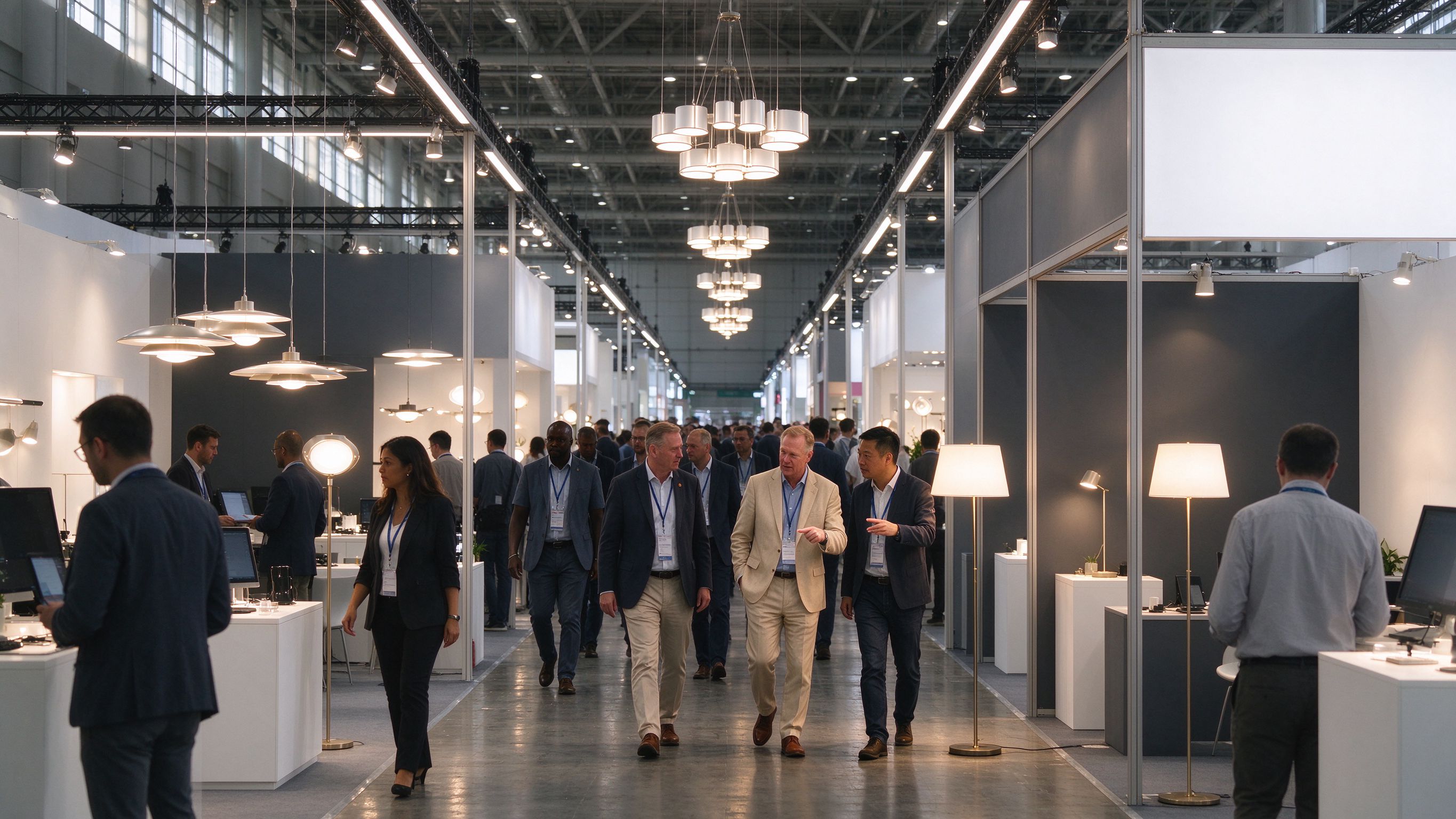
How to use a fair without wasting the airfare
1. Before the show: build a must-meet list
Filter the exhibitor directory by category down to 15–20 companies, email them in advance to book a time, and state your market, certification requirements and expected annual volume. You can still browse for surprises on site, but the meetings are what make the trip efficient.
2. At the booth: three questions that reveal the supplier
First, "Are you the factory or a trading company, and where is the factory?" Second, "Which markets is this model certified for, and can you send me the certificate number?" Third, "What is the MOQ, the lead time and the driver brand?" Suppliers who cannot answer go on a watch list, not a shortlist.
3. Collect evidence: shoot the sample and the label
Photograph the whole fixture, but also the rating plate, the driver label, the carton shipping mark, the booth number and the business card. Photos are more reliable than memory when you get home, and the driver model is usually the key to comparing quotes later.
4. After the show: follow up within 48 hours
The three days after a fair are the best window for quote response rates. Put the five to eight suppliers you liked into a spreadsheet, send one email with a shared specification sheet, and ask everyone to quote on the same basis so the numbers are comparable.
What the Market Actually Sells: Six Categories and Their Risks
Lighting spans an enormous range, from LED beads costing a few cents to crystal project chandeliers costing tens of thousands of dollars. The buying logic differs by category: residential lighting is about appearance and consistency, commercial lighting about optics and glare, outdoor lighting about ingress protection and service life, and components about material and matching.
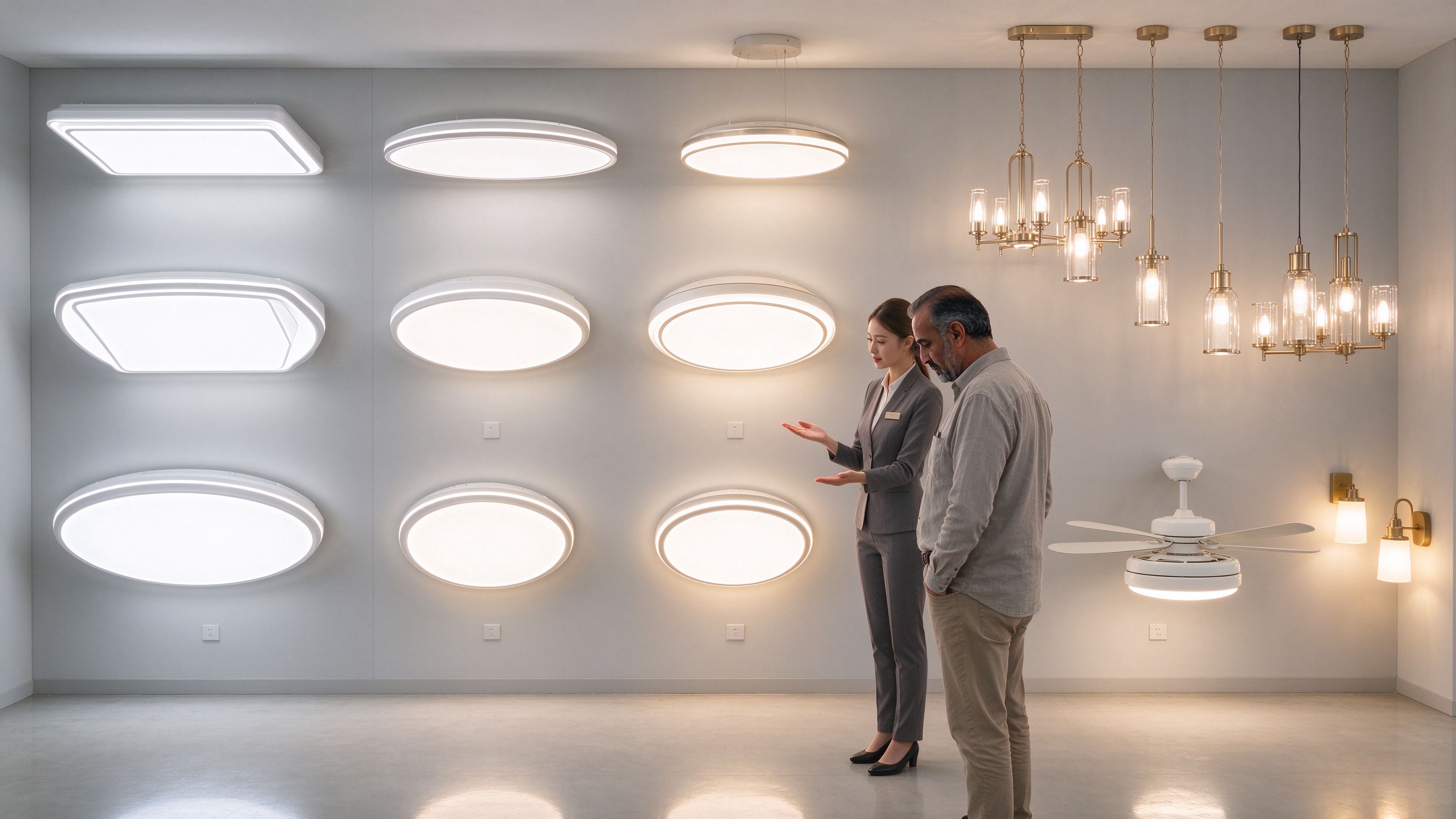
Residential lighting CEILING · PENDANT · WALL · FAN LIGHTS
The highest-volume category and the one most export orders concentrate in. The typical bill of materials is body + LED board + driver + remote. Ultra-thin ceiling lights, sealed "tri-proof" ceiling lights, smart ceiling lights and hidden-blade fan lights have been the fastest-moving directions in recent years.
Check the light pattern: light it against a wall and look for yellow edges, dark zones or graininess. A poor diffuser is visible immediately.
Check consistency: light three pieces of the same model and compare color temperature and brightness. Factories with weak color tolerance control ship cartons that are "one warm, one cold."
Check the structure: ultra-thin models have little heat-sink space, so driver and board quality decide service life. Do not judge by thickness alone.
Key specs: wattage (W), luminous flux (lm), CCT (K), CRI (Ra), diameter or dimensions, dimmable and tunable or not.
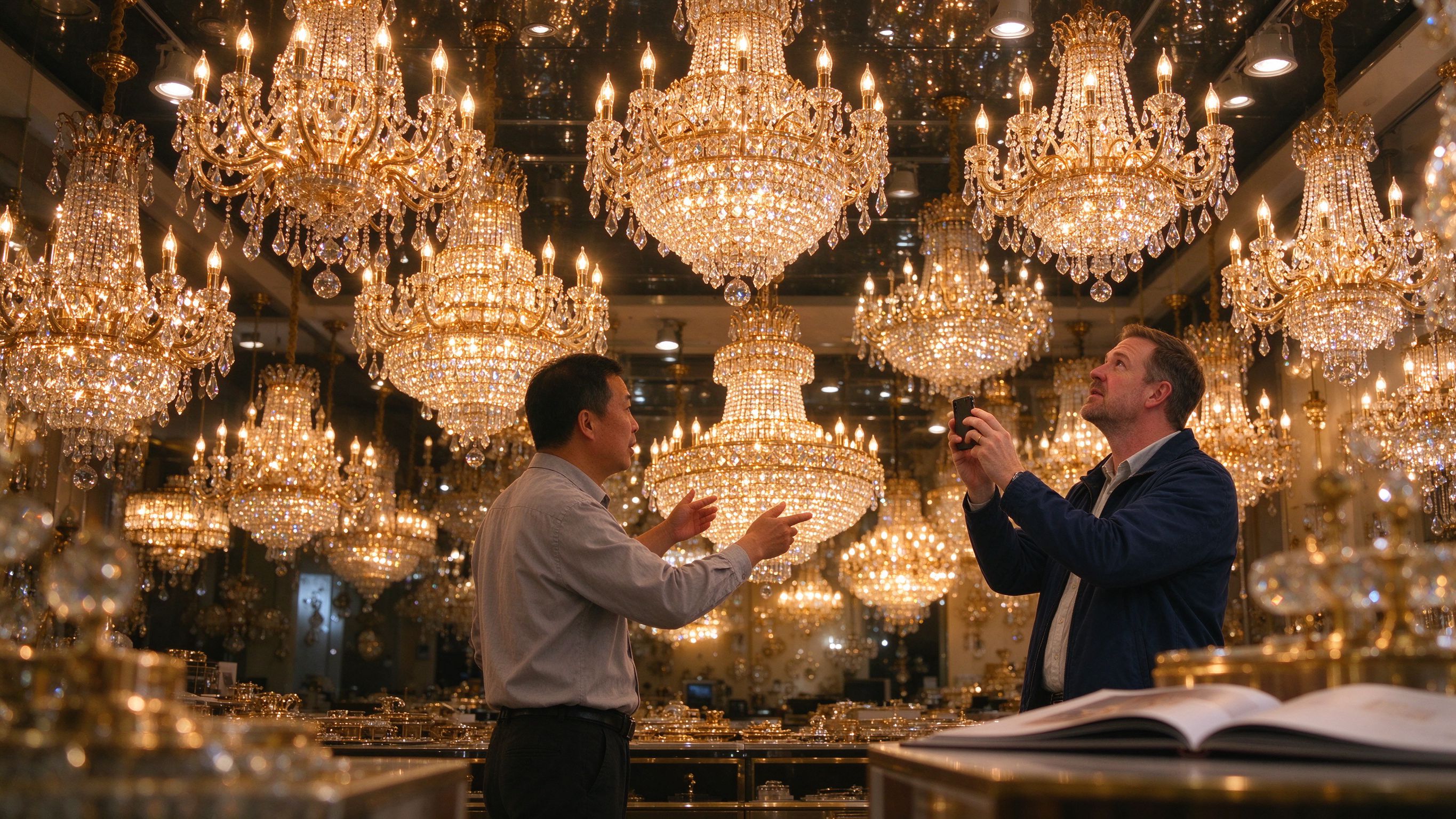
Decorative lighting CRYSTAL · IRON · MODERN METAL
Decorative lighting carries the highest appearance premium and also the widest room for hidden cost. On the same chandelier silhouette, K9 optical crystal, ordinary glass or acrylic, combined with electroplated copper, painted iron or zinc alloy, can multiply the price while looking almost identical in a photo.
Crystal: ask whether it is K9, glass or acrylic; check whether the cuts are sharp, whether there are bubbles, and weigh it to feel the density and refraction.
Metal parts: confirm the base material and surface process (electroplating, baking enamel, brushing). For coastal or humid markets, rust protection is the priority.
Packaging: crystal parts must be individually wrapped and layer-fixed. Poor packaging produces very high breakage rates, so write it into the inspection standard.
Key specs: crystal material, metal base and finish, number of arms, overall dimensions, adjustable drop length, packing method.
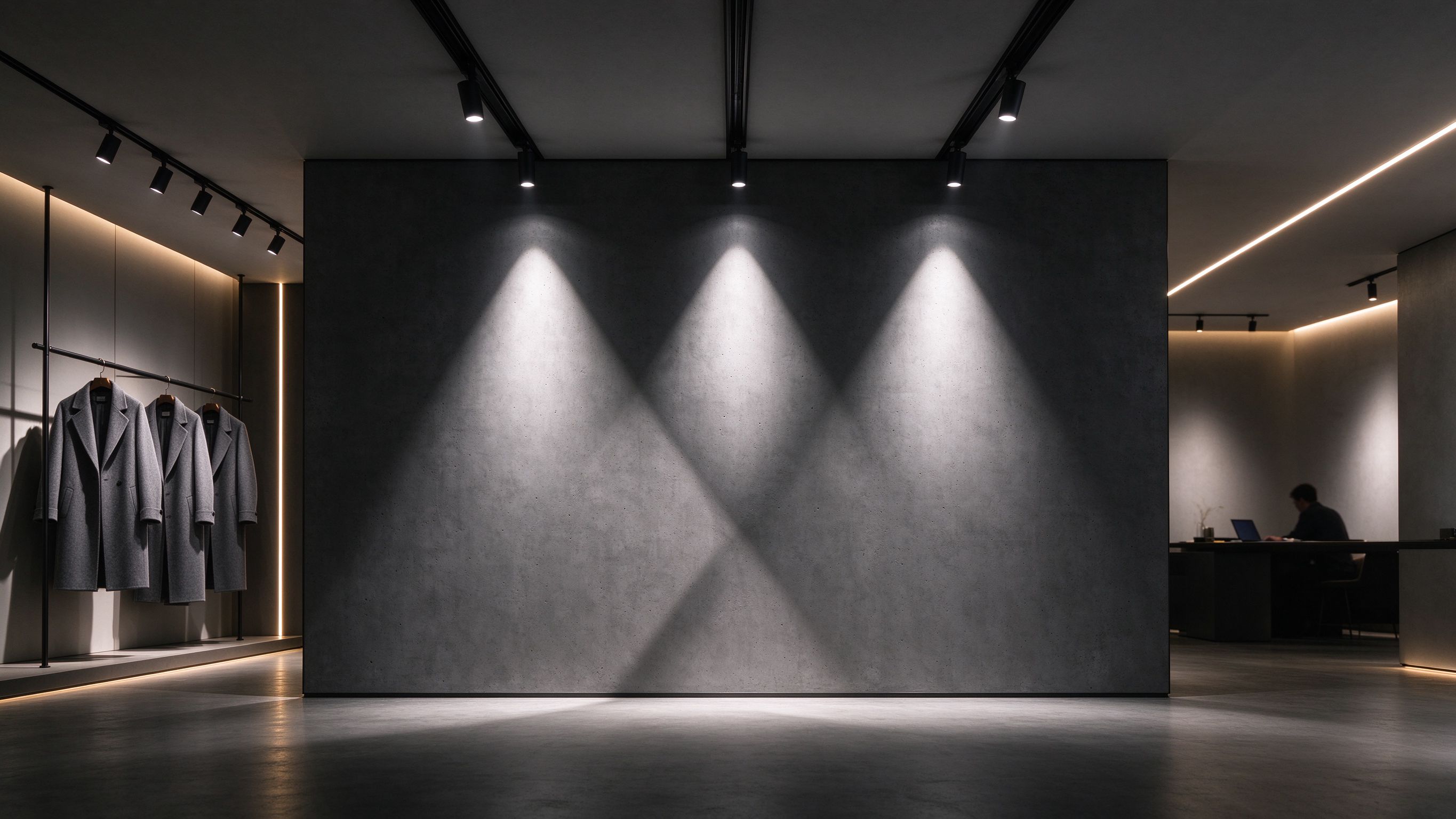
Commercial lighting DOWNLIGHTS · SPOTS · TRACK · LINEAR
Commercial lighting is the most technical category, and the customer is usually a store, hotel, developer or contractor. The product itself is not complex, but optical design, driver quality and dimming compatibility decide whether the project passes inspection.
Optics: check whether the beam angle is accurate and whether the pattern has spill light or a yellow ring. For wall-washing, check how evenly the light transitions up the wall.
Glare: ask for the UGR value. Deep anti-glare structures cost more, and retail and residential projects are sensitive to glare.
Dimming: confirm whether it is TRIAC, 0–10V, DALI or a wireless protocol, and ask the factory for a compatibility test with your control system.
Driver: most commercial project callbacks trace back to the driver. Do not accept "equivalent quality" as an answer.
Key specs: beam angle, UGR, Ra and R9, CCT and color tolerance, dimming method, IP rating, driver brand and model.
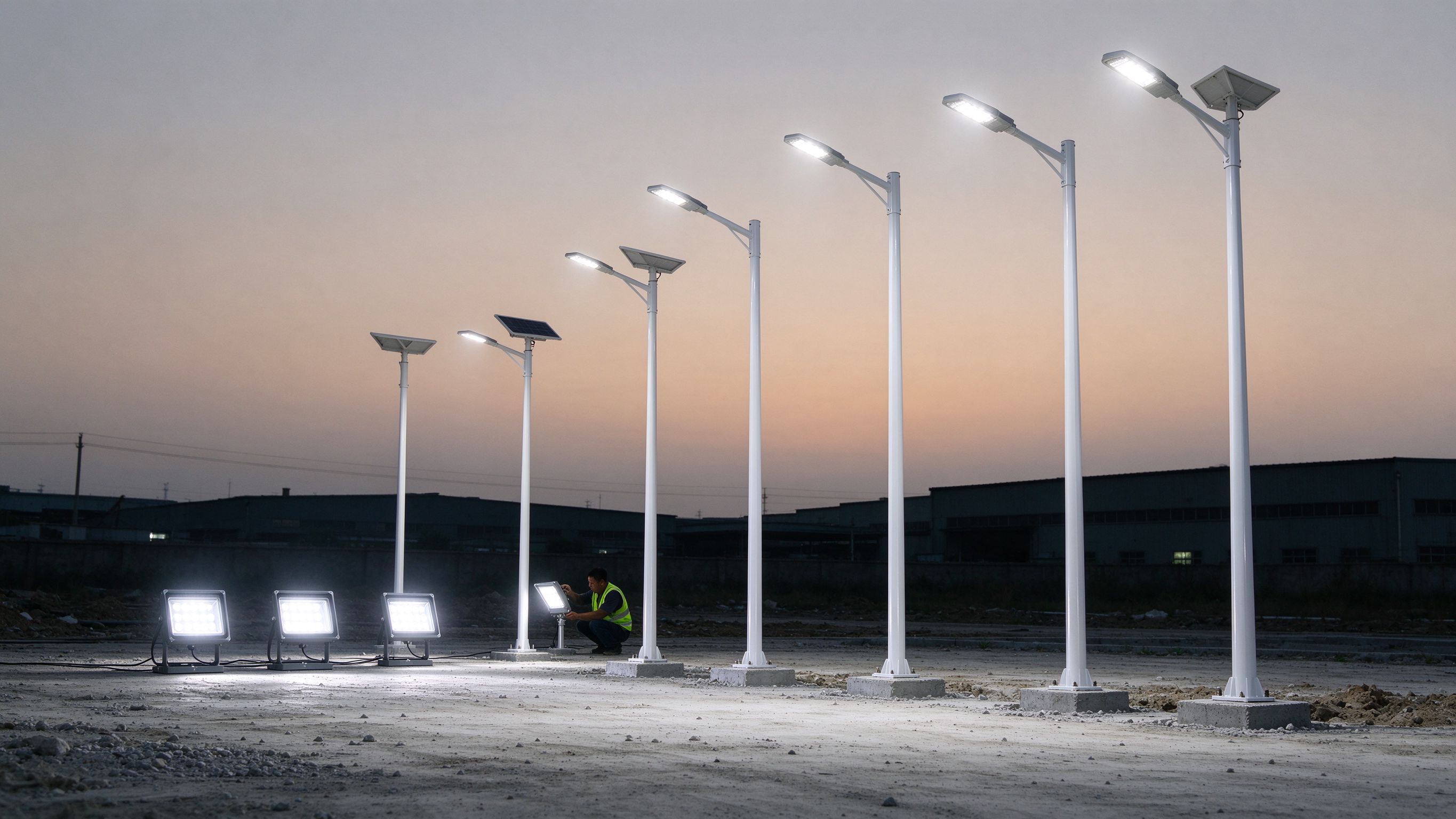
Outdoor and project lighting STREET · FLOOD · HIGH BAY · SOLAR
Outdoor fixtures face rain, dust, lightning, salt fog and temperature swings, and they test a factory's structural design more than any other category. Project orders are large and inspected strictly; the cost of a failure is far higher than with residential lighting.
Ingress protection: look at the actual IP test report, and at the sealing method, breather valve and potting process in the structure.
Surge protection: ask for the surge level (for example 10kV or 20kV). Projects in high-lightning regions must have it written into the contract.
Solar: battery capacity, panel wattage and controller efficiency are the most commonly overstated figures. Ask for the sizing calculation and measured runtime.
Efficacy: luminaire efficacy (lm/W) is more honest than a single-chip datasheet. Require quotes based on whole-luminaire test data.
Key specs: IP rating, surge level, luminaire efficacy, CCT, housing material and finish, solar configuration, mounting method.
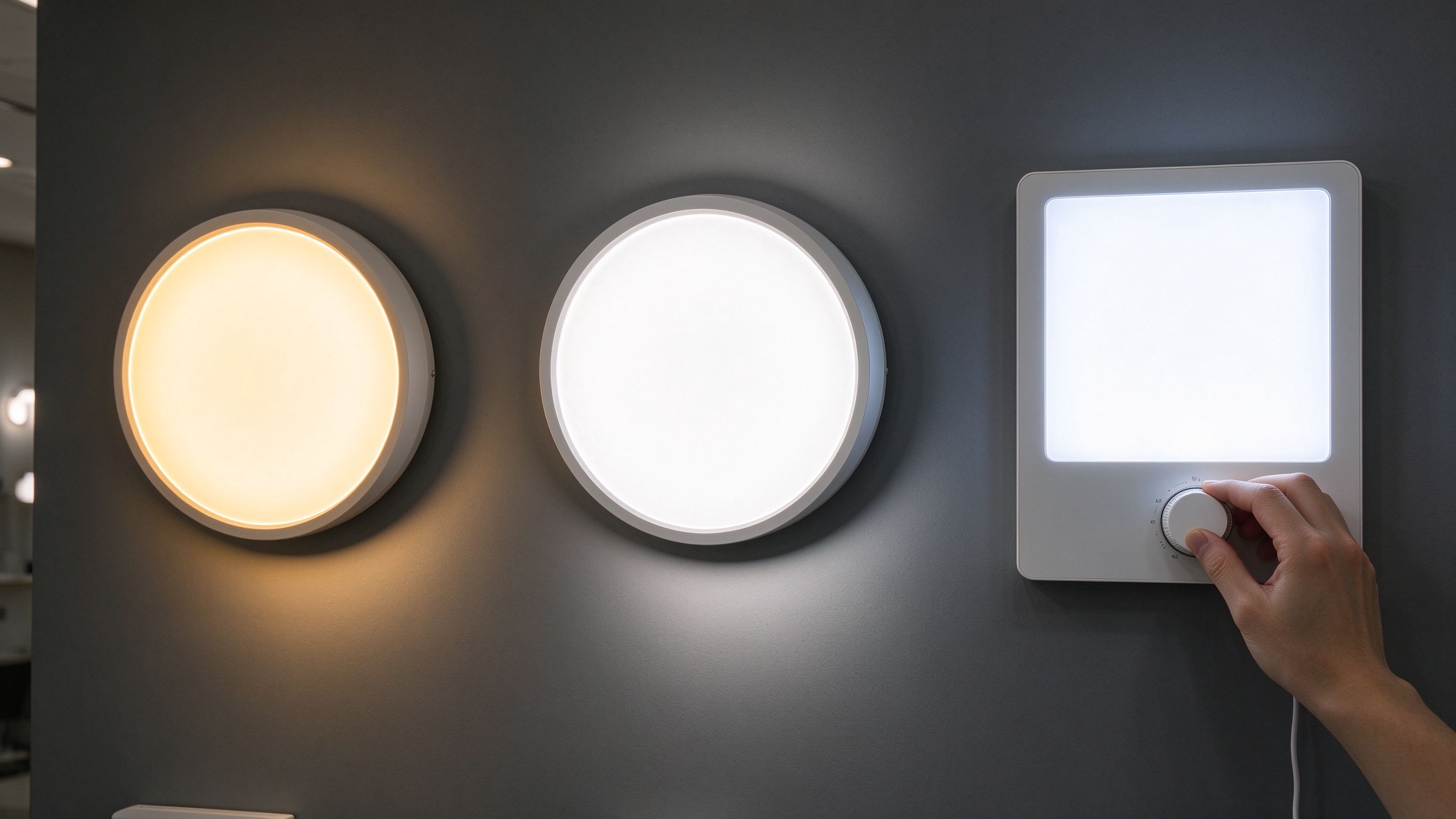
Light sources, drivers and smart modules LED · COB · STRIP · CONTROL
The heart of every fixture sits in this category: LED beads, COB, filament lamps, flexible and rigid strips, driver power supplies and smart control modules. Much of the difference between two finished-lamp quotes is simply these invisible parts changing.
Chip: ask for the brand and model (for example Bridgelux, Sanan, Epistar) and for binning information on brightness, voltage and CCT.
Driver: confirm constant-current accuracy, power factor, CCC/CE/UL certification, and the warranty term.
Flicker: point a phone camera at the lit lamp. Rolling bands mean visible flicker, which is unsuitable for both residential and commercial use.
Smart: test ecosystem compatibility for Wi-Fi, Bluetooth Mesh, Zigbee and Matter in person. A factory demo is not a test.
Key specs: chip brand and model, driver brand and certification, flicker depth, protocol and ecosystem, dimming range, watts per meter and cut interval for strips.
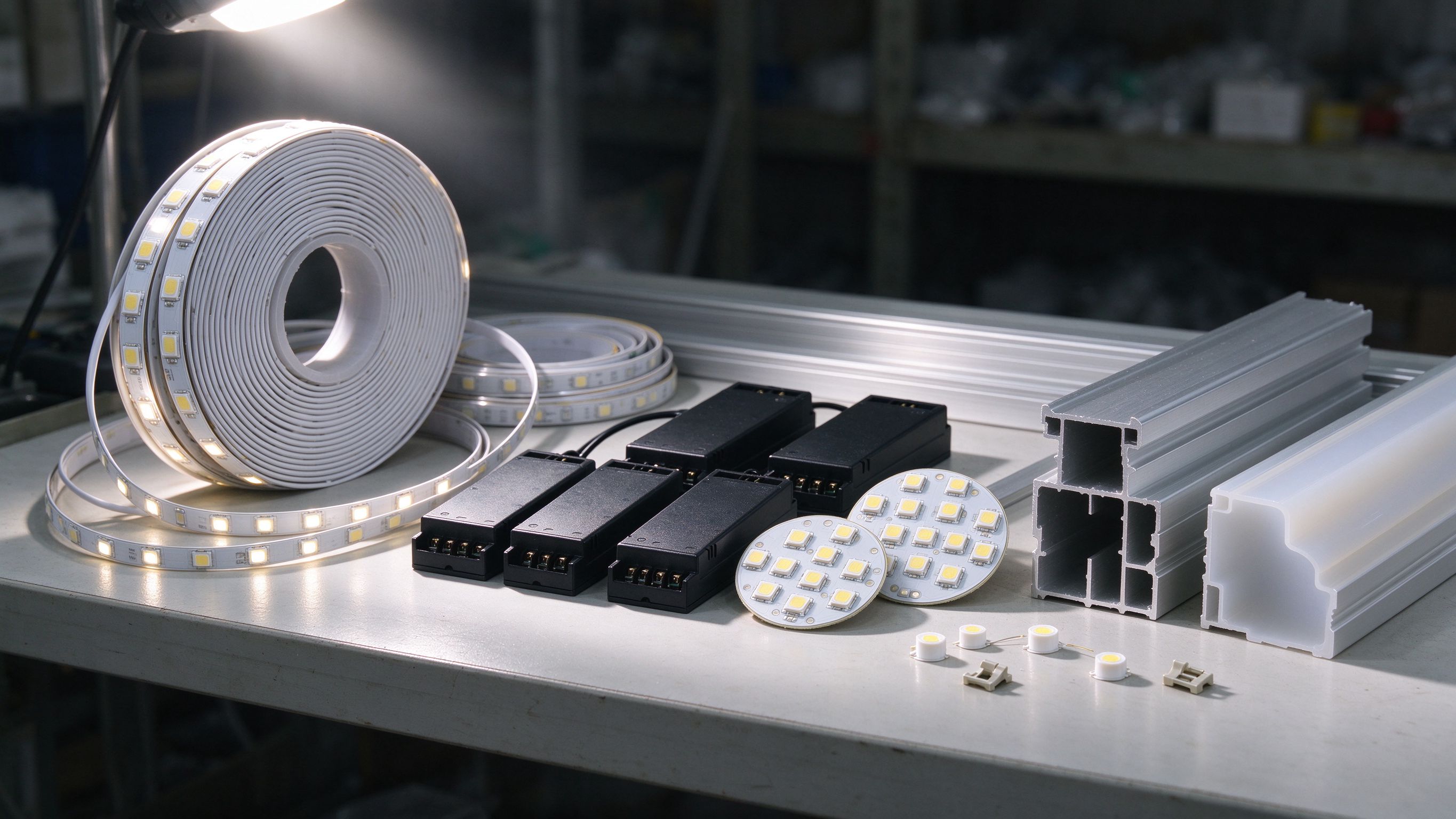
Components and structures ALUMINUM · DIFFUSER · LENS · BASE
The component zone is the most hardcore part of Guzhen. Body wall thickness, aluminum grade, whether the diffuser is PC or PMMA, and whether the lens has secondary optics determine the feel, heat management and optical performance of the finished lamp — and they determine how much water is in the quote.
Aluminum profiles: check wall thickness (commonly 0.8–2.0 mm) and whether the material is recycled. Thin-wall recycled aluminum is light and cheap but poor at heat dissipation and structural strength.
Diffusers: PC is impact-resistant; PMMA transmits light well but is brittle. Ask for the material and the flame-retardant grade.
Lenses and reflectors: check whether the beam is clean and free of yellow rings. Spill light usually comes from a cheap lens.
Matching: if you assemble locally, driver current and voltage must match the board, or lumen depreciation and dead lamps will spike.
Key specs: aluminum wall thickness and grade, surface finish, diffuser material and transmission, flame rating, lens angle, lamp base standard.
Six numbers to record every time you look at a lamp
| Parameter | Why it matters | How to check it on site |
|---|---|---|
| Wattage (W) | Drives brightness and energy use, and is the basis for price tiers | Check that the rating plate and driver label agree; do not rely on a verbal figure |
| Luminous flux (lm) | Actually determines how bright the lamp is, and is more reliable than wattage | Ask for whole-luminaire test data; compare lumen output across models of the same wattage |
| CCT (K) | Warm white, neutral or cool white directly determines the application | Light a batch together and compare; ask for the color tolerance range (for example within 5 SDCM) |
| CRI (Ra) | Determines whether colors look true; critical for both retail and residential | Ask for Ra and R9, and require a test report rather than a verbal promise |
| Beam angle | Shapes the light pattern and the atmosphere of a space, especially in commercial work | Look at the actual projection; watch for spill light, yellow rings and edge transition |
| IP rating and driver | Determines service life and suitable environments; essential outdoors and in damp areas | Review the IP test report; open the fixture and confirm the driver brand and model |
How to Turn a Market Visit into a Purchase Order
The usual failure in lighting sourcing is not that the buyer cannot find product. It is that they look too fast, ask too little and write too loosely. The sequence below runs in time order, from the month before departure through inspection and container loading to the repeat order.
Write your requirement into one sheet
Do not arrive in China to "see what sells." Write down the category (residential, commercial, outdoor, decorative), the target market, the certifications required, the voltage and plug standard, the packaging language, the expected annual volume and the acceptable target price range. That sheet decides whether you should be in Guzhen or Zouqu, and whether a factory will bother quoting seriously.
Settle three things — market, category and certification — before you book the flight.
Visa, pre-registration, factory appointments and hotels
Pre-register as a visitor on the fair website; some shows do not issue badges on site. Book factories three to five days ahead, because in peak season many owners are not at the stall. Hotel rates in Guzhen rise sharply during the lighting fair, so book early in the town center or toward Xiaolan. Install WeChat, WhatsApp and a translation app, and bring plenty of business cards plus a one-page English company profile.
Put factory address, contact and WeChat into one itinerary sheet, and work zone by zone on site to avoid backtracking.
Start in the trade malls and set a price anchor
Walk Star Alliance and Lihe Lighting Expo Center first and pick three to five benchmark products. Record model number, dimensions, wattage, CCT, driver, quote, MOQ and lead time. This is not about ordering; it is about learning what comparable product costs in a good showroom, so that street prices have a reference point.
Take three photos per model: the whole fixture, the lit effect, and the rating plate or driver label.
Work the lighting street and compare at least three quotes per model
The stalls along Zhongxing Avenue are the densest, and the right place for regular models and container consolidation. Ask at least three suppliers for the same model, and insist on a quote for the same configuration: same body thickness, same driver brand, same light source and same packaging. If one is clearly cheaper, ask what changed rather than celebrating.
If the same model is more than 20% cheaper, one specification has usually been swapped.
Price the components
The Caosan and Gangnan component zone will tell you what bodies, LED boards, drivers, aluminum profiles, diffusers and crystal parts actually trade at. You do not have to assemble lamps yourself, but knowing the price band of the key parts changes the negotiation completely: when a supplier says "this body uses thickened aluminum," you can weigh it and look at the cross-section on the spot.
Carry a small tape measure and a coin: measure wall thickness and compare weight. It beats listening to a sales pitch.
Switch the lamp on — never judge by appearance alone
Ask the stall to power the sample and look at the edge of the beam, the wall transition, yellow rings and spill light. Point a phone camera at the lamp to check flicker. Light two or three pieces of the same model side by side to compare CCT and brightness. For fan lights, listen for noise and test the remote; for smart lamps, pair them on site. Discuss price only after this.
Daylight in a showroom hides beam problems. Ask them to kill the ambient light and look again.
Narrow to three to five suppliers, then book factory audits
Ask for the business license, factory address and scanned certificates, and determine whether you are dealing with a factory or a trading company. Trading companies are not automatically a problem, but customization, quality traceability and lead-time control are usually weaker. Cut the list to three to five and allocate half a day to a full day for factory visits.
If the production address on the business license differs from the stall address, ask exactly what the relationship is.
The five-point audit: equipment, testing, warehouse, driver, takt
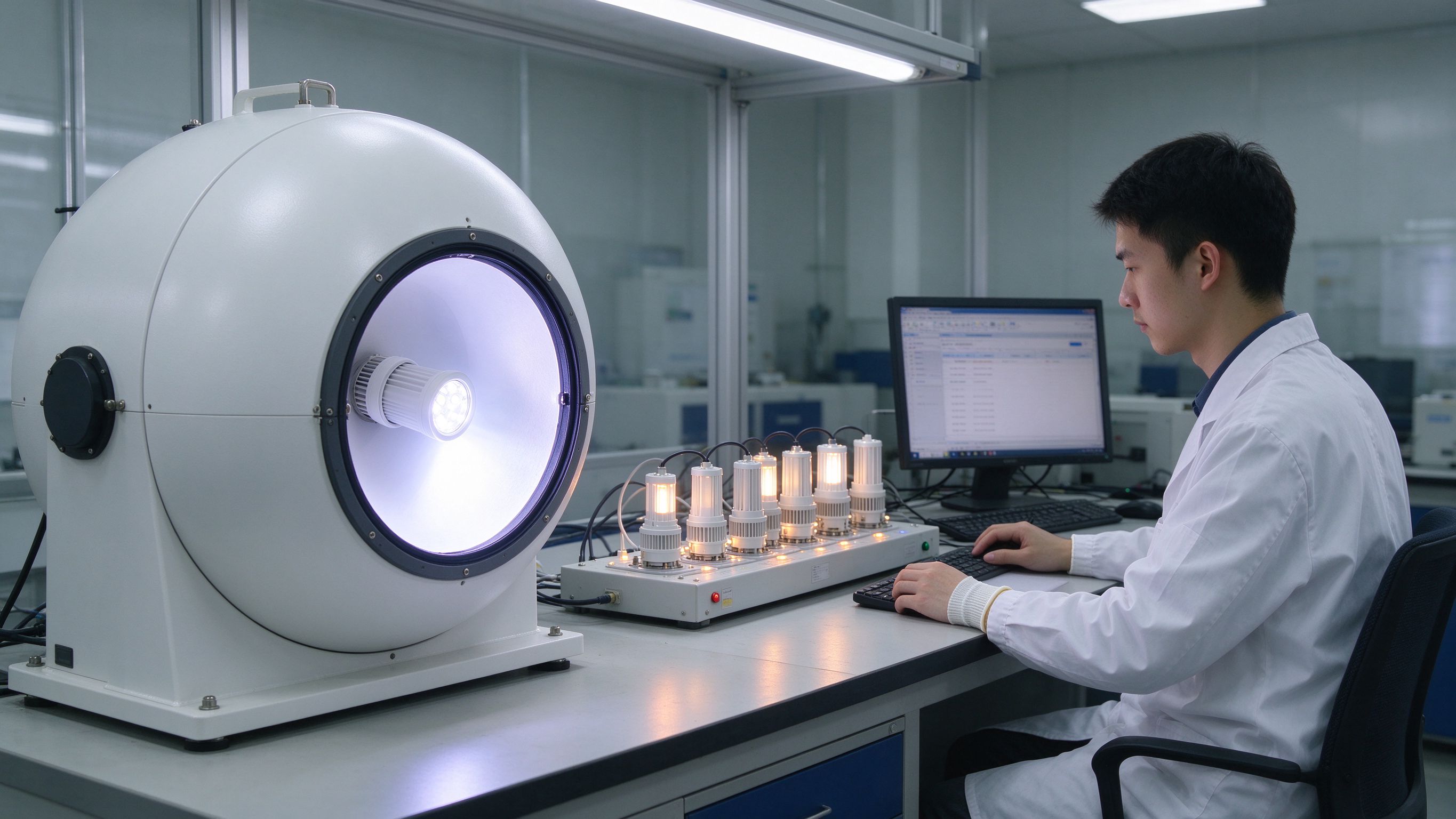
One: does the plant have die-casting, metalworking, SMT or final assembly? Two: is there an aging rack, an integrating sphere, or at least a burn-in process? Three: are warehouse materials segregated, and do drivers and light sources carry brand markings? Four: is the driver actually used on the line the same model quoted? Five: what is the line takt and headcount, and therefore the real capacity?
Ask them to pull one finished lamp at random and light it. That is more honest than a showroom sample.
Seal the sample and turn a verbal yes into a physical reference
Pay the sample fee, place the sample order, and check every item on receipt: dimensions, weight, wattage, CCT, luminous flux, driver model, packaging. Once confirmed, each side keeps one sealed sample, photographed, labeled and signed. Bulk acceptance is judged against that sealed sample, not against a chat history.
Write model, date, CCT and wattage on the sealed bag, sign both copies, and photograph them for the file.
Break the "total price" into seven lines
Require the quote to separate body, light source, driver, packaging, mold or plate fee, certification fee and freight. Then calculate CBM from the outer carton dimensions, and confirm whether the term is FOB or CIF and who pays destination charges. Lighting is classic volumetric cargo; costing freight by net weight will always understate the number.
Only the same configuration, the same Incoterm and the same packaging are comparable.
30/70 terms, with the details written down
The common structure is a 30% deposit and 70% after inspection, paid to the company account. Attach the specification, driver brand and model, CCT, packaging, inspection standard (for example AQL 2.5/4.0), lead time and late-delivery liability, quality claim procedure and IP ownership to the contract. For larger amounts, use a letter of credit or an escrow platform.
The contracting entity, the receiving entity and the business license must all be the same company.
Inspect, load, then manage the after-sales loop
For first orders, custom models and new suppliers, book third-party inspection with AQL sampling, focused on lit function, CCT consistency, appearance, driver, packaging and shipping marks. Photograph the container number, seal and stowage pattern during loading. Keep spare parts, record the failure rate, and adjust the configuration for the repeat order based on data rather than on how cheap the last quote felt.
File the inspection report, loading photos and sealed-sample photos together in the supplier record.
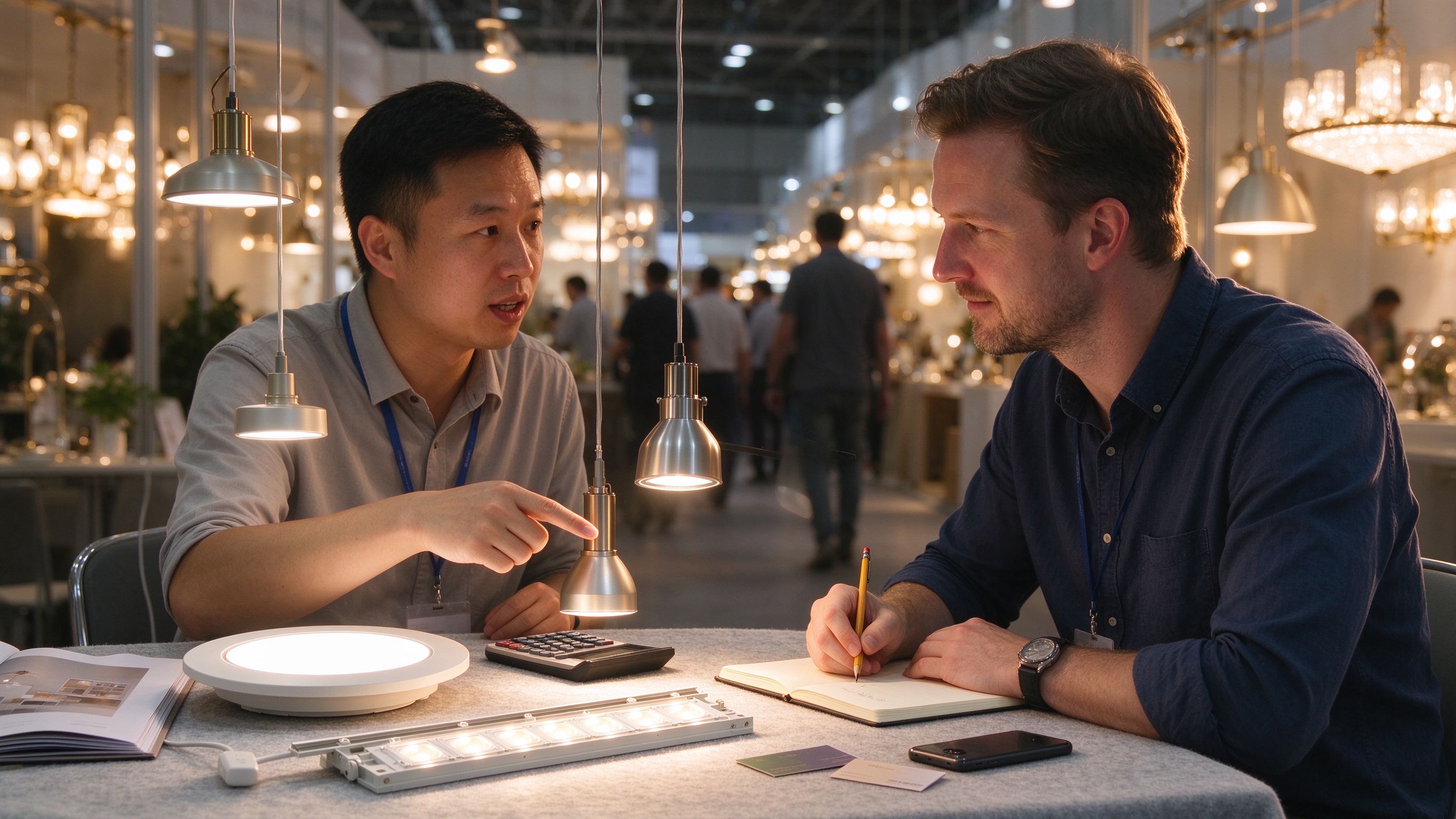
Fourteen questions to ask every supplier
Ask these in order. Suppliers who cannot answer half of them are not ready for an export order.
| Question | Why it matters |
|---|---|
| Is this the price for a complete set, or the body only? | The most common lighting quote trap; light source and driver are often priced separately |
| Which driver brand and model, and what certification? | The driver drives service life and callback rate, and is where cost is most often cut |
| What are the chip brand, luminous flux and Ra? | Determines brightness, color rendering and the real grade of the product |
| What CCT, and what color tolerance? | Batch-to-batch color shift is a leading cause of residential returns |
| What is the MOQ, and how much is in stock? | Distinguishes stock wholesale from production scheduling, which affects lead time |
| What is the normal lead time, and the peak-season lead time? | Peak season (August–October and before Chinese New Year) routinely adds weeks |
| Is there certification for my target market, and can you send the certificate number? | A CE self-declaration is not a test report; UL and ETL numbers must be verifiable |
| Can you configure voltage, frequency and plug for the destination country? | 110V/220V and US/EU/UK plug differences are significant |
| How is it packed: pieces per carton, carton dimensions and weight? | Directly affects volumetric weight, breakage rate and destination charges |
| What is the sample fee, and is it credited against the order? | Sample policy reveals how a factory treats small buyers |
| What are the payment method and the receiving entity? | Avoid private accounts and deals without a contract |
| What is the warranty, and how are failures compensated? | Turns after-sales from a promise into a clause |
| Can you private-label, and change the gift box and manual? | Own-brand work requires confirming plate fees and MOQ in advance |
| Where is the factory, and can you arrange an audit? | A refusal to host an audit usually means a trader or a consolidated stall |
The Twelve Problems First-Time Buyers Run Into
These do not depend on your country or your order size; almost every newcomer hits at least a few. They share one pattern: everything looks fine on the day, and the problem only appears when the cargo reaches the warehouse, the lamp is installed, or the customer returns it.
The quote covers the body only — not the light source, driver or packaging
What it looks like: the supplier quotes a very competitive unit price. After the contract is signed, you learn that the LED board, driver, remote and gift box are all extra.
What it costs you: landed cost comes in 20–50% above budget, and the margin disappears.
How to avoid it: make your first question "is this a complete set?" and require the quotation to list body, light source, driver, packaging, tooling and certification as separate lines.
The driver is swapped for an "equivalent quality" part
What it looks like: the sample uses a certified brand-name driver; bulk production uses an unmarked cheap one. The appearance and the weight of the fixture are almost identical.
What it costs you: flicker, dead lamps and slow starts, with a callback rate whose cost far exceeds the saving on the driver.
How to avoid it: write the driver brand, model, wattage and certification into both the contract and the sealed sample; during inspection, open one lamp at random and check the label.
Overstated lumens, wattage and chip brand
What it looks like: a fixture rated 24W actually draws 18W; a rating of 2,000 lm measures below 1,400 lm; the supplier claims a brand-name chip but cannot produce binning documentation.
What it costs you: customers say the product is not bright enough, project acceptance fails, and brand credibility takes the hit.
How to avoid it: require whole-luminaire test data from an integrating sphere, write lumens, wattage and chip model into the contract, and run third-party spot testing on the first batch.
Color temperature drift, batch color shift and overstated CRI
What it looks like: the sample is 3000K warm white and bulk stock runs cool; lamps in the same carton do not match; the label says Ra>90 and the measurement says 80.
What it costs you: residential and retail projects cannot tolerate "one warm, one cold," and whole batches get returned.
How to avoid it: specify CCT and color tolerance (for example within 5 SDCM) plus Ra and R9 in the contract; during inspection, light five to eight pieces from the same batch side by side.
Material substitution: thin aluminum, recycled aluminum, acrylic posing as crystal
What it looks like: body wall thickness drops from 1.5 mm to 0.8 mm and the aluminum is recycled; a crystal chandelier uses acrylic or ordinary glass instead of K9.
What it costs you: poor heat dissipation, deformation and yellowing; decorative fixtures lose their refraction and can no longer carry a premium price.
How to avoid it: carry a tape measure for wall thickness, weigh the part, and look at the cross-section. For crystal, check cut sharpness, bubbles and refraction, and put the material specification into the contract when needed.
Fabricated certification or a borrowed certificate
What it looks like: a CE self-declaration presented as a test report; a UL or ETL certificate number that belongs to a different model; a certificate whose applicant is not this factory.
What it costs you: customs holds, marketplace delisting, customer claims, and in serious cases a shipment that cannot clear at all.
How to avoid it: verify the certificate number in the issuing body's database, then match the model, applicant and expiry date. For the EU, check LVD, EMC, RoHS and ERP under CE; for the US, check UL or ETL and FCC.
Voltage, frequency or plug does not match the destination
What it looks like: a 220V driver shipped to a 110V market; an EU plug for a market that uses UK plugs; a 50Hz product used on a 60Hz grid.
What it costs you: the entire batch is unusable, and rework plus returns are extremely expensive.
How to avoid it: put the destination voltage, frequency and plug standard in one line of the contract before ordering; power-test the first batch and photograph the result.
"In stock" becomes a production order, and peak-season dates slip
What it looks like: the supplier says stock is available, then switches to production scheduling after the deposit. In peak season (August–October and before Chinese New Year) capacity tightens and lead time moves out by two to four weeks.
What it costs you: you miss the selling season, ocean freight and storage costs rise, and customers cancel.
How to avoid it: write lead time and late-delivery liability into the contract; ask for a warehouse photo or video; build 15–20 days of buffer into peak-season orders.
The sample and the bulk order do not match
What it looks like: the sample uses a good light source and driver; bulk production swaps the configuration; dimensions, color and packaging details also drift.
What it costs you: disputes at acceptance, rework or a price reduction, and the trust needed for a long-term relationship breaks.
How to avoid it: keep one sealed sample on each side, signed and photographed; inspect against the sealed sample item by item; book third-party inspection on the first batch.
Weak packaging: breakage, volumetric freight and missed destination charges
What it looks like: crystal parts wrapped in a single film layer, long fixtures without reinforcement; carton dimensions understated so CBM is calculated short; only ocean freight asked for, with destination charges ignored.
What it costs you: breakage of 5–15%, a freight bill inflated by volumetric weight, and extra charges appearing at clearance.
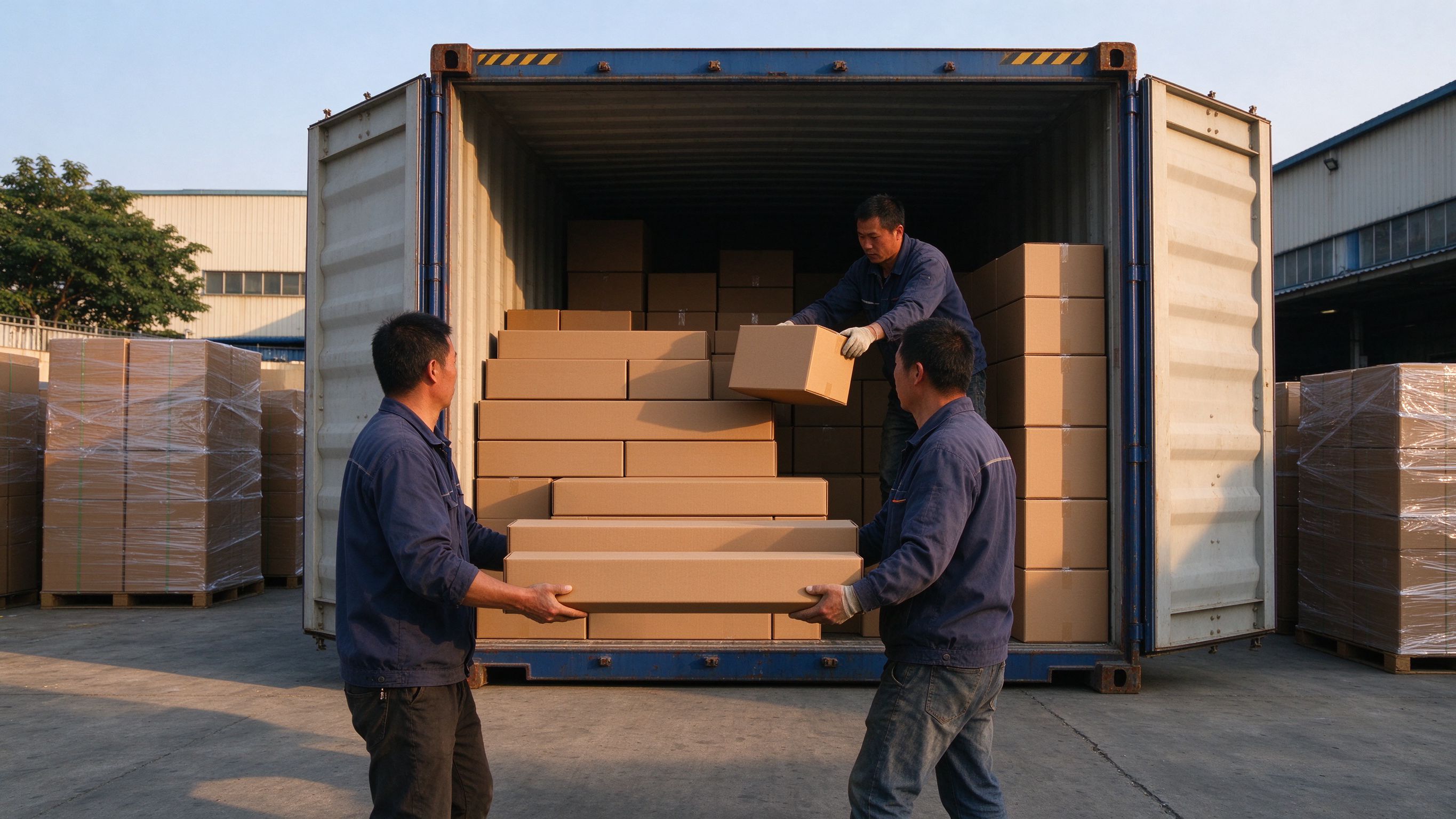
How to avoid it: write the packing method into the contract and confirm it with photos; calculate CBM from outer carton dimensions; ask your forwarder to itemize the FCL or LCL cost structure and destination charges in advance.
Design patent and copyright exposure
What it looks like: copying a best-selling appearance directly, or using unauthorised patterns, cartoon characters or brand marks.
What it costs you: marketplace complaints and delisting, customs detention, claims from rights holders, and in serious cases the whole store is affected.
How to avoid it: run design patent and trademark searches before ordering; ask the factory to explain where the design came from; keep design drawings and first-use evidence for original models.
Payment and contract risk: private accounts and no acceptance clause
What it looks like: a request for the full amount to a private account; a one-page contract with a price and nothing else — no specification annex, no inspection standard, no claim clause.
What it costs you: no recourse when something goes wrong, and a materially higher risk of losing both the money and the goods.
How to avoid it: pay to the company account, use 30/70 terms, and make sure the contracting and receiving entities match; attach specification, inspection, lead time, claims and IP terms to the contract.
Fourteen Questions First-Time Buyers Ask
The questions are ordered the way a trip unfolds — before you fly, on site, at the order, and at shipment. The answers aim at an action you can take, not general advice.
Q1For a first lighting purchase in China, should I start in Guzhen, Zouqu or Linyi?
Q2Can I source lighting on my own without speaking Chinese?
Q3Do I need to book factories or fairs in advance?
Q4What is a typical minimum order quantity for lighting?
Q5Can I order samples only, and is the sample fee refundable?
Q6Which certifications does lighting need for export?
Q7How do I confirm voltage, plug and driver?
Q8How long is normal lead time?
Q9Why is ocean freight for lighting so high?
Q10How can I tell whether a stall is a factory or a trading company?
Q11What payment structure is safest for a first order?
Q12How is lighting inspected, and do I need a third party?
Q13Is it safe to place an order at a trade fair?
Q14Can I customize my own brand and packaging, and how should after-sales be defined?
Data Notes and Sources
Public sources used to check market scale, share figures, fair schedules and certification references.
- Guzhen Town People's Government, Zhongshan — public information on the lighting industry, total showroom space and the number of lighting and supporting enterprises (guzhen.gov.cn).
- Guzhen Lighting Fair official site — past and current fair dates and hall arrangements (guzhen-lightingfair.com).
- Guangzhou International Lighting Exhibition (GILE) official site — dates and exhibition zones (gile-china.com).
- China Import and Export Fair (Canton Fair) official site — phase dates and product ranges (cantonfair.org.cn).
- Hong Kong Trade Development Council — Hong Kong International Spring and Autumn Lighting Fairs (hktdc.com).
- Changzhou Zhonglou District and Zouqu Lighting City public materials — market scale and merchant counts (local government and market publications).
- European Commission and U.S. certification bodies — public guidance on CE (LVD, EMC, RoHS, ERP), UL/ETL and FCC scope for luminaires.
This article is market observation and sourcing method. It contains no specific pricing and no recommendation of any market, showroom, factory or fair. Images are scene illustrations used to explain market forms and sourcing steps; they do not represent any specific company. Market and fair information changes over time — verify before you travel.