
Home / Shipping to Yemen / How to Ship from China to Yemen
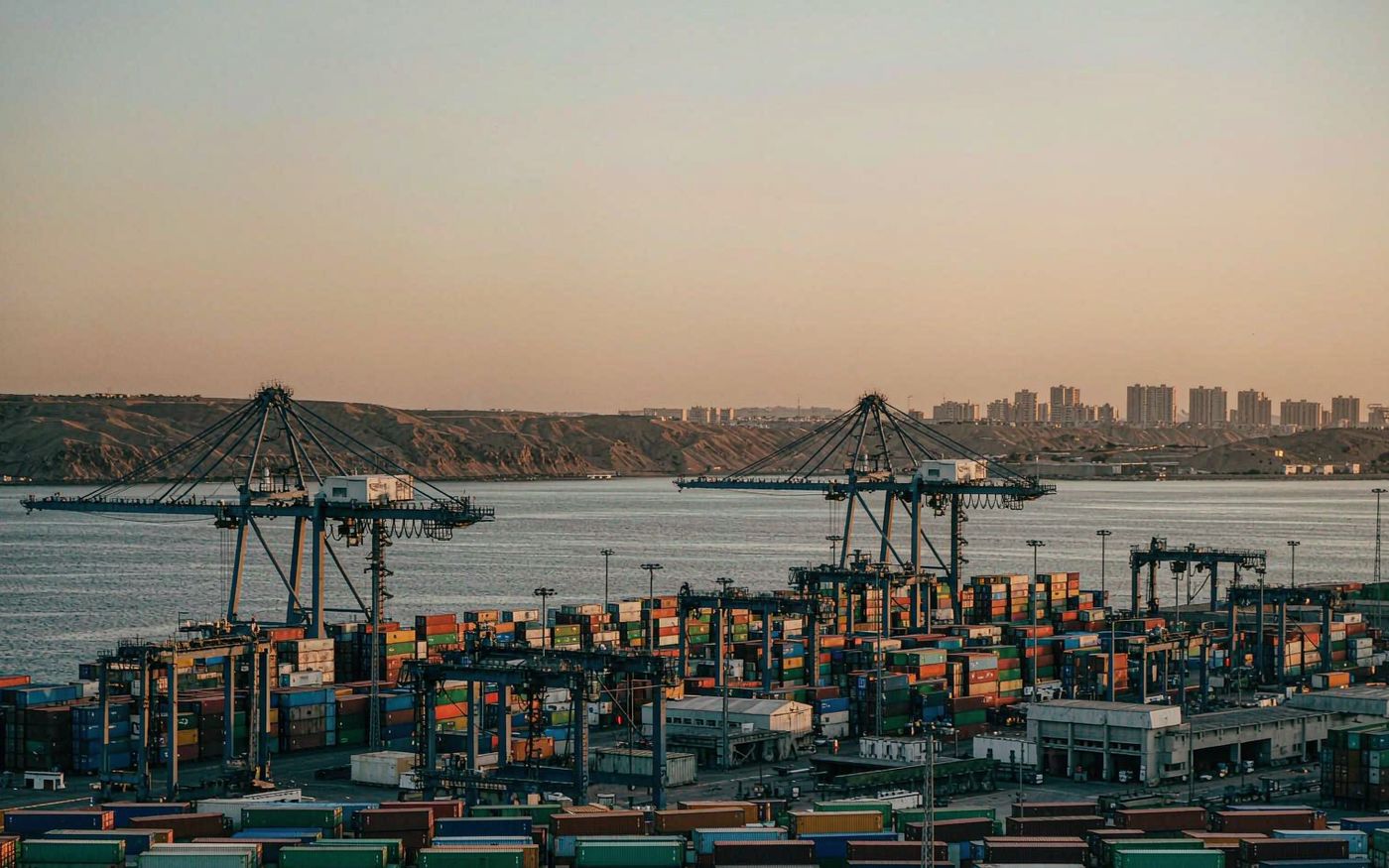
How to Ship from China to Yemen: Aden, Hodeidah & the Attested Invoice
What this guide is, and what it is not. Everything below is operational: documents, sequencing, ports and paperwork. It is not legal advice and not a compliance clearance. Yemen has been affected by conflict since 2014, its administration is split between different authorities, and it is subject to United Nations, United States and European Union sanctions regimes that change over time. Before you contract, take your own advice on sanctions and export controls. This page describes how the freight and documentation side works.
The first decision on a Yemen shipment is not the carrier, it is the port — because the port decides which customs administration you will be dealing with. Published guidance describes the country as divided, with Aden in the south operating under the internationally recognised government and Hodeidah on the Red Sea operating under a different authority, and customs practice, fee collection and even the chamber of commerce that issues your certificate of origin differ accordingly. A buyer who books "to Yemen" without naming and agreeing the discharge port has left the most consequential variable in the hands of whoever happens to be holding the container.
The second thing to internalise is that the commercial invoice has to be attested before it gets there. Trade guidance specific to this lane describes the invoice as needing attestation by a chamber of commerce and certification by a Yemeni diplomatic mission, and calls it the requirement that most often catches first-time importers out. That work has to happen in China, while the goods are still in China. There is no version of it that you can do cheaply at the discharge port.
The third is that declaring a lower value to save duty is the most expensive shortcut available to you here. Customs compares declared values against reference pricing databases, and the published consequences run to a fine of up to one hundred percent of the under-declared amount, seizure of the cargo, and blacklisting of the importer. On a lane where clearance already runs long, a valuation dispute is not a rounding error.
At a glance
Country: at the southern end of the Arabian Peninsula on the Red Sea, the Gulf of Aden and the Arabian Sea, bordered by Saudi Arabia and Oman; capital Sanaa, main southern port city Aden. · Currency: the Yemeni rial. · Duty: assessed on CIF value at the HS code rate; published references put typical ranges at roughly 0–10 percent for machinery, 5–15 percent for electronics and 5–25 percent for apparel and footwear. · Additional tax: around 5 percent of CIF value, with collection reported as inconsistent between zones. · De minimis: sometimes quoted near USD 50, not meaningful for commercial imports. · FTA: Greater Arab Free Trade Area, claimed with a certificate of origin in Arab League format. · Customs: the Yemen Customs Authority, operating differently by zone. · Ports: Aden, Hodeidah and Mukalla. · Air: commercial service is severely limited; most cargo moves by sea, often via a regional transhipment hub.
How your cargo moves: China to Yemen
Eight steps from your supplier's door to yours. The last four are the ones shaped by local rules.
- Pickup from your supplierWe collect the goods anywhere in China and bring them to our consolidation point.
- Export clearanceChina customs declaration filed and released before the goods move to the port.
- Loading and departureContainer loaded, sealed and handed to the carrier at the Chinese port.
- Main carriageOcean, air or rail movement booked on the route agreed for your cargo.
- Arrival at the gatewayDischarge at the port or airport of entry, recorded on the carrier's manifest.
- Import clearanceCustoms declaration filed locally, with duty and tax assessed on the declared value.
- Customs releaseGoods released into free circulation once duty and tax are settled.
- Final deliveryOnward movement to your delivery address, warehouse or nominated depot.
Duty rates, VAT rates and clearance times move, and the figure that applies to your goods is the one set for your commodity code on the day of clearance. We check the current position against your code before your goods sail and confirm it to you in writing — ask for that check when you request a quote.
Start with the port, because Yemen is not one customs regime
Most country guides tell you to pick a port on cost and transit time. On this lane the port decision carries a second, heavier meaning: it determines which authority assesses your goods, which chamber's paperwork is recognised, how consistently the additional five percent tax is collected, and how predictable your clearance timeline is. Aden is generally described as the most secure and consistently operational port. Mukalla operates with more limited capacity. Hodeidah handles a large share of food imports and sits under separate monitoring arrangements.
The practical consequence for a buyer in China is simple and uncomfortable. Before you accept an order, get the discharge port in writing from your consignee, along with the name of the customs broker who will file. If the buyer and the broker disagree about which port the cargo should land at, treat that as a reason to slow down rather than a detail to resolve later. Cargo that arrives at the wrong port on this lane does not simply get trucked across.
Set the port and the broker before the proforma invoice is signed. Everything downstream — the chamber that attests the invoice, the format of the certificate of origin, the currency of the fee schedule — inherits that one decision.
Reaching Aden, Hodeidah and Mukalla
There is no meaningful overland option from China, and no reliable commercial air freight lane into the country for general cargo. Published guidance notes that Sanaa airport has been closed to commercial traffic, that major couriers do not serve the country normally, and that DHL operates at best limited service via Aden or Djibouti. In practice your choices are sea freight to Aden or Mukalla, sea freight to Hodeidah where the consignee operates in that zone, or a regional transhipment through Djibouti or Jebel Ali followed by a short-sea or overland leg.
Routing has been materially affected by attacks on commercial vessels in the Red Sea, which is why several published lane guides describe longer transit times and routings that avoid the Red Sea and the Suez Canal entirely. That change has two knock-on effects worth pricing in. First, transit time is longer and less predictable, so any production slot you commit to should assume the slower routing. Second, a longer voyage in humid coastal conditions is genuinely hard on cargo: guidance for construction materials on this lane specifically recommends full wooden crating rather than palletising, with reported breakage rates falling from around five percent to under one percent when crating is used.
Which mode fits which cargo
| Mode | When it fits | What to watch |
|---|---|---|
| FCL to Aden | Building materials, machinery, full-container retail stock | Cratering and moisture protection; the extra handling at transhipment hubs is real |
| FCL to Hodeidah | Food staples and consignees operating in that zone | Separate monitoring arrangements and a different clearance practice |
| LCL | Smaller consignments where you can accept a longer dwell | Demurrage exposure if the file is not complete on arrival |
| Short-sea or road via Djibouti | Where the consignee prefers to clear at a neighbouring port | Adds a border and a second handling to a file that is already document-heavy |
The commercial invoice has to be attested before it reaches Yemen
This is the step that turns a routine shipment into a delayed one when it is missed. Published guidance for this lane describes the commercial invoice as requiring attestation by a chamber of commerce and certification by a Yemeni diplomatic mission — a two-stage chain that has to be completed in China. It is not a formality you can backfill: consignees and brokers on this lane describe retroactive handling at the port as slow and expensive, and in the worst case the goods sit in the terminal while it is sorted out.
Sequence it against your production calendar, not against your booking. The attestation chain needs the final commercial invoice, which means the invoice must be final before you start it. If your supplier is still adjusting quantities or values after packing, you will be chasing an amended document through a chain that has already started.
What you need in China
- Final commercial invoice, with the real transaction value
- Chamber of commerce attestation
- Certification by the Yemeni diplomatic mission
- Certificate of origin in Arab League format where GAFTA is claimed
- Arabic translations of key documents, where customs asks
What it costs if you skip it
- Container held at the terminal while the file is corrected
- Demurrage accruing against a clearance already running long
- Retroactive handling at the port, which is the expensive version
- A consignee who learns the hard way not to order again
What duty and the 5 percent tax add up to
Customs duty into Yemen is assessed on the CIF value at the tariff rate for the HS code. An additional tax of roughly 5 percent of CIF value is levied alongside it, though published sources are consistent in noting that collection is inconsistent — different rates and different practice are reported in different zones, and that inconsistency is itself a planning problem. You cannot budget precisely from a published table; you can only budget a range and then confirm it with the broker who will actually file.
| HS chapter | Product category | Typical duty range reported |
|---|---|---|
| 84 | Machinery and mechanical equipment | 0–10% |
| 85 | Electronics and electrical goods | 5–15% |
| 94 | Furniture and bedding | 10–20% |
| 61–62 | Apparel and clothing | 5–25% |
| 68–70 | Stone, ceramics and glass | 5–15% |
| 72–73 | Iron and steel products | 5–15% |
| 39 | Plastics and articles | 5–10% |
Ranges reflect published references for this lane and are a planning guide, not an assessment. The rate that applies is the one for your HS code, applied by the office that clears your goods. Where a product qualifies under GAFTA and the certificate matches the declaration, duty can be reduced or removed entirely.
Documents the declaration is built on
Treat the declaration as a file rather than a form. Everything in it has to agree with everything else on description, quantity and value, and the file has to be complete on arrival rather than assembled afterwards.
- Original bill of lading or telex release — confirm which your consignee's bank and broker expect.
- Attested commercial invoice — chamber attestation plus Yemeni diplomatic mission certification, completed in China.
- Packing list — with shipping marks, piece counts, and gross and net weights.
- Certificate of origin — Arab League format where GAFTA preferential duty is claimed.
- Insurance policy copy.
- Import licence — for regulated categories including pharmaceuticals, chemicals and food products.
- Arabic translations of key documents, which customs may request.
- Product-specific certificates — health certificate for food, ISPM 15 fumigation certificate for wooden packaging, YSMO conformity for electronics, MSDS for chemicals.
Product rules and the YSMO mark
Electronics and electrical goods are described as needing the YSMO conformity mark, and the consistent practical advice is to complete testing and certification in China before the goods ship. Retroactive certification at the port of entry is the expensive path. Arabic labelling on products and packaging, including user instructions, is also required. Where your cargo includes lithium batteries, an MSDS and a UN38.3 test report are needed and the batteries must be declared as dangerous goods for ocean freight.
For construction materials — tiles, sanitary ware, glass, aluminium profiles, steel — certain building materials require mandatory YSMO certification, and the guidance is to send samples for testing before the mass shipment rather than after. For food, a CIQ health certificate applies. For anything with solid wood packaging, the ISPM 15 heat treatment or fumigation and the IPPC stamp are not optional; non-compliant packaging is rejected at destination.
Seven steps from discharge to release
Vessel arrival and discharge
The container is unloaded at Aden, Hodeidah or Mukalla. Published guidance puts this at one to two days.
Customs broker engaged
Your forwarder's local agent starts the clearance. This is the party whose competence determines the timeline, so name them before the vessel sails.
Delivery order retrieved
The broker obtains the release authorisation from the shipping line against the original bill of lading or telex release.
Customs value declared
The declaration is submitted with the duty and tax calculation. This is where declared value is tested against reference pricing.
Inspection and assessment
Customs reviews the documents and may physically inspect. Published guidance reports inspection on roughly five to ten percent of shipments.
Duty, tax and port charges paid
Duties, the additional tax and port charges are settled, in the currency and at the schedule the local office requires.
Release and exit
The container is scanned, released and loaded for inland transport. Inland road conditions are a genuine packaging consideration.
Three Yemen consignments and where each one stalled
A container of ceramic tiles from Foshan. The cargo itself was never the problem; the packing was. Palletised rather than crated, it arrived with breakage after extra handling at a transhipment hub and rough inland roads. The fix was unglamorous: full wooden crating, which took the breakage rate from around five percent to under one percent on the repeat order.
A mixed container of LED lighting and solar accessories. The delay was certification. The goods needed the YSMO conformity mark and Arabic labelling, and the attempt to sort it at the port cost more than doing it in China would have. On the second shipment the testing was finished during production and the file cleared without incident.
A part-container of food products. Here the choke point was the import licence and the health certificate, both of which needed to exist before arrival. Everything else — the booking, the sea leg, the delivery order — went to plan, and the container still waited, because a food consignment without its licence is a storage bill, not a clearance.
Red Sea risk, transit time and what it does to your planning
Shipping to this coast has to be planned on the assumption that the routing may be longer than the published average. Attacks on commercial vessels in the Red Sea have pushed carriers onto routings that avoid the area, which lengthens the voyage and adds a transhipment in many cases. Two consequences follow for a buyer in China.
First, quote your customer a range, not a date, and make the range generous enough that a rerouting does not turn into a broken promise. Second, price the packaging for the longer voyage. The combination of extended transit, coastal humidity and several handling stages is what turns palletised tiles into broken tiles, and it is the reason the lane-specific advice on this route keeps coming back to crating and moisture-proof wrapping.
Mistakes that cost the most on this lane
- Under-declaring value. Reference pricing databases are actively used; penalties run to a fine of up to one hundred percent of the under-declared amount, seizure, and importer blacklisting.
- Leaving the invoice attestation until after sailing. The chain runs through a chamber and a diplomatic mission in China. It cannot be done at the port cheaply.
- Naming "Yemen" instead of a port. The port determines the customs administration, the recognised chamber, and how the additional tax is collected.
- Treating certification as a customs task. YSMO conformity and Arabic labelling are production-stage work.
- Assuming a published transit time. Confirm the current rotation and routing at the time of booking.
- Shipping food or pharmaceuticals without the licence in hand. The licence is a precondition, not a formality.
Why importers use Goodhope on this lane
Six things that are different about working with us on China to Yemen shipments.
Have the invoice attested in China, not at the port
Tell us what you are shipping, the HS codes if you have them, the packed dimensions and gross weight, the pickup city in China and the agreed discharge port in Yemen. We will start the chamber attestation and diplomatic certification while the goods are still in China, prepare the certificate of origin in the format your consignee's broker expects, flag any product that looks like it needs YSMO conformity or an import licence, and confirm the current routing and rotation at the time of booking rather than quoting you a published average. Where a product needs a permit, we will say so before you order.
Get a quote Talk to usRelated pages
Frequently asked questions
Does the invoice really need to be attested?
Published guidance for this lane describes chamber attestation plus certification by a Yemeni diplomatic mission, both completed in China. Confirm the current requirement with your consignee's broker before production finishes.
Which port should I ship to?
Aden is generally the most secure and consistently operational; Mukalla has more limited capacity; Hodeidah handles much of the food traffic under separate arrangements. Agree the port in writing before you book.
How much duty and tax will I pay?
Duty on CIF value at the HS code rate, plus an additional tax of around five percent of CIF. Published ranges run roughly 0–10 percent for machinery and 5–25 percent for apparel. Treat them as a planning range.
Can GAFTA reduce my duty?
Where the product qualifies and an Arab League format certificate of origin matches the declaration, duty can be reduced or removed. Ask which chamber your broker expects before the certificate is issued.
What happens if I under-declare?
Declared values are checked against reference pricing databases. Published penalties include a fine of up to one hundred percent of the under-declared amount, seizure and importer blacklisting.
Do electronics need certification?
Yes — the YSMO conformity mark, plus Arabic labelling and instructions. Complete it in China during production; retroactive certification at the port is the expensive path.
How long does clearance take?
Roughly five to seven business days under favourable conditions, and published guidance advises planning for seven to thirty days or more depending on zone, commodity and file completeness.
What documents are required?
Attested commercial invoice, packing list with marks and weights, bill of lading or telex release, Arab League format certificate of origin where GAFTA is claimed, insurance copy, import licence for regulated goods, Arabic translations where asked, and product certificates.
Is there a duty-free threshold?
Some references quote around fifty US dollars. It is not meaningful for a commercial import — plan on duty and the additional tax being assessed.
What is prohibited or restricted?
Narcotics, explosives, weapons, counterfeit goods and currency are prohibited. Medicines, food, plants and seeds, lithium-battery electronics and some cosmetics need permits. Alcohol is prohibited under Islamic law.