
Trade Fair Guide
The Canton Fair Complex stands at 382 Yuejiang Middle Road, Haizhu District, Guangzhou, Guangdong, China, on Pazhou Island. What follows follows an overseas buyer's own sequence — from booking a flight to walking onto a booth: the country, province and city, where the four zones sit, the roads around them, the metro and buses, the nearest airport, and how train and plane compare from Beijing, Shanghai Pudong and Hong Kong.
Contents
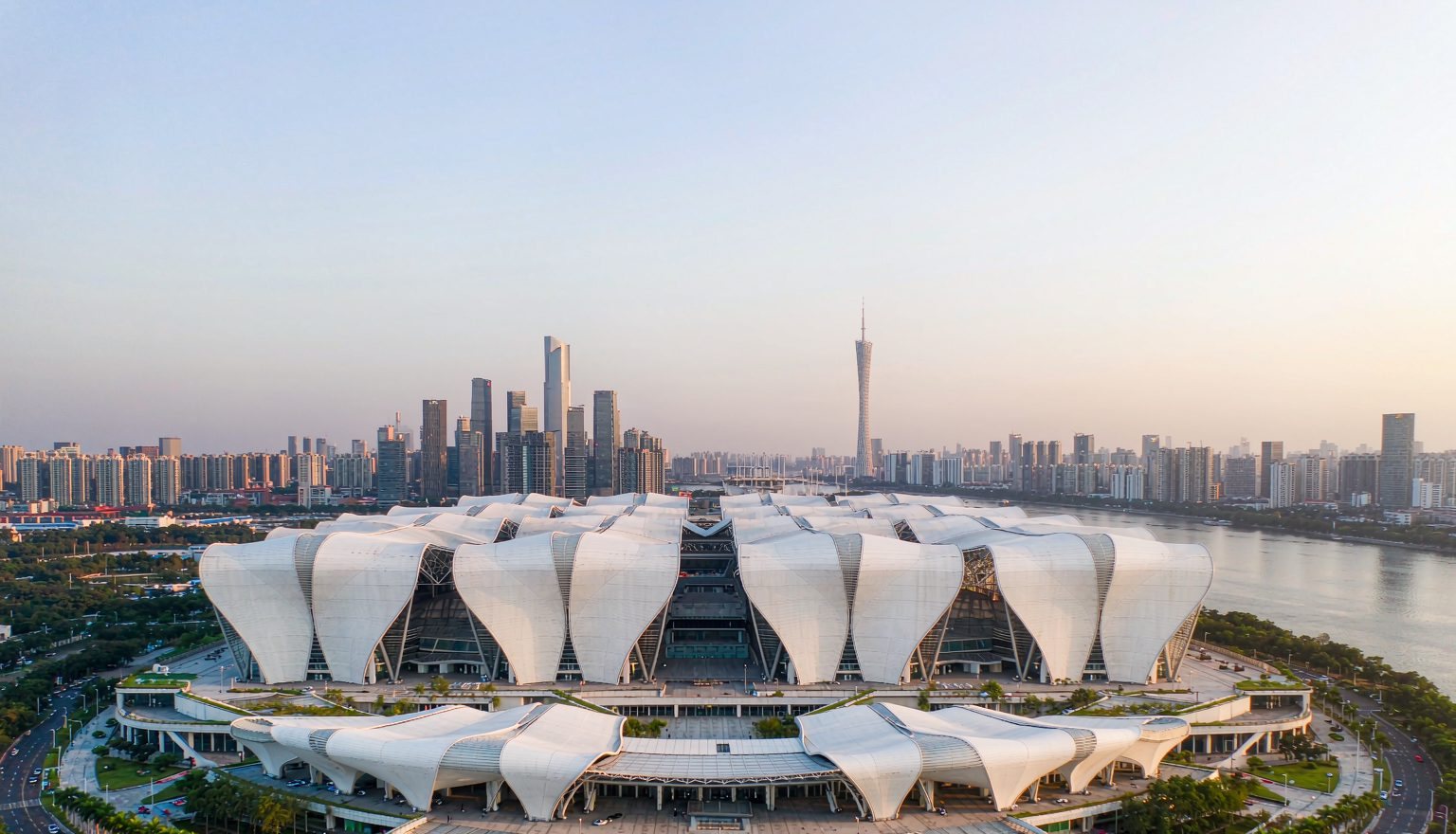
Pazhou is an island in the Pearl River inside the Guangzhou urban area. The complex occupies its northern riverside strip, facing Canton Tower and the Zhujiang New Town skyline across the water. The island is small — ten-odd minutes by car from its western tip to its eastern end — so for an exhibitor or buyer, Pazhou itself is an area you can cover entirely on foot and by metro.
Set the position on a larger scale: Guangzhou is China's southern gateway city and one of the core cities of the Greater Bay Area, about 100 km from Shenzhen and about 130 km from Hong Kong, China. Buyers flying in from outside China overwhelmingly land first at Guangzhou Baiyun International Airport; some choose to fly into Hong Kong, Shanghai or Beijing and come on by high-speed rail.
The time difference matters when you are fixing meetings. Guangzhou is 7 to 8 hours ahead of London, 6 to 7 hours ahead of Paris, Frankfurt and Amsterdam, 4 hours ahead of Dubai, 12 to 13 hours ahead of New York, 15 to 16 hours ahead of Los Angeles and 11 hours ahead of São Paulo. There is no time difference with Singapore, Kuala Lumpur or Hong Kong, China; Guangzhou is 1 hour behind Tokyo and Seoul and 2 to 3 hours behind Sydney. When you fix a booth meeting with a supplier, fix it in Beijing time and say so in the email.
For emails, courier labels and customs paperwork, “382 Yuejiang Middle Road, Haizhu District, Guangzhou, Guangdong, China — Canton Fair Complex (Pazhou)” is the standard form. If you are sending samples to a booth, always add the zone (A / B / C / D) and the booth number in the recipient line; the complex is too large for a delivery to find you otherwise.
The Pazhou Canton Fair Complex is not one building but a group of halls laid out along the river, made up of Zones A, B, C and D, plus the Canton Fair Hall and Canton Fair Tower Blocks A (Westin Canton Fair) and B (Courtyard by Marriott Canton Fair). Its total floor area exceeds 1.62 million m², making it the largest exhibition complex in the world.
Where the four zones sit decides which metro station you get off at:
| Zone | Rough position | Nearest station and exit |
|---|---|---|
| Zone A | West side of the complex, on Yuejiang Middle Road and the river | Metro Line 8, Xingang Dong station, Exit A |
| Zone B | East of Zone A, on the same riverside strip | Metro Line 8 / Line 11, Pazhou station, Exits A and B; Line 11 Exits E and F |
| Zone C | West of Pazhou station, around Huizhan South 3rd Road | Metro Line 8 / Line 11, Pazhou station, Exit C, then about 300 m west on foot |
| Zone D | North side of Xingang East Road, adjoining Zone A | Metro Line 8, Xingang Dong station, Exit A |
Zone allocation and exits follow the official complex map and on-site signage; they can be adjusted slightly from session to session.
Booth numbers are normally written as hall number, floor, row letter and stand number. For example 9.2A15 means hall 9, second floor, row A, stand 15. Once a supplier gives you the booth number, look the hall number up on the official complex map or app, then use the table above to work out which station to use — that alone saves the hour or two most first-time visitors spend walking back and forth inside the halls.
Watch the changeovers. Each session runs in three phases with changeover days between them, when the halls are closed to visitors, and different phases can occupy different zones. Before booking flights and hotels, confirm which phase your product categories fall into, then confirm which zone that phase uses.
The road network on Pazhou Island sorts into three layers: one east–west arterial, one riverside road, and a set of island side streets. Hold those three in mind and you will not loop around when driving or taking a taxi.
Driving or taking a car from Guangzhou Baiyun International Airport, the standard route is Airport Expressway → Huanan Expressway → leave at the Xinzhou toll gate → onto Xingang East Road → follow the zone signs into the appropriate car park. Coming from central Guangzhou, most drivers stay on Xingang East Road all the way in, or filter off earlier onto Yuejiang Middle Road.
Evening peak geofencing. During the fair, every day from 16:00 to 19:00, a geofence for taxis and ride-hailing cars is enforced around Xingang East Road and Yuejiang Road. Vehicles may not pick up or set down at the kerb and must use the designated points: Pazhou Avenue East; Huizhan South 2nd and 3rd Roads; Fengpu Middle Road; and the north plaza of the Canton Fair Hall. Check the day's pickup point in the app before leaving the halls; it is faster than waiting at the roadside.
| Zone | Spaces (approx.) | Charges, for reference |
|---|---|---|
| Zone A | 2,960 | Daytime, first 3 hours: about RMB 2.5 per half hour; beyond 3 hours: about RMB 5 per half hour; overnight: about RMB 1 per half hour; 24-hour cap about RMB 45 |
| Zone B | 1,640 | |
| Zone C | 800 | |
| Zone D | 1,909 |
Space counts and charges follow the notices posted at the complex. Parking is tight during the fair; the metro is the better choice.
For an overseas buyer, Guangzhou Metro Lines 8 and 11 are the most reliable way in and out of the fair: unaffected by road congestion, cheap, and frequent. During the fair the metro also extends operating hours and adds trains.
| Starting point | Route | Rough time |
|---|---|---|
| Guangzhou South (main high-speed rail station) | Line 2 → change at Changgang to Line 8 → Xingang Dong / Pazhou | About 40 min |
| Guangzhou East | Line 3 → change at Kecun to Line 8 → Xingang Dong / Pazhou | About 30 min |
| Guangzhou Railway Station | Line 2 → change at Changgang to Line 8 | About 45 min |
| Guangzhou Baiyun International Airport | Line 3 North Extension → change at Jiahewanggang to Line 2 → change at Changgang to Line 8 | About 1 h to 1 h 20 min |
| Zhujiang New Town / Canton Tower | Line 3 → change at Kecun to Line 8; or cross the river and enter the island on Line 8 | About 20 to 30 min |
Journey times are normal-day references and exclude waiting and walking. During the fair, queues are longer and you should allow more.
Guangzhou Metro runs roughly from 6:00 to 23:30 daily, with later last trains and extra services during the fair. You can ride by scanning an Alipay, WeChat or UnionPay metro QR code, or buy a physical Yangchengtong card. For a foreign visitor, a phone QR code is the least hassle.
Main bus routes serving the Pazhou area include 229, 239, 262, 304, 582, 763, B7 express and 303A. Stops include Canton Fair Complex, Yuejiang Middle Road, Pazhou, Convention Centre North and Convention Centre Pier. Buses suit a direct run from a city-centre hotel to the gate when you are not in a hurry; the fare is normally RMB 2.
The Haizhu tram runs along the Pearl River and doubles as sightseeing and feeder service. Three stops serve the complex directly: Huizhan West, closest to Zone D; Huizhan Centre, closest to Zones A and B; and Huizhan East, closest to Zone B. If there is still a stretch to cover after leaving the metro, one or two tram stops is easier than walking it.
In the morning peak from 8:00 to 9:30 during the fair, the queues outside Pazhou and Xingang Dong stations are at their worst. If you have a morning appointment, leave 30 minutes earlier than usual, or choose between Xingang Dong (Zones A and D) and Pazhou (Zones B and C) according to which zone you are heading for that day.
The nearest airport is Guangzhou Baiyun International Airport (code CAN), about 45 km from the Pazhou complex. Baiyun is one of China's three national all-round gateway hubs, with more than 100 international and regional destinations. In December 2025 annual passenger throughput passed 80 million for the first time, of which over 16.6 million were international passengers; Terminal 3 and the fifth runway are now in service.
These are the common non-stop international points. Schedules change with the season — check with the airline before booking:
If your city has no direct flight, connecting through Hong Kong, China; Dubai; Doha; Singapore; Seoul; Tokyo or Istanbul usually works best. Two things to confirm when connecting: whether your baggage can be checked through to Guangzhou, and, if you need to enter the country at the transit point, what the visa conditions are.
The Guangzhou Baiyun airport port operates the 240-hour (10-day) visa-free transit policy: eligible foreign nationals holding a connecting ticket to a third country can apply at the port for a 240-hour temporary entry permit, with the permitted area covering Guangdong and allowing travel across provincial borders. In the first year of the policy more than 22,000 foreigners applied for the permit at Baiyun, an increase of about 125 per cent over the earlier 72- and 144-hour arrangements. The list of eligible countries, the ports covered and the conditions are set by China's National Immigration Administration; check the current version once more before you fly.
Arrivals are concentrated during the fair, so immigration and customs queues can be long. Keep the complex address, your hotel booking, your return ticket and your invitation letter or buyer badge where you can reach them easily and present them in one go — clearance is faster.
Baiyun already covers most major cities, but if the flight times from your origin are poor, the fare is high, or you have business in Hong Kong, Shanghai or Beijing anyway, using one of those cities as your first entry point into China and continuing to Guangzhou is a well-established route. Here is how the two methods compare.
| Gateway and airport | Distance to Guangzhou | By air | By high-speed rail |
|---|---|---|---|
| Beijing Capital PEK Daxing PKX |
About 1,890 km in a straight line; about 2,298 km by rail | About 2 h 35 min to 3 h 10 min in the air; 6 to 7 hours door to door with check-in and transfers | Beijing West → Guangzhou South, fastest about 7 h 17 min, commonly 7 h 20 min to 8 h, some services over 10 h; second class about RMB 862 to 1,033 |
| Shanghai Pudong PVG Hongqiao SHA |
About 1,200 to 1,310 km by air route; about 1,790 km by rail | About 2 h 5 min to 2 h 40 min in the air; 5 to 6 hours door to door | Shanghai Hongqiao → Guangzhou South, fastest about 6 h 30 min, commonly 7 h 40 min to 8 h 30 min; second class about RMB 793 to 949 |
| Hong Kong, China Hong Kong International HKG |
About 130 to 160 km | Very few direct flights between the two cities; generally not the first choice | West Kowloon → Guangzhou South, about 48 min to 1 h 10 min, second class about RMB 215; cross-border coach about 3 to 3.5 hours |
Flight times are airborne time and exclude check-in and airport transfers; rail times are running time and exclude transfers to and from the stations. Fares and schedules move with the date — check 12306 or the airline for the actual figure.
A simple rule for choosing: time first, fly; budget first and light on luggage, take the high-speed train. Guangzhou to Shanghai and Beijing by rail is 6 to 8 hours, with second class roughly in the RMB 800 to 1,000 band depending on the service. Flying is only 2 to 3 hours in the air, but once you add the airport runs at both ends and check-in, door to door it is not much faster than rail and usually costs more. From Hong Kong the picture inverts: just under 1 h 10 min by rail is close to unbeatable.
Hong Kong International has a denser international network than Guangzhou, and many second- and third-tier cities are genuinely faster via Hong Kong. Each of its three connections has a precondition:
How you get here varies a good deal by region. The only test that matters: if there is a direct flight to Baiyun, take it, because the complex is 45 km from the airport. When a direct flight does not make sense, look at Hong Kong, China or another hub.
London, Paris, Amsterdam, Frankfurt, Madrid, Moscow and Istanbul have direct flights to Guangzhou, about 10 to 13 hours. Cities without a direct service usually connect via Hong Kong, Dubai, Doha or Istanbul. Connecting through Beijing or Shanghai also works, but adds 6 to 8 hours by rail or another flight.
New York, Los Angeles, San Francisco, Toronto and Vancouver have direct flights, about 13 to 16 hours. Other cities normally connect via Los Angeles, New York, Seoul, Tokyo or Hong Kong. From the US west coast, entering via Hong Kong, China and taking the 48-minute high-speed train is also worth pricing.
Flights between Dubai, Doha, Riyadh and Guangzhou are dense, about 7 to 9 hours. Most African cities require a connection via Dubai, Doha, Nairobi or Hong Kong, and total journey time is often over 15 hours — build a day of buffer into the itinerary.
Singapore, Kuala Lumpur, Bangkok, Hanoi, Ho Chi Minh City, Jakarta and Manila are only 2 to 5 hours from Guangzhou, with the widest choice of flights; many visitors make it a day trip or stay two or three nights. Flying into Hong Kong, China first and taking the train in also works if you want to source there on the way.
Islamabad, Lahore, Dhaka, Kathmandu, Almaty, Tashkent and Bishkek have direct flights to Guangzhou or connections via Urumqi and Kunming. Some South Asian points are still being restored and increased, so check direct options first and fall back to Dubai, Bangkok or Hong Kong.
Sydney, Melbourne, Brisbane, Perth and Auckland have direct flights, about 9 to 12 hours. Guangzhou to Darwin is about 6 hours, among the shortest air routes to Australia. Cities without a direct service can connect via Hong Kong or Singapore.
There is currently no established direct route from South America to Guangzhou. The usual path connects through North America (Los Angeles, New York), Europe (Madrid, Paris) or the Middle East (Dubai, Doha), with total journey times above 25 hours. Allow at least two days in transit and keep the first two days of the fair as slack.
Seoul, Tokyo and Osaka are about 3 to 4 hours away with dense schedules, and Taipei, China (Taoyuan) also has direct flights. From Hong Kong, China and Macao, China the main options are high-speed rail, cross-border coaches and fast ferries; West Kowloon to Guangzhou South in about 48 minutes is the most efficient channel of the three.
Whichever region you start from, when buying a ticket prefer a direct or one-connection itinerary that lands at Baiyun (CAN). If a second connection is unavoidable, put the transit point in an Asian hub on the same time zone as Guangzhou — Hong Kong, Singapore, Seoul or Tokyo — rather than crossing half the world and then adding another long leg.
QWhich country, province and city is the Canton Fair in?
China — Guangdong Province, Guangzhou. The complex is on Pazhou in Haizhu District. The administrative hierarchy runs China → Guangdong → Guangzhou → Haizhu. Pazhou is an island in the Pearl River inside the urban area; the complex sits on its northern riverside strip, facing Canton Tower and Zhujiang New Town across the water.
QWhat is the exact address of the complex?
382 Yuejiang Middle Road, Haizhu District, Guangzhou, Guangdong, China. The complex comprises Zones A, B, C and D plus the Canton Fair Hall and Canton Fair Tower. When sending samples or arranging a collection, always add the zone and booth number to the address.
QWhich metro stations are closest?
Three. Xingang Dong on Line 8 (Exit A leads to Zones A and D); Pazhou on Lines 8 and 11 (Exits A and B lead to Zone B, Exit C is about 300 m west of Zone C, and Line 11 Exits E and F also lead to Zone B); and Wanshengwei on Line 4 (interchange with Line 8, used when approaching the island from the east). The metro runs roughly 6:00 to 23:30 daily, with extra trains and extended hours during the fair.
QWhich airport is closest, and how far is it?
Guangzhou Baiyun International (CAN), about 45 km from the complex. By metro about 1 h to 1 h 20 min, fare about RMB 8; by taxi or ride-hailing about 45 to 50 minutes, about RMB 150 to 200; there is also an official shuttle during the fair, boarded with a buyer badge. Baiyun has more than 100 international and regional destinations.
QFrom Beijing, how long by train and by plane?
By high-speed rail: about 2,298 km of track from Beijing West to Guangzhou South, fastest about 7 h 17 min, commonly 7 h 20 min to 8 h (some services over 10 h), second class about RMB 862 to 1,033; from Guangzhou South take Line 2 and change to Line 8, about 40 minutes to Pazhou. By air: about 2 h 35 min to 3 h 10 min in the air between Guangzhou and Beijing, and 6 to 7 hours door to door with check-in and airport transfers.
QHow long from Shanghai Pudong airport?
If you stay on a plane: about 2 h 5 min to 2 h 40 min in the air between Guangzhou and Shanghai, arriving at either Hongqiao or Pudong. If you switch to rail: Pudong airport to Hongqiao station is about 1 hour by maglev plus Line 2, about 75 to 80 minutes by the Airport Line 1 coach, or about 1 h 20 min by taxi; then Shanghai Hongqiao to Guangzhou South, fastest about 6 h 30 min, commonly 7 h 40 min to 8 h 30 min, about 1,790 km of track, second class about RMB 793 to 949.
QHow do I get to the fair from Hong Kong International Airport?
Three ways. High-speed rail is fastest: the Airport Express takes about 22 minutes to Kowloon, a ten-minute walk to West Kowloon station, which operates co-location; West Kowloon to Guangzhou South is about 48 min to 1 h 10 min, second class about RMB 215, and you should allow 2.5 to 3 hours in total including border formalities. Cross-border coach: about 3 to 3.5 hours. High-speed ferry: from SkyPier to Nansha or Pazhou, about 2 hours, for transit passengers not entering Hong Kong only.
QWhich bus routes and tram stops serve the complex?
Bus routes include 229, 239, 262, 304, 582, 763, B7 express and 303A, stopping at Canton Fair Complex, Yuejiang Middle Road, Pazhou, Convention Centre North and Convention Centre Pier. The Haizhu tram runs along the Pearl River, with Huizhan West near Zone D, Huizhan Centre near Zones A and B, and Huizhan East near Zone B.
QWhat roads surround the complex, and how do I drive or take a taxi in?
The east–west arterial is Xingang East Road; the riverside road is Yuejiang Middle Road; on the island there are also Pazhou Avenue East, Huizhan South 2nd and 3rd Roads, Fengpu Middle Road, and Zhanchang Middle and West Roads. Coming from the airport or the city, the usual route is the Airport Expressway to the Huanan Expressway, leaving at the Xinzhou toll gate onto Xingang East Road. During the fair a geofence operates daily from 16:00 to 19:00 around Xingang East Road and Yuejiang Road, and cars must use the designated points: Pazhou Avenue East, Huizhan South 2nd and 3rd Roads, Fengpu Middle Road and the north plaza of the Canton Fair Hall.
QIs there parking, and what does it cost?
Yes. About 2,960 spaces in Zone A, 1,640 in Zone B, 800 in Zone C and 1,909 in Zone D. Daytime parking is about RMB 2.5 per half hour for the first 3 hours, about RMB 5 per half hour beyond that, about RMB 1 per half hour overnight, with a 24-hour cap of about RMB 45. Space is tight during the fair, so the metro is the better choice.
Whether you are shipping samples collected at the complex or a first container ordered after the show, ocean FCL and LCL, air freight, express, consolidation and customs clearance can all be arranged from Guangzhou or Shenzhen.
Email sales007@goodhopefreight.com | WhatsApp & phone +86 189 3869 1638