
Trade Fair Guide
A trade fair that has run for nearly seventy years without a single break. Where it came from, the four times it moved site, who runs it, what kind of fair it is, how the phases and product categories are organised, what buyers actually get out of it, and how it stacks up against online platforms such as Alibaba.com — taken one at a time.
Contents
The full name of the Canton Fair is the China Import and Export Fair. It is co-sponsored by the Ministry of Commerce of the People's Republic of China and the People's Government of Guangdong Province, organised by the China Foreign Trade Centre, and was founded in the spring of 1957. It is held in Guangzhou twice a year, in spring and autumn.
It is not a consumer show and not a regional fair, but a national-level, comprehensive, professionally organised trade fair with exports as its main body and imports included. The official description runs: China's longest-running, largest, most complete in product range and best-attended comprehensive international trade event, drawing buyers from the widest spread of countries with the strongest transaction results and reputation. It has long been called China's No. 1 Exhibition, and also the barometer and weather vane of Chinese foreign trade.
That character settles three practical points. First, you need buyer status to get in — overseas buyers apply for a buyer badge free of charge against a valid passport or other overseas identity document. Second, you come here to negotiate business, not to shop — samples on a booth exist for discussion and orders, and are normally not sold retail. Third, most of the people you meet are the factory or the export house itself rather than layers of intermediaries — which is one of the fair's core values.
The Canton Fair was not a commercial venture responding to a market. It was a strategic choice made by the state under very specific historical pressure.
In the early years of the People's Republic, a group of Western countries led by the United States imposed an economic blockade and cargo embargo on China. Foreign trade was squeezed into a very narrow space, largely barter-style accounting with the Soviet Union and other socialist countries.
At the same time the First Five-Year Plan had just begun, and industrialisation needed enormous quantities of material — rubber, fertiliser, steel, machinery, even asphalt had to be imported. The foreign exchange to pay for it was almost impossible to obtain because of the blockade. The country urgently needed a channel to the international market.
The opening came through Guangzhou. Between 1955 and 1956 the city held three export commodities exchange exhibitions, and they worked unexpectedly well. Yan Yijun, then the Ministry of Foreign Trade's commissioner in Guangzhou and concurrently head of the Guangdong Foreign Trade Bureau, saw a larger possibility: if the small fairs worked, why not hold a big one? Bring the foreign trade companies of every sector and every province under one roof, invite foreign merchants to negotiate face to face and conclude deals on the spot, let the combined effect work, and earn more foreign exchange for the country.
“I thought at the time — if the small ones go well, why not hold a big one? Put the foreign trade companies of every trade and every province into one exhibition hall, invite foreign merchants to negotiate, conclude on the spot, let the whole thing work as one, and win more foreign exchange for the country's construction.”
— Yan Yijun, then commissioner of the Ministry of Foreign Trade in Guangzhou and head of the Guangdong Foreign Trade BureauOn November 10, 1956, a dress rehearsal for the real fair opened at the Sino-Soviet Friendship Building in Guangzhou: the China Export Commodities Exhibition. The China Council for the Promotion of International Trade invited foreign trade departments to form 13 trade delegations, and the exhibition ran across five halls covering industrial goods, textiles, food, arts and crafts, and native produce. More than 30,000 products were on display, from raw silk, satin, tea, soya beans, bristles and tung oil to Beijing cloisonné, Fujian lacquerware, Jiangxi porcelain and Shantou drawn-work lace, alongside metal-cutting machine tools and power machinery. The exhibition received close to 40,000 merchants, officials and overseas Chinese from more than 50 countries across five continents, drew some 950,000 visitors from provinces around the country, and closed export contracts worth USD 53.8 million.
That success led directly to the real thing. In March 1957 the Ministry of Foreign Trade approved holding an export commodities fair in Guangzhou, and the approval document made the method explicit: letting buyers inspect goods in person and negotiate face to face was particularly useful for selling new and small products.
On April 25, 1957, the 1st China Export Commodities Fair opened at the Sino-Soviet Friendship Building in Guangzhou. By today's standards the first session was modest: 9,600 m² of exhibition space, more than 10,000 export products, 1,223 buyers from 19 countries and regions, and USD 17.54 million in turnover, of which agricultural produce and handicrafts accounted for roughly 63 per cent.
Its significance went well beyond those numbers. The two sessions of that first year together concluded USD 86.86 million, about one fifth of the country's total foreign-exchange earnings for the year. Under the Western embargo, the Canton Fair opened a working channel between New China and the world economy, and became a window onto what the country was building.
The short Chinese name Guangjiaohui was settled in 1958, and it came from Zhou Enlai. Receiving officials from the Ministry of Foreign Trade, he observed that “China Export Commodities Fair” was too long a name; since it was held in Guangzhou, it might as well simply be shortened. The name has been in use ever since.
Over nearly seventy years the fair has moved four times and been held at five venues. Each move is a cross-section of how China's export volume grew and how the city's own frame pushed outwards.
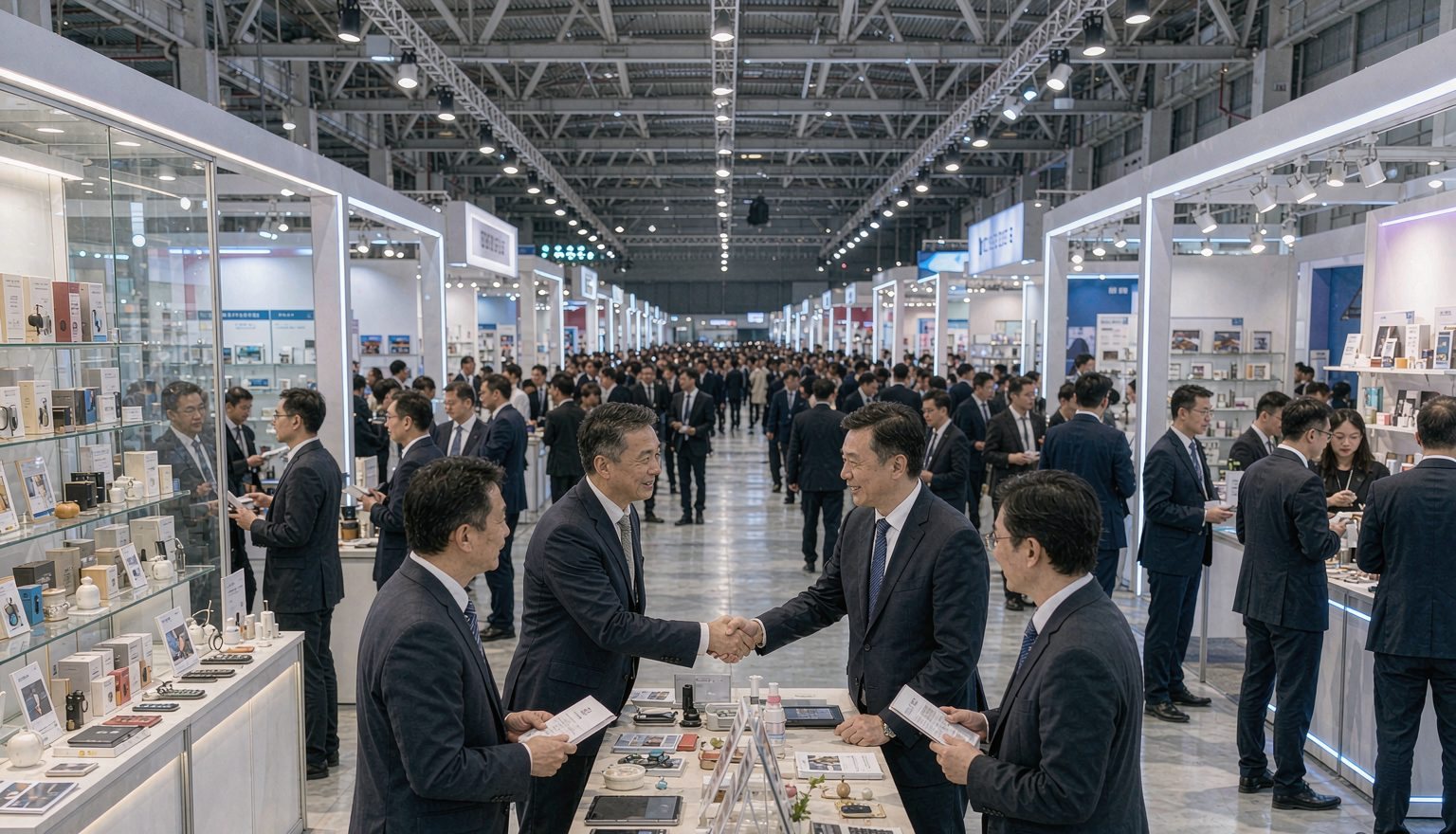
Sino-Soviet Friendship Building · Sessions 1–2
Completed at the end of July 1955, with 9,600 m² of exhibition space. Both the first and second sessions were held here. The building sits on a 97,854 m² site with 19,000 m² of floor area, and on completion was among the most imposing structures in Guangzhou.
Qiaoguang Road exhibition hall · Sessions 3–5 (first move)
Construction began on November 4, 1957 and finished on April 10, 1958 at 2 Qiaoguang Road: five storeys, a 3,600 m² site, 14,500 m² of floor area and 13,000 m² of usable exhibition space. The 3rd session opened here on April 15, 1958 — the fair's first relocation.
Qiyi Road exhibition hall · Sessions 6–34, twenty-nine in all (second move)
Built as one of the projects marking the tenth anniversary of the founding of the People's Republic: work started on November 1, 1958 and finished at the end of August 1959. The site covered 10,900 m², total floor area 40,200 m², usable exhibition space 34,500 m², with a ten-storey central block, designed by a team led by Lin Keming, who also designed landmark buildings such as the Sun Yat-sen Library. The 6th session opened here on November 1, 1959 and the fair stayed until the 34th in 1973. The Soviet-style building was listed as a registered protected heritage site by the city in 2008 and was later converted into Haiyin Binbin Plaza.
Liuhua Road complex · Sessions 35–103 (third move)
Construction began in October 1972 and the complex was completed in April 1974; the 35th session opened at 117 Liuhua Road on April 15, 1974. The nine characters across the main facade were written by Guo Moruo. The site covered 98,000 m² with 110,500 m² of floor area, later extended storey by storey to 170,000 m². The fair spent 34 years here. In the 1980s the complex, together with the neighbouring Dongfang and Liuhua hotels and the Friendship Theatre, was chosen as one of the “Eight Sights of Guangzhou”, known as “Liuhua Jade Mansions”.
Pazhou Canton Fair Complex · trial use from Session 94, full use from Session 104 (fourth move)
On Pazhou Island, on the south bank of the Pearl River. Guangzhou ran an international invited competition for the design in December 1999, construction started in April 2001, and the first phase was completed on December 28, 2002. The design concept was taken from the Pearl River's floating motion: the wave-like roofline makes the building look as though it drifted in off the water. In October 2003 the 94th session used part of the Pazhou halls for the first time; from the 95th in April 2004, Pazhou Zone A and the Liuhua Road complex ran simultaneously; and in September 2008 the 104th session moved to Pazhou in full — the fourth relocation.
Today's Pazhou complex is made up of Zones A, B, C and D, the Canton Fair Hall, and Canton Fair Tower Blocks A (Westin Canton Fair) and B (Courtyard by Marriott Canton Fair). Its total floor area exceeds 1.62 million m², making it the largest exhibition complex in the world. The 140th session has about 1.55 million m² of exhibition space, 13 product categories and 54 exhibition sections, more than 75,000 booths and over 30,000 exhibiting companies.
Two sessions a year becomes the pattern
After the 3rd and 4th sessions, holding the fair every spring and autumn became established practice. Even during the Cultural Revolution the fair was never suspended — an exhibition-industry anomaly for those years.
The country's main channel for export earnings
From 1965 the fair's annual export turnover accounted for more than 30 per cent of China's total annual exports; in 1972 and 1973 that share exceeded 50 per cent. The 32nd session in 1972 concluded USD 1.07 billion, the first time the fair broke the billion-dollar mark.
Reform and opening rewrite the logic of the fair
Reform broke the state monopoly on foreign trade. At the 44th session the sector notched up several firsts: production determined by sales as a trade policy, compensation trade, and processing with supplied materials. After that, manufacturing enterprises, private companies and foreign-invested firms were progressively allowed to exhibit.
Private firms take the stage, and the format is reformed
In 1999 the first private enterprises granted self-managed import and export rights appeared at the fair, and it opened their first door to foreign trade. In spring 2002 the 91st session reformed boldly into “one session, two phases”, re-sorting exhibits around international practice and how buyers actually purchase, which made the zone layout clearer and more rational.
WTO accession year: buyers pass 100,000
China joined the World Trade Organization, and in the same year the number of buyers at the fair broke 100,000. Buyer numbers and turnover went on setting records after that.
Renamed, and an import section opens for the first time
To promote trade balance the fair created an import section. At the 101st session the official name therefore changed from “China Export Commodities Fair” to the China Import and Export Fair — one extra word, and the character of the event shifted from selling only to trading in both directions. Brand zones followed.
The first attempts at digital operation
An online Canton Fair was tried for the first time in 2003, and the Canton Fair e-commerce company was set up in 2011. Those early experiments laid the ground for the fully online sessions during the pandemic.
From “two venues, two phases” to “one venue, three phases”
The 104th session moved to Pazhou in full: more than 1 million m² of exhibition space, more than 55,000 booths (13,000 more than the previous session) and 22,000-plus exhibitors. Split into three phases, product categories were refined from 5 to 15 and exhibition sections from 34 to 50. From this session onwards exhibitors passed 20,000 and booths passed 50,000, largely relieving the shortage of booth space.
Never interrupted under COVID-19: three sessions online in a row
When the pandemic broke in 2020, the State Council decided the 127th session would be held online. From June 15 to 24, 2020, the 127th session ran entirely online for the first time, over ten days, with 25,000 exhibitors presenting 1.8 million products and hundreds of thousands of buyers worldwide negotiating around the clock with millions of Chinese export staff. The 128th (October 2020) and 129th (April 2021) sessions also ran online. In 2021 the 130th session combined online and on-site for the first time, condensed from three phases into one five-day phase, and introduced the mascots — the bees Haobao and Haoni. The 131st session in 2022 continued online.
Full return on site, and the fourth-phase halls open
The 133rd session returned fully to physical exhibition and used the fourth-phase halls for the first time, expanding exhibition space to 1.5 million m².
The 140th session, coinciding with the fair's seventieth anniversary
The 140th session opened on October 15, 2026 in three phases. Founded in 1957, the fair reaches seventy here. To date 139 sessions have been held, trade relations have been established with 229 countries and regions, cumulative export turnover has passed USD 1.5 trillion, and more than 13 million overseas buyers have attended on site or online. The 139th session, just closed, drew 314,000 overseas buyers, a record, with on-site intended export turnover of USD 25.7 billion.
One detail that tends to be missed: since the 122nd session the fair has waived booth fees for exhibitors from designated low-income areas, relieving them of more than RMB 86.7 million in total, and has added a zone for specialty products from those areas, with 892 exhibitor participations admitted free of charge. Arrangements like these show that beyond its trade function the fair also carries a public role in industrial support and regional balance.
The structure has three layers — government sponsors, a professional organiser, and provincial and municipal trade delegations — which is what separates it from an ordinary commercial exhibition.
| Role | Body | Responsibility |
|---|---|---|
| Sponsor | Ministry of Commerce of the People's Republic of China | National-level sponsorship and policy coordination |
| Sponsor | People's Government of Guangdong Province | Provincial sponsorship and logistical support |
| Organiser | China Foreign Trade Centre | Overall operation, exhibitor and buyer recruitment, on-site management, venue operation and services |
| Exhibitor grouping | Provincial and municipal trade delegations | Organising local companies to exhibit, vetting eligibility, handling exhibition formalities |
| Assessment | Relevant import and export chambers of commerce | Reviewing brand booths and adjusting them year on year |
Badges, pre-registration and invitations are handled only through the official website and app, and the official channels are free for overseas buyers. Anyone claiming to guarantee entry for a fee through a third party should be treated as unreliable, and there is a real risk of personal data being misused.
The 140th session runs in three phases with two changeover periods in between. The phases are not simply the booths cut into three slices: product categories are regrouped, following how international buyers purchase, into three clear sourcing lines — industrial and electronic, home and gifts, consumer and textile.
| Phase | Dates | Theme | Main exhibits |
|---|---|---|---|
| Phase 1 | Oct 15 – 19, 2026 | Advanced Manufacturing | Home appliances; consumer electronics and IT products; industrial automation and smart manufacturing; processing machinery and equipment; power and electrical equipment; general machinery and mechanical parts; construction machinery; agricultural machinery; new materials and chemicals; new energy vehicles and smart mobility; vehicles; auto parts; motorcycles; bicycles; lighting products; electrical and electronic products; new energy; hardware; tools; service robots |
| Phase 2 | Oct 23 – 27, 2026 | Quality Home Living | Household ceramics; kitchenware and tableware; housewares; glass artware; home decorations; garden products; festival and holiday products; gifts and premiums; watches and eyewear; art ceramics; woven, rattan and iron artware; building and decorative materials; sanitary ware; furniture; fashion accessories; prefabricated houses and outdoor living |
| Phase 3 | Oct 31 – Nov 4, 2026 | Better Life | Toys; maternity, infant and child products; children's clothing; men's and women's clothing; underwear; sportswear and casual wear; fur, leather, down and products; garment accessories and parts; textile raw materials and fabrics; footwear; bags and luggage; home textiles; carpets and tapestries; office stationery; healthcare products and medical devices; food; sports, travel and leisure products; personal care items; bathroom products; pet products; specialty products from rural revitalisation areas; smart healthcare |
Changeovers: October 20–22 and October 28–30, 2026, when the halls are used for dismantling and rebuilding and are closed to visitors. Negotiation hours are 09:30–18:00 daily.
From the product side, the fair's exhibits are grouped into 13 categories, broken down into 54 exhibition sections, covering practically the whole range of labour-intensive and mid-to-high-end manufacturing exports:
The fair has two parts. The export exhibition is the main body, aimed at Chinese exporters selling into the world. The import exhibition, set up at the 101st session in 2007, is aimed at overseas companies wanting to enter the Chinese market. Inside the halls there are also special zones such as specialty products from rural revitalisation areas and service robots. In one visit a buyer can both look for suppliers and see what overseas competitors are trying to sell into China — and the second often tells you something about your own market that you did not know.
The 140th session runs at about 1.55 million m² of exhibition space, with more than 75,000 booths and over 30,000 exhibiting companies. Behind that volume, the exhibitor base itself divides into layers.
Booths in the export exhibition are either brand booths or general booths. Brand booths go through a dedicated assessment and adjustment process and generally belong to larger companies with their own brands; general booths are applied for online against the exhibit catalogue and are open to a wider field. For a buyer there is a practical use to the distinction: if your goal is a supplier who can run OEM/ODM work, hold the certifications and carry a long-term high-volume order, the brand zones are denser. If your goal is a price-competitive small or mid-sized factory and a trial order, the general zones give you far more to choose from.
Recent sessions have pushed “newer, greener, smarter”, and three strands show up clearly in the exhibits:
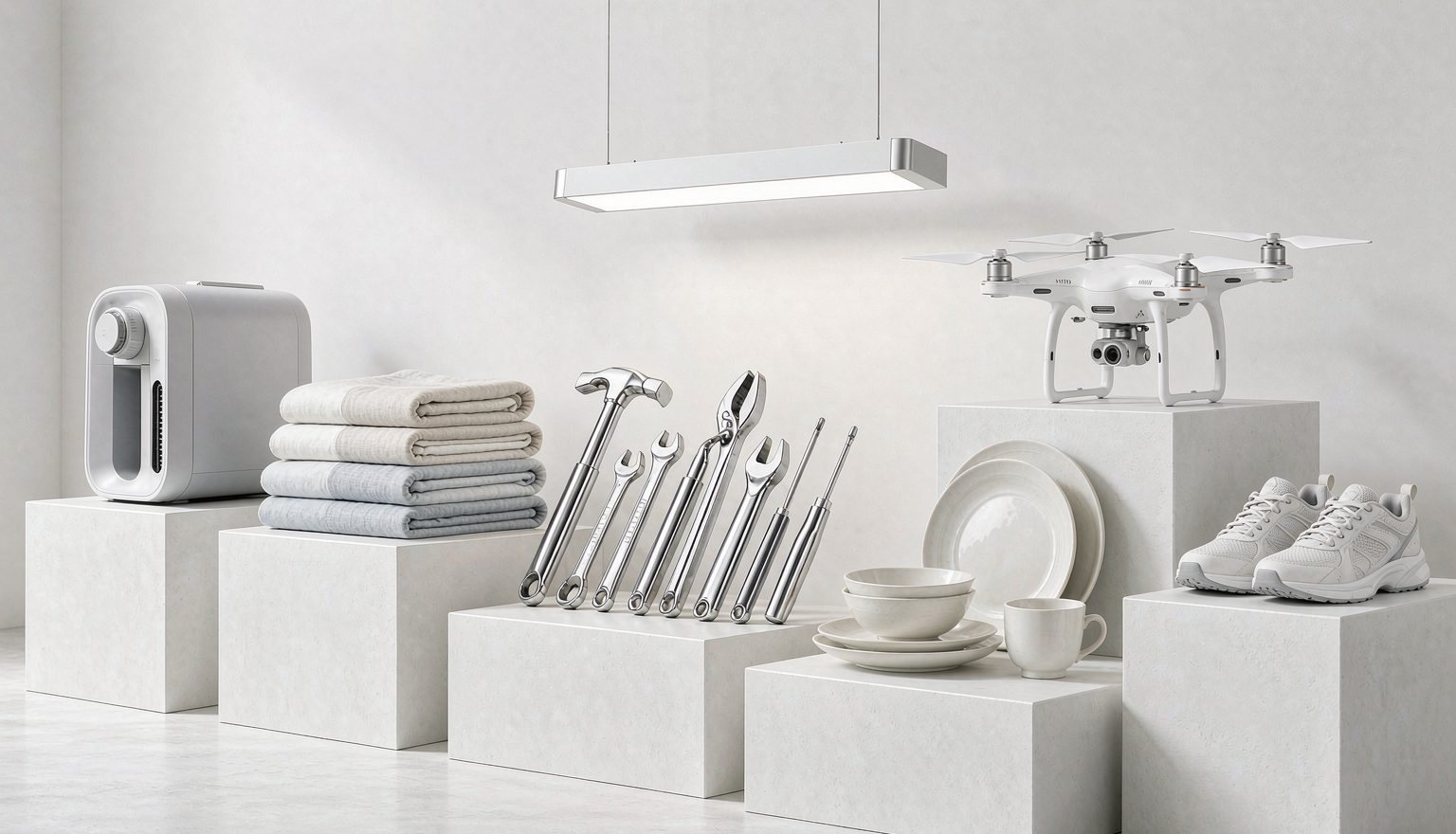
On-site services are not an afterthought at the fair; they are part of sourcing efficiency. The usual set includes financial services (bank branches and currency exchange), travel and accommodation services, customs services, intellectual property protection and trade dispute handling, design services (PDC), the CF Award for design innovation, services linked to the cross-border e-commerce comprehensive pilot zones, and information desks in each zone. The IP protection mechanism deserves particular mention: the fair has built a full chain of proactive screening before the show, fast handling during it and follow-up tracking afterwards, and it encourages exhibits not yet patented or trademarked in China to make their first public appearance here. For buyers and brand owners worried about designs being copied, that is a practical route to redress.
The target visitors are professional buyers: importers and wholesalers, retailers and chain procurement teams, brand owners and private-label operators, e-commerce and cross-border sellers including Amazon marketplace sellers, project and engineering buyers, regional agents and distributors, and start-up brands looking for a contract manufacturer or an OEM/ODM partner. Exhibitors, in turn, are mainly manufacturers from around China and specialist foreign trade companies.
Who it is not for: the fair sells no tickets to the public and its booths do not sell retail. If you simply want to buy one or two items in Guangzhou for your own use, this is the wrong place — you need buyer status to enter, and exhibitors will not break a sample pack to sell you a piece.
For a first visit: do not try to see it all. At 1.55 million m², three phases and 75,000 booths, covering everything is physically impossible. The workable method is to lock 20 to 30 target suppliers before you travel, sort them by booth number into a route that never doubles back, allow 20 to 30 minutes of real conversation at each, and leave the rest of the time for accidental discoveries.
The fair was born in the blockade years, and its first task was the plainest and most urgent one — earning foreign exchange through exports. The first two sessions together turned over USD 86.86 million, roughly a fifth of the country's total earnings that year; from 1965 the fair's annual export turnover long stood above 30 per cent of national exports, and in 1972 and 1973 above 50 per cent. In an era of scarce information and few channels, the Canton Fair was effectively China's only window on international trade.
After reform and opening up, its role changed fundamentally: from the main channel for earning foreign exchange to a public platform for companies entering international markets. China joined the WTO in 2001 and in the same year buyer numbers passed 100,000; in 2007 the import section opened and the fair was renamed, moving from one-way exports to two-way trade; and the online sessions from 2020 made it a testing ground for the digitalisation of the exhibition industry. Its official positioning today is as a major platform for China's all-round opening up, for high-quality development of international trade and for connecting the domestic and international circular economies.
For overseas buyers the fair offers a twice-yearly, predictable, plannable sourcing moment. In years when supply chains move constantly, that certainty is itself worth something: you know there is a window in April and another in October, and that within two weeks you can complete a whole year's product selection, price comparison and negotiation, instead of picking away online through the year.
The fair's most underrated value may lie in what it does for small and medium enterprises. In 1999 the first private companies to obtain self-managed trading rights took the stage here, and it opened their first door to foreign trade. Today a factory in the Pearl River Delta with no overseas sales team and no brand recognition can still stand behind one booth and meet buyers from 220 countries and regions. That structure — factory meeting buyer directly — is the fundamental difference between the Canton Fair and most commercial platforms.
The fair and the city built each other. From Haizhu Square to the Liuhua lakeside to the foot of the Pazhou Pagoda, the four relocations track the outward expansion of Guangzhou's urban frame and the eastward drift of its CBD almost exactly. To serve the construction and operation of the fair, the city built metro lines ahead of demand; Pazhou grew from a river island into an exhibition and headquarters district. The flows of visitors, hotel nights, restaurant covers, transport and business services generated twice a year form a dependable economic cycle for the city.

A question that comes up constantly: with Alibaba.com, Made-in-China and Global Sources available, why spend the money to fly to Guangzhou? And the reverse: with the Canton Fair, what use is an online platform?
Put the two on the same table and the answer is fairly clear — they solve different problems, and neither replaces the other.
| Dimension | Canton Fair (physical) | Online B2B platform (e.g. Alibaba.com) |
|---|---|---|
| How you engage | Face to face, with immediate follow-up questions | Inquiries, platform messaging, video calls |
| Time structure | Two sessions a year, three phases, 15 days in total — a concentrated window | 365 days a year, 24 hours a day |
| Category coverage | 13 categories, 54 exhibition sections, comparable side by side | Extremely broad, but requires searching one by one; comparability depends on platform tools |
| Supplier credibility | Eligibility screening, plus assessment and adjustment of brand booths; companies under penalty cannot exhibit | Lower barrier to listing; qualifications and authenticity must be verified by the buyer, with information asymmetry |
| Sample verification | Physical goods in front of you, hands-on, workmanship compared directly | Depends on photos, video, live streams and mailed samples — verification lags |
| Price transparency | Suppliers of one category concentrated together; comparison is fast | One seller, one price; a reference point requires inquiring with each |
| Speed of trust | Very fast: conversation, business card, and a factory visit can follow | Slower: built up through platform endorsement, transaction history and reviews |
| Cost per conversation | High: flights, hotels, visa, time | Low: almost zero marginal cost |
| Reach | Limited by itinerary and visa to what you can physically cover | Global; in theory thousands of suppliers at once |
| Best stage to use it | Large, long-term purchases needing physical verification and deep customisation | Fast screening, small trial orders, routine replenishment, ongoing contact |
| Typical path | See sample → negotiate → audit factory → order | Inquiry → quotation → sample → order |
Note: online platforms differ widely among themselves. The comparison above is a general one against mainstream comprehensive B2B platforms and is not an assessment of any particular platform.
One further difference that gets overlooked: information online is optimised, while information at the fair is compressed. A product page shows the side of the product the supplier wants you to see — chosen angles, retouched photographs, written selling points. In a hall you can walk past a dozen competing products in twenty minutes and, on the way, hear what other buyers are asking about and complaining about. That unedited density of information on the floor is something no online platform currently reproduces.
For a buyer the effective approach is not either-or but a chain that links the two. Four steps, in the order we would run them:
QWhat is the full name of the Canton Fair?
The China Import and Export Fair; the short international name is Canton Fair. Before the 101st session in 2007 the full name was “China Export Commodities Fair”, because the fair was export-only and had no import section; the import section was created at the same time as the renaming. The Chinese short form Guangjiaohui was settled in 1958 and came from Zhou Enlai.
QWhat kind of trade fair is it?
A government-sponsored, comprehensive international trade event built on exports and also covering imports — a textbook B2B professional trade fair: open only to professional buyers and exhibiting companies, no tickets to the public, no retail at the booths. Two sessions a year, spring and autumn, each in three phases. It is currently China's longest-running, largest, most complete in product range and best-attended comprehensive international trade fair, with buyers from the widest spread of countries.
QWho sponsors and organises it?
Sponsored jointly by the Ministry of Commerce of the People's Republic of China and the People's Government of Guangdong Province, and organised by the China Foreign Trade Centre. Provincial and municipal trade delegations organise local companies to exhibit, and the relevant import and export chambers of commerce take part in assessing brand booths. Official channels are the website www.cantonfair.org.cn and the Canton Fair app.
QWhy was it founded in 1957?
In the early years of the People's Republic, a group of Western countries led by the United States imposed an economic blockade and cargo embargo, so foreign trade was largely confined to barter accounting with the Soviet Union and the socialist countries, while industrialisation urgently needed foreign exchange to import rubber, fertiliser, steel and machinery. Three export commodities exchange exhibitions in Guangzhou in 1955–1956 worked well, and Yan Yijun, then the Ministry of Foreign Trade's commissioner in Guangzhou, proposed a nationwide export commodities fair. In November 1956 the China Export Commodities Exhibition opened at the Sino-Soviet Friendship Building as the forerunner. The Ministry of Foreign Trade approved the plan in March 1957, and on April 25, 1957 the 1st China Export Commodities Fair opened with 1,223 buyers from 19 countries and regions and USD 17.54 million in turnover.
QHow many times has the fair moved, and where?
Four relocations across five venues: the Sino-Soviet Friendship Building (sessions 1–2) → the Qiaoguang Road exhibition hall (sessions 3–5, first move in 1958) → the Qiyi Road exhibition hall (sessions 6–34, second move in 1959) → the Liuhua Road complex (sessions 35–103, third move in 1974) → the Pazhou Canton Fair Complex (trial use from the 94th in 2003, full move at the 104th in 2008, the fourth relocation).
QHow many phases are there now, and what does each show?
The 140th session runs in three phases. Phase 1, October 15–19, 2026 (advanced manufacturing: appliances, consumer electronics, industrial automation, processing machinery, construction machinery, vehicles and parts, lighting, hardware and tools, new energy, service robots). Phase 2, October 23–27 (quality home living: household ceramics, kitchenware, housewares, gifts and premiums, building materials, sanitary ware, furniture, fashion accessories). Phase 3, October 31–November 4 (better life: toys, maternity and baby products, clothing, footwear, bags, home textiles, office stationery, healthcare, food, sports and leisure, pet products). The halls are closed during changeovers.
QWhat kind of visitor is the fair suited to?
Importers, wholesalers, retailers, chain procurement teams, brand owners, e-commerce and cross-border sellers, project buyers, regional agents, and start-up brands looking for a contract manufacturer or OEM/ODM partner. It is not suited to an ordinary consumer who wants to buy one or two items — no tickets are sold to the public and the booths do not sell retail.
QHow is it fundamentally different from Alibaba.com and similar platforms?
The core difference is the method of verification and the time structure. The fair is a physical exhibition, twice a year, 15 days a session: you can cover 13 categories in one complex, handle the goods, compare prices across the aisle and meet the factory principal, so verification and trust-building are extremely fast — but itinerary and visa limit how many suppliers you can reach. Online B2B platforms are open around the clock, reach widely and cost little to use, which suits fast screening and small trial orders, but they are mostly image and text, supplier quality varies, and you have to judge for yourself. They are complementary: the physical fair handles verification and trust, the online platform handles breadth and efficiency.
QWhy is it called China's No. 1 Exhibition?
Because it was founded earliest (1957), has never been suspended, is the largest, has the most complete product range and draws buyers from the widest spread of countries. Since it began it has been held on schedule, including through the three years of hardship and the Cultural Revolution. From 1965 its annual export turnover long accounted for more than 30 per cent of China's total exports, and in 1972 and 1973 for more than 50 per cent.
QWas it cancelled during the pandemic?
No. The 127th session ran entirely online from June 15 to 24, 2020, over ten days, with 25,000 exhibitors presenting 1.8 million products; the 128th and 129th sessions also ran online; the 130th in 2021 combined online and on-site for the first time, condensed from three phases into one five-day phase; and the 133rd in 2023 returned fully on site, using the fourth-phase halls for the first time and expanding exhibition space to 1.5 million m².
QHow large is the complex?
The Pazhou Canton Fair Complex consists of Zones A, B, C and D, the Canton Fair Hall, and Canton Fair Tower Blocks A (Westin Canton Fair) and B (Courtyard by Marriott Canton Fair). Its total floor area exceeds 1.62 million m², making it the largest exhibition complex in the world. The 140th session has about 1.55 million m² of exhibition space, 13 categories and 54 exhibition sections, more than 75,000 booths and over 30,000 exhibiting companies.
QHow do I get samples I pick up at the fair back to my country?
Choose by volume. Small, non-sensitive samples travel with you as baggage or checked luggage; documents and light parcels go by international express such as DHL, FedEx, UPS or EMS; anything with real volume or weight that needs formal export declaration goes by air freight to the destination airport; bulky, heavy or high-volume cargo goes by LCL sea freight from one cubic metre up; and large, steady replenishment goes by FCL. The cheaper method is consolidation across suppliers: have samples from different factories delivered to one forwarder's warehouse in Guangzhou or Shenzhen, inspected and reinforced together, then packed into a single LCL shipment or container — one export, one set of documents, one consignee. Batteries, liquids, powders, magnetised goods and branded goods carry extra testing and documentation requirements.
Samples collected on the floor, trial orders placed after the show and the volume that follows all need an export chain that holds. Ocean FCL and LCL, air freight, express, consolidation from multiple suppliers, customs clearance and trucking can be arranged from Guangzhou or Shenzhen.
Email sales007@goodhopefreight.com | WhatsApp & phone +86 189 3869 1638