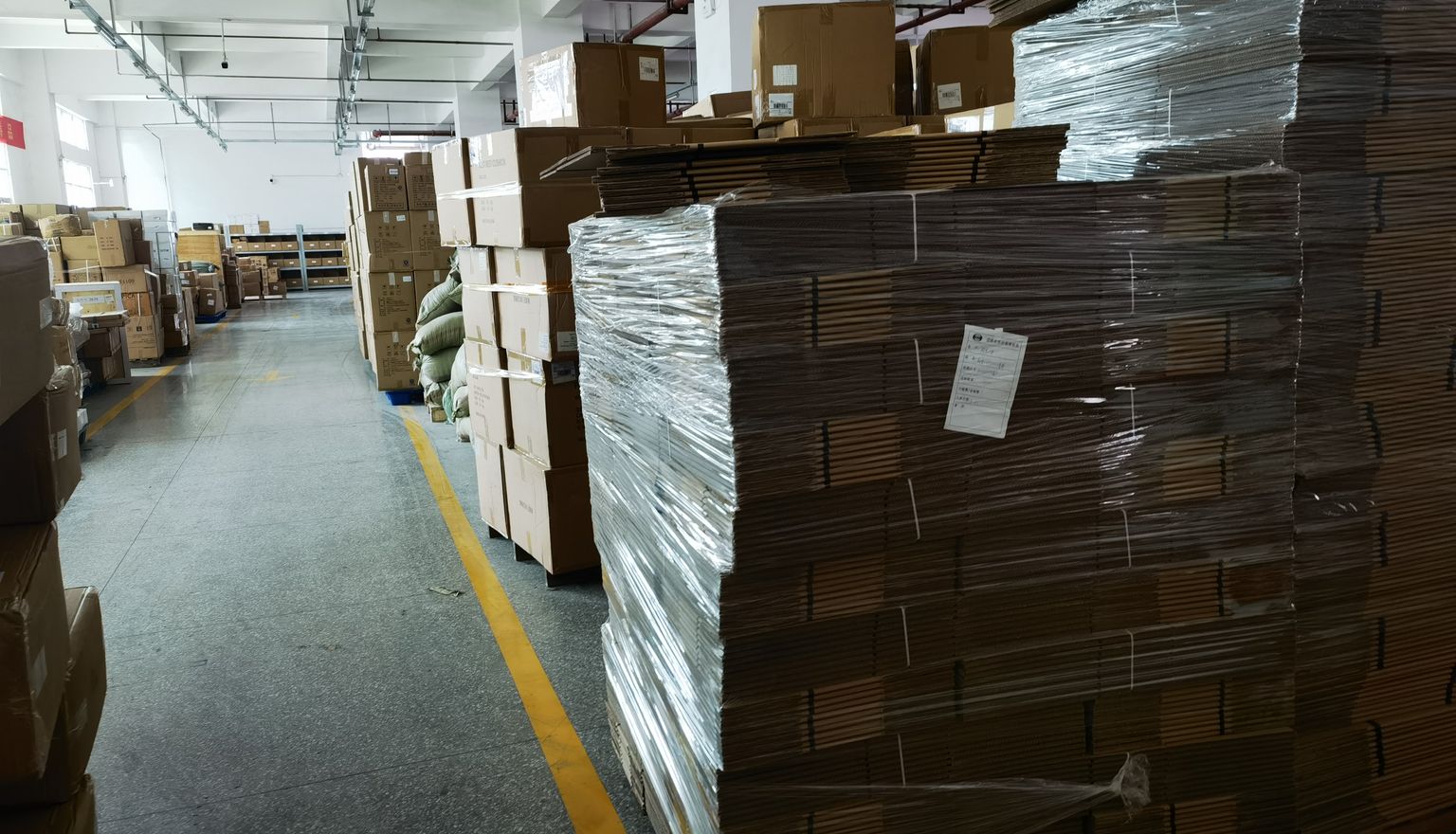
Mostly air, priced as cargo. A light fitting leaves the factory as volume: shade, diffuser and insert take more room than the product. This aisle is what the airline and the shipping line both charge for.
Three Products in One Box
A table lamp contains a luminaire, a control gear and a connection to the mains. In regulatory terms those are three objects with three different standards, and a supplier who quotes you one certificate for the whole assembly has either simplified the file or never built one.
The failure mode is consistent across the category. The fitting is well made, the finish is good, the price is right, and the driver inside is a component bought at the electronics market with a mark printed on it that does not correspond to a real approval. The lamp works. It also runs hot, flickers at low output, and fails in the second year, which is inside the warranty period in most markets and outside the supplier's interest.
Nothing about this is visible at a booth. It is visible in a folder, and the folder is worth more attention than the sample shelf, because the sample shelf is what the factory wants you to look at.
Voltage and Frequency Are Not the Same Problem
Two variables, and buyers often check only the first.
Voltage. A fitting designed for 220 to 240 volts run on 120 volts produces light, badly, or produces nothing. A fitting designed for 120 volts run on 230 volts fails immediately and sometimes loudly. Most LED drivers are wide-range, marked 100 to 240 volts, which handles the voltage question.
Frequency. 50 Hz against 60 Hz is the variable that gets missed. It matters for anything with a magnetic ballast, a synchronous motor, or a timer that counts mains cycles. It also matters for older fluorescent fixtures, which are still sold in volume in some markets. An LED driver with a switch-mode supply does not care; a clock inside a lamp does.
For a buyer shipping one SKU to several markets, the practical answer is a wide-range driver and a market-specific plug and label. That is a factory decision made at the design stage, and it is much cheaper to specify at the fair than to re-engineer after the first container.
The Plug Is a Moulded Part, Not an Accessory
Four plug families cover most of the trade, and the differences are not cosmetic.
Type A and B. North America and Japan, ungrounded and grounded, 120 volts. Type A is unpolarised in older installations, which is why some US fittings are built to accept either orientation.
Type C and F. Most of continental Europe, 230 volts. Type C is the two-round-pin plug; Type F adds the side earth clips and is what most European sockets actually are.
Type G. United Kingdom, Ireland, Singapore, Malaysia, Hong Kong. Fused, bulky, and required by law in the UK for domestic plugs.
Type I. Australia, New Zealand, China, Argentina. Two angled pins, often with an earth pin.
Two consequences follow. First, a moulded plug is part of the product for certification purposes: a lamp assessed with a Type C plug is not the same product as the same lamp with a Type G plug, and the file has to cover the version you are importing. Second, the fuse in a UK plug is a real component with a rating, and cheap assemblies ship with a fuse that is a metal tube in a ceramic body with nothing inside it.
Ask which plug the quotation assumes. It is a one-line question that prevents a container of unusable lamps.
The Driver Decides the Life of the Fitting
An LED is a current-driven device. The driver converts mains alternating current into a controlled direct current, and almost every failure that a buyer experiences as "the lamp died" is a driver failure.
Four parameters worth reading off the label.
Constant current or constant voltage. Constant current drivers are matched to a string of LEDs and rated in milliamps. Constant voltage drivers feed strips and modules at 12 or 24 volts. Mixing the two destroys the light source.
Power factor. Above 0.9 is normal for quality commercial fixtures; 0.5 is a cheap driver and a problem for large installations, where the electricity supply authority may care.
Flicker. Visible flicker comes from inadequate output smoothing. It is measurable, it is a documented health complaint, and it is the first thing a European buyer rejects after the price.
Dimming protocol. Phase-cut, 0 to 10 volt, DALI, or proprietary wireless. A fixture sold as dimmable without naming the protocol is a fixture that will not dim on the customer's system.
Ask for the driver brand and the driver's own certificate. If the answer is "our own", ask which factory makes it. Half the category buys drivers from a handful of component makers, and a supplier who knows which one is a supplier with an engineering function.
Which Standard Applies to Which Part
The standards map is more useful than a certificate, because it tells you what a report should have covered.
EN 60598. Luminaires. General requirements plus a part for the type: portable, fixed, recessed, or for particular environments.
EN 61347. Lamp control gear, which is the driver.
EN 62471. Photobiological safety, which matters for high-brightness sources and for anything a child can look into.
EN 55015 and EN 61547. Emission and immunity for lighting equipment, under the EMC directive.
UL 1598 and UL 8750. The North American equivalents for luminaires and LED components. In the US the practical route is a listing from a recognised laboratory, and a component listing is not a luminaire listing.
A report citing EN 60598 for a fixture that comes with an external driver has covered half the product. The driver needs EN 61347 as well, and the plug has to match the market. Those three documents, taken together, are what a compliance officer at a retailer will ask for, in that order.
Smart Bulbs Fail in a Different Place
Anything with a radio adds a layer that is unrelated to light output and much more likely to end a product line early.
Radio approval. A Wi-Fi or Bluetooth bulb is radio equipment. In the EU that means the Radio Equipment Directive, in the US an FCC ID for the intentional radiator, and in Canada an ISED number. All three are checkable in public databases.
The app. The bulb is only half the product; the other half is a cloud service and a phone application. Suppliers change platforms, stop paying for servers, and abandon applications. A bulb whose app is withdrawn is a bulb that cannot be commissioned, which for the customer is the same as a failure.
Firmware and the cloud. Ask where the server is, who operates it, and what happens to existing installations if the supplier stops trading. The answer is usually honest and usually uncomfortable, and it is worth knowing before you print a box that promises a smart home.
Interoperability. A bulb that speaks only a proprietary protocol locks your customer into one supplier. Matter, Zigbee and Thread exist precisely because buyers got tired of that, and a supplier who supports a standard is a supplier thinking past the first order.
Light, Bulky and Easy to Break
Lighting is volumetric cargo with a fragility problem, and the two interact.
The cartons are large relative to their weight, so freight prices on cubic metres and the container fills long before the payload matters. Shades, glass diffusers and linear fixtures need volume to protect them, and every centimetre of foam bought for protection is a centimetre of freight paid for.
Glass and acrylic shades travel in individual cartons with moulded pulp, packed upright. Flat-packed shades arrive flat and stay flat.
Linear fixtures need a rigid carton with end caps; a 1.2 metre aluminium profile flexes and its diffuser pops out under its own length.
Drop test. A carton that survives a 60 cm drop onto a corner is a carton built for export. Ask whether the factory tests, and at what height.
Marking. Fragile, this way up, and carton numbers. Hand-written marks at the warehouse are a sign that the packing was designed after the order.
For small orders, air freight is often cheaper than it looks on this category because the goods are light: a pallet of bulbs may weigh 200 kilograms and occupy four cubic metres, and volumetric weight will govern the air rate. Compare on chargeable weight, not on the scale.
What to Ask at the Stand
Six questions, in the order that saves the most time.
Which voltages and frequencies does this fitting accept, and is the driver wide-range.
Which plug is moulded on, and can the same fitting be built with the plug for my market.
Which driver, made by whom, and what is its certificate.
Which standards does the test report cite, and does it cover the driver or only the luminaire.
For anything with a radio, the FCC ID and the ISED number.
What drop height does the export carton survive, and what is the carton dimension per unit.
Take the driver photograph. It is a small label with a model number, an input range and a power factor, and it tells you more about the build quality than the finish on the housing. Buyers who photograph drivers tend to be the ones who do not have dead lamps in the second year.
Voltages, plug types and standard numbers above describe the general position as of late 2026. National requirements change, and a specific market should be confirmed before an order is placed.
FAQ
Q Can one lamp be sold in both the EU and the US?
Yes, if it is designed for it: a wide-range driver, two plug options, two sets of documentation and two labels. What cannot be done is shipping the European version to the US and changing the plug at the warehouse, because the file covers the product as assessed.
Q Is a CE mark enough for a light fitting?
It is a claim that the file exists, covering the luminaire standard, the driver standard and the EMC requirements. Ask for the test reports by standard number rather than the declaration alone.
Q Do LED lamps need a driver certificate?
The driver is a separate component with its own standard, EN 61347 in Europe. A luminaire report that does not mention the driver has not assessed the part most likely to fail.
Q Why does my dimmable lamp flicker?
Usually a driver that is not compatible with the dimmer, or one with insufficient output smoothing. Dimming protocol matters: phase-cut dimmers and 0 to 10 volt systems are not interchangeable.
Q How is lighting charged for air freight?
On chargeable weight, which for light bulky cartons is the volumetric figure: length times width times height in centimetres, divided by 6,000 for most carriers. A pallet of bulbs usually pays for its volume, not its mass.
Q What happens if the supplier's smart bulb app is discontinued?
The bulb stops being commissionable for new users. Ask who operates the cloud service and whether the product also works over a standard protocol, because the application is a service with a commercial life of its own.
A container of lamps that will not run on the destination mains
Tell us the market, the voltage and the plug and we will check the shipment against the documentation the carrier and the customs broker will ask for before it sails.