
Home / Shipping to the Comoros / How to Ship from China to the Comoros
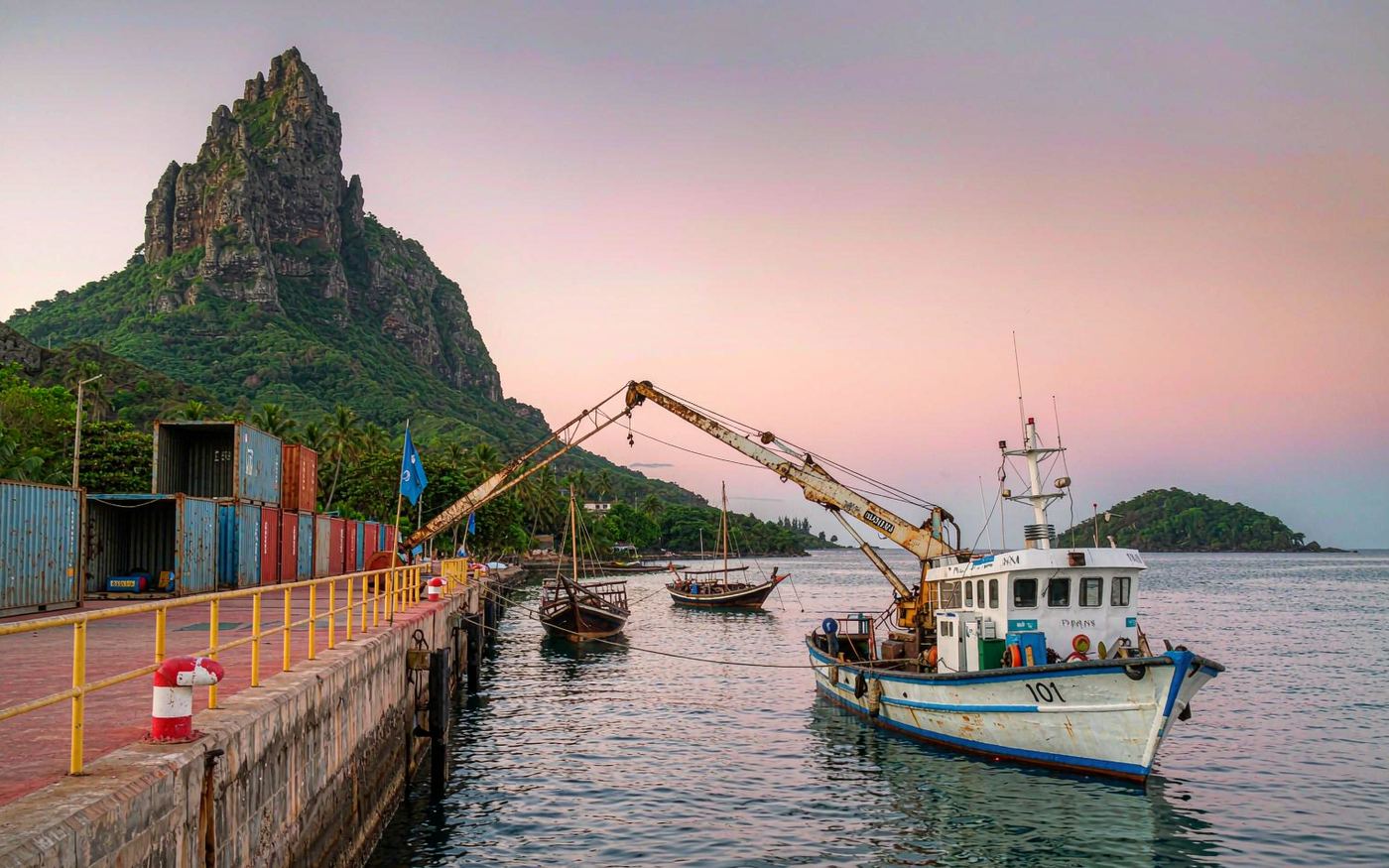
How to Ship from China to the Comoros
The Comoros is three islands in the northern Mozambique Channel — Grande Comore, Anjouan and Mohéli. Almost everything is imported, port capacity is modest, and the last leg is often an inter-island move rather than a truck ride.
Plan for a slow, paperwork-heavy clearance. Customs runs an advance declaration system that expects your file before the ship berths, French is the working language of the administration, and the cyclone season from November to April affects both sailings and port working.
At a glance
Main ports: Moroni (Grande Comore) and Mutsamudu (Anjouan, the larger and deeper of the two, able to take vessels of roughly 25,000 tonnes). Air gateway: Prince Said Ibrahim International Airport near Moroni. Customs system: SYDONIA / SYDONIA++ with advance electronic declaration, commonly 72 hours before arrival. Import duty: roughly 0 to 30 per cent by HS code. VAT: commonly quoted at 10 per cent — sources differ between 10 and 15 per cent]. A marine service charge, usually quoted at 0.5 per cent of cargo value, also applies. Cyclone season: November to April.
How your cargo moves: China to the Comoros
Eight steps from your supplier's door to yours. The last four are the ones shaped by local rules.
- Pickup from your supplierWe collect the goods anywhere in China and bring them to our consolidation point.
- Export clearanceChina customs declaration filed and released before the goods move to the port.
- Loading and departureContainer loaded, sealed and handed to the carrier at the Chinese port.
- Main carriageOcean, air or rail movement booked on the route agreed for your cargo.
- Arrival at the gatewayDischarge at the port or airport of entry, recorded on the carrier's manifest.
- Import clearanceCustoms declaration filed locally, with duty and tax assessed on the declared value.
- Customs releaseGoods released into free circulation once duty and tax are settled.
- Final deliveryOnward movement to your delivery address, warehouse or nominated depot.
Duty rates, VAT rates and clearance times move, and the figure that applies to your goods is the one set for your commodity code on the day of clearance. We check the current position against your code before your goods sail and confirm it to you in writing — ask for that check when you request a quote.
Three islands, one main port, and a shallow draft to plan for
Grande Comore carries the capital and the international airport; Anjouan has the better harbour; Mohéli is the smallest of the three. For freight planning that means the port your carrier can actually use is a function of the vessel and the draft, not simply of where your consignee is.
Port capacity is limited. Berths are few, handling equipment is basic, and heavy lifts need to be arranged in advance. Free storage at the port is short — commonly quoted at seven days — after which charges accrue on a rising scale. A slow file is expensive here, more so than in larger African ports where there is more room to absorb delay.
Tell your forwarder the weight and dimensions of any single heavy or oversized piece at quotation stage. Crane capacity and booking lead times at Comorian ports are not the same as at a regional hub.
Moroni or Mutsamudu: which port your carrier will actually use
Moroni on Grande Comore is the port most often named, because it sits next to the capital, the airport and the largest market. Mutsamudu on Anjouan is the larger and deeper port and can handle substantially bigger vessels — quoted at around 25,000 tonnes.
In practice the carrier's rotation and the vessel's draft decide it. Confirm which port is on the booking rather than assuming, and make sure your consignee knows, because a container discharged at Mutsamudu is not a short drive from a Moroni address.
Sea freight from Chinese ports to the Comoros is typically quoted at several weeks, with transshipment. It is not a fast route and it is not a daily one.
Routed through Dubai or Port Louis, not direct
There is no direct service from China. Cargo is transshipped through a regional or Gulf hub — Dubai, Dar es Salaam and Port Louis are the common ones — and then carried on a feeder service into Moroni or Mutsamudu.
Each transshipment is another handover and another chance to miss a connection, so build slack into the schedule. It also means your container is handled more than once, so pack to survive that and record the seal number at origin.
Air freight via Prince Said Ibrahim International Airport is the alternative for urgent or high-value cargo, and express courier is the only mode that delivers to the door. Sea and air services both end at the port or airport unless door delivery has been specifically agreed.
Entry logged three days ahead of the berth
Comorian customs operates an advance declaration regime: the cargo file is lodged electronically before the vessel arrives, commonly quoted at 72 hours ahead. An authorised broker enters the shipment details into the SYDONIA system and receives a pre-declaration reference, and the system cross-checks the data.
The practical consequence is that your documents have to be complete and in the hands of the broker well before arrival — not produced once the ship is alongside. If the HS codes or the values look inconsistent with what the system expects, the declaration can be flagged for physical examination.
That is worth taking seriously here, because examination rates are not trivial and because a container selected for opening at a port with limited handling capacity takes longer to be examined and resealed than it would at a large terminal.
Duty, VAT and then the port service charge
Import duty is assessed on the CIF value by HS code, with rates commonly quoted across a range of roughly 0 to 30 per cent. As elsewhere in the region, raw materials and equipment sit at the low end and finished consumer goods at the high end, and excise applies to a short list including tobacco and alcohol.
VAT is usually quoted at a standard rate of 10 per cent. Be aware that sources disagree — figures of 10, 15 and 18 per cent all appear in published material — so treat 10 per cent as the working assumption and confirm the current rate with your broker before you commit to a landed cost.
A marine service charge, commonly quoted at 0.5 per cent of cargo value, is also applied, and exemptions or reductions are available for categories such as agricultural machinery, medical supplies and building materials on application. Everything is settled in Comorian francs, which are pegged to the euro.
Moving cargo between Grande Comore, Anjouan and Moheli
If your consignee is not on the island where the container is discharged, you have an inter-island move to arrange. That is a coastal shipping leg with its own schedule and its own handling at both ends, and it is a separate cost from the international freight.
Agree in writing who is responsible for it and who pays. A sea freight quote normally ends at the port of discharge; getting goods to a Mohéli address is a different contract with a different operator.
Infrastructure investment announced for 2026 includes port rehabilitation at Moroni and a new inter-island vessel, so capacity on this leg may improve. Confirm the current schedule rather than relying on published plans.
Food, medicine, chemicals: permits you apply for early
Regulated categories need approvals issued in the Comoros before the goods arrive. Food products call for health and microbiological certification; pharmaceuticals need approval from the health authorities and labelling that meets local requirements; chemicals require a safety data sheet in the working language.
Animal and plant products need phytosanitary certification from the Chinese inspection authorities, and in some cases fumigation treatment with the certificate to prove it. Consular legalisation is sometimes required on commercial documents above a value threshold.
These approvals are the slow part of shipping to the Comoros, not the vessel. Start them at the same time as you book space, and do not let a supplier ship before the permit question is settled.
Buying privately or trading under a Comorian company
Commercial importing expects a registered business and a licensed broker acting on the file. The importer of record has to be identifiable to the administration, and the broker lodges the advance declaration on their behalf.
Private individuals can import personal effects, and certificates of conformity are required for regulated goods regardless of who is importing them. Low-value shipments below a threshold — quoted at around KMF 50,000, roughly USD 110 — may use simplified procedures, but do not assume a general duty-free allowance exists.
Where a shipment is declared as personal but is plainly commercial in volume or in nature, treat it as commercial from the start. Re-classification after arrival is slow and expensive.
Where our China-side work stops and Moroni takes over
In China your forwarder books space, arranges collection and export customs clearance, issues the bill of lading, and prepares or corrects the commercial invoice and packing list so they are usable at destination. They can also arrange cargo insurance, which is worth having on this route.
At the Comorian end, the broker lodges the advance declaration, answers queries, arranges examination if the container is selected, calculates duty and VAT, and obtains release. The importer or their agent then handles collection and any inter-island move.
Sea freight service ends at the port; air freight ends at the airport. Only express courier delivers to the door. Make sure your consignee understands which one they have bought.
Three consignments into the Comoros, start to finish
Building materials, full container, for a contractor in Moroni. Cement, steel and fittings, one 40 foot container, transshipped through a Gulf or East African hub. Duty depends on the HS code of each line; building materials may qualify for a reduced treatment on application. Discharged and cleared at Moroni with no inter-island leg.
Pharmaceuticals, air freight, for a distributor. Health ministry approval obtained first, labelling checked, flown in via a regional hub. Air avoids the long sea transit and the feeder wait, which matters when the goods have a shelf life or a tender deadline.
General merchandise, LCL, for a shop on Anjouan. Consolidated in China, discharged at Mutsamudu where the deeper berth is, cleared there and moved on within the island. The inter-island question only arises if the final address is on Grande Comore or Mohéli.
Cyclone season, port storage and other costs of waiting
The cyclone season runs from November to April. Sailings and port working both slow down in that window, and insurance that covers natural damage is worth carrying rather than treating as optional. Standard practice on this route is to insure at 110 per cent of invoice value.
Port storage is the other cost of delay. Free time is short — commonly seven days — and charges rise after that. If a claim is necessary, a survey report from a recognised surveyor issued within the allowed window after discharge is normally what the insurer will ask for.
Both are arguments for doing the paperwork early. The vessel is rarely the reason a Comoros shipment is late; the file usually is.
A practical timeline from Chinese factory to Moroni
Work backwards. Start permits and approvals as soon as the order is placed, because they are the longest lead item. Book space and begin preparing documents while the goods are still in production. Send the full document set to the Comorian broker in time for the advance declaration window, not on arrival.
Then allow the sea transit with transshipment, a clearance window of roughly a week to a fortnight when the file is clean and longer if the container is examined, and any inter-island leg on top. Express courier compresses all of this to a few days but only for small parcels.
Build the plan with slack at the transshipment hub and at the port, and you will not be surprised by any of it.
Why importers use Goodhope on this lane
Six things that are different about working with us on China to the Comoros shipments.
How often the Moroni service runs, and what that does to your promise
Tell us the goods, the weight of any heavy pieces and which island the consignee is on. We will confirm the port, the routing, and what has to be filed before the vessel arrives.
Get a quote Talk to usRelated pages
Frequently asked questions
Which ports serve the Comoros?
Moroni on Grande Comore is the port most often named, next to the capital and the international airport. Mutsamudu on Anjouan is the larger and deeper port, able to take vessels of roughly 25,000 tonnes. The carrier's rotation and the vessel's draft usually decide which one is used.
Is there a direct service from China?
No. Cargo is transshipped through a regional or Gulf hub such as Dubai, Dar es Salaam or Port Louis, and then carried on a feeder into Moroni or Mutsamudu.
How far in advance must I declare the cargo?
Comorian customs runs an advance electronic declaration, commonly quoted at 72 hours before the vessel berths. Your broker lodges the file in the SYDONIA system and receives a pre-declaration reference, so the documents have to be with them well before arrival.
What are the duty rates?
Import duty is assessed on the CIF value by HS code and is commonly quoted across a range of roughly 0 to 30 per cent. Excise applies to a short list including tobacco and alcohol. Reductions or exemptions may be available for categories such as agricultural machinery, medical supplies and building materials on application.
What is the VAT rate?
A standard rate of 10 per cent is the most commonly quoted figure, but published sources disagree, with 10, 15 and 18 per cent all appearing. Treat 10 per cent as the working assumption and confirm the current rate with your broker before committing to a landed cost.
Are there other charges besides duty and VAT?
Yes. A marine service charge, usually quoted at 0.5 per cent of cargo value, applies, along with port handling and, after the short free period, storage charges that rise with time. Everything is settled in Comorian francs, which are pegged to the euro.
What permits do I need for food, medicine or chemicals?
Food needs health and microbiological certification, pharmaceuticals need health ministry approval and compliant labelling, and chemicals require a safety data sheet in the working language. Plant and animal products need phytosanitary certification and sometimes fumigation. Start these before booking, not after.
How do goods reach Anjouan or Moheli?
By inter-island coastal shipping from the island of discharge. That is a separate leg with its own schedule and cost, and it is normally not included in an international sea freight quote. Agree who arranges and pays for it in writing.
Does cyclone season affect shipments?
Yes — roughly November to April. Sailings and port working both slow down, and cargo insurance covering natural damage is worth carrying. Insuring at 110 per cent of invoice value is standard practice on this route.
Do you deliver door to door?
Sea freight ends at the port and air freight ends at the airport; the consignee handles import clearance and final delivery. Express courier is the only mode with true door-to-door delivery, and it is limited to parcels and documents.