Since 2012 NVOCC GD20230925153335 24h Response
+86 13392162503 sales8015@goodhopefreight.com Login
Goodhope Freight
Export documents from China

Form F: the China–Chile certificate of originThe paper that gets your cargo into Chile at the FTA rate — and why the issue date matters more than the signature

Form F is the preferential origin certificate under the China–Chile Free Trade Agreement, carried as code F on the export declaration. China Customs or CCPIT issues it, Chile's Servicio Nacional de Aduanas accepts it, and your Chilean broker wants the original before entry. This guide covers who can file, the issue window you cannot miss, what the 12-month validity really covers, how the 40% value test is run, and the errors that turn a routine entry into an origin verification.

12 monthsvalidity from the issue date
Before or at shipmentstandard issue window
$0official visa fee
40%regional value content floor

Ask for a Form F quoteRead the FAQ first

Certificate of origin issued in Shenzhen showing exporter, consignee, transport route, HS code, quantities and the issuing chamber's seal
A certificate of origin issued in Shenzhen. Form F is laid out the same way, with one extra box that matters: the origin criterion. Every field still has to reconcile with your invoice, packing list and bill of lading.

The short version

Form F — printed on the form as Certificate of Origin Form F for China–Chile FTA — is a preferential certificate of origin. It is issued by China Customs at the port of export, or by CCPIT and its local branches, and its job is narrow: certify that the goods meet the China–Chile origin rule so the Chilean importer can declare the agreement rate instead of the MFN rate.

It is not a discount coupon. The rate your buyer actually gets depends on the tariff schedule for the 8-digit Chilean code, and on whether the goods clear the origin test — the product-specific rule for that heading, or a 40% regional value content where no product-specific rule applies. It also does not touch Chile's VAT: IVA is assessed separately, at the standard 19% rate.

Who files: the exporter or the manufacturer, or an agent holding a signed power of attorney. When: before or at the time of shipment, with a 12-month validity from issue. If that window is missed, retroactive issuance is possible within one year of the shipment date — but only for force majeure, an inadvertent error or other reasonable cause, and the certificate says so on its face. Cost: the issuing office charges nothing; you pay the agent's service fee.

Certificate typePreferential certificate of origin, China–Chile FTA
Declaration codeF
Issuing officesChina Customs or CCPIT and its local branches
Filing methodFiled online, self-printed on A4 in English
Validity12 months from the date of issue
PriceNo visa fee; agent service fee per certificate
Definition and legal basis

What Form F actually is

Two dates explain the version of the rules you are filing under today: the original China–Chile agreement took effect on October 1, 2006, and the upgrade protocol — the one that rewrote the origin rules — took effect on March 1, 2019.

China and Chile signed their free trade agreement on November 18, 2005. Chile was the first Latin American country to sign one with China, and the deal has been in force since October 1, 2006. In November 2017 the two governments signed the protocol that revised both the goods agreement and the services supplement; it entered into force on March 1, 2019, and the origin rules moved with it.

The filing rules live in two places. The Measures on the Administration of Origin for Import and Export Goods under the China–Chile FTA, published as GACC Announcement No. 39 of 2019 and effective March 1, 2019, set the origin tests and the certificate requirements. The Measures on the Administration of Certificate of Origin Visas for Export Goods (GACC Order No. 270, in force September 1, 2024) govern acceptance, review, retroactive issuance and amendments. On the declaration, the certificate is code F.

Origin is decided one of three ways. Wholly obtained: grown, raised, mined, caught or produced entirely in China. Produced entirely from originating materials: every input is itself Chinese or Chilean under the agreement. Otherwise, the goods have to pass the product-specific rule for their heading — a tariff shift, a value test, or a stated manufacturing process — and where no product-specific rule applies, the fallback is a regional value content of at least 40%.

The value test is not a margin calculation. Under Article 6 it is (FOB value − value of non-originating materials) ÷ FOB value × 100, and it has to be built on the books you keep. The agreement also gives you bilateral cumulation (Chinese material used in Chile counts as Chilean, and the reverse), a de minimis allowance of 10% of the FOB value where a tariff shift is missed, a 15% allowance for sets, and a list of seventeen minimal operations — simple assembly, repacking, labeling, simple mixing, sharpening, grinding — that never confer origin no matter how much paperwork surrounds them.

The distinction that matters: Form F proves the cargo qualifies for the agreement rate. It does not prove the cargo is duty-free. The tariff schedule decides the rate; the origin rule decides eligibility. A certificate that clears one and fails the other is a certificate that gets refused at entry.

Three ways to qualify

  • Wholly obtained — the goods come out of China's soil, water, farms or mines.
  • All originating materials — every component is Chinese or Chilean under the agreement.
  • Product-specific rule — tariff shift, value test or process rule for the heading; where none exists, RVC ≥ 40%.

Simple assembly of imported parts, repacking and relabeling are on the minimal-operations list. They do not earn origin, and the certificate cannot fix that.

Why it matters to you

You are the importer of record in Chile. Here is what this page does for you.

Your broker — the agente de aduanas — files the entry with the Servicio Nacional de Aduanas, and the origin document is what decides which duty column the goods land in. Without it, the same cargo is assessed at the MFN rate, and an entry filed at the agreement rate without support gets amended, held or liquidated at the higher rate.

It sets the rate your broker declares

With a valid Form F the entry goes in at the agreement rate. Without it, the same HS line is assessed at MFN — and because Chile's MFN rates are already moderate on many industrial goods, the mistake is easy to miss until the liquidation notice arrives.

The lines where the gap is real

After the upgrade protocol, roughly 98% of the two-way tariff lines carry no duty. Chile eliminated duties immediately on 24 product groups, including textiles and apparel, home appliances and sugar; China phases out duties on some wood products over three years. Those are the categories where the certificate pays for itself.

It sits on the entry document list

Chilean customs can call for the original certificate on a preferential entry. If the certificate number, the description or the value does not line up with the invoice and the bill of lading, the entry stops, the container goes to inspection, and the broker amends the declaration.

It travels with the letter of credit

Chilean banks open credits that list “Certificate of Origin Form F in one original”. A different shipper name, an issue date after the on-board date or a value that does not match is a documentary discrepancy, and payment sits until it is waived.

Origin verification and trade cases

Chilean customs runs post-entry origin checks and can send a verification request to China. Anti-dumping, countervailing and safeguard measures are decided on origin as well, so the certificate is the first document pulled when a case file is opened.

A clean record, and a lower exam rate

Every preferential entry leaves a trace in both systems. A certificate that had to be amended or a claim that was disallowed follows the importer, and it shows up in how often later shipments get pulled.

Duty is not the whole bill. Chile assesses VAT (IVA) at the standard 19% on the customs value plus duty and other charges. Form F reduces the duty line; it does not reduce the VAT line. If your buyer asks whether the certificate means no tax at all, the answer is no — it means no duty on qualifying goods.
Issuing offices

Where to get it: two official channels

Inside China, Form F comes from one of two offices — China Customs at the port of export, or CCPIT and its local branches. Both are legally valid and both are accepted in Chile. Which one you use is usually decided by the contract, the letter of credit or the buyer's preference.

ChannelWhat it isWhere you fileChoose it when
China Customs Government issuing authority — the customs house at the port of export Internet + Customs at online.customs.gov.cn (tax and fee services → origin management → certificate issuance), or the Single Window at singlewindow.cn → origin certificate → China–Chile FTA Your buyer or the credit wants a government-issued certificate, or you want the certificate tied to the declaration data
CCPIT Chamber-of-commerce issuer — the China Council for the Promotion of International Trade and its local branches CCPIT origin certificate system at co.ccpit.org or declare.ecoccpit.net Your buyer specifies a chamber certificate or a chamber stamp, or your company already files everything through the CCPIT system

Online first, counter second

Issuance is electronic end to end. You file in one of the systems above, the authority reviews it online, and once it clears you print it yourself on A4 in color, with the electronic seal and signature — the same legal effect as a pre-printed certificate. A paper original can also be collected at the counter, but in practice the counter visit count is zero.

There is no residency requirement. Any customs house or local CCPIT branch accepts an online filing. Cargo out of Shenzhen and the Pearl River Delta is usually filed with Shenzhen Customs or CCPIT Shenzhen, which keeps follow-up simple; cargo moving through Guangzhou, Nansha, Ningbo, Shanghai, Qingdao, Tianjin or Xiamen is filed with the office that matches the port of export.

The certificate has its own format rules. Form F is completed in English, carries a unique certificate number, and may cover one or more goods of the same consignment. The paper original must carry a signature or seal among its security features, and it may not be erased or overprinted. If something has to be corrected, the wrong entry is struck through, the correct information added, and the issuing office's seal applied — a certificate you corrected yourself is one Chilean customs can simply refuse.

The traffic runs both ways. Chilean goods entering China at the agreement rate need a certificate from Chile's authorized issuing agency, checked against the same rules. If the certificate is not in hand at the time of entry, the Chinese importer can file an origin declaration, post a security and produce the certificate within one year of that declaration — but a claim made after release does not reopen the assessment. Consignments valued at USD 1,000 or less are exempt from the certificate requirement, unless the goods were split up to stay under that line.

Who applies

Who can file: three routes, one line we will not cross

The rule is short. The certificate is issued on the application of the exporter or the manufacturer, and either of them can appoint an agent with a signed power of attorney filed with the issuing office. In daily practice that gives you three arrangements.

The factory files

The manufacturer registers, keeps its own profile current and files its own certificates. Tightest control over the origin story, and it works best when the product range is narrow and there is a documents desk on site.

The trading company files

The exporter applies in its own name, so the name on the certificate matches the invoice and the bill of lading it issued. The sensible route for high-volume shippers with a dedicated documents team.

The forwarder files as agent

We file on your behalf and the certificate still carries your name or your supplier's name — never ours. The usual route for companies with no registration yet, a thin documents desk, or cargo spread across several ports.

The first-application threshold

Before the first filing, the company profile has to exist in the system: unified social credit code, Chinese and English name and address, contacts. A company already registered with customs as an importer or exporter can sync that record instead of re-entering it. Self-printing requires uploading the company seal and the declarant's signature and having them authorized. When an agent files, the entrustment is also recorded in the e-port system and the power of attorney uploaded there.

Our line: we file certificates; we do not sell them. The certificate, the invoice and the bill of lading have to point at one real transaction. We decline borrowed company names, invented descriptions, altered values and origin criteria picked to fit the answer. A false origin declaration is the declarant's legal exposure, and customs can act on it.
Timing

When to file: before or at shipment, not a week after

The agreement is specific: the certificate is issued before or at the time of shipment, and it is valid for 12 months from the date of issue. That is not a formality. The form carries a box for means of transport and route — departure date, vessel and voyage or flight number, port of discharge — none of which is fixed until the booking is confirmed.

5 days out

Booking confirmed

Departure date, vessel or flight and discharge port are locked. Pull the invoice, packing list, HS codes and the origin support for the goods.

3 days out

Origin test settled

Check whether the heading has a product-specific rule. If it does, run that rule; if not, build the 40% value calculation and keep the bill of materials behind it.

Before departure

Filed and reviewed

Filed in the Customs or CCPIT system, description taken from the commercial invoice. Review takes two business days; a clean file often clears the same day.

Sailing day

Travels with the cargo

PDF goes to the Chilean broker for pre-filing, the original goes with the shipping documents or by courier. Certificate number matches the entry.

If you missed the window

Retroactive issuance exists, but it is narrower here than under most Chinese FTAs. Under Article 23, where the certificate could not be issued in time because of force majeure, an inadvertent error, negligence or another reasonable cause, the issuing office may issue it retroactively within one year of the shipment date, and the certificate is marked as issued retrospectively. “We forgot” is not force majeure, and “we did not think it was needed” is not a reasonable cause. The rule used to allow issuance up to 30 days after export; since March 2019 it does not.

Expect the date to be questioned. A certificate issued after the on-board date is exactly what a Chilean bank reads against the credit, and some credits refuse retroactive certificates outright. If it can be filed on time, file on time.

Keep three dates apart: the issue date (start of the 12-month validity), the shipment date (the on-board date on the bill of lading or the air waybill date), and the application date. The first two decide whether the certificate counts as retroactive, and therefore whether the credit will take it.
A replacement is not a new application: if the paper original is lost, stolen or damaged, the exporter or manufacturer can ask the issuing office for a certified true copy, marked as a true copy of the original with its number and date. The copy carries the same validity; once it is presented, the original is void, and a copy of an original that has already been used is void itself. If the content is wrong, the correction is struck through and stamped — that is an amendment, not a re-issue.
Export containers and a customs building at a Chinese port of departure
The certificate prints the port of departure and the routing. A Shenzhen-based shipper loading in Ningbo still shows the Ningbo routing, or the first comparison against the bill of lading raises a question.
Process

Eight steps from origin test to certificate

Self-filing and agent filing walk the same official path. What changes is who fills the form, who checks it, and who does the rework when a field is wrong. Form F carries one extra step a plain CO does not: settling the origin criterion before anything is typed.

Confirm the agreement applies

Destination is Chile, and the goods sit in the agreement's tariff schedule. There is no second bilateral route into Chile, so this check is quick.

Settle the origin criterion

Is there a product-specific rule for the heading? Run it. If not, calculate the regional value content. Keep the bill of materials that supports the number you type.

Pull the three document sets

Commercial invoice, packing list, and bill of lading or air waybill. Reconcile invoice number, date, value, package count, gross and net weight, and marks.

Match the tariff codes

Chile declares at 8 digits; China exports at 10. The first six have to agree, and the Chilean suffix has to be the one your broker will file.

File online

Enter company and goods details. The description follows the invoice line by line — specification, quantity, HS code — and the origin criterion box states what you actually used.

Review and issue

The authority responds within two business days; corrections usually come back in one pass. Then self-print on A4 in color, or collect at the counter.

Hand it to the consignee

PDF first so the Chilean broker can pre-file, original with the shipping documents or by courier. Ask the broker to check the certificate number against the entry.

Archive for three years

Certificate copy and application file are kept at least three years from issue — that is the file you produce when a verification request lands.

The box that gets certificates refused is the origin criterion. Declaring wholly obtained while using imported parts, claiming the value test without the numbers behind it, or ticking a tariff shift that never happened are all false declarations. The issuing office can ask for the bill of materials, the cost build-up and the material invoices; Chilean customs can ask China to verify. One wrong box means an amendment, and the clock belongs to the vessel.
Documents

What we need from you

The list is short, and one item on it is heavier than the rest: the origin support. That is where Form F differs from a plain CO, and where review questions usually start.

Always required

  • Commercial invoice — in English, with invoice number and date, Incoterms, unit price and total value, consignee details.
  • Packing list — package count, package type, gross and net weight, shipping marks (N/M if there are none).
  • Tariff codes — the 10-digit code used for the China export declaration and the 8-digit Chilean code your buyer will declare.
  • Company details — business license, unified social credit code, Chinese and English name and address.
  • Origin support — material sources and suppliers, a bill of materials, a cost build-up where the value test applies, and a process description where a tariff shift is claimed.

Depending on the shipment

  • Bill of lading or air waybill — required for retroactive issuance as proof of the shipment date; otherwise it supplies the transport details.
  • Power of attorney — when we file as your agent, with the entrustment mirrored in the e-port system.
  • Letter of credit clauses — number of originals, language, chamber stamp or legalization, and whether a retroactive certificate is acceptable.
  • Non-manipulation proof — for cargo transshipped through a third country, to support the direct shipment rule.
  • Quarantine and labeling papers — food, agricultural and cosmetic lines face separate Chilean SAG inspection and Spanish labeling requirements.
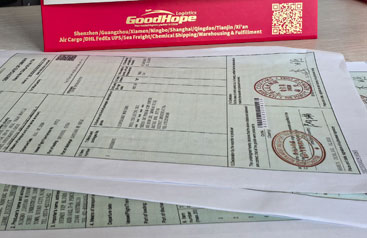
Stack of export certificates and customs documents prepared by Goodhope Freight
Certificates, declarations and invoices for one shipment, kept together. If a verification request arrives two years later, this stack is the answer.
Retention is an obligation, not advice: the certificate copy and the supporting file are kept at least three years from issue. A destination verification can pull contracts, invoices, ledgers and production records, and the issuing office can ask for the same set.
Pricing

What it costs: nothing at the counter, a service fee per certificate

Two separate numbers, paid to two different parties: the official fee charged by the issuing office, and the fee charged by whoever prepares and files the certificate.

Line one

Official fee: zero

China Customs publishes no charge for origin certificate issuance, and the CCPIT system publishes the same. Certificate stock, review and the electronic seal are not billed to the applicant.

Line two

Service fee: per certificate

What we charge covers labor: running the origin test, assembling the file, reconciling the three document sets, filing, chasing the review, printing and delivering, and reworking an error. One certificate, one price.

What makes a certificate cost more

  • Origin work — building a value calculation or a tariff-shift argument from a bill of materials takes longer than describing a simple product.
  • Rush handling — same-day issuance means priority queueing and someone watching the review queue, and it is priced as a rush service.
  • Amendments and re-issues — a wrong field, a revised invoice or a lost original each start a review cycle.
  • Third-party invoicing — a Hong Kong or other intermediary invoice needs the corresponding remark and a careful match against the invoice your broker files.
  • Chamber stamp or legalization — occasionally required by a credit or a buyer, and it is a separate process.
  • Extra originals and courier — more originals, or express delivery to Santiago, are billed at cost.
On quoting: we do not publish a flat price list, because the origin work varies far more than the document does. Send the invoice, the packing list and the Chilean tariff code and you get an itemized quote for the number of certificates you actually need — no teaser rate followed by add-ons.
One thing we will not do: “guaranteed issuance”, buying a certificate from someone else's company, or filing an amended value to fit a credit. Those are forged or fraudulent origin certificates, and the exposure lands on the shipper — first at the Chinese issuing office, later at a Chilean verification.
Certificate comparison

Form F and its neighbors: one table

There is exactly one preferential route into Chile for Chinese-origin goods. The confusion usually comes from Chile's membership in the CPTPP, which people read as a second door. It is not, because China is not a party to it.

CertificateCodeCoversWorks for a Chile entry?
China–Chile FTA — Form FFChileYes, at the agreement rate
Certificate of origin — COCOAny destination, no agreement neededNo preference; proof of origin only, MFN rate
China–Peru, China–Costa Rica, China–Ecuador and similarR / L / ECParties to those agreementsNo; unrelated to a Chile shipment
RCEPRCASEAN ten plus China, Japan, Korea, Australia, New ZealandNo; Chile is not an RCEP party
CPTPP—Chile is a party; China is notNo; China cannot issue a CPTPP origin certificate

Why “Chile is in the CPTPP” does not open a second route

A preferential certificate is bilateral in practice: Chinese authorities issue it under an agreement China has signed, and the destination authority accepts it on that basis. China is not a CPTPP party, so no Chinese office issues a CPTPP origin certificate, and Chilean customs has nothing to grant preference against. Form K, Form E and Form B do not work either — Chile is not a party to those agreements.

The reverse direction runs the same way: Chilean goods entering China at the agreement rate need a certificate from Chile's authorized agency, and no other agreement applies. Cargo that moves through a third country also has to satisfy the direct shipment rule — only unloading, reloading, repacking, relabeling to meet the importer's requirements, splitting the consignment or preserving the goods in condition, all under customs control, with a stay of no more than 12 months, and with a certificate or other evidence from that country's customs.

No agreement with the United States or the EU. Neither destination needs a preferential certificate from China, because there is none. A plain CO remains the standard proof of origin there, especially in anti-dumping and countervailing cases and in letter of credit sets. Follow your buyer and your broker on what the entry actually calls for.
Risk

Why some Form F certificates get pulled for verification

Issuance is the easy half. Chilean customs examines preferential entries after release, and the question is rarely whether a certificate exists — it is whether the certificate holds up against the invoice, the tariff code and the production record.

The origin criterion does not hold

Declared wholly obtained while using imported materials, or a value test claimed without a cost build-up behind it. This is the most common and the most expensive problem, and it can be checked years after the entry.

The description is too broad

“Machinery”, “parts”, “goods” describe nothing. The description box has to follow the invoice line by line — product name, model, quantity, tariff code — and name the producer where the form asks for it.

The tariff codes do not line up

The Chilean schedule runs 8 digits; the Chinese declaration runs 10. The first six should match and the Chilean suffix must be the one your broker files. A code that disagrees with the invoice takes the goods out of the schedule the certificate relied on.

The three document sets disagree

Invoice number, date, value, package count, gross and net weight, marks — any mismatch against the packing list, bill of lading or declaration opens the door. Correcting a filed entry costs more than getting the invoice right the first time.

The transshipment is not documented

Cargo routed through Hong Kong, Busan or another hub has to stay under customs control, stay out of processing beyond the permitted operations, and stay inside 12 months. An itinerary decided at booking decides this, not the paperwork afterwards.

The date or the paper is wrong

A certificate issued after the on-board date without being marked retroactive, or a form with visible erasure or overprinting, invites a question about authenticity. Corrections on Form F have to be struck through and stamped by the issuing office.

What a verification actually costs you

Chilean customs can ask China to confirm the certificate and the origin of the goods. While that runs, release may be held, a security deposit demanded, or duty assessed at the MFN rate up front. If the answer does not satisfy the authority, the duty difference is collected with interest and the importer's preferential history gets worse.

For the exporter there is one effective defense: settle the origin criterion, then align the three document sets, before anything is filed. That is why our routine starts with the bill of materials and ends with a cross-read of invoice, packing list and bill of lading — not with the filing screen.

FAQ

Questions importers ask

The twelve questions that come up most often from Chilean buyers and their brokers, answered with the rule rather than the sales pitch.

What is the difference between Form F and a certificate of origin?

Form F is the preferential certificate under the China–Chile Free Trade Agreement, printed as Certificate of Origin Form F for China–Chile FTA and carried as code F on the export declaration. A plain CO is non-preferential: it proves the goods are Chinese, supports the MFN rate and trade statistics, and grants nothing under the agreement. Both come from the same offices, but the filing content, the origin test and the duty outcome are different.

Does every shipment to Chile need a Form F?

No. It depends on your contract, the letter of credit, what your Chilean broker needs for the entry, and whether the goods sit in the agreement's tariff schedule. If the buyer is content with the MFN rate, a plain CO can be enough. To declare the agreement rate, Form F is the only document that works. Consignments valued at USD 1,000 or less are exempt from the certificate at entry, unless they were split to stay under the threshold.

Does a Form F mean zero duty?

Not automatically. Tariffs are phased by line: after the upgrade protocol roughly 98% of two-way lines carry no duty, but some products remain outside the schedule or still move through a transition. The rate depends on the 8-digit Chilean code, and eligibility depends on the origin rule. Chile's VAT (IVA, 19%) is assessed separately and is not reduced by the certificate.

How fast can a Form F be issued?

The issuing office completes its review within two business days of accepting the filing. With a clean file and a settled origin criterion, most certificates are issued the same day or the next; a same-day request depends on that day's queue.

What does a Form F cost?

The issuing office charges no visa fee, and both China Customs and CCPIT publish a zero charge. What you pay is the agent's service fee, quoted per certificate and itemized by certificate type, rush handling, amendments, extra originals and any chamber stamp or legalization.

Who is allowed to apply?

The exporter or the manufacturer, or an agent appointed with a signed power of attorney. When we file on your behalf, the certificate stays in your name or your supplier's name; we never issue one in our own name.

Do we have to register before the first application?

Yes. The company profile has to exist in the filing system: unified social credit code, Chinese and English name and address, contacts. Companies already registered with customs as importers or exporters can sync that record. Self-printing also requires uploading the company seal and the declarant's signature.

When do the goods qualify as Chinese origin?

Three routes: wholly obtained in China; produced entirely from Chinese or Chilean originating materials; or, for goods not wholly obtained, meeting the product-specific rule for the heading, or a regional value content of at least 40% where no such rule applies. RVC is (FOB value minus non-originating material value) divided by FOB value. Simple assembly, repacking and relabeling are minimal operations and do not confer origin.

The cargo has already sailed. Can we still get a Form F?

Only on the agreement's terms, which are tighter than most Chinese FTAs. The certificate is meant to be issued before or at shipment; where that failed because of force majeure, an inadvertent error, negligence or another reasonable cause, the issuing office can issue it retroactively within one year of the shipment date, marked as issued retrospectively. A missed deadline is not a reasonable cause, and some letters of credit refuse a retroactive certificate.

How long is a Form F valid?

Twelve months from the date of issue. Amendments and certified true copies have to be requested inside that window. A retroactively issued certificate runs from the shipment date, not from the date it was printed.

What if the cargo moves through a third country?

It still qualifies if the third country did no more than unload, reload, repack, relabel to meet the importer's requirements, split the consignment or preserve the goods in condition, if the cargo stayed under that country's customs control for no more than 12 months, and if you can produce a certificate or other evidence from that customs authority. Decide the routing at booking, not after the certificate is filed.

Chile is in the CPTPP. Can we use a CPTPP certificate?

No. China is not a CPTPP party, so no Chinese authority issues a CPTPP origin certificate and Chilean customs has nothing to grant preference against. Chile is also outside RCEP and the APTA, so Form K, Form E and Form B do not apply. The China–Chile FTA, Form F, is the only preferential route for Chinese-origin goods entering Chile.

How we work

How Goodhope handles Form F

We are a freight forwarder and documentation desk in Shenzhen, working out of Futian. Export declarations, origin certificates, fumigation, commodity inspection and legalization for one order are delivered through one window wherever the rules allow it.

Origin first, filing second

The product-specific rule is checked, or the value calculation is built, before the filing screen is opened. A wrong origin criterion is an amendment at best and a verification at worst.

The issue date is built into the schedule

Form F has to be issued before or at shipment, so our filing slot sits after the booking is confirmed and before the vessel loads — not after the on-board date, when the only option left is a retroactive certificate.

Any China port, one desk

Cargo out of Shenzhen, Guangzhou, Nansha, Huangpu, Ningbo, Shanghai, Qingdao, Tianjin or Xiamen is filed with the office that matches the port of export, so the certificate and the routing agree.

PDF first, original follows

The PDF goes out the moment it clears so the Chilean broker can pre-file. The original travels with the bill of lading or by courier, and the file is archived for the three-year retention period.

Related services and reading

Compiled by the documentation desk at Goodhope Logistics (China) Limited. Sources: the Measures on the Administration of Origin for Import and Export Goods under the China–Chile FTA (GACC Announcement No. 39 of 2019, effective March 1, 2019), the Measures on the Administration of Certificate of Origin Visas for Export Goods (GACC Order No. 270, effective September 1, 2024), the China–Chile FTA and its 2017 upgrade protocol, and the public service guides published by the General Administration of Customs. Tariff schedules and origin rules change; the current rules at your issuing office and the requirements of the Chilean customs authority prevail. Last updated: November 10, 2026.

Send the invoice, the packing list and the Chilean tariff code.

Tell us what the goods are made of and when the vessel loads. You get an origin assessment, the issue date we can hold, the document checklist, and an itemized quote for the filing — from Shenzhen, for cargo out of any China port.

call us: +86 13392162503