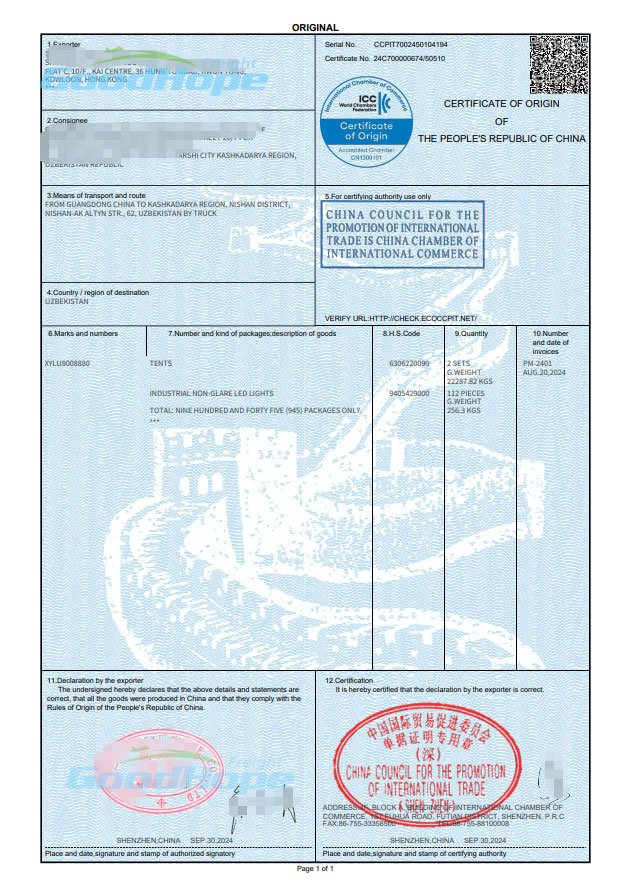
China and Peru signed their free trade agreement on April 28, 2009. It took effect on March 1, 2010, the second such deal China signed with a Latin American country after Chile, and it is the only preferential route for Chinese-origin goods into Peru today. The upgrade protocol entered into force on November 1, 2026, and the origin measures were replaced with it.
The filing rules live in two places. The Measures on the Administration of Origin for Import and Export Goods under the China–Peru Free Trade Agreement, published as GACC Announcement No. 155 of 2026 and effective November 1, 2026, set the origin tests and the certificate format (Annex 2); it supersedes GACC Order No. 186, the 2010 version. The Measures on the Administration of Certificate of Origin Visas for Export Goods (GACC Order No. 270, in force September 1, 2024) govern acceptance, review, retroactive issuance, amendments and certified copies. On the declaration, the agreement is code 12.
Origin is decided one of three ways. Wholly obtained: grown, raised, mined, caught or produced entirely in China or Peru. Produced entirely from originating materials: every input is itself Chinese or Peruvian under the agreement. Otherwise, the goods have to pass the product-specific rule for their heading in Annex 1 — a tariff classification change, a value test, or a stated manufacturing process. Where the rule calls for a value test, the formula is (FOB value − value of non-originating materials) ÷ FOB value × 100, with the percentage taken from that heading's rule. This agreement does not run on one flat regional-value number the way some others do.
Three allowances sit around those rules. Bilateral cumulation: Chinese material used in Peru counts as Peruvian, and the reverse. De minimis: where a tariff classification change is missed, non-originating materials up to 10% of the FOB value still leave the goods originating. Sets: non-originating components of a set may be up to 15% of the set's value. And Article 9 lists thirteen minimal operations — preserving, splitting a shipment, repacking, simple assembly, washing, sharpening, screening, labeling, simple mixing, bottling — that never confer origin, however much paperwork surrounds them.
The distinction that matters: Form R proves the cargo qualifies for the agreement rate. It does not prove the cargo is duty-free. The tariff column decides the rate; the origin rule decides eligibility. A certificate that clears one and fails the other is a certificate that gets refused at entry.