China and Switzerland signed their free trade agreement in 2013 and applied it from July 1, 2014. Form S is the origin document the agreement created: fifteen boxes, printed in English, one original and two copies, up to fifty items per certificate, tariff codes at six digits. Box 12 is the issuing authority's endorsement, box 13 is the exporter's declaration, and boxes 14 and 15 stay empty — they belong to the importing customs authority when it asks China to verify a certificate.
The rules sit in two layers. The Measures on the Administration of Origin for Import and Export Goods under the China–Switzerland FTA (GACC Order No. 223, effective July 1, 2014) set the origin tests and the certificate requirements. The Measures on the Administration of Certificate of Origin Visas for Export Goods (GACC Order No. 270, in force September 1, 2024) govern how applications are accepted, reviewed, issued late and amended. The certificate format itself is an annex to the agreement, reproduced in the customs service guide.
On a Chinese import entry for Swiss goods the certificate is entered as document code Y, with <17>C and the certificate number in the number field — 17 is the agreement's code in the Chinese system. That is a Chinese-side convention. On a Swiss entry the broker simply attaches the original Form S to the declaration; nothing about the number needs to be typed into your entry as a code.
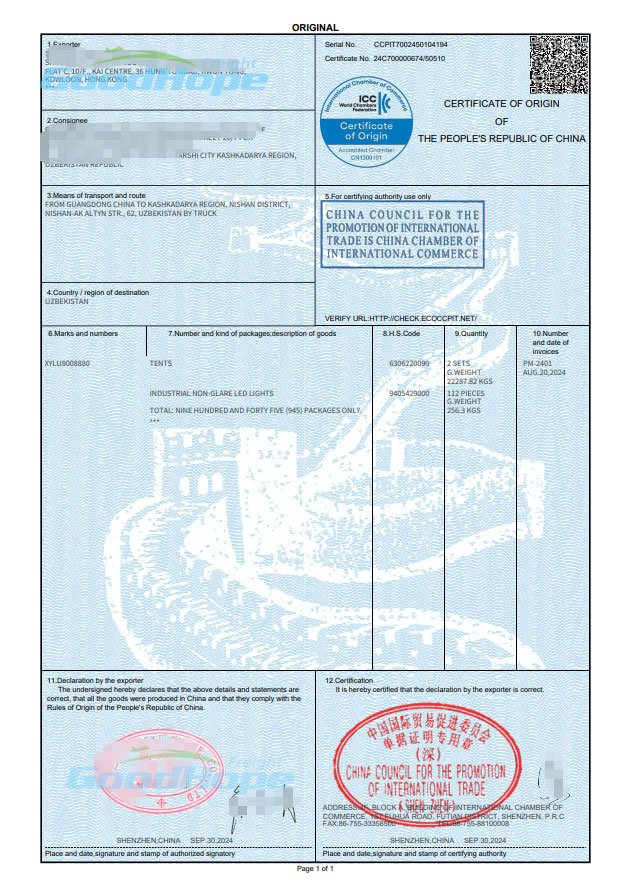
The confusion worth ending here: a plain CO and a Form S are both certificates of origin, printed on similar paper, issued by the same offices. A plain CO proves the goods are Chinese and buys nothing under the agreement. Form S claims the agreement rate. Handing a Swiss broker a CO when the entry claims the agreement rate gets the claim refused.