
Home / Shipping to Hungary / How to Ship from China to Hungary
How to Ship from China to Hungary: 27% ÁFA, EKAER & Danube Routing
Hungary has three characteristics that a new importer will not guess from the freight quote, and each of them costs money if discovered late. The first is that Hungary charges 27% VAT, the highest rate in the European Union. The second is that it runs its own road transport register, EKAER, which can stop a truck that nobody filed a number for. The third is that Hungary is landlocked but not riverless — the Danube gives it working inland ports that most routing plans ignore.
The VAT rate is the one that bites hardest. On a container of goods with a landed customs value of €10,000, the ÁFA line is €2,700. That money is recoverable if you are registered, but recoverable is not the same as free: it is your cash sitting with the tax authority until the return is filed. For a business importing regularly, the difference between paying that at the border and accounting for it on a return is a working-capital decision worth more than most freight discounts.
Everything else is standard EU. Hungary has been in the customs union and single market since 2004, duty comes from the TARIC code, and the customs and tax administration is a single body, NAV. The complication is not the rules themselves but the three Hungarian particulars above, and the fact that they are invisible until someone mentions them.
This guide is written for buyers importing from China for the first time. It covers what the 27% rate actually does to your budget, how cargo physically reaches Budapest, the gateway choice, rail and the Danube ports, trade terms and the inland leg nobody prices, the documents NAV asks for and how to lock down a commodity code in advance, EKAER, product rules including lithium batteries, and how to tell whether a forwarder knows this lane.
Hungary at a glance
- ÁFA 27% — the highest standard VAT rate in the EU. Reduced rates of 18% and 5%. Recoverable only if you are registered.
- Landlocked, with a river. Danube ports at Csepel (Budapest), Baja and Győr-Gönyű; access seaports Koper, Rijeka, Trieste, Constanța, Hamburg and Rotterdam.
- BILK, the Budapest Intermodal Logistics Centre, is the main rail terminal. Air cargo lands at Budapest Ferenc Liszt (BUD), with Debrecen growing.
- NAV — Nemzeti Adó- és Vámhivatal — runs tax and customs in one administration.
- EKAER road transport registration. Narrowed to risk categories since 2021; bulk B2B road movements still need a number before the vehicle moves.
- EU member since 2004. EU customs union and single market. Duty from the TARIC code. No EU–China free trade agreement.
- Plan around the calendar. Hungarian public holidays in March, August and October stop depots and authorities, and weekend driving bans apply to trucks over 7.5 tonnes.
How your cargo moves: China to Hungary
Eight steps from your supplier's door to yours. The last four are the ones shaped by local rules.
- Pickup from your supplierWe collect the goods anywhere in China and bring them to our consolidation point.
- Export clearanceChina customs declaration filed and released before the goods move to the port.
- Loading and departureContainer loaded, sealed and handed to the carrier at the Chinese port.
- Main carriageOcean, air or rail movement booked on the route agreed for your cargo.
- Arrival at the gatewayDischarge at the port or airport of entry, recorded on the carrier's manifest.
- Import clearanceCustoms declaration filed locally, with duty and tax assessed on the declared value.
- Customs releaseGoods released into free circulation once duty and tax are settled.
- Final deliveryOnward movement to your delivery address, warehouse or nominated depot.
Duty rates, VAT rates and clearance times move, and the figure that applies to your goods is the one set for your commodity code on the day of clearance. We check the current position against your code before your goods sail and confirm it to you in writing — ask for that check when you request a quote.
What 27 percent ÁFA does to a Hungarian import budget
The rate itself is simple. Hungarian VAT, ÁFA, is 27% on the standard rate, with reduced rates of 18% and 5% for defined categories. Two other numbers matter more than the rate: what it is charged on, and when you get it back.
Import ÁFA is not charged on the invoice value. It is charged on the customs value plus the customs duty plus the costs of getting the goods to their first destination in the EU. Freight and insurance are inside the base, which surprises buyers who assumed tax was calculated on what they paid the factory.
Then there is timing. A Hungarian VAT-registered business reclaims import ÁFA as input tax on its periodic return, which is normally monthly and due on the 20th of the month following the period. So the practical cycle is: pay 27% at clearance, wait, reclaim it. On regular imports that is a permanent float of roughly one to two months' worth of VAT sitting with the state, and on a high-value container it is a large number.
There are three legitimate ways to reduce that exposure, and they suit different situations:
| Approach | How it works | Who it suits |
|---|---|---|
| Pay and reclaim | Pay import ÁFA at clearance, deduct it as input tax on the next monthly return. | Most importers, especially on occasional shipments. Simple, but it costs you the float. |
| Deferred or postponed ÁFA accounting | With a NAV permit, import ÁFA is accounted for on the periodic return instead of paid at the border. | Large, established, demonstrably compliant importers. Eligibility is restrictive — see the dedicated section below. |
| Bonded or VAT warehousing | Duty and import ÁFA stay suspended while goods sit in an approved warehouse, and only fall due when they are released for free circulation. | Anyone re-exporting or distributing onward, and anyone who does not need all the stock immediately. |
If you are importing as a private individual, none of this applies. You pay the 27% and it stays paid. On a €10,000 landed customs value that is €2,700 you will not see again, and it belongs in your budget as a cost.
Landlocked again, but with a river: how cargo reaches Budapest
Hungary has no sea coast, so every container enters through a port in another country. What it does have is the Danube, and that changes the inland picture in a way most quotations ignore.
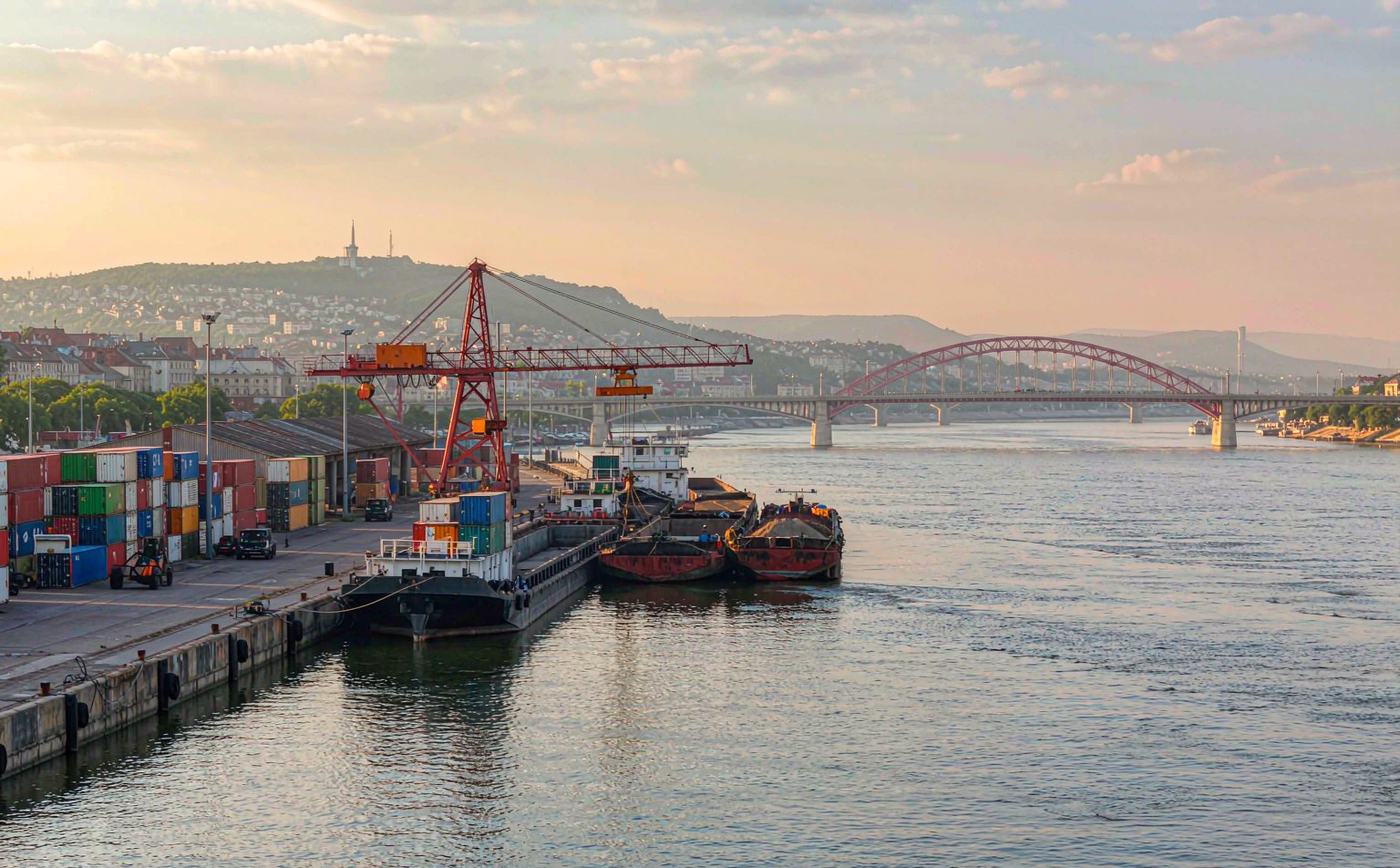
The Danube gives Hungary working inland ports at Csepel in Budapest, Baja in the south and Győr-Gönyű in the north-west. These handle barge traffic and, for heavy or bulky cargo, are a genuine alternative to rail over the last leg. The honest caveat is that river capacity and schedule are less predictable than rail, and low or high water can interrupt service, so treat barge as an option rather than a plan.
The main inland node is BILK, the Budapest Intermodal Logistics Centre, where containers arrive by rail from the seaports and are dispatched by road. Road movements run on the M1 towards Vienna, the M5 towards Serbia and the M0 ring around Budapest, and two local rules catch out foreign shippers: weekend and public holiday driving bans for trucks over 7.5 tonnes, and the HU-GO distance-based toll which applies from 3.5 tonnes. A container that arrives on a Friday afternoon may simply wait.
Delivery geography matters more here than people expect. Western Hungary around Győr and Szombathely is closer to the Adriatic and Austrian corridors; eastern Hungary around Debrecen and Szeged is better served from Constanța; the battery and automotive clusters at Győr and Debrecen generate their own regular flows. Tell your forwarder the delivery town, not just the country.
Koper, Rijeka or Constanta: Adriatic and Black Sea gateways compared
Choosing the seaport is the decision that determines both your transit time and your inland cost. Here is how the realistic options compare:
| Gateway | Where it is | Where it suits | Trade-off |
|---|---|---|---|
| Koper | Slovenia, northern Adriatic | The default for most of Hungary; the shortest inland run to Budapest | Well-developed rail shuttle to BILK. The usual fastest routing: Ningbo to Koper to Budapest runs around 30 to 34 days in total. |
| Rijeka | Croatia, northern Adriatic | Southern and western Hungary; an alternative when Koper is tight | Similar sea position with a slightly longer inland leg; useful for capacity. |
| Trieste | Italy, northern Adriatic | Western Hungary and the Austrian corridor | Comparable Adriatic position; worth pricing alongside Koper when schedules differ. |
| Constanța | Romania, Black Sea | Eastern Hungary around Debrecen, Szeged and Békéscsaba | The natural gateway for the east. Longer sea leg from China but a much shorter inland run to eastern delivery addresses. |
| Hamburg / Rotterdam | North Sea | When a specific service or price makes it worthwhile | Deep capacity and frequent sailings, but the longest inland leg to Budapest — a Qingdao to Rotterdam to Budapest routing runs around 42 to 45 days. |
Notice the spread: roughly 30 to 34 days on the fastest common routing versus 42 to 45 on the slowest. That is more than a week of difference for the same origin country, and it comes entirely from which seaport you picked.
One caution that applies across all of them: the sea routing of the service matters as much as the port's position. Whether a service runs via Suez or around the Cape of Good Hope changes which of these gateways is genuinely faster, and that has shifted more than once since 2023. Ask for the actual routing for your cargo-ready date rather than accepting last year's answer.
Rail and air into Hungary, and the Danube ports nobody mentions
Rail is a live option into Hungary. Trains from Chinese inland hubs run west and reach Budapest as the main Hungarian terminal, with onward road delivery to Győr, Debrecen, Szeged and Pécs, and further connections into Slovakia, Romania and the Balkans. Station-to-station times commonly run 18 to 25 days, and door-to-door including pickup, export clearance, EU import clearance and final delivery is typically 25 to 35 days. Hungary sits on the Orient/East-Med and Rhine-Danube rail freight corridors, which is why the service exists at all.
The restrictions are the usual ones for the northern corridor and they are enforced: dangerous goods of any class are not carried, loose lithium batteries and most battery-powered products are excluded, and chemicals need a non-hazardous safety appraisal issued before booking. Given Hungary's battery cluster, that exclusion catches a surprising number of first enquiries. Full detail on our dangerous goods to Hungary and non-DG chemicals to Hungary pages.
Air freight lands at Budapest Ferenc Liszt (BUD), with Debrecen handling a growing share. Airport-to-airport is about three to seven days, and express courier runs one to five days door to door with the courier handling clearance. Air is the answer for high-value electronics and for production stoppages, and chargeable weight rules mean a light bulky carton costs far more than the buyer expects.
The Danube option deserves one more mention because it is genuinely under-used. For heavy, non-urgent cargo — steel, machinery, bulk building products — barge to Csepel, Baja or Győr-Gönyű can undercut the rail leg. It is slower and less predictable, so it suits planned replenishment rather than a launch date.
Trade terms on a Hungarian order, and the inland leg nobody prices
The three letters on your supplier's quotation decide who pays for the inland leg, and for a landlocked destination that leg is a meaningful part of the total cost. It is also the part most often left unpriced.
| Term | Supplier handles | You handle | Note for Hungary |
|---|---|---|---|
| EXW | Goods at the factory door. | Everything from pickup onward. | Only workable with your own agent in China. |
| FOB | Goods on board at the Chinese port, export clearance done. | Main carriage, insurance, Hungarian clearance, duty, ÁFA, inland leg. | The usual recommendation — you choose the gateway and can see the inland cost. |
| CIF | Carriage and insurance to a named port. | Clearance, duty, ÁFA, inland leg, all destination charges. | CIF needs a named port. "CIF Budapest" is not a valid term. Ask which port is named and who pays Koper-to-Budapest. |
| DAP | Delivery to your Hungarian address. | Unloading, clearance, duty and ÁFA. | Works if you are VAT-registered and want to reclaim the ÁFA yourself. |
| DDP | Everything including duty and taxes. | Unloading. | Simple to receive. Ask where they clear: if it is Koper rather than Hungary, you lose visibility of classification and of the VAT treatment. |
The second question behind any of these terms is who is the importer of record and where does release for free circulation happen. If the container is cleared at Koper, duty and ÁFA are assessed in Slovenia and the goods travel to Hungary as an intra-EU movement. If you want the import in your own Hungarian VAT return, the container needs to move under a transit procedure and be released in Hungary. Neither is wrong, but they produce different paperwork, different cash timing, and different people holding the liability.
Our DDU and DDP and local charges pages cover the detail of what lands at the destination end.
The documents NAV will ask for, and the ruling that settles them
Hungary's customs and tax administration is NAV, the Nemzeti Adó- és Vámhivatal, a single body handling both. That structure means the authority clearing your goods is the same authority that later audits your VAT, and it is a reason to treat declaration data as a compliance record rather than as shipping paperwork.
The document set is the standard EU one: commercial invoice with a description that matches the declared commodity code, packing list with weights and dimensions, bill of lading or air waybill or CIM/SMGS rail consignment note, the importer's EORI number, certificate of origin where a preference is claimed, and conformity documents such as the CE declaration of conformity for regulated products.
The Hungarian tool worth knowing about is the advance tariff ruling. Through NAV you can request an official determination of the applicable commodity code and duty rate before the goods ship. For a business importing the same product line repeatedly, this takes classification out of the realm of argument: cost certainty before the cargo leaves China, faster clearance because the code is pre-approved, and no post-clearance dispute about whether the code was right. It is under-used by first-time importers, who tend to discover classification as a problem rather than settle it as a step.
Two more administration details. Hungarian VAT returns are normally monthly, due on the 20th of the month following the period. And once you are issuing invoices under a Hungarian VAT number, Hungary operates Online Számla, a real-time invoice data reporting system feeding NAV — so your invoicing software needs to be able to talk to it. That is not an import requirement, but it arrives shortly after your first sale.
More on our import clearance documents page.
Postponed ÁFA accounting, and who actually qualifies for it
This is the subject where public information is most contradictory, so it is worth being precise about what is settled and what is not.
The settled part. The ordinary route is that import ÁFA is paid at clearance and reclaimed as input tax on the periodic VAT return. Any Hungarian VAT-registered business with a full deduction right can do this, and for most importers this is the reality.
The part that needs checking. Hungary also has a deferment arrangement under which a qualifying importer accounts for import ÁFA on the periodic return instead of paying it at the border. Published eligibility criteria are restrictive and include being classified as a reliable taxpayer, having a high proportion of zero-rated export or intra-EU supplies, holding AEO certification, and meeting a substantial annual turnover threshold. Some industry guidance describes the mechanism as broadly available to VAT-registered importers; other guidance describes it as a permit for large, low-risk businesses. Treat the published criteria as the position to verify, not as a promise, and confirm your own eligibility with NAV or a Hungarian tax adviser before you build a cash-flow plan around it.
An honest rule: budget on the assumption that you will pay ÁFA at clearance and reclaim it, and treat any deferment approval as upside. A plan that depends on a permit you have not been granted is a plan that breaks on your first container.
There are two alternatives that do not depend on a permit. Bonded and VAT warehousing suspend duty and import ÁFA until goods are released for free circulation, which suits anyone re-exporting or distributing onward. And there is a relief reported for goods imported into Hungary and then re-exported or dispatched to another member state within a short window — commonly described as 30 days — under strict conditions including Hungarian VAT registration and sometimes a financial guarantee. Both are worth asking a Hungarian adviser about if your business is a transit or distribution model rather than a domestic one.
One limit to keep in mind: customs duty is not deferred by the VAT scheme. Only the ÁFA component moves to the return.
EKAER: the Hungarian road rule that can stop your truck
EKAER — the Elektronikus Közúti Áruforgalom Ellenőrző Rendszer — is Hungary's electronic road transport control system, run by NAV to track goods moved by road and to detect VAT fraud. If your road movement falls in scope and no number has been filed, the vehicle can be stopped and the goods seized.
Its scope was narrowed considerably on 1 January 2021, following European Commission pressure on free-movement grounds. Before that it covered almost all B2B road freight crossing the Hungarian border. Since then it has applied to risk-product categories, plus bulk movements above set thresholds.
| Category | Reported threshold | Examples |
|---|---|---|
| Non-risk goods | Gross weight above 2,500 kg, or tax-base value above HUF 5,000,000 per truck per consignee | General merchandise moved in bulk. A full container comfortably exceeds the weight threshold. |
| Risk goods | Gross weight above 500 kg, or tax-base value above HUF 1,000,000 | Certain foods including meat, dairy, sugar and some oils listed in the EKAER decree annex; fuels; certain chemicals; building materials. |
| Ordinary e-commerce parcels | Outside scope in 2026 | Clothing, consumer electronics and accessories sent by courier or post generally do not need a number. |
How it works in practice: before the vehicle loads, a notification is opened in the NAV portal or by API, giving the sender and consignee tax numbers, origin and destination addresses, a description of the goods with the VTSZ customs code, gross weight, cargo value, vehicle registration plate and planned arrival window. NAV returns a 15-character EKAER number that must accompany the load. The notification can be amended — plate change, weight tolerance — right up to the moment the shipment arrives.
Who files depends on the direction: for goods coming into Hungary, the obligation generally sits with the consignee. Penalties for a missing or inaccurate notification run to 40% of the cargo value, and seizure of the goods is possible.
Practical checklist: if you move bulk B2B freight by road in Hungary, check the gross weight and value against the thresholds above, confirm whether your product is on the current risk list, and agree in writing who files the EKAER number before dispatch. Thresholds and the risk list are updated periodically, so verify against current NAV guidance each time you plan a movement.
What the tariff code decides, and how to lock it down early
Duty in Hungary is EU duty. There is no separate Hungarian tariff: the rate comes from TARIC along with any trade-remedy or restriction measures attached to the code. There is no EU–China free trade agreement, and China has largely graduated out of the EU's preferences scheme, so most Chinese goods pay the standard rate for their code.
What tends to matter more than the rate is what the code triggers alongside it. This is where Hungary's import profile makes a difference:
| Common import | What the code and category trigger |
|---|---|
| Electronics and consumer devices | CE marking with EMC and safety documentation, WEEE registration, and usually a battery inside the device — which changes how it can travel. |
| Lithium batteries and battery packs | Dangerous goods classification under UN3480 or UN3481, a UN38.3 test summary, DG packaging and documentation, and exclusion from most rail services. Hungary's battery plants around Debrecen and Győr make this a routine enquiry. |
| Automotive parts and accessories | Classification often turns on whether the part is vehicle-specific or generic. Type approval and REACH questions follow for some categories. |
| Machinery and industrial equipment | CE marking under the Machinery Regulation, a declaration of conformity and a technical file, plus Hungarian-language instructions. |
| Textiles, furniture and home goods | Material and construction drive the code; labelling and, for furniture, treatment declarations can apply. |
| Food-contact articles, cosmetics, chemicals | Sector-specific certificates and REACH or CLP obligations, usually a bigger hurdle than the duty rate. |
On small consignments: the EU relief for goods valued at €150 or less was removed from 1 July 2026 and replaced with a flat charge of €3 per tariff line for consignments up to that value. The older €22 VAT relief was abolished across the EU back in 2021, so import ÁFA is charged regardless of value. Some marketplace pages still quote the old figures, which is worth knowing before you rely on them.
And the point from the documents section bears repeating here: if you are going to import the same product repeatedly, apply for an advance tariff ruling from NAV before the first shipment. It converts classification from a risk you carry for years into a decision you hold in writing.
CE marking, REACH and EPR before a Hungarian buyer will list you
Customs release is not permission to sell. Hungarian distributors and market surveillance ask for product documentation, and they ask early.
- CE marking with a declaration of conformity and technical file behind it, for machinery, electrical equipment, toys, PPE, medical devices and construction products. The mark alone is not evidence.
- GPSR, the General Product Safety Regulation, requires an identifiable responsible person established in the EU for most consumer products. If you import, that may be you.
- REACH and CLP for chemicals and mixtures, plus separate regimes for cosmetics and food-contact articles.
- EPR obligations for packaging, electrical equipment and batteries placed on the Hungarian market. Registration is usually handled through a collective compliance scheme, and distributors often ask for proof before listing a product.
- Hungarian-language documentation. Instructions, safety information and consumer labelling generally need to be in Hungarian. Customs will not check this; your customer will.
- Batteries and dangerous goods need UN38.3 test summaries, correct packaging and DG documentation, and they change the transport mode available to you.
The cheapest insurance remains asking the factory for the declaration of conformity, the test reports behind it and Hungarian-language artwork before the container ships. If they cannot produce them, the problem is not shipping.
A private buyer and a registered Hungarian business compared
As a private individual
You can import personal goods and pay duty plus 27% ÁFA, and NAV will ask for the same documents as for a commercial shipment. You cannot reclaim the ÁFA, deferment is not available to you, and you may be asked to show the goods are for personal use rather than resale. For a one-off personal purchase this is acceptable. For anything you intend to sell, it is an expensive way to operate.
As a registered business
A Hungarian company — commonly a Kft. — needs a tax number, an EU VAT number for cross-border trade and an EORI number, with the EORI application made through NAV. In exchange, import ÁFA becomes recoverable, bonded warehousing and any deferment become discussable, and you can invoice Hungarian customers properly. Businesses established outside the EU typically appoint a fiscal representative and register on their first taxable supply.
The deciding question is whether you will resell. If yes, register before the goods arrive, because retrofitting VAT registration onto a container already in the country is slow and expensive.
Finding a factory you can actually audit
Most first-time importers meet their supplier on a screen. Marketplaces are fast and transparent on price, and they tell you nothing about whether the seller is the manufacturer, whether the product has been tested for EU conformity, or whether the listing matches what will ship.
There is a pattern worth naming in this market: many Hungarian businesses buy through Austrian or German trading houses before they ever import directly. Going direct to China is the step that changes your margin, and it is also the step that moves classification, product compliance, VAT and EKAER obligations onto you. That is a good trade once you have volume, and a poor one for a single experimental line.
The two questions to ask any marketplace seller are the same everywhere: can you provide a CE declaration of conformity and test report for this exact model, and will the commercial invoice describe the goods the way customs requires? Then order samples from three shortlisted suppliers, and visit the one that survives sampling.
On consolidation: several small suppliers into one container at a Chinese warehouse is usually faster and cheaper per cubic metre than several LCL shipments, and gives you one set of documents and one clearance. See our warehouse and consolidation and consolidated shipment pages.
How to test a forwarder who claims to know Hungary
Every item below is one question you can ask before paying anything, and each one separates someone who runs this lane from someone reselling generic space.
- Which seaport and which Hungarian terminal? If the answer is only "Hungary", the quote is generic.
- Have they heard of the Danube ports? Csepel, Baja and Győr-Gönyű are real options for heavy cargo. A forwarder who has never mentioned them is quoting rail by default.
- Do they ask whether your goods are EKAER-relevant before quoting a road leg? A bulk B2B road movement without a filed number is a 40% penalty risk.
- Do they know ÁFA is 27% and can they explain the deferment honestly? The right answer distinguishes paying-and-reclaiming from the permit-based deferment and does not promise the latter.
- Are they straight about lithium batteries? If they offer rail for loose lithium cells, they have not read the corridor restrictions.
- Do they warn about weekend driving bans and the HU-GO toll? These are routine on Hungarian road legs and they affect delivery promises.
- Do they quote all-in, in writing, with a validity period? An all-in figure naming terminal handling, documentation and inland delivery beats a low headline plus "plus local charges".
- Do they hold a Chinese NVOCC registration and run their own consolidation warehouse? Both are checkable.
- Do they offer cargo insurance and explain the exclusions? See our cargo insurance page — carrier liability limits sit far below cargo value.
- Do they say what they do not do? Hungarian import clearance, ÁFA accounting, EKAER filing and product registration belong to the importer of record. A forwarder claiming all of it is overstating.
From the factory to a Hungarian warehouse, in order
Classify the product and decide the mode
Settle the commodity code — consider an advance tariff ruling from NAV if you will repeat the import — and confirm whether the goods are dangerous, battery-powered or chemical, because that decides whether rail is available at all.
Agree the trade term and name the gateway
FOB for most first imports. Make the forwarder name the seaport and the Hungarian terminal, and confirm who pays the inland leg.
Register on the Hungarian side
EORI first, Hungarian VAT registration before the goods arrive if you intend to reclaim ÁFA. Set up access with NAV and authorise your broker.
Collection, consolidation and export clearance in China
Goods are collected from one or several factories, consolidated if needed, and cleared for export.
Main carriage to the gateway port
Ocean, rail or air. Track the shipment and watch for routing changes that alter which gateway was the right choice.
Inland leg to the Hungarian terminal
Rail shuttle to BILK, barge to a Danube port, or road — remembering the weekend driving ban on trucks over 7.5 tonnes. If you are clearing in Hungary rather than at the seaport, the container moves under transit with duty and VAT suspended.
Clearance, duty and ÁFA
The import declaration is filed with NAV, duty is paid, and import ÁFA is either paid at clearance or accounted for on the return if a deferment permit is in place. Keep the declaration — NAV audits both tax and customs.
Road delivery and the EKAER check
Before the truck loads, confirm whether the movement is EKAER-relevant and who files the number. Then final delivery to your address.
A first container into Budapest, and the bill that surprised them
A distributor serving the Debrecen battery cluster came to us with a first order from two Shenzhen suppliers: lithium-ion battery packs and the chargers that go with them, around 20 CBM in total. The buyer had been quoted a single door-to-door number and had assumed the whole thing would travel by rail, because that was the mode the supplier's agent had suggested.
The first surprise was the mode. Loose lithium battery packs are dangerous goods under UN3480 and UN3481 and are excluded from most China–Europe rail services. That removed the 18-to-25-day option entirely and put the shipment on sea freight with dangerous goods handling into Koper, then rail to BILK. The transit got longer and the plan had to be rebuilt, but it was rebuilt before booking rather than discovered at the terminal.
The second surprise was the ÁFA line. At 27% on customs value plus duty plus freight, the import VAT on this container was a five-figure sum, and the buyer had budgeted on the assumption that being VAT-registered meant not paying it. It does not — it means being able to reclaim it. We said so plainly at quotation stage and the buyer arranged the cash, which is a much cheaper outcome than discovering it at clearance. Deferment was discussed and, on the published eligibility criteria, was not realistically available to a business of that size on a first import.
The third item was EKAER. A full container of battery packs is comfortably over the 2,500 kg gross weight threshold, so the road leg from the terminal needed an EKAER number filed by the consignee before the vehicle loaded. Nobody had mentioned it. Arranged in advance it was a form in a portal; discovered at a roadside check it would have been a penalty measured as a percentage of the cargo value.
The container cleared and reached Debrecen. What decided it: all three issues were knowable three weeks before the vessel sailed, and one question at quotation stage would have surfaced each of them.
Goodhope's role before a Hungarian consignment sails
Goodhope Freight has been moving cargo out of China since 2012, operating as a licensed NVOCC (registration GD20230925153335) from Shenzhen. On a Hungarian shipment our value is concentrated in the part that happens before the vessel leaves.
- Ocean freight port to port — FCL and LCL to Koper, Rijeka, Trieste, Constanța, Hamburg or Rotterdam, with the reason for the choice written down.
- We name the gateway and the inland routing — and tell you when a routing change makes a different port the better answer.
- We check the mode question early — lithium batteries, dangerous goods and chemicals change what is possible, and we would rather say so at quotation than at booking. See our reefer containers to Hungary and LCL to Hungary pages for the service range.
- Rail into Budapest where the cargo allows it — 18 to 25 days station to station, with an honest answer on restrictions.
- Air freight to Budapest Ferenc Liszt — airport to airport, with chargeable weight worked out before you book.
- Consolidation in China — several suppliers, one container, one set of documents, one clearance.
- Documents checked before sailing — commodity codes, descriptions and conformity paperwork, because that is where Hungarian clearance problems start.
- Plain answers on what we do not do — Hungarian import clearance, ÁFA accounting, EKAER filing and product registration belong to the importer of record or their Hungarian representative. We coordinate with them and we do not pretend otherwise.
Why importers use Goodhope on this lane
Six things that are different about working with us on China to Hungary shipments.
What we see across Hungary
Five shipments bought in China and delivered into Hungary, told end to end — where the order came from, how it moved, where it nearly went wrong, and how it finished. Client names are withheld at their request; the situations and the handling are what we deal with on this lane.
Twenty-seven per cent · first container · Shenzhen to Budapest
The purchase. A buyer new to importing worked his landed cost on the rate he knew from a neighbouring country.
The move. Full container with twenty-seven per cent modelled from the start, alongside duty.
Where it nearly went wrong. The rate here is the highest in the European Union and it is charged on the duty-inclusive value. Reusing a figure from elsewhere understates the landed cost by more than the freight on most consignments.
How it finished. We rebuilt his costing. He repriced before quoting and kept the customer.
Gateway choice · total cost · Ningbo to Hungary
The purchase. A first-time buyer picked the lowest ocean rate without comparing the onward legs.
The move. Full container compared across all three sea gateways on door cost rather than freight.
Where it nearly went wrong. Koper, Rijeka and Constanta each open a different inland route, and the differences in the onward leg usually exceed the difference in the ocean rate. Comparing only the freight compares the wrong thing.
How it finished. We quoted all three door to door. He switches between them now as routings change.
EKAER · the truck stopped · Guangzhou to Hungary
The purchase. A buyer moving cargo by road did not know the road registration requirement existed.
The move. Full container with the road movement registered before the truck left the port.
Where it nearly went wrong. Road transport into Hungary needs its own registration, and it has to be in place before the vehicle moves. Finding out at a roadside check means an immobilised truck rather than a form-filling exercise.
How it finished. We registered before dispatch. No Hungarian road leg of his has been stopped since.
Postponed accounting · cash flow · Yiwu to Hungary
The purchase. A buyer budgeted the twenty-seven per cent as cash payable at the border on every shipment.
The move. Full container with postponed accounting applied where the importer qualified for it.
Where it nearly went wrong. Registered importers may be able to account for the tax rather than paying it in cash at entry, which turns a payment into an accounting entry. It depends on how the importer is registered, so it is confirmed rather than assumed.
How it finished. We confirmed the treatment with his accountant. He stopped holding cash against every arrival.
CE, REACH and EPR · before he lists you · Shanghai to Hungary
The purchase. A buyer assumed his CE marking alone would satisfy a Hungarian distributor.
The move. Consolidated sea freight with environmental compliance and registration handled before shipment.
Where it nearly went wrong. A Hungarian buyer asks about extended producer responsibility and chemical compliance before he asks about freight, along with CE. Goods that clear customs can still be unsaleable if that file is not in order.
How it finished. We flagged the full list at quotation. His distributor accepted the file on first submission.
Why importers use Goodhope on this lane
Six things that are different about working with us on China to Hungary shipments.
Ask us to cost a Hungarian shipment from China
Send us the product and its commodity code if you have it, whether it contains batteries or chemicals, the carton count and total weight or volume, the supplier's city and your delivery town in Hungary. We will name the gateway and the terminal, tell you honestly which modes your cargo can use, and itemise the destination charges so the ÁFA line is not a surprise.
Frequently asked questions
What is the VAT rate on imports into Hungary?
Hungary's standard VAT rate, AFA, is 27%, the highest in the European Union, with reduced rates of 18% and 5%. Import AFA is charged on the customs value plus duty plus the costs of moving the goods to their first destination in the EU, not on the invoice value alone. Businesses registered for Hungarian VAT reclaim it as input tax on their periodic return, which is normally monthly and due on the 20th of the following month. Private individuals cannot reclaim it.
Can I avoid paying Hungarian import VAT in cash at the border?
Sometimes, but not automatically. The ordinary route is to pay import AFA at clearance and reclaim it as input VAT on the next return. Hungary also has a deferment arrangement under which qualifying importers hold a NAV permit and account for import AFA on their periodic return instead of paying at the border; published eligibility criteria include reliable taxpayer status, a high proportion of zero-rated export or intra-EU supplies, AEO certification and a substantial annual turnover threshold. Public sources disagree on how accessible this is, so confirm your own position with NAV or a Hungarian tax adviser before budgeting around it.
What is EKAER and when is it required?
EKAER is Hungary's electronic road transport control system operated by NAV, and it requires certain goods movements by road to be registered before the vehicle starts, producing a 15-character number that travels with the load. Since 1 January 2021 its scope has been narrowed to risk-product categories. Reported thresholds are a gross weight above 2,500 kg or a tax-base value above HUF 5,000,000 for non-risk goods, and above 500 kg or HUF 1,000,000 for risk goods such as certain foods, fuels, chemicals and building materials. Ordinary e-commerce parcels are outside the current scope, but bulk B2B road movements are not. Penalties run to 40% of cargo value and the goods can be seized.
Which seaport should I route a Hungarian shipment through?
Hungary is landlocked, so the choice is a foreign gateway plus an inland leg. Koper and Rijeka on the Adriatic are the shortest runs to Budapest and suit most of the country; Trieste is a nearby alternative; Constanta on the Black Sea suits eastern Hungary around Debrecen and Szeged; Hamburg and Rotterdam work but add a longer inland leg. As a rough guide, a Ningbo to Koper to Budapest routing runs around 30 to 34 days in total, while a Qingdao to Rotterdam to Budapest routing runs around 42 to 45 days.
How long does shipping from China to Hungary take?
Sea freight is about 30 to 45 days door to door depending on the gateway and origin port, with LCL adding roughly five to ten days for consolidation and deconsolidation. Rail from Chinese inland hubs into Budapest is commonly 18 to 25 days station to station, and about 25 to 35 days door to door. Air freight into Budapest Ferenc Liszt is about three to seven days airport to airport, and express courier one to five days door to door. Add time for Hungarian public holidays in March, August and October, and for weekend driving bans on trucks over 7.5 tonnes.
Do I need an EORI number to import into Hungary?
Yes. Any business importing into the European Union needs an EORI number, and one issued by any member state is valid throughout the EU, so you do not need a Hungarian one specifically. Businesses established in Hungary apply through NAV, the National Tax and Customs Administration. It is a customs identifier, separate from a VAT number, and clearance cannot begin without it.
What documents does NAV require for import?
A commercial invoice with a description matching the declared commodity code, a packing list with weights and dimensions, the transport document being a bill of lading, air waybill or CIM or SMGS rail consignment note, the importer's EORI number, a certificate of origin where a preference is claimed, and product conformity documents such as the CE declaration of conformity. Hungary also offers an advance tariff ruling through NAV, which fixes the commodity code and duty rate before the goods ship and removes classification disputes later.
Is there a duty-free threshold for goods from China into Hungary?
The EU relief that exempted consignments valued at 150 euro or less from customs duty was removed from 1 July 2026 and replaced with a flat charge of three euro per tariff line for consignments up to that value. The older 22 euro VAT relief was abolished across the EU in 2021, so import AFA is charged regardless of value. Some marketplace pages still quote the old figures, which is worth knowing before you rely on them.
Can I ship lithium batteries from China to Hungary?
Yes, but not by the usual rail corridor and not as ordinary cargo. Lithium batteries are dangerous goods under UN3480 and UN3481, require a UN38.3 test summary, correct packaging and dangerous goods documentation, and are excluded from most China to Europe rail services. Plan on sea freight with dangerous goods handling or on air freight under the relevant airline rules, and tell your forwarder at enquiry stage rather than at booking. Hungary's battery manufacturing cluster around Debrecen and Gyor makes this a common question.
What does a Chinese freight forwarder handle on a Hungarian shipment?
On the China side a forwarder collects goods from the factory or factories, consolidates them if needed, clears them for export, books space and issues the bill of lading, air waybill or rail consignment note, and provides tracking. Goodhope works port to port on ocean freight and airport to airport on air freight, names the gateway port and the inland routing, and coordinates with your Hungarian broker. Hungarian import clearance, AFA accounting and any EKAER registration belong to the importer of record or their Hungarian representative.