
Home / Shipping to Kyrgyzstan / How to Ship from China to Kyrgyzstan
How to Ship from China to Kyrgyzstan: Bishkek, the EAEU Tariff & the Advance Ruling
Kyrgyzstan does not set its own import tariff — the Eurasian Economic Union does. The country joined the EAEU in 2015 and applies the union's common external tariff under the EAEU Customs Code, so procedures, tariff schedules and technical regulations are harmonised with Russia, Belarus, Kazakhstan and Armenia. For a buyer in China that is good news and bad news: the rules are more predictable than a small national tariff would be, but the product compliance rules are EAEU-wide rather than local, and they are not optional.
The second thing to settle early is who is the importer of record. Import business has to be conducted by a Kyrgyz-registered importer or by a licensed customs broker acting for one, and the declaration documents must be in Kyrgyz or Russian. A foreign company cannot simply file on its own account. That is an organisational question, not a paperwork one, and it needs answering before the cargo moves.
The third is that you can lock the classification in advance. Importers may request a binding advance ruling on tariff classification and customs valuation, issued within about thirty calendar days. On a lane where the border is a mountain pass and a dispute means a truck waiting, converting an argument into a settled position before departure is worth the effort.
At a glance
Country: landlocked and mountainous in Central Asia, bordered by China, Kazakhstan, Uzbekistan and Tajikistan; capital Bishkek. · Currency: the Kyrgyz som. · Customs regime: EAEU member since 2015, applying the EAEU Customs Code and common external tariff. · Duty: most rates reported between 0 and 10 percent, with some sources citing a wider 0–15 percent band and an average around 5–8 percent. · VAT: 12 percent on the customs value plus duty. · Excise: alcohol, tobacco and fuel. · Processing fee: reported around 0.15 percent of customs value; some sources quote 0.2 percent with a minimum. · Customs: the State Customs Service under the Ministry of Finance, with declarations filed electronically through ASYCUDA World. · Crossings: Irkeshtam and Torugart by road, Manas airport by air.
How your cargo moves: China to Kyrgyzstan
Eight steps from your supplier's door to yours. The last four are the ones shaped by local rules.
- Pickup from your supplierWe collect the goods anywhere in China and bring them to our consolidation point.
- Export clearanceChina customs declaration filed and released before the goods move to the port.
- Loading and departureContainer loaded, sealed and handed to the carrier at the Chinese port.
- Main carriageOcean, air or rail movement booked on the route agreed for your cargo.
- Arrival at the gatewayDischarge at the port or airport of entry, recorded on the carrier's manifest.
- Import clearanceCustoms declaration filed locally, with duty and tax assessed on the declared value.
- Customs releaseGoods released into free circulation once duty and tax are settled.
- Final deliveryOnward movement to your delivery address, warehouse or nominated depot.
Duty rates, VAT rates and clearance times move, and the figure that applies to your goods is the one set for your commodity code on the day of clearance. We check the current position against your code before your goods sail and confirm it to you in writing — ask for that check when you request a quote.
EAEU membership sets the tariff, not Kyrgyzstan alone
When you look up a duty rate for this lane, you are looking up an EAEU rate. That has a practical consequence worth understanding: the same code carries the same duty whether the goods clear in Bishkek, Almaty or Yerevan, and goods that have already cleared in one EAEU country circulate within the union without further duty. It also means the technical regulations your product has to meet are EAEU technical regulations, not a Kyrgyz national list.
What harmonisation gives you
- One tariff schedule across five markets
- Predictable classification under the EAEU HS
- Goods cleared in one member state move on without further duty
- A published route to a binding advance ruling
What harmonisation demands
- EAEU technical regulations apply to many consumer goods
- EAC conformity documentation is expected at retail
- The declaration is filed in Kyrgyz or Russian
- A local importer or licensed broker must file it
Torugart, Irkeshtam and where the box is opened
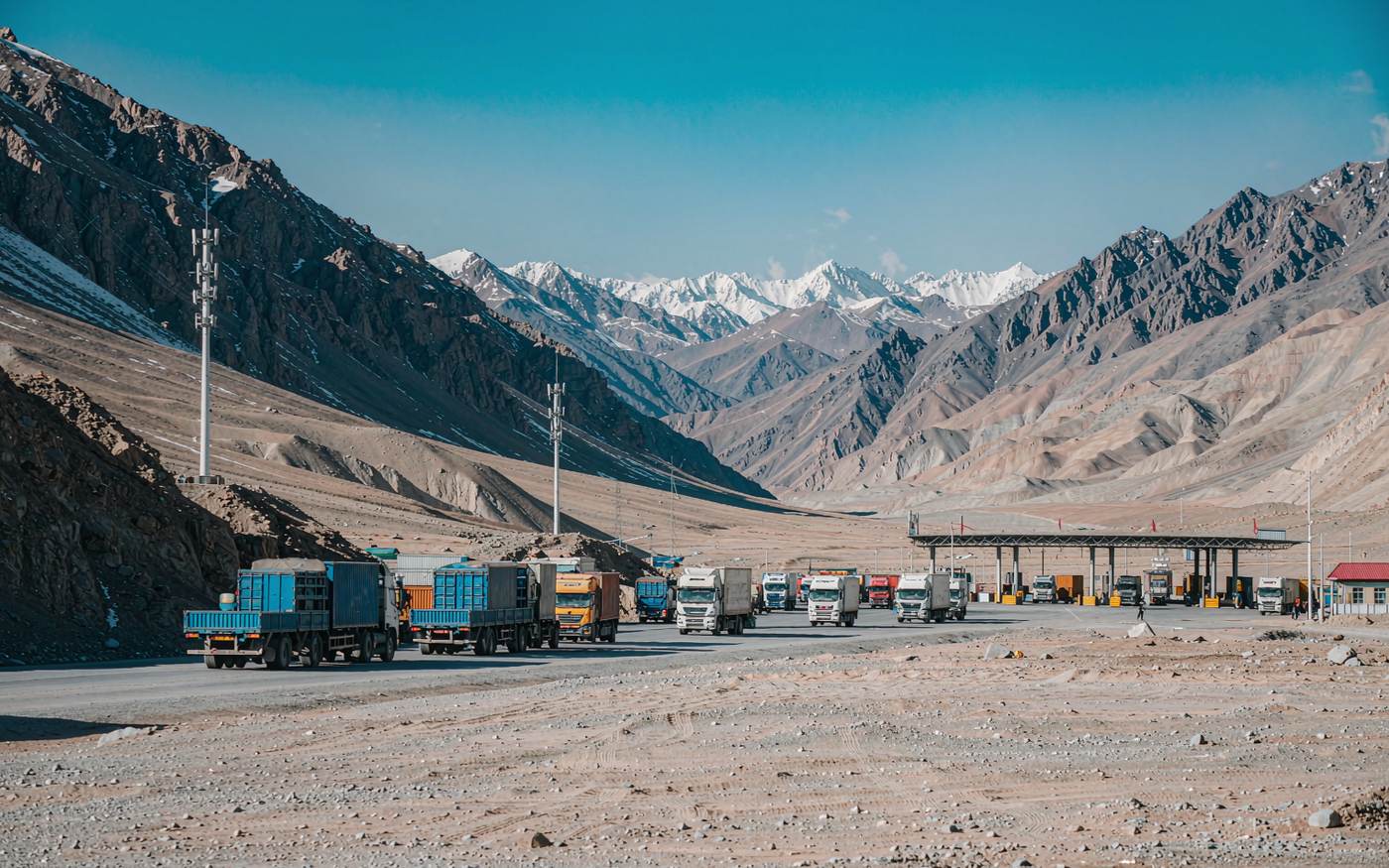
Most cargo from China arrives overland. The two main road crossings are Irkeshtam, administered by Osh customs, and Torugart, administered by Naryn customs, with Bedel as a further crossing. Air freight comes into Manas airport near Bishkek. Which crossing you use is usually decided by where in the country the consignee sits and by conditions at the pass.
Cargo reaching the border is normally required to enter clearance within a few working days, which is the reason the declaration file should be finished before the truck is, not after. Where the goods are moving on to another EAEU market, or where they arrived by a route that keeps them under customs seal, ask whether a TIR-qualified carrier can run them through to the final warehouse instead of being opened and re-checked at intermediate points.
Filing the declaration in Russian or Kyrgyz
The declaration is filed electronically, and published references describe ASYCUDA World as the platform used for customs data. The documents behind it are the familiar set — commercial invoice, packing list, bill of lading or airway bill, certificate of origin where preference is claimed, import licence or permit where the product needs one, and a certificate of conformity for regulated products.
Two requirements are specific enough to call out. First, the paperwork must be in Kyrgyz or Russian, so certified translation is a production-stage task. Second, the filing has to be done by a Kyrgyz-registered importer or a licensed customs broker. Where your buyer is new to importing, that is the first conversation to have, and it is the one that most often decides whether the first shipment goes smoothly.
Duty, the 12 percent VAT and the small processing fee
Three charges apply on most imports: duty, VAT and the processing fee, with excise on top for alcohol, tobacco and fuel. The order matters.
Customs value
Primarily the transaction value, with alternative methods such as deductive or computed value used where the declared value is judged inaccurate.
Customs duty
At the EAEU common external tariff rate for the code. Most rates are reported between zero and ten percent, with some sources citing a wider band and an average of around five to eight percent.
Excise
Only for alcohol, tobacco and fuel. For everything else this step drops out of the calculation.
VAT at 12 percent
On the customs value plus the duty. Budget it on that combined base, not on the invoice figure.
The processing fee is small, reported at around 0.15 percent of the customs value with some sources quoting 0.2 percent and a minimum in local currency, and the exact figure depends on the operation and the current schedule. Some categories carry reduced rates or exemptions — basic food items and some medications are commonly cited — and agricultural equipment and medicines are named in published guidance as benefiting. Check your own code rather than the product description.
Locking the code in advance with a binding ruling
This is the most underused tool on the lane. Importers may request an advance ruling on tariff classification and customs valuation from the State Customs Service. The request goes in writing with the product description, technical documentation and supporting material, and rulings are typically issued within thirty calendar days. The ruling is binding.
Use it when either of these is true: your product sits near a classification boundary and two plausible codes carry different rates, or your declared value is the kind that invites a query. Thirty days spent before departure is cheaper than a truck waiting at a mountain crossing.
Conformity certificates, and no mutual recognition with China
Certain categories require mandatory conformity confirmation in the EAEU — electrical equipment, machinery, food products, children's goods, medical devices and toys among them — and retail goods commonly need EAC conformity documentation. Published guidance for the lane recommends allowing fifteen to twenty days to complete certification before shipment.
The point that catches importers out is that China and Kyrgyzstan have not signed a mutual recognition arrangement for inspection certificates, and published commentary notes that border controls tightened after EAEU accession. Food consignments are described as needing an official Chinese health certificate and as being subject to sampling at the border. Treat certification as production-stage work that finishes before the goods leave, not as something the broker can sort at the crossing.
What to have ready
- Commercial invoice and packing list — consistent on description, quantity and value.
- Transport document — CMR for road, airway bill for air.
- Certificate of origin — from a recognised chamber where a preference is claimed.
- Certificate of conformity — where the HS code requires it, completed before departure.
- Official health certificate — for food, with sampling expected at the border.
- Import licence or permit — for alcohol, tobacco, pharmaceuticals, dual-use goods and weapons.
- SDS and classification report — for chemicals, declared to the emergencies ministry where required.
- Certified Russian or Kyrgyz translations — of the invoice and supporting documents.
Winter roads, TIR trucks and the last leg
Delivery inside the country is mostly by road, and the terrain is the reason seasonal planning matters. Published guidance for this lane advises using carriers equipped for winter conditions and taking out inland transit insurance covering jolting and handling damage, because the mountain road is where the damage happens rather than the sea leg.
Where the route qualifies, a TIR-qualified carrier is worth asking for: customs-sealed vehicles can run through to the final warehouse rather than being opened and re-checked at intermediate points, which removes both handling and a class of delay. Confirm the carrier actually holds TIR status rather than assuming it.
Preferential origin and what the certificate has to show
Preferential treatment depends on the arrangement being claimed, and the rules of origin follow that arrangement rather than being uniform. A certificate of origin from a recognised chamber of commerce is the usual starting point, and where preference is claimed the certificate has to evidence the origin criteria — the production or processing that confers origin — rather than simply naming a country of shipment.
The trap is promising a customer a reduced rate before checking qualification. Where the goods include imported inputs, the origin criteria often require a minimum level of regional value content, and the evidence for that has to exist at the manufacturer, not be reconstructed by the forwarder. Establish whether your product actually qualifies before the rate goes into a quotation.
Free economic zones and the 2026 tax measures
Kyrgyzstan operates free economic zones, including one at Bishkek, which run under a customs regime treated as outside the domestic customs territory — useful if you are holding stock for re-distribution rather than importing into the domestic market on arrival. Zone benefits generally require approved resident status rather than applying automatically on registration, so the application step is part of the plan.
Separately, published commentary describes a government resolution in May 2026 introducing targeted measures for Chinese market participants, under which a Chinese tax resident holding more than twenty percent of a Kyrgyz company may see dividend withholding tax reduced from ten to five percent on production of a tax residence certificate, with the measures stated to run to May 2027. That is a corporate tax matter rather than a freight one, and the eligibility rules are a matter for the local tax authority — worth knowing exists, not worth building a quotation on without advice.
The re-export trade and why it touches your paperwork
A large share of Chinese consumer goods entering Kyrgyzstan is destined for re-export across Central Asia, and Bishkek's Dordoi market is widely described as the region's main re-export hub. If your buyer is one of those traders, two things follow for your documents.
First, the goods may be intended to move on within the EAEU, which makes the correctness of the original import file more consequential than for a domestic sale — an error travels with the goods. Second, published guidance notes that inward processing and re-export can allow duty paid on imported inputs to be reclaimed, while exports using locally purchased inputs generally allow a VAT reclaim only. If your buyer intends to re-export, say so when you brief the broker, because it changes how the entry should be documented.
Why importers use Goodhope on this lane
Six things that are different about working with us on China to Kyrgyzstan shipments.
How it happens bound for Kyrgyzstan
Five shipments bought in China and delivered into Kyrgyzstan, told end to end — where the order came from, how it moved, where it nearly went wrong, and how it finished. Client names are withheld at their request; the situations and the handling are what we deal with on this lane.
No mutual recognition · certificates · Shenzhen to Bishkek
The purchase. A buyer new to importing presented his supplier's Chinese test reports and expected them to satisfy the entry.
The move. Consolidated cargo with conformity documents obtained to the union's requirements, separately from the Chinese ones.
Where it nearly went wrong. Membership of the customs union means its conformity system applies, and there is no recognition arrangement that carries Chinese certification across. The documents have to be raised in their own right.
How it finished. We obtained them before departure. His consignments have not been stopped on conformity since.
Language · filing · Guangzhou to Kyrgyzstan
The purchase. A first-time buyer prepared a full English documentation set, as he does for most lanes.
The move. Sea and road leg with the declaration prepared in Russian for filing.
Where it nearly went wrong. The declaration is filed in Russian or Kyrgyz through the customs system. An English-only document set is not refused; it simply does not get filed until it exists in one of the working languages.
How it finished. We build the translated set during transit now. Nothing waits at the crossing for language.
Winter · the road closes · Ningbo to Bishkek
The purchase. A buyer scheduled a December delivery through the mountain crossings.
The move. Consolidated cargo routed and timed around seasonal road conditions.
Where it nearly went wrong. The crossings sit high and the winter affects whether the road is passable at all. Planning a mountain crossing in deep winter is planning the exception rather than the shipment.
How it finished. We moved his order to early autumn. It crossed without incident.
Re-export · paperwork follows · Yiwu to Kyrgyzstan
The purchase. A buyer was confused why his paperwork faced more questions than the goods themselves.
The move. Consolidated cargo documented for onward movement, with the transit position stated up front.
Where it nearly went wrong. A meaningful share of what passes through here is re-exported, and that trade draws attention to declarations generally. Ordinary shipments get asked the questions the re-export trade created.
How it finished. We documented the transit position at entry. His shipments have cleared without repeated queries.
Lock the code · binding ruling · Shanghai to Kyrgyzstan
The purchase. A buyer importing a product that could sit under two codes picked one and hoped.
The move. Full container with the tariff code settled by a binding ruling before arrival.
Where it nearly went wrong. Classification here can be settled in advance rather than argued at the border. Doing it while the goods are moving rather than after they arrive keeps the difference between two codes from becoming a storage bill.
How it finished. He applies for the ruling on every new line now. None has been reclassified on arrival.
Why importers use Goodhope on this lane
Six things that are different about working with us on China to Kyrgyzstan shipments.
Lock the HS code while the goods are in transit
Tell us what you are shipping, the HS codes if you have them, the packed dimensions and gross weight, the pickup city in China and the delivery address in Kyrgyzstan. We will confirm which crossing is moving and quote road and air side by side, flag any code that looks like it needs EAEU conformity certification before the goods leave, arrange certified Russian or Kyrgyz documentation, and tell you plainly where an advance ruling is worth the thirty days. Where the buyer intends to re-export within the EAEU, we will document the entry accordingly.
Get a quote Talk to usRelated pages
Frequently asked questions
Does Kyrgyzstan set its own tariff?
No. It applies the EAEU common external tariff, harmonised with Russia, Belarus, Kazakhstan and Armenia. Most rates are reported between 0 and 10 percent.
How is the 12 percent VAT calculated?
On the customs value plus the duty. Excise applies to alcohol, tobacco and fuel, and a processing fee of roughly 0.15 percent is also charged.
Who can file the declaration?
A Kyrgyz-registered importer or a licensed customs broker, with documents in Kyrgyz or Russian. A foreign company cannot file on its own account.
What is an advance ruling?
A binding ruling on classification and valuation from the State Customs Service, issued within about thirty calendar days on a written request with technical documentation.
Do I need conformity certification?
Yes for electrical equipment, machinery, food, children's goods, medical devices and similar. Allow 15–20 days before shipment. There is no mutual recognition arrangement with China.
Which crossings are used?
Irkeshtam under Osh customs and Torugart under Naryn customs by road, with Bedel as a further crossing. Air comes into Manas near Bishkek.
How long does clearance take?
Typically two to seven days with a complete file. Sector certificates, laboratory tests or permits are the usual reason it runs longer.
What does winter do to the last leg?
Road delivery in mountainous terrain needs a carrier equipped for winter, plus inland transit insurance. A TIR-qualified carrier can run sealed to the final warehouse.
Can a certificate of origin reduce duty?
Where the product qualifies under an arrangement the certificate has to evidence the origin criteria, not just name a country. Check qualification before promising a rate.
Are zones or tax measures worth knowing?
Free economic zones including Bishkek run outside the domestic customs territory, but benefits require approved resident status. A 2026 resolution also addresses dividend withholding for Chinese shareholders — confirm with a local adviser.