
Home / Shipping to Montenegro / How to Ship from China to Montenegro
How to Ship from China to Montenegro
Montenegro is a small Adriatic market with one port that matters. Bar handles the large majority of the country's sea freight and connects by rail to the interior, which makes the route from a Chinese factory to a Montenegrin warehouse shorter and simpler than it looks on a map.
Montenegro is not an EU member state, so the formalities are its own rather than Brussels'. That means a national import declaration and a national VAT called PDV. It also means Montenegro's own network of trade arrangements, which is broader than a country of this size would suggest.
Two recent developments are worth knowing before you plan. Montenegro joined the common transit convention, which changes how goods move across its borders, and electronic invoicing has become mandatory in the domestic tax system, which affects how your Montenegrin customer transacts. Both are described below.
At a glance
Main seaport: Bar, handling most of Montenegro's sea freight and linked by rail to the interior. Airports: Podgorica and Tivat, with much cargo routed via a regional hub. Customs authority: the revenue and customs administration. Standard VAT (PDV): 21 per cent, with reduced rates on defined goods. Currency: the euro, used unilaterally. Montenegro is not an EU member state.
How your cargo moves: China to Montenegro
Eight steps from your supplier's door to yours. The last four are the ones shaped by local rules.
- Pickup from your supplierWe collect the goods anywhere in China and bring them to our consolidation point.
- Export clearanceChina customs declaration filed and released before the goods move to the port.
- Loading and departureContainer loaded, sealed and handed to the carrier at the Chinese port.
- Main carriageOcean, air or rail movement booked on the route agreed for your cargo.
- Arrival at the gatewayDischarge at the port or airport of entry, recorded on the carrier's manifest.
- Import clearanceCustoms declaration filed locally, with duty and tax assessed on the declared value.
- Customs releaseGoods released into free circulation once duty and tax are settled.
- Final deliveryOnward movement to your delivery address, warehouse or nominated depot.
Duty rates, VAT rates and clearance times move, and the figure that applies to your goods is the one set for your commodity code on the day of clearance. We check the current position against your code before your goods sail and confirm it to you in writing — ask for that check when you request a quote.
Port of Bar and the rail link behind it
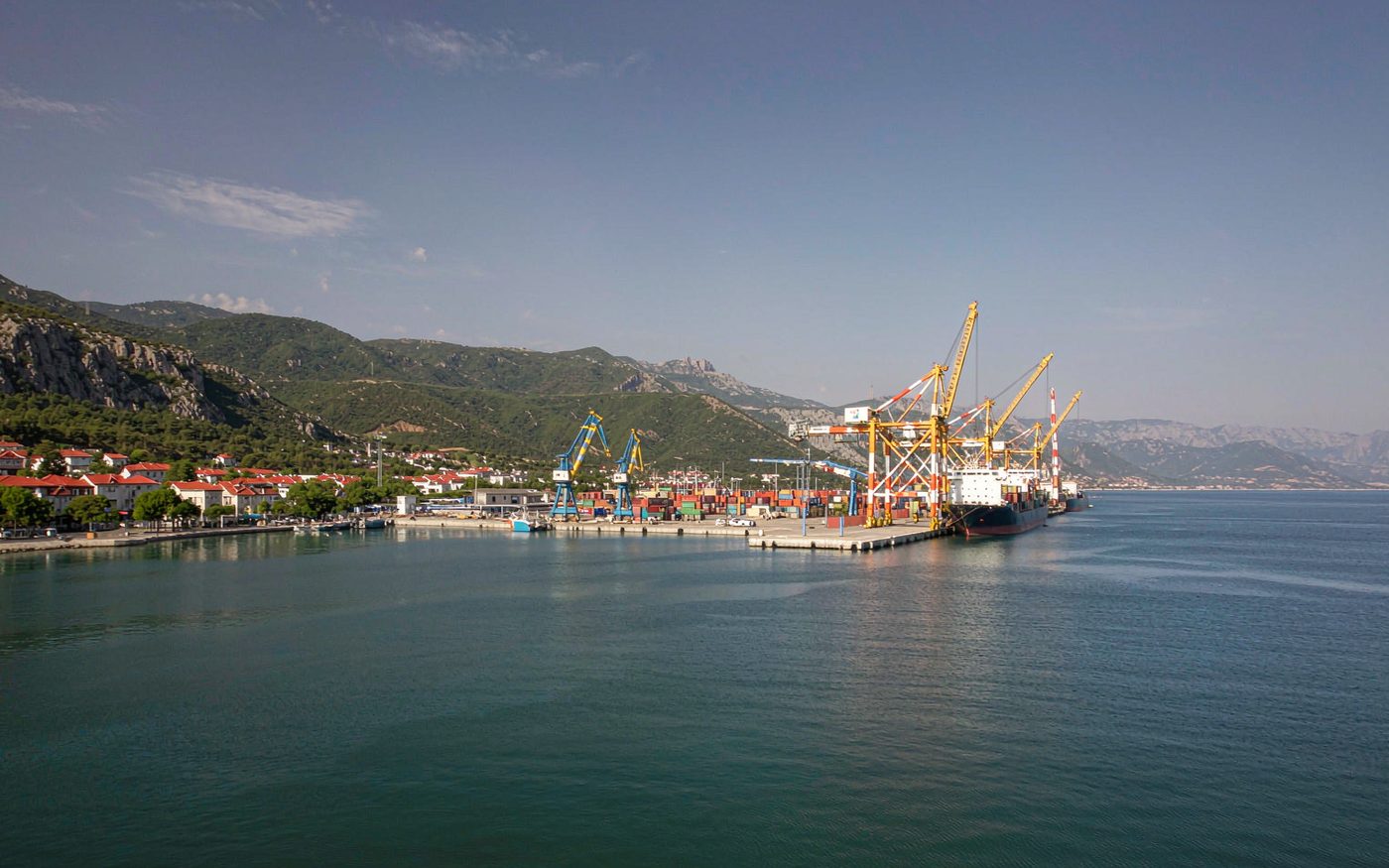
Bar is the port. It handles the large majority of Montenegro's sea-borne freight and has the container handling, storage and rail connection that an importer needs. There are other coastal facilities, but for a container from China, Bar is the answer.
The rail link is what makes Bar useful. A line runs from the port north to Podgorica and on towards Belgrade, so goods can move inland by rail rather than by road. For regular volume that is a genuine alternative; for a first shipment road is simpler to arrange, but it is worth knowing the rail option exists.
Services from China are not direct. Expect a mainline vessel into a Mediterranean hub — Piraeus, Rijeka, Koper, or a northern European port with a feeder — and then a short leg to Bar. Because Montenegro is small, groupage services are usually consolidated at the hub, so LCL is often a better fit than a full container for a first order.
Filing the import declaration in Montenegro
The declaration is lodged with the revenue and customs administration, normally by a licensed broker. A foreign company without a Montenegrin entity cannot simply declare for itself, so the practical arrangement is a broker filing under a power of attorney with a Montenegrin-registered importer named on the declaration.
Decide that structure before the goods move. The importer of record is the party that answers for the duty and the PDV, and if the arrangement is improvised at the port the result is usually a delay and an awkward conversation about who pays.
Declaration data must match the invoice and transport documents exactly: classification, value, origin, quantity. Montenegrin customs uses risk assessment to decide what is examined, and a first-time importer with an unfamiliar code is more likely to be selected than an established one.
Transit procedure since the common transit accession
Montenegro acceded to the common transit convention, which brings it into the same transit system used across the EU and a group of neighbouring countries. In practice this simplifies moving goods under customs control between Montenegro and its neighbours: a single transit document covers the movement rather than a separate national guarantee at each border.
This matters most if your goods arrive at a port elsewhere in the region — Rijeka, Koper, Thessaloniki or Durres — and move to Montenegro overland. That movement now runs on the common transit procedure.
Alongside transit, Montenegro operates customs warehousing and a free zone at Bar, which allow duty and PDV to be deferred until goods are released for home use. For an importer holding stock or re-exporting part of a shipment, the free zone is worth looking at.
Montenegrin duty rates and free trade partners
Montenegro applies its own tariff. Rates run from zero upward depending on the product, with finished consumer goods generally higher than raw materials and industrial inputs. Duty is assessed on the customs value, built up from the transaction value plus the cost of getting the goods to the Montenegrin frontier.
Montenegro has an unusually wide set of trade arrangements for its size: membership of the Central European free trade area, agreements with the European Free Trade Association, a stabilisation and association arrangement with the EU, and a free trade agreement with Turkey, among others. Preference follows the origin of the goods, though, so none of these reduces duty on Chinese-origin cargo.
The practical advice is the same as everywhere: verify the HS classification before you commit, because the code sets the rate and a convenient code inherited from a supplier is often not the correct one.
PDV and how it is calculated at import
PDV is Montenegro's value added tax. The standard rate is 21 per cent, with reduced rates applying to a defined list of goods. It is charged on the customs value plus duty plus excise where applicable, and it is payable at import.
Montenegro uses the euro as its currency, having adopted it unilaterally rather than through the eurozone. That removes a layer of currency work for anyone pricing in euros, and it means the PDV you calculate at order stage is close to the PDV you pay, with the main remaining variable being the customs value itself.
Recovery follows the familiar pattern: a Montenegrin-registered business that is PDV registered and uses the goods for taxable supplies can normally deduct import PDV. A foreign buyer importing through another party's registration generally cannot, so treat it as a cost rather than a timing difference in that case.
Local representation and electronic invoicing
Two domestic requirements catch foreign suppliers out. The first concerns tax representation: a foreign entity carrying out taxable activity in Montenegro may be required to appoint a fiscal representative. If you are supplying the Montenegrin market on an ongoing basis, ask before your first invoice rather than after.
The second is electronic invoicing. Montenegro has made e-invoicing mandatory in its domestic tax system, so your Montenegrin customer will expect to receive and process invoices electronically in the local format. This is a commercial requirement rather than a customs one, but it affects whether you get paid on time, so it belongs in your planning.
Both of these are questions for your customer and for a local accountant rather than for a freight forwarder. Resolve them before the first shipment rather than during it.
Product permits and certificates required
Food, feed, animal-origin products and plants need prior notification and health or phytosanitary certification from the relevant national authority. Arrange these when the order is placed, not when the vessel sails.
Electrical and electronic goods, machinery, toys and construction products are subject to conformity requirements. Montenegro's technical regulations are substantially aligned with the European model, so documentation prepared for the EU market — declaration of conformity, test reports, technical file — usually covers the substance, but confirm local recognition of the specific certificate.
Pharmaceuticals, medical devices, chemicals, pesticides, telecommunications equipment and anything with a dual-use dimension need their own licences or opinions. If your product sits near one of those categories, get it checked before booking.
Labelling and packaging for the Montenegrin market
Montenegrin is the official language and consumer information — instructions, warnings, warranty terms, composition — should be available in it. In practice the market is small and multilingual packaging is common, but relying on English-only documentation is the recurring first-shipment failure.
Category rules overlay this: composition for textiles and footwear, ingredient and allergen declarations for food, shelf-life dating, and energy labelling for appliances. Check the rule for your line rather than assuming a generic label suffices.
Wooden packaging must meet ISPM-15 and carry the treatment stamp. Specify it to the factory at packing time; untreated wood is a real risk to the whole consignment and costs nothing to prevent.
Documents to have ready before sailing
Commercial invoice with seller and buyer, description, HS codes, unit and total prices, currency, Incoterm and origin. Packing list matching it. Bill of lading or air waybill. Certificate of origin. Insurance certificate. Conformity documentation where the product requires it. Any permit or licence the product needs. Power of attorney to the broker. Importer registration details.
A certificate of origin establishes that the goods are Chinese; it does not unlock a preference, because Montenegro's free trade arrangements do not extend to Chinese origin. It is still worth having, because origin affects marking and any trade measure applied to the product.
Declare the real transaction value. Customs has access to freight and insurance data, and an implausible invoice value leads to a valuation review that costs more in delay than the duty it was intended to save.
Moving boxes inland from the Port of Bar
Bar to Podgorica is a short run — roughly 50 km — and the road is a modern corridor. Podgorica is the main inland destination and the distribution point for the rest of the country. Niksic, Budva and the coastal towns are all within a few hours.
Rail from Bar to Podgorica and onward is a real option for regular volume and connects towards Belgrade. For a first shipment road is simpler, but if you expect to move containers regularly it is worth pricing the rail alternative.
The terrain is mountainous and the coast road is busy in summer. Between June and September, tourist traffic slows inland moves noticeably. Confirm free time, demurrage and detention before booking, because a container held up by a missing permit costs more than the ocean leg.
Cost lines worth planning for
Import PDV is the largest single addition and the one most often omitted from a first calculation. Whether it is recoverable depends on who imports, so settle that before the goods move.
Then terminal handling and documentation fees at Bar, storage if the container waits, demurrage and detention if it waits longer, and the inland haul. If you use the free zone or a customs warehouse, add storage rent.
On the compliance side: broker fees, permit and certification costs where the product needs them, conformity documentation, translation of instructions, and the fiscal representative arrangement if one is required. And because Montenegro-bound cargo often moves as groupage, check whether a minimum or a deconsolidation fee applies at the hub.
Why importers use Goodhope on this lane
Six things that are different about working with us on China to Montenegro shipments.
Real orders shipping into Montenegro
Five shipments bought in China and delivered into Montenegro, told end to end — where the order came from, how it moved, where it nearly went wrong, and how it finished. Client names are withheld at their request; the situations and the handling are what we deal with on this lane.
Not an EU member · first order · Shenzhen to Montenegro
The purchase. A buyer new to importing assumed European Union procedures applied because the country uses the euro.
The move. Full container declared under national procedures rather than EU ones.
Where it nearly went wrong. Montenegro is not an EU member state, though it uses the euro unilaterally. Currency and customs status are separate things, and confusing them produces a declaration prepared for the wrong system.
How it finished. We set out the national procedure. His entries have gone through first time ever since.
Bar and the rail link · first container · Ningbo to Bar
The purchase. A first-time buyer compared ports without knowing what sits behind the one he picked.
The move. Full container into Bar, with the rail link inland built into the schedule rather than arranged after arrival.
Where it nearly went wrong. The port is linked by rail to the interior, and that link is what makes the routing work rather than the berth itself. Choosing a port without an onward plan is choosing half a move.
How it finished. He books the rail leg with the freight. Transit has been predictable since.
Transit · cash flow · Guangzhou to Montenegro
The purchase. A buyer budgeted duty and VAT as cash payable on arrival at the frontier.
The move. Full container moved under the transit procedure and entered where it suited him rather than where the truck stopped.
Where it nearly went wrong. Transit lets the goods move without being entered at the frontier. It is a planning tool rather than a paperwork one, and using it changes when the money leaves your account.
How it finished. He moves under transit on repeat lines now. His cash cycle shortened by weeks.
Local representation · invoicing · Yiwu to Montenegro
The purchase. A buyer was asked for local representation and electronic invoicing late in the process and did not know either was required.
The move. Consolidated cargo with representation and electronic invoicing arranged before shipment.
Where it nearly went wrong. Both are requirements here rather than preferences, and both take time to set up. Discovering them after the goods have sailed means discovering them while the container is being charged for waiting.
How it finished. We arrange them at quotation now. Nothing has waited on them since.
Air via a hub · routing · Shanghai to Montenegro
The purchase. A buyer booked air freight expecting a direct flight into Podgorica.
The move. Air freight routed through a regional hub, with the onward leg booked with the freight.
Where it nearly went wrong. Most air cargo arrives via a regional hub rather than direct. Planning around a direct flight means planning around a schedule that is not the one your cargo is on.
How it finished. He books the hub leg with the freight. His urgent orders arrive when promised.
Why importers use Goodhope on this lane
Six things that are different about working with us on China to Montenegro shipments.
Getting a first consignment into Montenegro
Send us your HS codes, weights and dimensions and we will advise whether LCL or FCL suits the volume, what duty and PDV to expect at Bar, and which certificates you still need.
Get a quote Talk to usRelated pages
Frequently asked questions
Which port should I ship to in Montenegro?
Bar. It handles most of Montenegro's sea freight and has the container handling, storage and rail connection to the interior. There are other coastal facilities but Bar is the practical answer for a container from China.
Is Montenegro in the EU?
No. It applies its own customs procedures and its own VAT, called PDV, rather than the EU system. It does have a stabilisation and association arrangement with the EU and belongs to the Central European free trade area.
How much duty will I pay?
It depends on the HS classification. Rates run from zero upward, with finished consumer goods generally higher than raw materials and industrial inputs. Have the code verified before you quote a landed cost.
Do Montenegro's free trade agreements reduce duty on Chinese goods?
No. Preference follows the origin of the goods. Montenegro's agreements cover partners in the region and beyond, but not Chinese-origin cargo.
What is the VAT rate in Montenegro?
PDV is 21 per cent standard, with reduced rates on a defined list of goods. It is charged on the customs value plus duty and is payable at import.
Does Montenegro use the euro?
Yes. Montenegro adopted the euro unilaterally rather than through the eurozone, so pricing and payment in euros avoids a currency conversion step.
Can I recover import PDV?
Yes if the importing entity is Montenegrin-PDV-registered and uses the goods for taxable supplies. A foreign buyer importing through another party's registration normally cannot.
Do I need a local representative?
A foreign entity carrying out taxable activity may be required to appoint a fiscal representative. Ask before your first invoice if you intend to supply the market regularly.
Is electronic invoicing mandatory?
Montenegro has made e-invoicing mandatory in its domestic tax system. This is a commercial rather than a customs requirement, but it affects how your Montenegrin customer processes your invoice.
How long does clearance take?
Moderate for a clean, correctly documented consignment. Missing permits, mismatched descriptions or a physical examination add time. Summer tourist traffic can also slow the inland move from Bar.