
Home / Shipping to the Netherlands / How to Ship from China to the Netherlands
How to Ship from China to the Netherlands: Rotterdam, Import VAT and CBAM
A great deal of Chinese cargo destined for Germany, France, Belgium, Poland and beyond never clears customs in those countries. It clears in the Netherlands, at Rotterdam, and then moves onward as EU goods. That is not an accident of geography — it is the result of three things the Netherlands does unusually well: dense onward connections, a tax mechanism that keeps your working capital out of the customs authority's hands, and the most developed bonded warehousing market in Europe.
This guide is written for overseas buyers sourcing in China and considering the Netherlands as their European entry point. It covers why the routing works, how the EU customs entry and duty calculation actually operate, how Article 23 defers import VAT, when bonded storage is worth the administration, and what changed on 1 January 2026 when the EU's carbon border mechanism became definitive.
The three Dutch advantages. One customs clearance for the whole EU; Article 23 import VAT deferment, so 21% VAT never leaves your bank account at the border; and bonded warehousing that lets you hold stock and pay duty only when goods are released for sale.
How your cargo moves: China to the Netherlands
Eight steps from your supplier's door to yours. The last four are the ones shaped by local rules.
- Pickup from your supplierWe collect the goods anywhere in China and bring them to our consolidation point.
- Export clearanceChina customs declaration filed and released before the goods move to the port.
- Loading and departureContainer loaded, sealed and handed to the carrier at the Chinese port.
- Main carriageOcean, air or rail movement booked on the route agreed for your cargo.
- Arrival at the gatewayDischarge at the port or airport of entry, recorded on the carrier's manifest.
- Import clearanceCustoms declaration filed locally, with duty and tax assessed on the declared value.
- Customs releaseGoods released into free circulation once duty and tax are settled.
- Final deliveryOnward movement to your delivery address, warehouse or nominated depot.
Duty rates, VAT rates and clearance times move, and the figure that applies to your goods is the one set for your commodity code on the day of clearance. We check the current position against your code before your goods sail and confirm it to you in writing — ask for that check when you request a quote.
Why Rotterdam, even when your customers are elsewhere
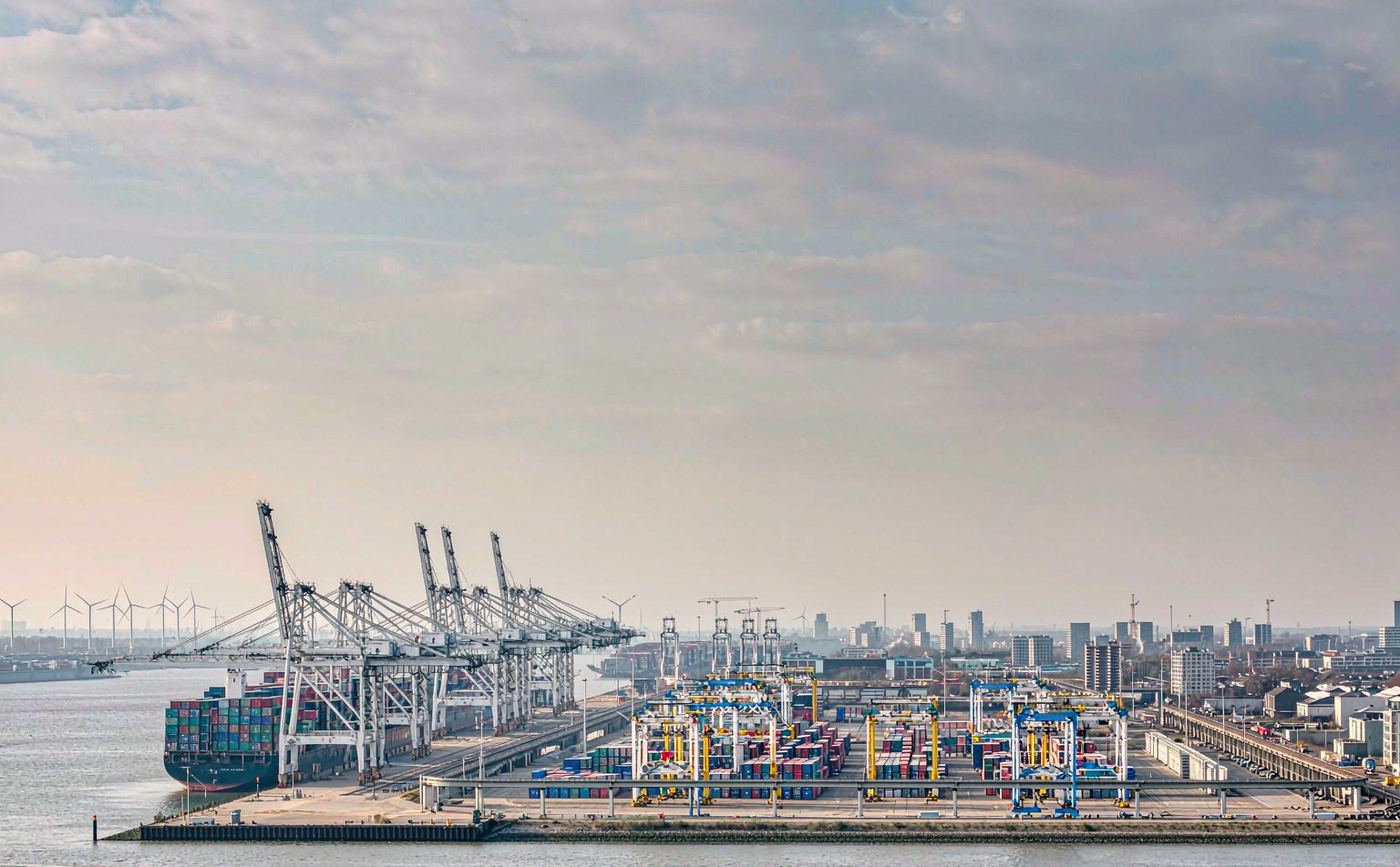
Rotterdam is Europe's largest container port, handling well over fourteen million TEU a year across deep-water, highly automated terminals at Maasvlakte. But the container volume is only half the argument. What makes it a distribution gateway rather than just a big port is what happens after the box is discharged.
Onward connections
Barge services up and down the Rhine into Germany and Switzerland, rail corridors east and south, and dense road haulage into Belgium, the Netherlands and northern France. A box landed at Rotterdam can reach most of north-west Europe without a second deep-sea leg.
Services from China
Direct deep-sea strings from every major Chinese port — Shanghai, Ningbo, Shenzhen, Qingdao, Xiamen and others — so you are not dependent on transhipment through another hub.
A mature service market
Licensed customs brokers, fiscal representatives, bonded warehouse operators and value-added logistics providers all clustered in one place. That density is why specialist structures are easier and cheaper to set up here than almost anywhere else in the EU.
Note the flip side: Rotterdam is a hub, not a destination. Your transit plan has to include the onward barge, rail or road leg, and terminal dwell plus onward transport is usually where delays actually appear — not on the ocean leg.
What EU membership means for your clearance
The EU is a single customs territory. Goods cleared in Rotterdam are in free circulation across all member states, so you clear once and sell anywhere in the bloc. That is a materially different proposition from the UK, which operates its own tariff, its own declaration system and its own product-marking regime.
| Element | What applies |
|---|---|
| Tariff | The EU Common Customs Tariff, with the rate set by your TARIC code. There is no EU–China free trade agreement, so no preferential origin benefit for Chinese-origin goods. |
| EORI | An Economic Operators Registration and Identification number is required for all customs transactions, obtainable from any member state's customs authority. |
| Declaration system | Dutch entries are filed through DMS (Douane Management Systeem) by a licensed broker (douane-expediteur). |
| VAT | Dutch import VAT at 21% standard, 9% reduced for certain goods such as food, water and medicines, charged on customs value plus duty. |
| Product compliance | CE marking under EU rules, which continues to apply in full — unlike Great Britain, where acceptance of CE is category-specific. |
Duty: TARIC, trade defence and the low-value rules
Your duty rate follows the TARIC code, not the product category in a marketing sense. Two similar-looking garments can sit at different rates, which is why the classification has to be settled before you commit to a landed price.
- Standard rates. Many consumer goods fall in the low single digits up to around 12%; clothing is commonly around 12%. The EU applies the Common Customs Tariff, and China receives no preferential treatment.
- Anti-dumping duties stack on top and are product- and producer-specific. The EU's definitive measure on Chinese battery-electric vehicles, imposed in October 2024, was amended in February 2026, with the Commission accepting an undertaking from one producer. That is precisely why a headline rate is never a substitute for a dated check of the current TARIC entry.
- Low-value consignments. For shipments up to about EUR 150 a simplified fixed duty of roughly EUR 3 per product category can apply — the arrangement familiar to dropshipping operations.
- A European handling fee is planned from November 2026; the amount had not been published at the time of writing, so e-commerce importers should budget for an additional per-parcel cost.
Verify, do not assume. Rates change, trade-defence measures are product- and producer-specific, and TARIC does not contain national VAT. Have your broker confirm the current entry for your exact code and intended import date, and treat any published range as indicative only.
Trade terms: why importing under your own EORI usually beats DDP
On this lane the trade term is not just about who pays the freight — it decides whether you get your VAT back.
| Term | Who pays the freight | Who clears | When risk transfers to you | Fit |
|---|---|---|---|---|
| EXW | You, from the factory door | You at both ends | At the supplier's premises | Avoid — you inherit Chinese export formalities. |
| FOB | You arrange the main freight | Supplier exports; you import | On loading | The default recommendation. Transparent costs, and you keep control. |
| CIF | Supplier pays to Rotterdam | Supplier exports; you import | On loading | The supplier chooses the carrier; destination charges are often higher than expected. |
| DAP | Seller delivers to your address | You clear and pay duty and VAT | On arrival | Workable only with your own EORI and broker already arranged. |
| DDP | Seller pays everything | Seller's side clears | On arrival | Easy for a one-off, but see the warning. |
| Port to port | You pay the ocean leg only | You both ends | Port to port | When you run both ends yourself. |
| Airport to airport | You pay the air leg only | You both ends | Airport to airport | The air equivalent, via Schiphol. |
Why DDP can cost you more than it saves. Import VAT is recoverable, but only by the party that imported the goods. Under a loosely structured DDP arrangement someone else is the importer and the 21% never comes back to you — which on a full container is usually worth far more than the difference between two freight quotes. If you import regularly, hold your own EORI and combine it with an Article 23 permit. Read our DDU and DDP page first.
Article 23: the Dutch cash-flow advantage
Under standard EU import procedure, import VAT is due when goods clear customs. On a shipment worth EUR 100,000 at the Dutch standard rate, that is about EUR 21,000 payable before the goods are released — capital frozen before a single unit is sold.
Article 23 of the Dutch VAT Act changes the moment of payment, not the amount. With an Article 23 permit, that EUR 21,000 is not paid at the border. It is reported on your periodic VAT return as output VAT and reclaimed as deductible input VAT in the same filing, so the net cash effect is zero and the money stays in your account. Because there is no VAT payment to process at release, goods are often cleared faster too.
What you need to qualify:
- A Dutch VAT registration (BTW-nummer). Non-EU companies obtain this through a fiscal representative established in the Netherlands, who handles the filings and is jointly liable for the obligations.
- The Article 23 permit itself, applied for with the Belastingdienst and typically processed in a matter of weeks.
- An EORI number for the customs transactions.
- A licensed Dutch customs broker who includes the permit number in the declaration.
- Record keeping — complete import, declaration and VAT records retained for seven years.
Substance matters. A virtual office or letterbox address is not enough. The Dutch tax authority looks for a real fixed establishment with local management and decision-making. For most foreign businesses without Dutch substance, the fiscal representative route is the practical and standard answer — not a workaround.
What it is worth
| Shipment | VAT at border without Article 23 | With Article 23 |
|---|---|---|
| EUR 50,000 CIF | about EUR 10,500 paid before release | EUR 0 at release; reported and reclaimed on the same return |
| EUR 100,000 CIF | about EUR 21,000 paid before release | EUR 0 at release |
| EUR 250,000 CIF | about EUR 52,500 paid before release | EUR 0 at release |
Illustrative, at the 21% standard rate on customs value plus duty, assuming the importer is entitled to deduct input VAT. Duty is still payable at import under either route.
CBAM: what changed on 1 January 2026
The EU's Carbon Border Adjustment Mechanism operated in a transitional reporting phase from 2023 to 2025. From 1 January 2026 it applies under its definitive regime, and that is a change in obligations, not just paperwork.
- Authorisation. Importers need authorisation to bring in-scope goods into the EU.
- Reporting. Declarations of embedded emissions, submitted through the CBAM Registry.
- Certificates. Importers must purchase and surrender CBAM certificates corresponding to the embedded carbon emissions of the goods, priced by reference to EU Emissions Trading System allowance auction prices.
- Scope. Selected goods in carbon-intensive sectors: cement, iron and steel, aluminium, fertilisers, electricity and hydrogen.
The important nuance for buyers: scope is determined at goods-code level. The fact that a material appears somewhere inside a finished product does not by itself bring that product into CBAM. Confirm the exact CN code before assuming the obligation applies — and equally, before assuming it does not.
If you import steel, aluminium, cement, fertilisers or hydrogen from China, treat CBAM as a cost line now. The certificate cost is real and variable, and it needs emissions data from your Chinese supplier that most factories are not in the habit of providing. Ask for it early.
Bonded warehousing: pay later, or not at all
A bonded warehouse holds non-EU goods under customs control. Duty and VAT are not due at arrival — they are due when the goods are released into free circulation, and not due at all if the goods are re-exported.
It is worth the administration when:
- You are distributing into several EU markets over time and do not want to pay all the duty upfront on stock that will sit.
- You hold buffer or seasonal inventory and want the tax to follow sales rather than arrivals.
- You re-export part of a shipment outside the EU, in which case that portion never carries EU duty at all.
- You want to defer the customs valuation and classification decision until closer to the point of sale.
Combined with Article 23, bonded storage turns a large upfront tax event into a payable-on-release one. For a business importing containers on a regular cycle, that is the difference between financing inventory and financing tax.
Documents and the Dutch clearance process
Classify before you ship
Settle the TARIC code and check for trade-defence measures and CBAM scope. Do this at quotation stage, not after the vessel sails.
Prepare the document set
Commercial invoice with value, Incoterm and origin; packing list; bill of lading or air waybill; and any certificates your goods require (CE conformity, phytosanitary, ISPM-15 for wooden packaging). Chinese-origin goods do not qualify for EU preference, so no preferential origin proof applies.
File the entry through DMS
Your licensed Dutch broker files the import declaration with your EORI, the TARIC code, the customs value and — if you hold one — the Article 23 permit number.
Pay duty; defer or reclaim VAT
Duty is settled at import. With Article 23, VAT is deferred to your return instead of paid at the border.
Release and onward distribution
Once released, goods are in free circulation across the EU. Move onward by barge, rail or road — or into bonded storage if you are not releasing yet.
Keep the records
Seven years of imports, declarations and VAT returns. This is a legal requirement, and the first thing requested in an audit.
Private buyers and companies: two very different routes
Private individuals
A private person can receive goods, but commercial quantities need an EORI, and routing regular purchases through personal parcels to avoid duty is treated as misdeclaration. There is also no meaningful low-value relief left: consignments up to EUR 150 now carry a flat duty per item. If you are buying to resell, register a business.
Companies
An EORI covers the customs side and is valid across all 27 EU member states, so a Dutch EORI works anywhere in the bloc. The VAT side needs a Dutch VAT registration, and for a business without a real establishment in the Netherlands that normally means appointing a fiscal representative, who files on your behalf and carries joint liability. A letterbox address will not get you there.
Marketplace orders and fair finds: how each reaches Europe
From online marketplaces
Sellers often start with parcels and graduate to containerised stock. Two things change the economics: the flat duty now applied to consignments up to EUR 150, and the fact that clearing once in Rotterdam puts the goods in free circulation for the whole EU — so one container can serve several country storefronts without re-clearing.
From a trade fair
Samples travel home by courier, and the first production order follows as LCL or a part-container. Agree FOB at the fair, then consolidate: if you met several factories at the same show, combining their output into one container in China gives you one customs entry rather than several.
The three parties a Netherlands import needs
This lane needs three parties, and it is worth being explicit about who does what.
Chinese freight forwarder
Origin handling, supplier collection, consolidation, export clearance and the ocean or air booking. Ask whether they run direct services to Rotterdam and whether they quote the full door-to-door cost including destination charges.
Dutch customs broker
Files the DMS entry. Ask whether they are licensed, whether they routinely work with Article 23 permits, and whether they will confirm your TARIC code and any trade-defence measure before you commit to a price.
Fiscal representative
Required for non-EU importers without Dutch substance. Handles VAT registration and filings and carries joint liability. Ask about setup time, ongoing filing costs and what they need from you.
What a China forwarder must know about EU entry to be worth hiring
Anyone can book a box to Rotterdam. What you need is a forwarder who understands what happens after it lands.
- Do they know the import VAT deferment regime? If they have never heard of the Article 23 permit, they are not set up for importers who care about cash flow.
- Do they flag carbon-border exposure? Goods in the covered sectors need emissions data from the Chinese mill, and that has to be requested early.
- Do they handle advance cargo data? The EU requires pre-arrival security information, filed by the carrier, and a disorganised forwarder means a missed filing.
- Will they confirm the TARIC code and check for trade-defence measures before you commit to a price?
- Can they consolidate multiple suppliers into one booking, and quote onward European distribution rather than just the ocean leg?
The usual warning signs apply with extra force here: a rate far below the others, no questions about the commodity, and any suggestion to under-declare or reroute as personal parcels.
Three ways importers actually use Rotterdam
EU-wide distribution for a home goods brand
Clear once at Rotterdam and distribute by barge and road into Germany, Belgium and France. Apply for the Article 23 permit before the first container, and hold part of the inventory in bonded storage so duty follows sales rather than arrivals.
E-commerce seller shipping parcels into the EU
The low-value fixed duty applies up to about EUR 150 per shipment, and a European handling fee is planned from November 2026. Model the per-parcel cost carefully — it is a different economics from containerised freight.
Steel or aluminium products
Stop and check CBAM first. From 1 January 2026 the definitive regime applies with certificate purchase and surrender obligations, and you will need embedded-emissions data from the Chinese mill. Build both the certificate cost and the data-collection lead time into your sourcing decision.
Frequently asked questions
Why do importers route Chinese cargo through Rotterdam instead of their own country?
Because the Netherlands clears it once and then distributes it across the EU. Rotterdam is Europe's largest container port with deep-sea berths, automated terminals and dense onward connections by barge, rail and road into Germany, Belgium, France and beyond. Combined with the Article 23 import VAT deferment and a mature bonded warehousing market, it lets a business land inventory in one place and move it onward without clearing separately in each destination country.
What is an Article 23 permit and is it worth applying for?
An Article 23 permit lets you defer Dutch import VAT to your periodic VAT return instead of paying it at the border. On a shipment worth EUR 100,000 that is about EUR 21,000 of VAT that stays in your bank account; it is reported as both output and deductible input VAT on the same return, so the net cash effect is zero. You need a Dutch VAT registration, the permit itself, an EORI number and a licensed Dutch customs broker, and non-EU businesses usually obtain it through a fiscal representative. Processing typically takes several weeks, so apply before you need it.
Does CBAM affect my imports from China into the EU?
From 1 January 2026 the EU Carbon Border Adjustment Mechanism applies under its definitive regime, with authorisation requirements, reporting obligations and the purchase and surrender of CBAM certificates matching the embedded emissions of imported goods. It covers selected goods in carbon-intensive sectors: cement, iron and steel, aluminium, fertilisers, electricity and hydrogen. Scope is determined at goods-code level, so a material appearing somewhere inside a finished product does not automatically bring it into scope. Check the exact CN code before assuming it applies.
How much import duty do I pay from China into the Netherlands?
There is no EU–China free trade agreement, so goods pay the EU Common Customs Tariff at the rate set by the TARIC code. Consumer goods often fall in the low single digits to around 12%, with clothing commonly around 12%. Anti-dumping duties can apply on top and vary by product and producer. For shipments up to EUR 150 a simplified fixed duty of about EUR 3 per product category can apply. Always verify the current TARIC entry for your exact code and import date.
What VAT rate applies to imports in the Netherlands?
The Dutch standard VAT rate is 21%, with a reduced rate of 9% for certain goods including food, water and medicines. Import VAT is charged on the customs value plus duty. If you are entitled to deduct VAT, you recover it as input tax, and with an Article 23 permit you never pay it at the border in the first place.
Can a non-EU company import through the Netherlands?
Yes, but not under its own name without local tax presence. You need an EORI number for customs, and for VAT purposes a foreign business without a fixed establishment in the Netherlands normally appoints a fiscal representative, who handles the VAT filings and is jointly liable for the obligations. A virtual office or letterbox address is not sufficient substance — the Dutch tax authority looks for real local management and decision-making, which is why the fiscal representative route is the standard solution.
What is a bonded warehouse and when is it useful?
A bonded warehouse lets you store imported non-EU goods under customs control without paying duty or VAT at the point of arrival. You pay only when the goods are released into free circulation, and nothing at all if they are re-exported. It is useful when you are distributing to several EU countries over time, holding buffer stock, or re-exporting part of a shipment outside the EU, because it converts a large upfront tax payment into a payable-on-release one.
How long does sea freight take from China to Rotterdam?
Rotterdam is served by direct deep-sea services from all major Chinese ports, typically around 30 to 40 days port-to-port depending on the origin port and the service string, with additional time for customs release and onward barge, rail or road distribution. Air cargo via Amsterdam Schiphol is several days door-to-door. Because Rotterdam is a hub rather than a final destination, plan on the onward leg, not just the ocean leg.
What Goodhope handles on the China–Europe leg
Direct services, not transhipment
Regular sailings from Shanghai, Ningbo, Shenzhen, Qingdao and Xiamen to Rotterdam, plus air options via Amsterdam Schiphol. We quote the ocean leg and the onward European leg together.
Documents checked in China
Classification, valuation and compliance paperwork reviewed at origin while an error is still cheap to fix. If your goods may fall under CBAM, we flag it before the booking is confirmed.
Broker-ready handover
We work alongside your Dutch customs broker rather than improvising clearance, and we supply a documentation set that fits the DMS entry. For dangerous goods or non-DG chemicals to the Netherlands, that is declared at booking.
Since 2012, NVOCC licensed
NVOCC licence GD20230925153335. One named contact from factory collection in China through to European delivery.
Goodhope Freight handles sea freight, air freight and express from China to the Netherlands, including consolidation, export clearance and cargo insurance. We are not a Dutch customs broker or a fiscal representative; we coordinate with yours and make sure everything on the China side is correct before the cargo leaves.
Why importers use Goodhope on this lane
Six things that are different about working with us on China to the Netherlands shipments.
Routing through Rotterdam? Let us price it properly
Send us the commodity, HS codes if you have them, dimensions and weight, origin city and European delivery address. We will confirm the routing, flag any CBAM or compliance exposure, and quote the full route.