
Home / Shipping to Norfolk Island / How to ship from China to Norfolk Island
How to ship from China to Norfolk Island
Norfolk Island is an Australian external territory in the South Pacific, with a resident population of around two thousand and a tourism economy that depends on almost everything arriving by sea or air. It is a beautiful place to ship to and a demanding one to plan for, because the infrastructure is small and the rules changed in a way many buyers still have not absorbed.
The change that matters most happened on 1 July 2016. From that date Norfolk Island was brought inside Australia's indirect tax zone, which means the Australian GST applies to imports here. That puts Norfolk in a different position from Christmas Island and the Cocos Islands, and it is the single most common source of wrong landed-cost calculations on this route.
At a glance
Australian external territory, but inside Australia's tax system since 1 July 2016, so the 10 per cent GST applies to imports. One port, Kingston, which does not hold dangerous goods certification and will not accept hazardous cargo including lithium batteries. No bonded warehouse, with temporary storage limited to about seven days. No direct sailing from China; cargo transits via Brisbane, Sydney or Auckland. Currency is the Australian dollar.
How your cargo moves: China to Norfolk Island
Eight steps from your supplier's door to yours. The last four are the ones shaped by local rules.
- Pickup from your supplierWe collect the goods anywhere in China and bring them to our consolidation point.
- Export clearanceChina customs declaration filed and released before the goods move to the port.
- Loading and departureContainer loaded, sealed and handed to the carrier at the Chinese port.
- Main carriageOcean, air or rail movement booked on the route agreed for your cargo.
- Arrival at the gatewayDischarge at the port or airport of entry, recorded on the carrier's manifest.
- Import clearanceCustoms declaration filed locally, with duty and tax assessed on the declared value.
- Customs releaseGoods released into free circulation once duty and tax are settled.
- Final deliveryOnward movement to your delivery address, warehouse or nominated depot.
Duty rates, VAT rates and clearance times move, and the figure that applies to your goods is the one set for your commodity code on the day of clearance. We check the current position against your code before your goods sail and confirm it to you in writing — ask for that check when you request a quote.
Norfolk sits inside the Australian tax system; Cocos and Christmas Island do not
Australia has several external territories, and they are not all treated the same way for tax. Christmas Island and the Cocos (Keeling) Islands sit outside Australia's indirect tax zone, which is why the GST does not apply to goods arriving there. Norfolk Island used to be in the same position, and then it was not.
Under the Norfolk Island reform legislation, the territory was integrated into the Australian tax and customs system with effect from 1 July 2016. Since then, imports into Norfolk are treated as imports into Australia for GST purposes, and the Australian Border Force administers clearance.
If you have shipped to Christmas Island or the Cocos Islands before, do not carry that experience across to Norfolk. The tax treatment is different, and the difference is the 10 per cent GST line on your landed-cost calculation.
A note on conflicting information: some commercial shipping references still describe Norfolk Island as having a VAT rate of around 20 per cent with a low value threshold. Those figures are not consistent with the Australian system that has applied since 2016 and should not be relied on. Confirm the treatment of your goods with the broker handling the entry.
The 10% GST has applied since 1 July 2016
The practical effect is that imports are subject to the Australian GST at the standard rate, collected at the border in the same way it is collected on the mainland. For a Chinese supplier this does not change what they charge you; it changes what your goods cost by the time they are released on the island.
It also means the valuation rules matter. GST is assessed on the customs value, which includes the goods, and in the standard Australian treatment also the transport and insurance to the point of entry, plus any duty and certain other charges. A buyer who calculates GST on the invoice value alone will under-budget.
Duty is a separate line. Goods are classified against the Australian tariff in the normal way, so the HS code you declare drives both the duty rate and the GST base. Get the codes right before the goods ship, and treat the classification as a costing exercise rather than a paperwork exercise.
Low-value consignment rules, if they apply to your shipment, are an Australian mainland mechanism that changes periodically. Ask rather than assume, particularly if you are sending small parcels rather than a consolidated consignment.
Kingston is the only port, and it will not accept dangerous goods
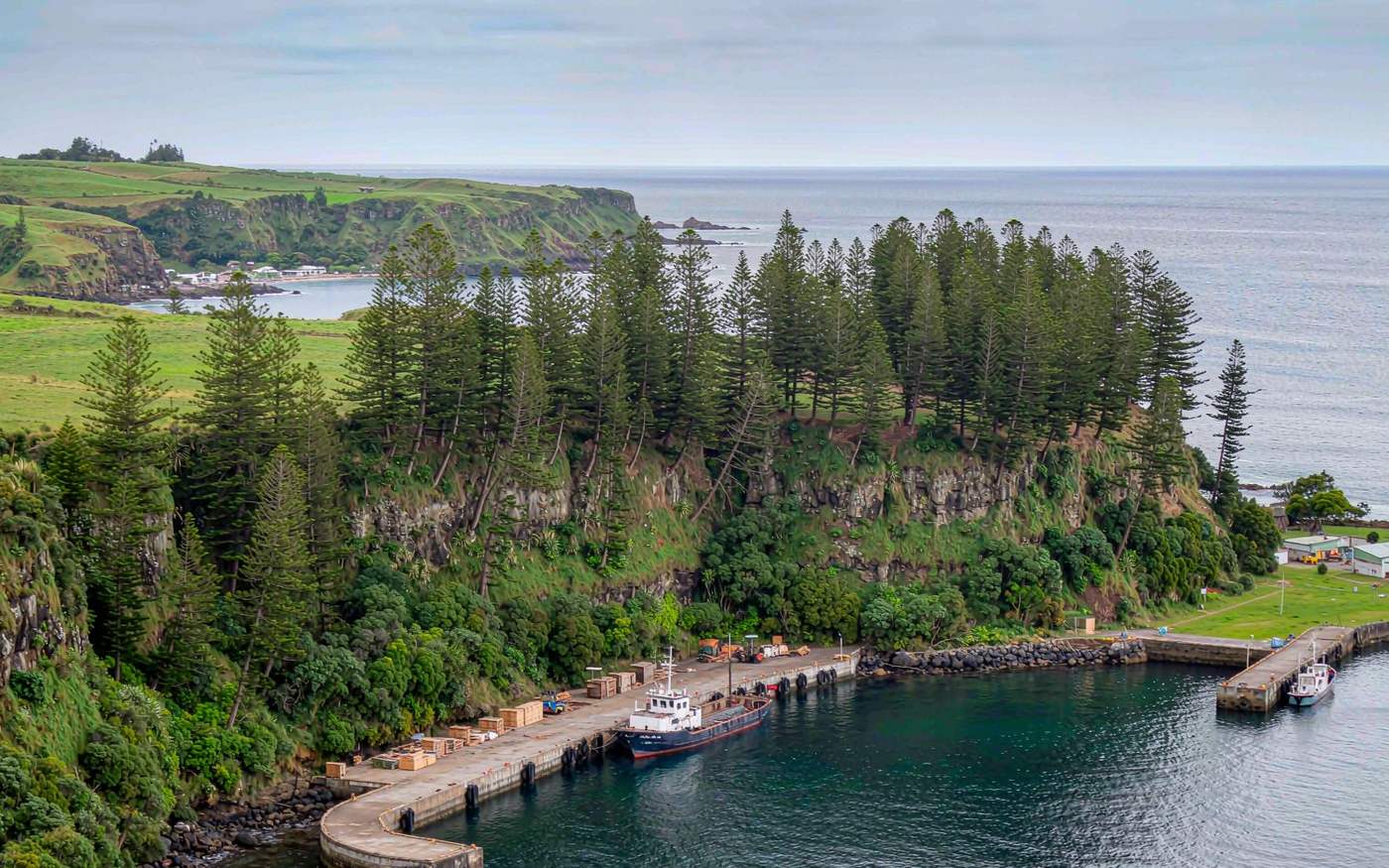
Kingston is the working port. It is a small harbour with a wharf, and it handles the island's general cargo. There is no container terminal, no gantry and no container yard in the mainland sense, so discharge is by ship's gear or mobile crane and cargo is handled piece by piece.
The restriction that matters most is this: the port does not hold dangerous goods certification under the IMDG Code, and it does not accept dangerous goods of any class. That includes lithium batteries shipped on their own, which is the most common way a Chinese supplier unintentionally creates an unshippable consignment.
If your goods contain a lithium battery, say so at the enquiry stage rather than at the booking stage. A battery fitted inside a device is treated very differently from a carton of batteries, and on this route the second one may have nowhere to go.
Everything else follows from the size of the facility. Heavy lifts need to be agreed in advance, awkward pieces need to be planned for, and the discharge window is short. Confirm the limits with us before the supplier builds the crate.
No bonded warehouse here, so the storage clock runs seven days
There is no bonded warehouse on Norfolk Island in the sense a mainland importer would use. Cargo that lands is held under a temporary arrangement, and the practical limit on that storage is about seven days. After that, the situation becomes a problem for everybody.
What that means for you is that the consignee must be ready before the vessel arrives, not after. The documents need to be lodged, the duty and GST need to be arranged, and the collection needs to be planned. A consignee who waits for a phone call from the port is a consignee who will run out of days.
It also means the delivery cannot be treated as an afterthought at the Chinese end. If the paperwork is incomplete when the goods land, there is no facility to park the container while it is sorted out, and the options on a small island with no bonded store are limited and expensive.
Every sailing routes through Brisbane, Sydney or Auckland
There is no direct service from China to Norfolk Island. Cargo sails from a Chinese port to an Australian east coast port, most often Brisbane or Sydney, or to Auckland, and then connects onward. The connection is the variable part of the schedule, and it is the part most likely to move.
Build the transit as a range. The Chinese leg is predictable; the connection is not, because the island service depends on the carrier's coastal pattern and on weather. Any date you are given should be understood as an estimate with the risk sitting at the transhipment end.
Consolidate for the same reason that applies everywhere on this kind of route: fixed costs dominate, and each additional shipment is another chance to miss a connection. See sea freight from China for how the main leg is built, and ask us which coastal connection is currently running.
Biosecurity bans are short and absolute
Norfolk Island is a small island with a fragile environment and an economy that depends on it, so biosecurity is enforced strictly. The Australian rules apply, and the prohibited and restricted list is short and not negotiable.
In broad terms, soil, seeds, plant material, fresh fruit and vegetables, meat and meat products, and untreated wood are the categories that cause trouble. Wooden packaging must meet the ISPM 15 standard and carry the mark, and this should be specified to the supplier in writing.
Declare everything. A consignment that contains an undeclared restricted item is treated far more harshly than one that was declared and permitted, and on a route with no bonded storage, a held container becomes urgent very quickly. See quarantine inspection.
The air service into Norfolk Island Airport, and what it suits
Norfolk Island Airport handles the air service from the Australian mainland and from New Zealand. Air freight suits urgent, compact, high-value goods: spare parts for equipment that is down, medical supplies, hospitality items needed before a season starts, and documents.
It does not suit bulk, and it does not suit anything heavy or awkward, because the handling at both ends is limited. It also does not escape any of the other rules: goods arriving by air still clear customs, still attract GST and duty where applicable, and still face the same biosecurity screening.
One practical point: air freight arrives at the airport, and the consignee still has to collect and move it. On an island with limited commercial transport, that last mile needs arranging in advance. See air freight from China.
Electronics need ACMA clearance before they are switched on
Australian communications and media rules apply, which means radio-emitting equipment has to comply before it can be used. If you are importing anything with a wireless function, radios, Wi-Fi equipment, certain remote controls, telemetry gear or similar, check the compliance position before you ship rather than after the goods arrive.
This catches buyers out because the equipment looks ordinary. A device that is legal to sell in China may not be permitted to operate on an Australian frequency allocation, and a shipment of non-compliant units has very little resale value on an island of two thousand people.
Tell us what the goods are and what spectrum they use, and we will flag it. It costs a few minutes at the enquiry stage and a great deal more if it is discovered at clearance.
Returns and reverse logistics are not realistically available
Plan on the basis that goods sent to Norfolk Island stay there. There is no routine reverse logistics channel, the sailings back are as infrequent as the sailings out, and the cost of returning a consignment regularly exceeds the value of what is being returned.
That changes how a first order should be structured. If you are supplying a new customer on the island, consider a smaller first shipment to confirm specification and demand, rather than a full container that cannot be adjusted afterwards. It also argues for careful specification up front: colour, voltage, plug type, frequency, sizing.
Australian standards apply for electrical goods, so voltage and plug configuration are not the same as in China. Getting that wrong is a common and entirely avoidable reason for a shipment to be useless on arrival.
Documents for an Australian Border Force clearance
Australian customs clearance is document-driven, and on a route with limited storage there is no room for a late correction.
- Commercial invoice with a specific description, quantity, unit and total value, currency named, HS code, country of origin and Incoterm.
- Packing list with piece count, net and gross weights and dimensions, matching the invoice.
- Bill of lading or air waybill, with consignee and notify party correctly named and a working contact number.
- Certificate of origin where it supports the classification or a preference claim.
- Import permit or licence for regulated goods, and biosecurity documentation where required.
- Compliance documentation for radio equipment, electrical goods and anything subject to an Australian standard.
- Insurance certificate.
Again, description quality is the difference between a smooth clearance and a held container. "Machine parts" will be queried; "stainless steel food mixer bowl, 12 pieces" will not. Our shipping documents page gives the format we ask suppliers to use.
How Norfolk differs from the other two external territories
Buyers who have shipped to more than one Australian external territory often assume the rules carry over. They largely do, with one important exception and a couple of operational differences.
| Norfolk Island | Christmas Island & Cocos | |
|---|---|---|
| GST on imports | Applies, 10 per cent, since 1 July 2016 | Does not apply; outside the indirect tax zone |
| Customs duty | Australian tariff applies | Australian tariff applies |
| Dangerous goods by sea | Not accepted at Kingston | Confirm per port and per carrier |
| Bonded storage | None; temporary storage about seven days | Limited; confirm locally |
| Routing from China | Tranship via Brisbane, Sydney or Auckland | Generally via Fremantle or Perth |
The tax line is the one that changes the quote. Everything else is a matter of degree, and in each case the operational constraint is the same: small ports, infrequent services, limited storage, and a premium on getting the paperwork right the first time.
Why importers use Goodhope on this lane
Six things that are different about working with us on China to Norfolk Island shipments.
Real shipments when importing into Norfolk Island
Five shipments bought in China and delivered into Norfolk Island, told end to end — where the order came from, how it moved, where it nearly went wrong, and how it finished. Client names are withheld at their request; the situations and the handling are what we deal with on this lane.
Dangerous goods · turned away · Shenzhen to Norfolk Island
The purchase. A buyer new to importing booked a consignment containing lithium batteries without asking whether the port could take them.
The move. Consolidated cargo screened against what the port will accept, with the hazardous lines removed before booking.
Where it nearly went wrong. The port does not hold dangerous goods certification and will not accept hazardous cargo, lithium batteries included. Discovering that at the berth means the goods go back rather than in.
How it finished. We screen before booking now. Nothing of his has been turned away since.
Seven days · no bonded warehouse · Ningbo to Norfolk Island
The purchase. A first-time buyer assumed cargo could sit at the port while he arranged collection.
The move. Consolidated cargo cleared inside the temporary storage window, with collection planned before sailing.
Where it nearly went wrong. There is no bonded warehouse here, so temporary storage runs to about a week. It is the shortest window on any lane we work, and planning around a longer one is planning to pay for a second movement.
How it finished. He books collection with the freight. Nothing has overstayed since.
GST applies · unlike the neighbours · Guangzhou to Norfolk Island
The purchase. A buyer compared Norfolk against the other two Australian external territories and assumed the tax treatment matched.
The move. Consolidated cargo with ten per cent applied, unlike the other territories.
Where it nearly went wrong. This island has sat inside the Australian tax system since 2016, so GST applies to imports. The other two external territories are outside it. Treating all three alike is one of the commonest costing errors in this part of the Pacific.
How it finished. We set out the difference clearly. His landed costs have been right ever since.
Biosecurity · absolute bans · Yiwu to Norfolk Island
The purchase. A buyer shipped goods with organic material on the packaging expecting a routine inspection.
The move. Consolidated cargo cleaned and declared accurately before departure.
Where it nearly went wrong. Biosecurity bans here are short and absolute rather than negotiable. Items that would be cleaned and released elsewhere are simply refused, and the consignment goes back at your cost.
How it finished. We made clean packing a booking condition. Nothing has been refused since.
Electronics · ACMA · Shanghai to Norfolk Island
The purchase. A buyer imported radio equipment that could not be switched on after delivery.
The move. Consolidated cargo with equipment clearance arranged before shipment.
Where it nearly went wrong. Electronics need clearance before they are used, and there is no realistic returns route from here. Getting it wrong means goods that clear customs and then cannot be used, with no practical way to send them back.
How it finished. We arrange the clearance before shipping. Every device has been usable on arrival.
Why importers use Goodhope on this lane
Six things that are different about working with us on China to Norfolk Island shipments.
Getting a quote for Norfolk Island
Tell us the commodity, HS codes if you have them, the weight and dimensions, and whether the goods contain batteries or any radio equipment. We will confirm the transhipment routing, flag the tax treatment, and tell you what Kingston can actually handle.
Get a quote Talk to usRelated pages
Frequently asked questions
Is Norfolk Island part of Australia for tax purposes?
Yes, since 1 July 2016. The territory was brought inside Australia's indirect tax zone under the Norfolk Island reform legislation, so imports are treated as Australian imports and the GST applies. That is different from Christmas Island and the Cocos Islands, which remain outside it.
What GST rate applies on imports?
The standard Australian rate of 10 per cent. It is assessed on the customs value, which in the standard Australian treatment includes transport and insurance to the point of entry as well as any duty, so calculating it on the invoice value alone will understate the cost.
I have seen a 20 per cent VAT figure for Norfolk Island. Is that right?
No. That figure appears in some commercial shipping references and is not consistent with the Australian system that has applied since 2016. Do not build a landed-cost model on it; confirm the treatment with the broker handling your entry.
Can I ship lithium batteries or dangerous goods?
Not to Norfolk Island by sea. Kingston does not hold IMDG certification and does not accept dangerous goods of any class, which includes lithium batteries shipped on their own. A battery fitted inside a device is a different question, so tell us at the enquiry stage.
How long can cargo be stored on arrival?
Not long. There is no bonded warehouse on the island and the practical limit on temporary storage is about seven days. The consignee needs to be ready, with documents lodged and duty arranged, before the vessel arrives.
Is there a direct sailing from China?
No. Cargo transits through an Australian east coast port such as Brisbane or Sydney, or through Auckland, and then connects to the island service. The connection is the least predictable part of the transit, so treat any date you are given as a range.
Can I ship by air?
Yes, to Norfolk Island Airport, and it suits urgent, compact, high-value goods. It does not escape the other rules: goods arriving by air still clear customs, still attract GST and duty where applicable, and still face biosecurity screening.
What biosecurity restrictions apply?
The Australian rules, enforced strictly. Soil, seeds, plant material, fresh fruit and vegetables, meat and meat products and untreated wood are the usual problem categories. Wooden packaging must meet ISPM 15 and carry the mark. Declare everything, because an undeclared item is treated far more harshly than a declared one.
Do I need any special approval for electronics?
Radio-emitting equipment needs to comply with the Australian communications rules before it can be used. Check before you ship if the goods have any wireless function. Also check voltage and plug configuration, because Australian electrical standards differ from Chinese ones.
Can I return goods if they are wrong?
Assume not. There is no routine reverse logistics channel and the cost of returning a consignment usually exceeds its value. Consider a smaller first shipment to confirm specification, and get voltage, plug type, sizing and colour agreed in writing before the supplier builds the order.