
Home / Shipping to Peru / How to Ship from China to Peru
How to Ship from China to Peru: Chancay, Callao & IGV
Peru is the one South American market where the logistics map physically changed this decade. For years, a container from China to Peru meant a long voyage with a transhipment in the middle — forty days or more, routinely. Then a deep-water port opened eighty kilometres north of Lima with direct services to China, and the Shanghai transit fell to roughly three weeks. If your reference for this lane is more than two years old, the schedule you remember is not the schedule that applies now.
The second thing worth knowing is that Peru's tariff is unusually shallow. There are only three duty bands — zero, six and eleven percent — and around seventy-one percent of the national tariff lines already sit at zero, a group that includes most capital goods and machinery. Add the China–Peru free trade agreement, in force since 2010, and around ninety percent of Chinese goods come in duty-free. On this lane the tariff is rarely the thing that decides whether a container makes money.
The third thing is the one that catches first-time importers, and it is not the tariff at all. It is percepción — an additional percentage collected on top of IGV at the moment of import, set higher for a first-time importer than for an established one. It is creditable, so it is not ultimately a cost. But it is cash out at the border on the very shipment where you have the least experience and the most money at stake, and if you did not budget for it, it is a genuinely unpleasant surprise.
At a glance
Duty: three ad valorem bands — 0%, 6% and 11%; roughly 71% of lines already at zero, and around 90% of Chinese goods duty-free under the China–Peru FTA. · IGV: 18%, made up of 16% IGV plus 2% municipal promotion tax, charged on CIF plus duty and creditable for a registered business. · Percepción: an additional withholding on top of IGV, commonly 10% on a first import and 3.5% thereafter — creditable, but cash at the border. · Customs agent: compulsory above US$2,000 FOB. · Gateways: Callao (the main port) and Chancay (the new direct-China port), plus Paita, Matarani, Ilo and Salaverry. · Air gateway: Lima (LIM). · Sea transit: 23–26 days Shanghai–Chancay direct; 25–35 days to Callao direct. · Power: 220V at 60 Hz.
How your cargo moves: China to Peru
Eight steps from your supplier's door to yours. The last four are the ones shaped by local rules.
- Pickup from your supplierWe collect the goods anywhere in China and bring them to our consolidation point.
- Export clearanceChina customs declaration filed and released before the goods move to the port.
- Loading and departureContainer loaded, sealed and handed to the carrier at the Chinese port.
- Main carriageOcean, air or rail movement booked on the route agreed for your cargo.
- Arrival at the gatewayDischarge at the port or airport of entry, recorded on the carrier's manifest.
- Import clearanceCustoms declaration filed locally, with duty and tax assessed on the declared value.
- Customs releaseGoods released into free circulation once duty and tax are settled.
- Final deliveryOnward movement to your delivery address, warehouse or nominated depot.
Duty rates, VAT rates and clearance times move, and the figure that applies to your goods is the one set for your commodity code on the day of clearance. We check the current position against your code before your goods sail and confirm it to you in writing — ask for that check when you request a quote.
What this guide covers, and who it is written for
This is written for a buyer outside China who is bringing goods from a Chinese supplier into Peru and wants to understand the whole route — which port, who has to be registered, who files what, what the tax bill looks like, and where the schedule slips. It assumes the commercial side is settled and you are now trying to work out the logistics and the compliance.
We cover the choice between Chancay and Callao, the registrations required before a shipment can be consigned, the customs agent and the declaration, the tariff bands and the free trade agreement, IGV and the percepción withholding, transit times by sea and air, the sector permits that have to be obtained in Peru rather than in China, and the practical document discipline that decides whether a clearance takes a day or a fortnight.
We do not publish freight rates here. Rates into South America move with fuel, capacity and season, and a printed number is stale before it is useful. For a live figure on your lane, send the details through the quote request and we will price the actual cargo. Anything in this guide you should re-check against current official sources before relying on it is marked.
The port that changed the map
Until recently, China–Peru cargo took one of two shapes: a direct Asia–West Coast South America service into Callao, or a routing that transhipped through Busan, Hong Kong, Manzanillo or Panama. The second of those was common, and it was slow — forty days and sometimes more, with a connection in the middle that could be missed.
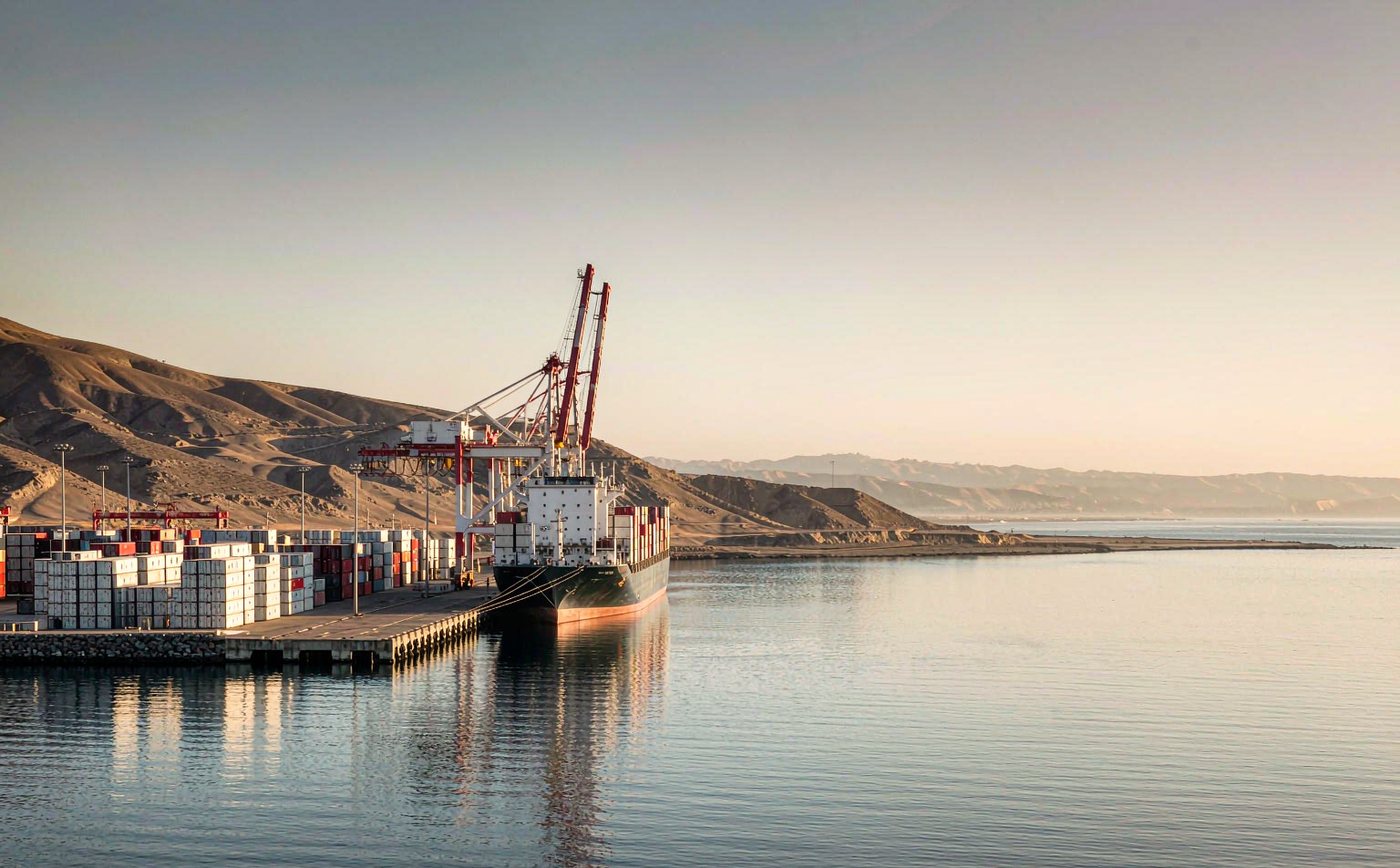
Chancay changed that. It is a deep-water port on the coast north of Lima, built and operated by a Chinese carrier group, inaugurated in November 2024 with commercial operations following in 2025. Its purpose, commercially speaking, is direct trade with China, and it delivers on that: direct sailings from Shanghai to Chancay run roughly twenty-three to twenty-six days port to port, against the forty-plus days the transhipment routings used to take.
That is not a marginal improvement. It removes around two weeks from the ocean leg, which means less working capital tied up in transit, faster inventory turns, and — for anything with a season or a launch date attached — a schedule that can be planned with some confidence. It is the single biggest change to this lane in twenty years, and it is the reason Peru now deserves a fresh look from importers who wrote it off as too far away.
It is worth being precise about what changed and what did not. Chancay is a port. It does not change Peruvian tax, Peruvian customs procedure, or the permits your product needs. Importers who hear "twenty-three days" and assume the whole exercise got simpler discover otherwise at the terminal. The voyage got shorter; everything at the destination end works exactly as it did before.
Chancay or Callao: how to choose between them
The two ports sit roughly eighty kilometres apart in the same metropolitan area, and both deliver into Lima. The choice between them is not about which is "better" — it is about which fits your origin, your carrier and your inland logistics.
| Chancay | Callao | |
|---|---|---|
| Best for | Speed from Shanghai and nearby Chinese ports; distribution into northern Lima | Carrier choice, consolidation options, and northern Chinese origins where transhipment is more efficient |
| Transit from Shanghai | Roughly 23–26 days on direct services | Roughly 25–35 days on direct services |
| Carrier coverage | Narrower, centred on the operator's own services | Wider — most major carriers call, and it handles the great majority of Peru's containerised imports |
| Inland leg to Lima | Longer haul, around 80 km | Short haul, around 15 km |
| Maturity | New, and its landside services are still building out | Mature, with established terminals, depots and broker coverage |
The practical way to decide is to ask your forwarder to quote both, including the inland leg to your door rather than port-only. A shorter voyage is worth less than it looks if the trucking from the far port costs more and takes longer, and on a shipment into Lima the difference in the inland leg is real. Get the comparison in writing, with transit and inland cost on both, and the answer usually makes itself obvious.
One more consideration: LCL consolidation is far more developed at Callao. If your volumes are less-than-container-load, Callao will usually give you more departure options and a shorter consolidation wait, and the saving in time can outweigh Chancay's faster ocean leg.
The tax number, and who can be named on the bill
Peruvian imports run against a RUC — the Registro Único del Contribuyente, the single taxpayer register maintained by the tax and customs authority, SUNAT. It is the identifier that ties the shipment to a Peruvian taxpayer, and unlike some markets it comes with a structural consequence that surprises foreign buyers.
The consignee or notify party on the bill of lading has to be a locally registered Peruvian company holding a valid RUC. You cannot consign a commercial shipment to a foreign entity and sort out the importer later. If you have no Peruvian company, you need one of three things before the vessel sails: a local entity, a representative arrangement, or an importer-of-record service that contracts with you and imports in its own name.
Two mechanical details belong on your checklist because they are cheap to get right and expensive to get wrong. The container seal number has to appear on the bill of lading — this is a Peruvian requirement, not a carrier preference, and a bill issued without it causes problems at the terminal. And the commercial invoice should be in Spanish, or accompanied by a translation, because the declaration is prepared from it by a Peruvian broker working in Spanish.
Sort out the consignee first. Of all the things that go wrong on this lane, discovering at the terminal that the named consignee cannot legally import is among the most expensive — because by then the container is ashore and the storage clock is running.
The customs agent, and the US$2,000 line
Above US$2,000 FOB, a shipment into Peru must clear through a licensed customs agent — the agente de aduana. This is a higher threshold than Chile's, but it sits below the value of almost any genuine commercial shipment, so in practice assume you need one.
The agent prepares and files the goods declaration, manages the channel the authority assigns, and handles the release. Appoint one before the goods sail, for a reason that has nothing to do with formality and everything to do with money: whether you can use the fast filing route — described in the next section — depends on the paperwork being ready in advance, and that is the agent's job to prepare with you.
The declaration itself is the goods declaration for merchandise, referred to as the DAM or, in some sources, the DUA, and it is lodged through the Peruvian foreign trade single window, the VUCE, which is also where sector permits are processed. The authority then assigns a channel: green releases on the documents, orange means a documentary review, and red means a physical inspection. Your agent cannot choose the channel. What you can influence is how often you see orange, and that comes down entirely to document consistency.
Filing before the vessel arrives, and why it is cheaper
Peru offers a genuine choice of timing on the declaration, and the choice is worth money. This is one of the more useful things to know about the lane and one of the least known.
Despacho anticipado — file early
The declaration is lodged before the vessel arrives and is pre-validated. When the container discharges it can be released within hours, because the paperwork has already been accepted. This is almost always the cheaper route, and it is the default a good agent will push for.
Despacho diferido — file late
The declaration is lodged after arrival. It is simpler to prepare, because you are working from a container that is physically there. But every day of delay is a day of terminal storage, billed by the customs depositary, and those charges escalate.
The reason the distinction bites is free time. Terminals at Callao and Chancay allow a short free storage window — commonly around a week, and sometimes less for LCL cargo that has to be deconsolidated — after which storage is charged daily at rates that are not designed to be comfortable. Free time starts at discharge. A deferred filing spends that free window preparing paperwork instead of collecting the container.
Ask for it in writing. Before you book, get your forwarder or agent to state the free storage period at the terminal you are using. A forwarder who will not put that number in writing is passing a known cost to you and hoping you do not notice it on the invoice.
Three duty bands, and which one your line sits in
Peru's applied tariff is unusually simple. There are three ad valorem bands: 0%, 6% and 11%. Roughly seventy-one percent of national subheadings sit at zero, and that group includes most capital goods and machinery — which is why, for a great deal of commercial equipment, the tariff is simply not the deciding factor in a China–Peru import.
Classification still comes first. Everything hangs on the tariff line, and the agent makes the call — but the agent does not know what your product is made of or what it does. A specification sheet, the material composition, photographs and the intended use settle most classification questions, and they cost nothing to provide early. A line that is later reassessed produces a bill for the difference plus penalties, and reassessment is far more likely where the importer could not explain the product.
There is one category where the shallow tariff does not hold. Certain textiles, clothing and footwear sit well above the standard bands, with averages reported around fifteen to seventeen percent on some lines. If you are importing apparel or footwear, the tariff is a real number in your model, and you should confirm the rate at quotation stage rather than assume the zero band applies.
Where the China–Peru pact still earns its keep
The China–Peru free trade agreement has been in force since 2010, and it takes around ninety percent of Chinese goods into Peru at zero duty. An upgrade protocol was signed in Lima in November 2024, modernising the rules of origin and customs facilitation chapters.
Against a tariff where seventy-one percent of lines are already zero, it is fair to ask what the agreement actually adds. Two things. It covers tariff lines beyond the zero group, so it is the mechanism that takes a six or eleven percent line to nothing. And it gives you a defensible, documented duty position rather than one that rests on an MFN classification nobody has checked recently.
The preference is claimed with a certificate of origin, and the discipline is the same one that applies in Chile and everywhere else: the certificate must exist, it must be issued in time, and its wording must match the commercial invoice exactly. Have your supplier issue it with descriptions that mirror the invoice line by line, and let your agent confirm the current position for your specific lines before the goods sail.
Note that the agreement has exclusions. Certain textiles, footwear and specific agricultural products remain outside the preference, which is why the tariff line still has to be checked even when you hold a certificate. A certificate does not make a non-qualifying line qualify.
Eighteen percent, and the two percent inside it
Peru's import VAT is IGV at 18%, and that figure is not a single tax. It is 16% IGV plus 2% IPM — the municipal promotion tax — charged together on the CIF value plus any duty payable.
| Illustration on a hypothetical CIF of US$10,000, duty at 0% | Amount |
|---|---|
| CIF value | US$10,000 |
| Duty | 0% |
| IGV base | US$10,000 |
| IGV at 16% | US$1,600 |
| IPM at 2% | US$200 |
| Total IGV charge | US$1,800 — that is the eighteen percent |
For a business registered for IGV, this is creditable. It offsets against the IGV you charge on your sales, in the same way domestic input tax does. So the eighteen percent is working capital, not cost — a timing effect, and one worth explaining plainly to a buyer who has only imported into markets where the VAT is dead money.
That is the theory. In practice, whether you can actually recover it depends on your filing position in Peru, which is part of why the consignee question earlier matters so much. If you are importing through someone else's RUC, the credit may be theirs rather than yours.
The withholding that hits your first import hardest
Now the part that surprises people. On top of IGV, Peru collects percepción — an advance percentage taken at the moment of import.
| Circumstance | Commonly applied rate | What it means |
|---|---|---|
| First-time importer | Around 10% | The heaviest rate lands on your first shipment — the one where you have least experience and most cash committed |
| Established importer | Around 3.5% | Falls away from the second import onward |
| Used goods | Around 5% | Applies where the cargo is not new |
Percepción is not a cost. It credits against your future IGV liability, so the money comes back. But it is cash at the border, and on a first import it is assessed at the highest rate on the largest payment of your engagement. SUNAT has adjusted aspects of this regime and exemptions exist in specific cases, so have your agent confirm the rate that applies to you before you fix a cash-flow plan.
Worked on a hypothetical CIF of US$10,000 with zero duty: IGV of US$1,800 plus percepción at ten percent of the same base — US$1,000 — means roughly US$2,800 of cash at clearance on a ten-thousand-dollar shipment. Most of it returns as credit. None of that helps if you did not have the cash.
The planning point is simple: budget the percepción on your first shipment at the first-import rate, and treat the drop to the established rate as a future benefit rather than a present assumption.
When the tax office questions your declared value
Peruvian customs has a specific instrument worth knowing about, because it stops shipments dead. SUNAT can raise a duda razonable — a reasoned doubt — about the value you have declared. When it does, clearance pauses until you substantiate the price.
What substantiation means in practice: the export invoice set from China, evidence that the money was actually paid and by whom, and for equipment, technical documentation showing what the machines genuinely are. A machinery shipment with a declared value that looks low for the specification is the classic trigger, because "this used machine is worth very little" and "this new machine has been under-declared" look identical from the customs side until someone produces documentation.
The defence is ordinary bookkeeping. Pay your supplier through a traceable channel, keep the payment record against the invoice, and make sure model designations are identical on the nameplate, the packing list, the commercial invoice and the bill of lading. Mismatches between those four documents are the most common trigger for a documentary review on this lane, and they cost nothing to prevent.
The obvious corollary: do not under-declare. On a lane where the duty is frequently zero anyway, the temptation should already be low, and the consequence — a paused clearance, a demand for substantiation, and a file flagged for closer attention next time — is disproportionate to anything you might have saved.
How long the box is at sea
These are port-to-port figures, and they need origin handling at the front and clearance and inland delivery at the back added to them.
| Routing | Mode | Typical port-to-port transit |
|---|---|---|
| Shanghai → Chancay, direct | Sea FCL | 23–26 days |
| Shanghai / Shenzhen → Callao, direct | Sea FCL | 25–35 days |
| Any major origin, via Busan, Hong Kong or Manzanillo | Sea FCL | 30–40 days |
| Major Chinese ports → Callao | Sea LCL | 28–42 days, including consolidation and deconsolidation |
| PVG / SZX → Lima (LIM) | Air freight | 3–8 days airport to airport, typically connecting |
| Major Chinese gateway → Peru | Express courier | 4–8 days door to door |
Two qualifications. First, clearance on a complete file runs one to three working days — so the difference between a three-week and a five-week door-to-door figure is usually the routing, not the customs. Second, an incomplete file does not sit quietly; it waits in the terminal and starts billing storage. The two days you might save by rushing the paperwork are not worth the week you can lose.
Following a shipment from Shanghai to a warehouse in Lima
A concrete run-through is easier to hold onto than an abstract one, so here is an ordinary shipment end to end.
Consignee settled, before anything else
You confirm that the Peruvian entity named on the bill of lading holds a valid RUC. If you have no Peruvian company, this is the point at which you arrange a representative or an importer-of-record — not the point at which you discover you needed one.
Agent appointed, and the declaration route chosen
You appoint a licensed customs agent before the goods sail. Because the paperwork is being prepared now, you can file the declaration in advance — despacho anticipado — which means release within hours of discharge instead of days of terminal storage.
Order, certificate of origin, and the invoice in Spanish
The order goes in with a supplier in Zhejiang on FOB Shanghai. The China–Peru FTA certificate of origin is requested at the same time, with wording that will match the commercial invoice exactly. The invoice carries the consignee's RUC and is issued in Spanish.
Permits, if the product needs them
If the goods are regulated — cosmetics, medical devices, food, telecoms equipment — the sector authorisation is applied for through the single window now. It is processed in Peru and takes weeks. This is the step that, if skipped, costs the most.
Loading, seal number on the bill
The container loads at Shanghai. The bill of lading is issued with the container seal number shown, as Peruvian practice requires, and with a consignee that can legally import.
The voyage — three weeks, not six
On a direct service to Chancay, the box is on the water for roughly twenty-three to twenty-six days. On the routings this lane used to depend on, the same leg would have been forty or more. This is the change that makes Peru worth re-examining.
Discharge, channel, release
The container discharges and, because the declaration was filed in advance, it is released within hours on a green channel. SUNAT has assigned green, orange or red; green and orange are resolved on the documents, red means physical inspection and takes longer.
Inland to your door
The container is trucked to your Lima warehouse — a short haul from Callao, a longer one from Chancay. You verify the seal number against the bill before opening, photograph any damage to the exterior, and count cartons against the packing list before signing anything.
Add it up and a clean sea shipment runs roughly four weeks from factory to warehouse door — of which the voyage is the large majority, and clearance is a small and predictable slice. Two weeks of that used to be avoidable delay. It no longer is.
When paying for air makes sense
Air into Lima is three to eight days airport to airport against three weeks or more by sea. Note the routing caveat: services typically connect through Miami, São Paulo or Panama City rather than running direct from China, so the air transit on this lane is less predictable than the sea transit is becoming.
Air earns its cost when
- The goods are high-value and light, so freight is a small share of landed cost.
- Equipment is needed to keep a project or a production line running.
- You are testing a market with a small first batch before committing to containers.
- Spare parts or samples are genuinely urgent.
Sea is almost always better when
- The cargo is heavy or bulky — air bills on chargeable weight and punishes density.
- Volumes approach container size. Around fifteen cubic metres and above, a full container usually beats any air option per unit.
- There is no deadline that a three-week voyage would break, which is the normal case.
- The goods are regulated and need permits anyway — you cannot air-freight your way past a sector authorisation.
The mixed strategy works here as it does everywhere: air the urgent fraction, sea the rest. Our air freight and sea freight pages set out what we handle on each mode, and the quote form will price both against your actual cargo.
Sharing a container, and what it costs at the destination
Below container volumes, cargo travels as LCL, sharing space with other importers' goods and charged by volume. On this lane the LCL transit is noticeably longer than FCL — twenty-eight to forty-two days against twenty-three to thirty-five — because consolidation at origin and deconsolidation at destination both take time.
The destination end is where LCL hurts. Deconsolidation and handling charges apply at the Peruvian terminal that a full container does not attract, and LCL cargo typically gets a shorter free storage window than FCL. On a small shipment, those destination charges can exceed the ocean freight itself. That is normal, but it means comparing an LCL quote against an FCL quote on freight alone is misleading.
The rule of thumb is the same one that applies across South America: once you are approaching fifteen cubic metres, price a twenty-foot container against the LCL option before booking. If you are sourcing from several Chinese suppliers, consolidating them into one container at origin is often better again — which is what our warehouse and consolidation service is for.
The permits that are issued in Peru, not in China
This is the step that costs the most time when it is discovered late, and the reason is structural: sector authorisations for regulated goods are processed through the Peruvian single window and issued in Peru. Your supplier in China cannot obtain them, and no amount of good paperwork at origin substitutes for them.
| Authority | What it covers |
|---|---|
| DIGEMID — medicines, medical devices and cosmetics | Pharmaceuticals, medical devices, cosmetics and related products require its authorisation before release. |
| SENASA — agricultural health | Food, plant material, agricultural inputs and animal products, including phytosanitary documentation. |
| SANIPES — fisheries | Fishery and aquaculture products for human consumption. |
| MTC — transport and communications | Telecommunications and radio equipment that uses the spectrum. |
| INACAL — standards | Machinery and products subject to Peruvian technical standards. |
These take weeks, they are applied for before the goods arrive, and a forwarder or agent who discovers them at arrival has already cost you storage. The instruction is short: for any regulated category, ask your agent what authorisation applies before you place the order, and assume the answer is a process measured in weeks rather than days.
Wood packaging follows the same rule as everywhere else in the Americas — see the next section — and dangerous goods, including lithium batteries, need the usual safety data sheet, test report and declaration at booking rather than at the terminal.
Pallets, crates and the treatment stamp
Any wood packaging entering Peru — pallets, crates, dunnage, bracing — must be treated against pests and marked under ISPM-15, the international standard whose mark is the IPPC stamp. This is inspected by the agricultural health authority, and unmarked wood does not get a warning.
It gets the shipment held, and at worst the packaging is ordered destroyed or the consignment re-exported at your cost. And because it is an agricultural matter rather than a customs one, perfect commercial paperwork does nothing to resolve it.
Give your supplier a short instruction before the goods are packed: either use treated, stamped wood and be able to show the stamp, or use non-wood packaging — plastic pallets or pressed-wood composites, which fall outside the rule. Confirming which of those is happening takes one email and prevents a category of delay that is entirely avoidable.
Beyond Lima: the northern and southern gateways
Lima handles the bulk of Peruvian imports, but it is not the only option, and for cargo destined outside the capital the regional ports can save a great deal of overland distance in a country where the roads are long and the terrain is not forgiving.
| Gateway | Serves | Why it is chosen |
|---|---|---|
| Callao | Lima and the central coast | The main port and the default for the capital, with the widest carrier coverage and the most mature landside services. |
| Chancay | Lima, northern Lima distribution | The new deep-water port with direct China services and the fastest ocean leg. |
| Paita | Northern Peru | Serves the northern regions directly rather than trucking from Lima. |
| Matarani | Southern Peru, and Bolivia | The southern gateway, and a routing for cargo continuing overland into landlocked Bolivia. |
| Ilo / Salaverry | South and north-central coast | Secondary ports used where the destination or the commodity suits them. |
The inland distances are what make this worth thinking about. From Callao, Arequipa is roughly a thousand kilometres and Cusco roughly eleven hundred — multi-day hauls on mountain roads. If your consignee is in the south, a southern port can remove most of that leg.
Peru's geography also makes it a staging point for Bolivia, which has no coastline of its own. Cargo routed through Matarani or Ilo and then overland is a standard solution for Bolivian destinations, and the Andean community framework that Peru shares with Bolivia, Ecuador and Colombia shapes some of the documentation. If your consignee is in Bolivia, say so at the outset — it changes the routing, not just the last leg.
Used goods, and the higher rate applied to them
Second-hand cargo is treated differently in Peru in two ways, and both belong in the landed cost before you commit.
First, the percepción rate for used goods is higher than the established-importer rate — commonly around five percent against three and a half. It is still creditable and still not a cost, but it is more cash at the border.
Second, used goods attract scrutiny on value. A used machine is genuinely worth less than a new one, and proving that to a customs authority that has every incentive to be sceptical requires documentation: maintenance history, age evidence, technical specification, and often a comparison against current market values. This is precisely the profile that triggers a reasoned doubt on declared value, described earlier.
If you are shipping used machinery, used vehicles or graded second-hand stock, tell your agent at quotation stage and expect to assemble a valuation file. Discovering the requirement after the container lands is the expensive version of the same exercise.
Two hundred and twenty volts, at sixty hertz
A small thing that is not small if you get it wrong. Peru runs on 220V at 60 Hz — the same nominal voltage as several of its neighbours but at a different frequency, which matters for anything with a motor, a compressor, a transformer or a timing circuit in it.
Peruvian outlets accept both flat-pin and round-pin plugs in common use, so specify the plug you want rather than assuming. And confirm the voltage and frequency requirement with your supplier before production, not after delivery. A container of equipment built for the wrong frequency is not a logistics problem any more — it is a write-off.
This is the kind of detail that separates a supplier who has exported to South America from one who has not. If your supplier cannot tell you what frequency they built to, ask again.
Business inventory, and personal effects into Peru
Commercial stock and household goods are different exercises with different rules, and treating them the same causes problems.
Commercial inventory is imported against a RUC, declared by a licensed agent, taxed at the duty band for its line plus IGV at eighteen percent, and — for a registered business — the IGV is creditable. Percepción applies on top at a rate that depends on whether this is your first import and whether the goods are used. It is a taxable transaction in the ordinary course.
Household goods and personal effects belong to someone relocating rather than to a business reselling. They are assessed on a different basis, they require a Spanish-language inventory and evidence that the owner is changing residence, and they are inherently second-hand — which brings both the higher percepción rate and the valuation scrutiny into view. Used household effects are generally treated more favourably than commercial second-hand cargo, but the treatment is not automatic and the paperwork decides it.
If you are moving a household rather than buying stock, say so at the beginning. It changes the declaration route, the document set and the tax outcome.
Holidays, and the weeks when nothing moves
Peru's calendar has its own shape, and the schedule notices.
- Chinese New Year — the origin-side shutdown. Production stops before it and ramps slowly afterwards. On a lane that is now only three weeks long, missing the pre-holiday cut costs you more in relative terms than it used to.
- Fiestas Patrias, around late July — the national holidays in the second half of July. A genuine shutdown rather than a long weekend.
- Holy Week — observed seriously, with several days effectively lost.
- October — a month with more than one public holiday and a tradition of long weekends, which compress the working week.
- December — the retail peak. Capacity tightens, space has to be booked further ahead, and terminal congestion follows.
Two structural risks sit on top of the calendar. The first is congestion at Callao, which is a mature port carrying a large share of national volume, and which does get busy in peak periods. The second is that Chancay is new: its ocean product is excellent, but its landside services are still building out, and in peak periods the constraint can be on the road rather than the water. Ask your forwarder which end is the risk on your specific sailing.
The mitigation is the same unglamorous one that works everywhere: book earlier than feels necessary, keep a buffer in any date you give a customer, and get the paperwork right in China.
The paperwork to have in hand before loading
Almost every avoidable delay on a China–Peru shipment traces back to something that did not happen before the vessel sailed. Here is the set to have in hand.
| Document | What it has to do |
|---|---|
| Commercial invoice | In Spanish, showing exporter, the consignee's RUC, tariff lines, unit values and terms of sale. Values must match what was actually paid. |
| Packing list | Carton count, dimensions and weights per item — real figures, because verified gross mass depends on them. |
| Bill of lading or air waybill | Consignee or notify party holding a valid RUC, and the container seal number shown on the bill, as Peruvian practice requires. |
| Certificate of origin | Issued for the China–Peru agreement, with wording that matches the commercial invoice exactly. |
| Sector authorisations | DIGEMID, SENASA, SANIPES, MTC or INACAL as the product requires — applied for in Peru, weeks in advance. |
| Dangerous goods documentation | Safety data sheet and test report for lithium batteries or cells; a dangerous goods declaration where the cargo is classed. |
| ISPM-15 evidence | Confirmation that wood packaging is treated and stamped, or that no wood was used. |
One discipline prevents most of the rest. Before the vessel sails, put the invoice, the packing list, the bill of lading and the certificate of origin side by side and confirm that the model designations, description, quantity and parties are identical on all four. On this lane that single check is the difference between a one-day clearance and a reasoned-doubt letter.
Related pages
Frequently asked questions
Should I ship to Chancay or to Callao?
Chancay is faster from Shanghai and nearby Chinese ports, with direct services around twenty-three to twenty-six days against forty-plus on the old transhipment routings. Callao is larger and more flexible, handling most of Peru's containerised imports with wider carrier choice and more consolidation options. Quote both with the inland leg included and the answer usually makes itself clear.
Do I need a customs broker in Peru?
Above US$2,000 FOB, yes — a licensed agente de aduana must file the declaration and represent the importer. Appoint one before the goods sail, because whether you can use the anticipated filing route depends on the paperwork being ready in advance.
What is despacho anticipado and why does it matter?
It means filing the declaration before the vessel arrives, so the cargo can be released within hours of discharge. It matters because free storage time starts at discharge — a deferred filing spends that free window preparing paperwork instead of collecting the container, and storage charges escalate daily afterwards.
How much duty and tax will I pay importing from China into Peru?
Duty runs in only three bands — zero, six and eleven percent — with roughly seventy-one percent of lines already at zero, and around ninety percent of Chinese goods duty-free under the China–Peru FTA with a certificate of origin. IGV of eighteen percent then applies to CIF plus duty, and is creditable for a registered business.
What is percepción and why does my first import cost more cash?
It is an additional percentage collected on top of IGV at import — commonly around ten percent for a first-time importer, three and a half percent once established, and five percent for used goods. It credits against future IGV, so it is not ultimately a cost, but it is real cash at the border on your largest and earliest payment. Confirm the rate that applies to you with your agent.
What happens if the tax office questions my declared value?
SUNAT can raise a reasoned doubt, a duda razonable, which pauses clearance until you substantiate the price with the export invoice set, payment evidence and, for equipment, technical documentation. Keep the payment trail clean and make sure model designations match exactly across nameplate, packing list, invoice and bill of lading.
How long does sea freight take from China to Peru?
Shanghai to Chancay runs roughly twenty-three to twenty-six days on direct services, Shanghai or Shenzhen to Callao around twenty-five to thirty-five days, and transhipped routings thirty to forty days. LCL runs twenty-eight to forty-two days including consolidation. Add one to three working days for clearance on a complete file.
Which permits do I need, and when should I start them?
Regulated categories need a sector authorisation through the Peruvian single window: DIGEMID for medicines, devices and cosmetics, SENASA for food and agricultural goods, SANIPES for fishery products, MTC for telecoms, INACAL for machinery. They are issued in Peru, not China, and take weeks — start them before the goods sail.
Can a foreign company be named as the consignee on the bill of lading?
No. The consignee or notify party must be a locally registered Peruvian company with a valid RUC, and the container seal number must appear on the bill of lading. Without a Peruvian entity you need a local importer, a representative arrangement or an importer-of-record service, settled before the vessel sails.
Does Peru run on 220 volts?
Yes, at sixty hertz — which differs from neighbours on the same nominal voltage and matters for anything with a motor or a timing circuit. Both flat-pin and round-pin plugs are in common use, so specify the plug, and confirm the voltage and frequency requirement with your supplier before production rather than after delivery.
Why importers use Goodhope on this lane
Six things that are different about working with us on China to Peru shipments.
End to end headed to Peru
Five shipments bought in China and delivered into Peru, told end to end — where the order came from, how it moved, where it nearly went wrong, and how it finished. Client names are withheld at their request; the situations and the handling are what we deal with on this lane.
The new port · first container · Shanghai to Peru
The purchase. A buyer new to importing had not heard of the newer port and was quoted only the established one.
The move. Full container on the direct service into the newer port, with both options priced side by side.
Where it nearly went wrong. The newer port takes direct sailings from China and cuts the transit by days against the established one. Quoting only the port you have always used is quoting the slower option without saying so.
How it finished. He switched to the direct service. Transit dropped and his reorder point moved with it.
Percepcion · cash at the border · Ningbo to Callao
The purchase. A first-time buyer budgeted the tax as fully creditable and did not expect cash at the frontier.
The move. Full container with the additional withholding modelled as cash on the first import.
Where it nearly went wrong. There is an additional withholding on top of the main tax, charged at a higher rate on a first import and lower afterwards. It is creditable, but it leaves your account on the day, and that is the part buyers miss.
How it finished. He holds the cash for it now. No first shipment has stalled on funds since.
Three bands · claiming zero · Guangzhou to Peru
The purchase. A buyer assumed duty would be charged at a mid-rate on most of his lines.
The move. Consolidated cargo with each line checked against the bands and the agreement claim made properly.
Where it nearly went wrong. Duty runs in three bands with most lines already at zero, and the trade agreement takes a large share of Chinese goods to zero as well. Not claiming it means paying on lines that should have been free.
How it finished. We claim on every qualifying line. His duty bill is a fraction of what he first budgeted.
The agent line · before booking · Yiwu to Peru
The purchase. A buyer planned to file himself on a consignment above the threshold.
The move. Consolidated cargo with a customs agent appointed at booking.
Where it nearly went wrong. A customs agent is compulsory above a set FOB value. It is a condition of the entry rather than an optional service, and arranging one after arrival is arranging it while the container waits.
How it finished. We appoint the agent with the booking. Every entry since has gone through cleanly.
Filing early · cheaper · Shenzhen to Peru
The purchase. A buyer's broker waited for the vessel to arrive before preparing the declaration.
The move. Sea freight with the declaration prepared and filed before arrival.
Where it nearly went wrong. Filing ahead of arrival is cheaper here than filing after it, which is unusual enough that brokers used to other lanes leave it late. The extra days of storage cost more than the preparation saves.
How it finished. We file before arrival now. He has not paid avoidable storage since.
Why importers use Goodhope on this lane
Six things that are different about working with us on China to Peru shipments.
Request a quote on your Peru shipment
Tell us what you are shipping, from where, how much it weighs and measures, and where in Peru it needs to arrive. We will come back within 24 hours with an itemised plan — Chancay against Callao, transit time on each, the duty and IGV position for your tariff line including percepción, and what documents and permits your shipment will need.
Get a Free Quote Explore Peru Services