
Home / / sea freight tools A Comprehensive Guide to 20' Standard Shipping Containers
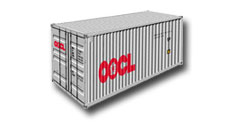
20' standard shipping containers, also known as 20GP containers, are one of the most common types of containers used in international shipping. These containers are designed for ease of cargo loading and transportation and meet international standards, allowing goods to be transported conveniently around the world. This article will provide a detailed explanation of 20' standard shipping containers.
20' standard shipping containers have several common names and terms, including:
20GP (20' General Purpose Container): Abbreviation: 20GP
Detailed Description: This is a common term used in the international shipping and logistics industries to refer to a container that is 6 meters (20 feet) long, 2.4 meters (8 feet) wide, and 2.4 meters (8 feet) high. GP stands for "General Purpose" or "Ordinary Use".
20ft Dry Container: Abbreviation: 20' Dry Container
Characteristics: The most common type of 20' container, used to transport a variety of goods that do not require special handling.
20' standard shipping containers have several common abbreviations, including:
20GP: This is the abbreviation for 20' general purpose container. GP stands for "General Purpose" or "Ordinary Use". It is a common term used in the international shipping and logistics industries, typically used to transport general cargo that does not require temperature control.
20' Standard: This also refers to a 20' standard container, but it places more emphasis on describing its size and standardization.
TEU: While this does not directly describe the size of a container, it is an important unit of measurement in container shipping. TEU stands for Twenty-feet Equivalent Unit, and it is the international unit of measurement based on a 20-foot container, also known as the international standard container unit. It is commonly used to express a ship's container loading capacity and is also an important statistical and conversion unit for container and port throughput.
20 ft
Small Container
20' standard shipping containers are a versatile and durable solution for a wide range of applications, including:
Ocean Freight:
20GP containers are one of the most common container types in ocean freight, used to transport a diverse variety of goods worldwide, including apparel, electronics, furniture, machinery, textiles, chemicals, and many more. Their inherent watertight, dustproof, and rust-proof properties effectively safeguard cargo from external elements and ensure its safety during transportation.
Rail Transport:
20GP containers seamlessly facilitate the transfer of goods between different modes of transportation, enabling efficient and cost-effective multimodal shipping strategies.
Temporary Housing:
20GP containers can be transformed into portable modular homes or container houses, serving a variety of purposes such as construction site dormitories, offices, shops, supermarkets, and rest areas. These container structures offer the advantages of easy installation, flexible mobility, and robust durability.

Furniture:
Electronics:
Textiles:
Chemicals:
Additional Products:
The versatility of 20GP containers allows them to handle a wide range of products, making them a popular choice for various shipping needs. Their standardized dimensions facilitate efficient stacking and transportation, while their durable construction ensures the safe delivery of goods.
Which shipping companies have 20 GP containers?
Tare Weight:
The tare weight of a shipping container, also known as its unladen weight, refers to the weight of the empty container itself. It is an essential factor in calculating the gross weight and net weight of the containerized cargo.
Net Weight:
The net weight of a shipping container represents the weight of the cargo it is carrying. It is determined by subtracting the tare weight from the gross weight.
Example:
Consider a 20' standard shipping container from Hapag-Lloyd. The tare weight of this container is:
External Dimensions of 20' Standard Shipping Containers
External Dimensions of 20' Standard Shipping Containers
External Dimensions of 20' Standard Shipping Containers
Calculating the Volume:
The volume of a 20' standard shipping container can be calculated using the following formula:
Volume = Length × Width × Height
Volume in Cubic Meters (m³):
Volume = 5.89 m × 2.36 m × 2.39 m ≈ 33.2 m³
Volume in Cubic Feet (ft³):
Volume = 19.4 ft × 7.9 ft × 7.10 ft ≈ 1,172 ft³
The dimensions of a 20' standard container are (length x width x height): 59 (length) * 23.52 (width) * 23.95 (height)
Bottom area = length × width
Bottom area = 59 meters × 23.52 meters = 1387.68 square meters
Price Range:
The price of a 20' standard shipping container can vary depending on several factors, including:
New vs. Used: New containers are generally more expensive than used containers due to the higher material and manufacturing costs associated with their production.
Condition: The condition of a used container can significantly impact its price. Well-maintained containers with minimal wear and tear will command a higher price compared to those with extensive damage or structural issues.
Location: The geographical location of the container can also influence pricing. Containers may be more expensive in areas with high demand or limited supply.
Brand: Reputable container manufacturers may charge a premium for their brand name and the perceived quality of their products.
Average Prices:
New 20' Standard Shipping Container: Approximately $3,000 USD
Used 20' Standard Shipping Container: Approximately $2,000 USD
Maximum Gross Weight (MGW):
The maximum gross weight (MGW) of a 20' standard shipping container is the total weight of the container itself plus the weight of the cargo it is carrying. The MGW is determined by various factors, including the container's design, materials, and structural integrity.
Example: Hapag-Lloyd 20' Standard Container
In the United States, the weight limit for a 20' standard shipping container on a truck is typically 17.5 short tons (35,000 lbs). This weight limit is based on federal regulations and may vary depending on state and local laws.
To determine the exact shipping costs for a 20' standard shipping container, shippers should consult with reputable international freight forwarders or shipping carriers. These professionals can provide detailed quotes based on the specific shipment details, current market conditions, and their respective pricing structures.
Information Required for Accurate Quotes:Port of Loading, port of Destination,Cargo Description,Shipping Date, cargo weight.
The sea freight of 20FT container use before 18TH July 2026
Using Hapag-Lloyd's 20' Standard container as an example, the ISO Type Group for this type of container is 22GP.
ISO Size Type for 20' Standard Shipping Containers
Again, using Hapag-Lloyd's 20' Standard container as an example, the ISO Size Type for this type of container is 22G1.
Dimensions of 40' Standard Shipping Containers
Length: 12,032 mm (39' 5 inches)
Width: 2,352 mm (7' 8 inches)
Height: 2,395 mm (7' 10 inches)
Tare Weight of 40' Standard Shipping Containers
Using Hapag-Lloyd's 40' Standard container as an example, the tare weight (empty weight) of this type of container is 3.75 tons.
Volume of 40' Standard Shipping Containers
Using Hapag-Lloyd's 40' Standard container as an example, the volume of this type of container is 67.7 cubic meters (cbm).
Number of Products That Can Fit in a 40' Standard Shipping Container
The loading capacity of a 40' standard shipping container depends on several factors, including the container type (e.g., 40GP or 40HQ), the size and weight of the products, and the stacking method. Here are some examples:
T-shirts: Due to their lightweight and stackable nature, a 40' standard shipping container can hold thousands of T-shirts. The exact number depends on the material, size, and packaging of the T-shirts.
Shoes (e.g., sneakers): Similar to T-shirts, shoes are also relatively light and stackable items. A 40' standard shipping container can hold hundreds to thousands of pairs of shoes, depending on the type, size, and packaging of the shoes.
Small appliances (e.g., rice cookers): Small appliances like rice cookers are relatively heavier but can still be efficiently packed and stacked within the container due to their compact size. A 40' standard shipping container can hold dozens to hundreds of rice cookers, depending on their size, packaging, and stacking density.
Furniture (e.g., chairs): Furniture items tend to be larger and heavier, but with proper packaging and stacking, a significant number can still fit within a 40' standard shipping container. For instance, a container can hold dozens to hundreds of chairs, depending on their size, material, and packaging.
Toys (e.g., stuffed animals): Lightweight and bulky items like stuffed animals can effectively fill the space within a container. A 40' standard shipping container can hold thousands of stuffed animals, depending on their size, material, and packaging.
Planning a shipment or just comparing options? Contact our freight experts to get a tailored rate within 24 hours.