
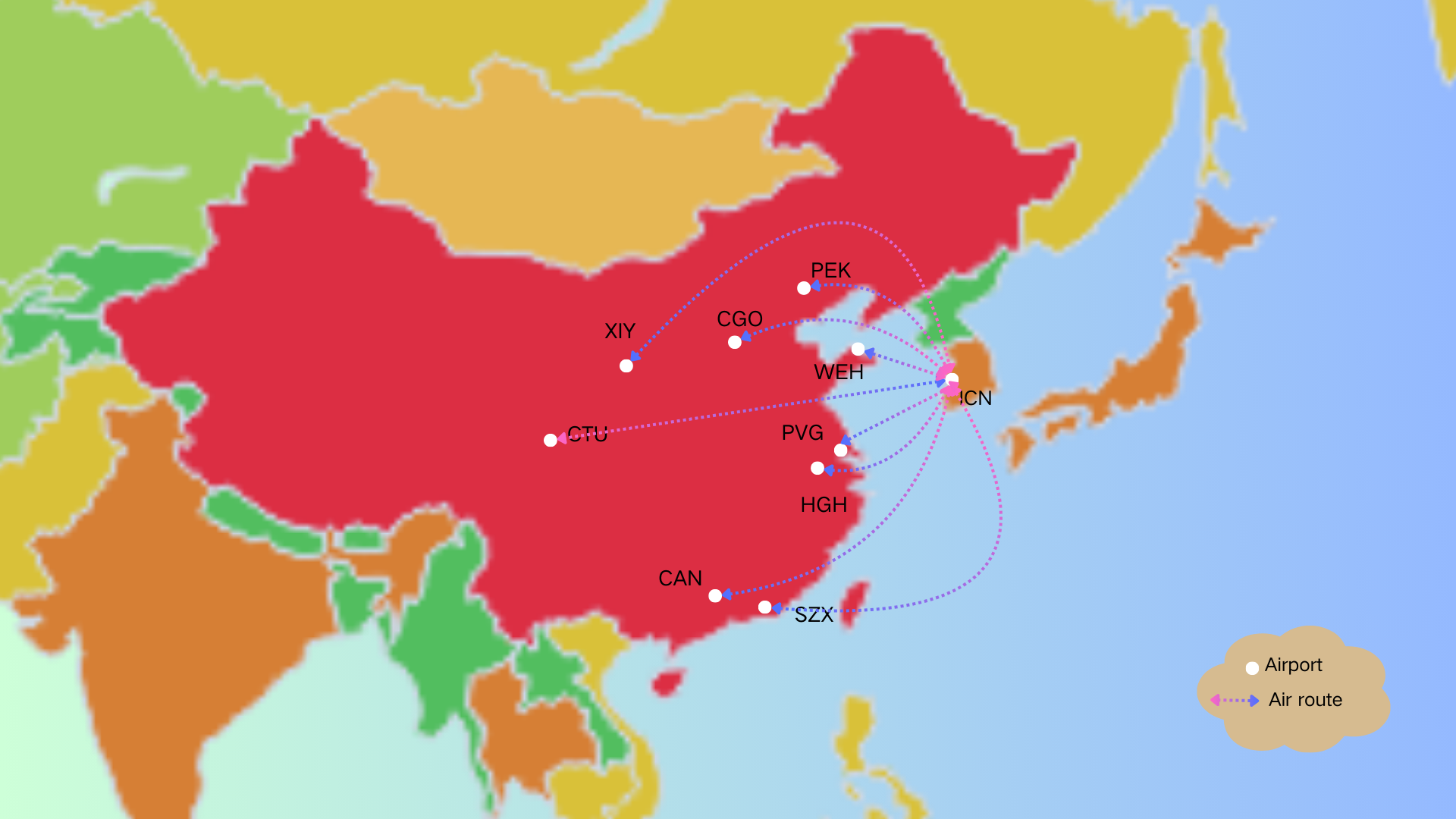
Air Freight from China to South Korean Airports
Which Airports in China Provide International Air Freight Services to South Korean Airports?
Many key airports in China have opened international freight routes to South Korea. These include core hubs like Beijing Capital International Airport (PEK), Shanghai Pudong International Airport (PVG), and Ezhou Huahu International Airport (EZY), as well as regional nodes such as Qingdao Jiaodong International Airport (TAO), Weihai Dashuibo International Airport (WEH), and Zhengzhou Xinzheng International Airport (CGO). These airports use high - frequency all - cargo flights to transport electronic products, cross - border e - commerce parcels, and cold - chain goods. They also offer special services, such as professional freight transfer in Ezhou and "same - day delivery" of fresh produce in Weihai. Together, they form an efficient logistics network covering the whole country, generally reducing the air freight transit time between China and South Korea to 6 - 12 hours, which strongly supports the trade and industrial chain collaboration between the two countries.
| Full Name of Airport (Three - Letter Code) | City | Province |
|---|---|---|
| Beijing Capital International Airport (PEK) | Beijing | Beijing |
| Shanghai Pudong International Airport (PVG) | Shanghai | Shanghai |
| Guangzhou Baiyun International Airport (CAN) | Guangzhou | Guangdong |
| Shenzhen Bao'an International Airport (SZX) | Shenzhen | Guangdong |
| Zhengzhou Xinzheng International Airport (CGO) | Zhengzhou | Henan |
| Ezhou Huahu International Airport (EZY) | Ezhou | Hubei |
| Xi'an Xianyang International Airport (XIY) | Xi'an | Shaanxi |
| Qingdao Jiaodong International Airport (TAO) | Qingdao | Shandong |
| Chengdu Shuangliu International Airport (CTU) | Chengdu | Sichuan |
| Weihai Dashuibo International Airport (WEH) | Weihai | Shandong |
| Yantai Penglai International Airport (YNT) | Yantai | Shandong |
| Hangzhou Xiaoshan International Airport (HGH) | Hangzhou | Zhejiang Province |
| Kunming Changshui International Airport (KMG) | Kunming | Yunnan Province |
Beijing Capital International Airport (PEK): Located in Shunyi District, Beijing, Beijing Capital International Airport has 4F - level facilities and an annual freight throughput of over 3 million tons. Its independent freight terminal and cold - chain processing center support the transportation of high - value - added goods in North China. The airport operates several all - cargo routes to South Korea. These include CA1033 (Beijing → Incheon, Seoul, 1 flight per day) and CA1035 (Beijing → Busan, 4 flights per week) by Air China Cargo (CA), OZ7157 (Beijing → Incheon, Seoul, 2 flights per day) by Asiana Airlines (OZ), and KE854 (Beijing → Incheon, Seoul, 3 flights per day) by Korean Air (KE). These flights transport a wide range of goods, including electronic products, cross - border e - commerce goods, and auto parts. International freight companies like FedEx and UPS also use the Beijing hub for transit, providing 10 - 15 flights per week to ensure the rapid distribution of high time-sensitive shipments.
Shanghai Pudong International Airport (PVG): Situated in Pudong New Area, Shanghai Pudong International Airport has an annual freight throughput of over 3.9 million tons. Its Western Freight Zone strengthens its position as an Asian logistics hub through the "sea - land - air combined transport" system. The density of freight routes from this airport to South Korea is extremely high. Asiana Airlines (OZ)'s OZ7159 (Shanghai → Incheon, Seoul) has 6 flights per day, covering early morning, noon, and evening with a maximum single - flight cargo capacity of about 100 tons. It mainly transports time-sensitive electronic products and precision instruments. Air China Cargo (CA)'s CA1035 (Shanghai → Incheon, Seoul) operates 2 flights per day, at 09:00 am and 15:30 pm respectively, mainly focusing on the transportation of electronic components and cross - border e - commerce parcels. Suparna Airlines (Y8)'s Y82457 (Shanghai → Incheon, Seoul) has 4 flights per week, taking off on Mondays, Wednesdays, Fridays, and Sundays. It focuses on lightweight and small - sized e - commerce goods, with a single - flight cargo capacity of about 15 tons. United Parcel Service (UPS)'s UPS188 (Shanghai → Incheon, Seoul) has 2 round - trip flights per day at 01:15 and 23:00, supporting "next - day delivery" e - commerce logistics with a single - flight transit time of 6 hours.
Shenzhen Bao'an International Airport (SZX): Located in Bao'an District, Shenzhen, Shenzhen Bao'an International Airport has an annual freight throughput of approximately 1.5 million tons, with cross - border e - commerce goods accounting for over 60%. The freight routes from this airport to South Korea are characterized by high frequency and high added value. China Southern Airlines Cargo (CZ)'s CZ1033 (Shenzhen → Incheon, 3 flights per week), China Eastern Airlines Cargo (MU)'s MU7157 (Shenzhen → Busan, 4 flights per week), and Shenzhen Airlines (ZH)'s ZH9833 (Shenzhen → Incheon, Seoul, 1 flight per day) operate on these routes. SF Airlines, through transit at the Ezhou hub, realizes the "Shenzhen - Ezhou - Incheon" next - day delivery service, further enhancing the logistics efficiency of South China to South Korea.
Zhengzhou Xinzheng International Airport (CGO): Located in Xinzheng City, Zhengzhou, Zhengzhou Xinzheng International Airport has an annual freight throughput of about 700,000 tons. It relies on the airport economic zone to build a cross - border e - commerce logistics hub. The freight routes from this airport to South Korea combine charter flights and regular flights. Korean Air (KE)'s KE132 (Zhengzhou → Incheon, Seoul, 1 flight per day) transports mobile phone components and auto parts, and Tianjin Cargo Airlines (GS)'s GS7924 (Zhengzhou → Incheon, Seoul, 2 flights per week) makes a stop - over in Linyi to support cold - chain transportation. Zhongyuan Longhao Airlines once opened a charter flight from Zhengzhou to Seoul, and it may resume in 2025, further strengthening Zhengzhou's role as a logistics node in Central China for trade with South Korea.
Ezhou Huahu International Airport (EZY): Ezhou Huahu International Airport is China's first professional freight hub, located in Echeng District, Ezhou. The core route from this airport to South Korea is SF Airlines (O3)'s O31234 (Ezhou → Incheon, Seoul, 5 flights per week). It transports express parcels, lithium - ion batteries, cosmetics, etc., providing a weekly transport capacity of nearly 280 tons and supporting the "domestic air - international air" transfer. This route connects China's first professional freight hub with the Incheon air freight gateway in South Korea, providing efficient logistics support for the integration of the industrial chains and supply chains between China and South Korea.
Qingdao Jiaodong International Airport (TAO): Located in Jiaozhou City, Qingdao, Qingdao Jiaodong International Airport has an annual freight throughput of about 200,000 tons. It develops cold - chain logistics relying on the China - South Korea Free Trade Area. Tianjin Cargo Airlines (GS)'s GS7458 (Qingdao → Incheon, Seoul, 3 flights per week) transports electronic products and agricultural and sideline products. Cold chain goods such as Yunnan fresh flowers can achieve a 2 - hour transfer time through the "direct transfer of international air - side inbound goods" service. Goods from Weihai, Yantai, and other places can be transferred through Qingdao. By combining the shortest sea - freight route between China and South Korea (Weihai - Incheon) with air freight, it forms a cross - border logistics advantage of "sea - freight cost, air - freight speed."
Chengdu Shuangliu International Airport (CTU): Located in Shuangliu District, Chengdu, Chengdu Shuangliu International Airport is a western air freight hub. SF Airlines (O3)'s O31235 (Chengdu → Incheon, Seoul, 1 flight per week) serves the transportation of electronic products and auto parts. Since its opening in 2023, the flight frequency has been gradually increased, and it may be increased to 3 flights per week in the future. Chengdu relies on the coordinated development of the China - Europe Railway Express under the "Belt and Road" initiative and air freight to form an "air - rail combined transport" model, further expanding the logistics channels to South Korea and Europe.
Weihai Dashuibo International Airport (WEH): Located in Wendeng District, Weihai, Weihai Dashuibo International Airport has 4D - level facilities with a relatively small annual freight throughput. However, it develops cold - chain logistics relying on the shortest route between China and South Korea (1 hour and 10 minutes). China Eastern Airlines (MU)'s MU5520 (Weihai → Incheon, Seoul, 2 flights per day) and Longhao Airlines (GS)'s GS7884 (Weihai → Incheon, Seoul, 2 flights per day) transport seafood, fresh produce, and other high -时效 cold - chain goods, with cold - chain goods accounting for over 70%. Jeju Air (7C)'s 7C8502 flight (Weihai → Incheon, Seoul, every Saturday) supplements the freight capacity, ensuring the "same - day delivery" cold - chain service from Weihai to Incheon.
Yantai Penglai International Airport (YNT): Located in Penglai District, Yantai, Yantai Penglai International Airport has 4E - level facilities with an annual freight throughput of about 50,000 tons. It focuses on cross - border e - commerce between China and South Korea. SF Airlines (O3)'s O31236 (Yantai → Incheon, Seoul, 5 flights per week) is SF Airlines' first direct freight route from North China to South Korea. Its service scope covers areas such as Qingdao and Weihai, transporting electronic products and e - commerce parcels. Through the intelligent scheduling system, it achieves a port - to - port transit time of 6 hours and a door - to - door D + 2 service. After accessing the global network of SF Airlines, it is expected to save 35% of the logistics costs for local enterprises.
Xi'an Xianyang International Airport (XIY): Located in Weicheng District, Xianyang, Xi'an Xianyang International Airport has 4F - level facilities with an annual freight throughput of about 300,000 tons. It develops international transfer services relying on the "Belt and Road" initiative. Korean Air (KE)'s KE178 (Xi'an → Incheon, Seoul, 2 flights per week) stops over in Xi'an to transport electronic components. China Postal Airlines once opened a postal flight route from Xi'an to Seoul (4 flights per week), but in 2025, it mainly uses the belly - hold of passenger planes for transportation. Xi'an once opened the "Seoul - Xi'an - Hanoi" fifth - freedom route, which may be resumed in the future, further strengthening its status as an international transfer hub.
Guangzhou Baiyun International Airport (CAN): Located in Huadu District, Guangzhou, Guangzhou Baiyun International Airport has an annual freight throughput of about 2 million tons and is a South China air freight hub. The airport operates several freight routes to South Korea, including CZ1033 (Guangzhou → Incheon) by China Southern Airlines Cargo (CZ), KE6608 (Guangzhou → Busan) by Korean Air (KE), and BK3205 (Guangzhou → Incheon, Seoul) by Okay Airways (BK).
Hangzhou Xiaoshan International Airport (HGH): Located in Xiaoshan District, Hangzhou, Hangzhou Xiaoshan International Airport is an important air freight hub in East China. The airport operates several freight routes to South Korea, including CA1033 (Hangzhou → Incheon) by Air China Cargo (CA) and MU7157 (Hangzhou → Busan) by China Eastern Airlines Cargo (MU).
Kunming Changshui International Airport (KMG): Located in Guandu District, Kunming, Kunming Changshui International Airport is an important air freight hub in Southwest China. The freight routes from this airport to South Korea include MU7157 (Kunming → Incheon) by China Eastern Airlines Cargo (MU) and KE6608 (Kunming → Busan) by Korean Air (KE).
Which Airlines Provide Freight Services from China to South Korean Airports?
The international air freight services from China to South Korea are jointly provided by Chinese and foreign airlines, forming a diversified and three - dimensional logistics network. Airlines such as Air China Cargo (CA), Asiana Airlines (OZ), and Korean Air (KE), relying on hubs like Beijing, Shanghai, and Zhengzhou, use high - frequency all - cargo flights to transport high - value goods such as electronic components and precision instruments, achieving "next - day delivery" service. Airlines like Tianjin Cargo Airlines (HT) and Suparna Airlines (Y8) focus on small and medium - sized cities and niche markets, providing services for electronic components, cross - border e - commerce parcels, and cold - chain fresh produce through "small - batch, high - frequency" routes. Each airline adopts the "hub - and - spoke + industry - customized" model to fully meet the high - sensitive and diversified freight demands between China and South Korea, becoming an important air link for bilateral economic and trade exchanges.
Air China Cargo (CA): As a leading enterprise in China's air cargo industry, Air China Cargo (CA) relies on the dual hubs of Beijing Capital International Airport (PEK) and Shanghai Pudong International Airport (PVG) to build a core freight network from North China and East China to South Korea. Its all - cargo routes are characterized by high load capacity and high frequency. The routes from Beijing to Seoul (CA1033, 2 flights per day) and from Shanghai to Seoul (CA1035, 2 flights per day) have a single - flight cargo capacity of 70 - 100 tons. They mainly transport electronic components, precision instruments, and cross - border e - commerce parcels. Through the "dual - hub + next - day delivery" time - guarantee service, it has become the preferred carrier for the technology manufacturing industry and e - commerce logistics. The routes cover the main industrial belts of China and South Korea, facilitating the rapid customs clearance of high - value goods and the stability of the supply chain.
Asiana Airlines (OZ): Using Shanghai Pudong International Airport (PVG) as the core hub, Asiana Airlines (OZ) has created a "high - frequency express line" for freight between China and South Korea and also increased the frequency of regional routes from Yantai to Seoul. The Shanghai - Seoul route (OZ7159, 6 flights per day) operates intensively throughout the day (at 00:50/06:30/12:15 and other time slots), with a maximum single - flight cargo capacity of 100 tons. It provides "morning - to - evening" express services for electronic products and high - end consumer goods. The Yantai - Seoul route (OZ985, 5 flights per week), relying on the geographical advantages of the Jiaodong Peninsula, realizes the "port - to - port 6 - hour" transportation of electronic components and cross - border e - commerce parcels, connecting with the Incheon hub to radiate globally. It is an important link for the logistics interconnection of the high - end manufacturing industries in China and South Korea.
Korean Air (KE): Focusing on the logistics needs of the industrial belts in China and South Korea, Korean Air (KE) uses Zhengzhou Xinzheng International Airport (CGO), Shanghai Pudong International Airport (PVG), and Guangzhou Baiyun International Airport (CAN) as key points to open differentiated freight routes. The Zhengzhou - Seoul route (KE828, 1 flight each on Thursdays and Saturdays) specializes in transporting high - value - added industrial products such as mobile phone components and automotive batteries, contributing to the construction of Zhengzhou's "Air Silk Road." The Shanghai - Busan route (KE0316, every other day, with transfer via Incheon) realizes the delivery of auto parts the next morning through "air - land combined transport." The newly added Guangzhou - Seoul route (OZ2206, 5 flights per week) covers the electronic and fast - moving consumer goods in the Pearl River Delta region, forming a logistics network of "north - south echo + industry - customized" services.
Tianjin Cargo Airlines (HT): Deeply engaged in the freight market from small and medium - sized cities in North China and East China to South Korea, Tianjin Cargo Airlines (HT) uses Zhengzhou (CGO), Jinan (TNA), and Qingdao (TAO) as key points. Through B737 - 800F all - cargo aircraft, it has opened "small - batch, high - frequency" routes from Zhengzhou/Jinan/Qingdao to Seoul (HT3845, 1 - 3 flights per day), with a single - flight cargo capacity of 15 - 25 tons. These routes flexibly transport electronic components, medical products, agricultural and sideline products, etc., providing customized logistics solutions for regional characteristic industries such as Jinan machine tools and Qingdao seafood. They fill the gap in freight services from non - hub cities to South Korea and achieve efficient "origin - direct connection + next - day delivery" transportation.
Suparna Airlines (Y8): Centered around Shanghai Pudong International Airport (PVG), Suparna Airlines (Y8) operates a dedicated all - cargo route from Shanghai to Seoul (Y82457, 1 flight each on Mondays, Wednesdays, Fridays, and Sundays). It focuses on transporting lightweight and small - sized cross - border e - commerce parcels. The flight departs at 02:45. Relying on the cross - border e - commerce exclusive cargo station at Pudong Airport, it provides one - stop services including sorting, security inspection, and loading. With a single - flight cargo capacity of about 15 tons, it has become a preferred logistics partner for small and medium - sized e - commerce sellers due to its cost - effectiveness and stable transit time, helping "Made in the Yangtze River Delta" reach South Korean consumers quickly through e - commerce channels.
Jeju Air (7C): Focusing on the high - density freight market from Yantai to Seoul, Jeju Air (7C) has opened an all - cargo route from Yantai Penglai International Airport (YNT) to Seoul (7C8402, 28 flights per week) with a weekly freight capacity of 700 tons and a single - flight transit time of 2 hours. It is one of the freight routes with the highest frequency between China and South Korea. The route mainly transports electronic products and cross - border e - commerce parcels, providing "port - to - port 6 - hour, door - to - door D + 1" express services. It is deeply integrated into the industrial chain of the Jiaodong Peninsula's trade with South Korea, serving as an "air bridge" for logistics interconnection between the two "maritime neighbors" and facilitating regional economic integration.
China Eastern Airlines Cargo (MU): Using Shanghai Pudong International Airport (PVG) as the core, China Eastern Airlines Cargo (MU) combines all - cargo aircraft and passenger aircraft belly - hold resources to build a diversified logistics channel between China and South Korea. In terms of all - cargo aircraft, the Shanghai - Seoul route (MU741, 2 flights per day) supports the transportation of bulk goods and high-sensitive electronic products. For passenger aircraft belly - hold, the Qingdao - Seoul route (MU715, 4 flights per week, with transfer via Incheon to North America) connects Qingdao's manufacturing industry with the South Korean hub through the "belly - hold + transfer" model, and also provides cross - regional transfer services for North American goods. In addition, the Shanghai - Busan route (MU503, 1 flight per day, belly - hold) transports light goods such as clothing and food, forming a three - dimensional logistics system of "all - cargo aircraft main lines + belly - hold feeder lines + global transfer".
Spring Airlines (9C): Relying on the passenger aircraft belly - hold at Shanghai Pudong Airport, Spring Airlines (9C) operates a low - cost freight service from Shanghai to Busan (9C8573, 1 flight per day) with a single - flight cargo capacity of 5 tons. It is suitable for lightweight and small - sized e - commerce parcels, providing a cost - effective option for small and medium - sized merchants in East China.
Shenzhen Airlines (ZH): Through the passenger aircraft belly - hold at Shenzhen Bao'an Airport, Shenzhen Airlines (ZH) has opened routes from Shenzhen to Jeju (ZH9041/ZH9042, 1 flight each on Tuesdays, Thursdays, and Saturdays), specializing in duty - free goods and tourism supplies, facilitating the connection of the tourism and retail supply chain between Shenzhen and Jeju.
Hainan Airlines (HU): Using the converted passenger - to - cargo B737 - 800 aircraft at Haikou Meilan Airport, Hainan Airlines (HU) operates the route from Haikou to Jeju (HU7012, 1 flight per week), mainly transporting off - island duty - free goods with a single - flight cargo capacity of 13 tons. It builds a stable logistics channel between Hainan Free Trade Port and Jeju's duty - free market.
How Long Does It Take to Ship Goods from China to South Korean Airports by Air?
The transportation time of air - freighted goods from China to South Korean airports varies depending on the route and customs clearance procedures. For direct flights, such as those from Beijing (2 hours), Shanghai (1.5 hours), and Yantai (1 hour and 10 minutes) to Incheon, the flight time is short. With expedited services, it can be delivered within 12 - 24 hours. Transfer flights require an additional 2 - 6 hours for transfer, and the total time is approximately 6 - 9 hours (excluding customs clearance). In terms of customs clearance, general goods take 0.5 - 1 working day. Fresh and cold - chain goods are given priority and can be cleared within 0.5 working day (with prior declaration of the health certificate). Dangerous goods and high - value goods take 1 - 2 working days (with additional reviews). Document errors or inspections may extend the process by 2 - 3 days. Overall, the transit time can be 12 - 24 hours for direct - flight expedited services, 2 - 3 days for regular services, and 5 - 7 days or more for transfer flights or complex customs clearance. It is recommended to consult airlines or freight forwarders in advance to optimize the process.
Transit Time of Direct Flights
| Departure Airport | Arrival Airport | Flight Time |
|---|---|---|
| Beijing Capital (PEK) | Incheon (ICN) | 2 hours |
| Shanghai Pudong (PVG) | Incheon (ICN) | 1.5 hours |
| Guangzhou Baiyun (CAN) | Incheon (ICN) | 3 hours |
| Qingdao Liuting (TAO) | Incheon (ICN) | 1 hour and 20 minutes |
| Yantai Laishan (YNT) | Incheon (ICN) | 1 hour and 10 minutes |
Transit Time of Transfer Flights
Transfer Time: Usually, an additional 2 - 6 hours of transfer time is required, depending on the airport transfer and flight arrangements.
Total Time = Direct - Flight Time + Transfer Time.
Examples of Transfer Airports:
- Zhengzhou Xinzheng (CGO) → Qingdao Liuting (TAO) → Incheon (ICN)
- Direct - Flight Time: CGO→TAO (1.5 hours) + TAO→ICN (1 hour and 20 minutes)
- Transfer Stopover: 4 - 6 hours
- Total Transportation Time: Approximately 7 - 9 hours (excluding customs clearance).
- Shenzhen Bao'an (SZX) → Shanghai Pudong (PVG) → Busan (PUS)
- Transfer Stopover: 3 - 5 hours
- Total Transportation Time: Approximately 6 - 8 hours (excluding customs clearance).
Customs Clearance Time in South Korea
Clearance of General Goods: 0.5 - 1 working day (if the documents are complete and there is no inspection).
Special Goods:
- Fresh/Cold - Chain Goods: Given priority in customs clearance, can be cleared within 0.5 working day (with prior application for the health certificate).
- Dangerous Goods/High - Value Goods: 1 - 2 working days (with additional reviews).
Delays:
- Document errors (such as inconsistent HS codes) or random inspections may extend the clearance time to 2 - 3 days.
Impact of Special Circumstances
Holidays/Peak Seasons: During the Spring Festival and Singles' Day, customs clearance may be delayed by 1 - 2 days (due to a sharp increase in the workload of South Korean customs).
Weather/Flight Cancellations: During the typhoon season (July - September), airports in the southeast coast of China (such as PVG and CAN) may experience delays of 12 - 24 hours.
Special Requirements for Goods: Lithium - ion batteries require UN38.3 certification, which may increase the transportation time by 1 - 2 days. Fresh food requires pre - booking of cold - chain vehicles, and it must be picked up within 6 hours after landing.
Freight Forwarding Services
Expedited Services: Relying on in - depth cooperation with top - tier air freight resources in the industry, expedited "same - day delivery" freight services are offered. Taking the Beijing (PEK) - Seoul (ICN) route as an example, the goods are arranged to board the morning flight, and through professional expedited customs clearance procedures, the entire delivery process from the origin to the destination can be completed in just 12 hours, meeting the strict time - sensitive requirements of customers for urgent cargo transportation.
Customs Clearance Agency Services: By sorting, checking, and submitting complete customs clearance documents in advance, the originally time - consuming customs clearance process can be significantly shortened to 2 - 4 hours, facilitating the rapid customs clearance of goods, reducing the detention time at the port, and making the entire freight process more smooth and efficient.
Summary: Transit Time Range
It generally takes 3 days to ship goods from China to South Korea by air, but the fastest can be achieved within 1 day. If there are incomplete documents or transfer is required, it may take 7 days.
| Scenario | Total Time | Example Route |
|---|---|---|
| Fastest | 12 - 24 hours | SF Airlines O3279 (YNT→ICN, taking off in the early morning + agent - assisted expedited customs clearance) |
| Regular | 2 - 3 days | China Eastern Airlines MU741 (PVG→ICN, standard customs clearance) |
| Slowest | 7 days or more | Transfer route + incomplete documents (such as KE0316 via ICN→PUS) |
It is recommended to consult freight forwarders or airlines in advance when arranging cargo transportation to obtain more accurate transportation times and arrangements.
What Are the Charter Flights for Air Freight from China to South Korean Airports?
Charter flights for air freight from China to South Korean airports are operated by multiple airlines, forming a direct - flight and transfer network covering major regions across the country. Air China Cargo (CA) has 2 direct flights per day to Incheon International Airport (ICN) in Seoul from Beijing (PEK), transporting electronic products, fresh produce, and express parcels. China Eastern Airlines Cargo (MU) has direct flights to Incheon from Shanghai (PVG, 2 flights per day), Qingdao (TAO, 3 flights per week), Nanjing (NKG, 3 flights per week), and Harbin (HRB, 3 flights per week), carrying e - commerce goods, medical supplies, and mechanical equipment. China Southern Airlines Cargo (CZ) has 4 direct flights per week from Guangzhou (CAN) to Incheon, mainly transporting fresh produce, electronic products, and cross - border e - commerce parcels. Cathay Pacific Cargo (CX) has 1 direct flight per day from Hong Kong (HKG) to Incheon, focusing on high - value goods and luxury items. For transfer routes, Sichuan Airlines (3U) has 3 flights per week from Chengdu (CTU) to Incheon via Beijing, and Cargolux Airlines (CV) has 2 flights per week from Zhengzhou (CGO) to Incheon via Anchorage, serving bulk goods such as biomedicine and industrial equipment. These charter flights mainly consist of high - frequency direct flights, supplemented by transfer flights, covering a wide range of cargo types and providing customized air freight services for China - South Korea trade.
| Departure Airport | Destination Airport | Airlines | Reference Air Freight Price |
|---|---|---|---|
| PEK | ICN | Air China Cargo | For over 100 kg: ¥20/kg; for over 300 kg: ¥17/kg; for over 500 kg: ¥15/kg; for over 1000 kg: ¥13/kg |
| PVG | ICN | China Eastern Airlines Cargo | For over 100 kg: ¥14/kg; for over 500 kg: ¥12/kg |
| CAN | ICN | China Southern Airlines Cargo | For over 100 kg: ¥20/kg; for over 300 kg: ¥18/kg; for over 500 kg: ¥16/kg; for over 1000 kg: ¥15/kg |
| HKG | ICN | Cathay Pacific Cargo | For over 100 kg: ¥22/kg; for over 300 kg: ¥20/kg; for over 500 kg: ¥18/kg; for over 1000 kg: ¥15/kg |
| CTU | ICN | Sichuan Airlines Cargo | For over 100 kg: ¥22/kg; for over 300 kg: ¥20/kg; for over 500 kg: ¥19/kg; for over 1000 kg: ¥18/kg |
| CGO | ICN | Cargolux Airlines International | For over 100 kg: ¥18/kg; for over 300 kg: ¥16/kg; for over 500 kg: ¥13/kg; for over 1000 kg: ¥11/kg |
| TAO | ICN | China Eastern Airlines Cargo | For over 100 kg: ¥10/kg; for over 300 kg: ¥8/kg; for over 500 kg: ¥5/kg; for over 1000 kg: ¥5/kg |
| NKG | ICN | China Eastern Airlines Cargo | For over 100 kg: ¥27/kg; for over 300 kg: ¥25/kg; for over 500 kg: ¥24/kg; for over 1000 kg: ¥23/kg |
| HRB | ICN | China Eastern Airlines Cargo | For over 100 kg: ¥26/kg; for over 300 kg: ¥24/kg; for over 500 kg: ¥23/kg; for over 1000 kg: ¥22/kg |
Airlines Information
Air China Cargo
Departs from Beijing (PEK), with flight number CA1033, a frequency of 2 flights per day, and the route segment is PEK - ICN (direct flight).
China Eastern Airlines Cargo
Departs from Shanghai (PVG), with flight number MU7157, a frequency of 2 flights per day, and the route segment is PVG - ICN (direct flight).
Departs from Qingdao (TAO), with flight number MU7159, a frequency of 3 flights per week, and the route segment is TAO - ICN (direct flight).
Departs from Nanjing (NKG), with flight number MU7161, a frequency of 3 flights per week, and the route segment is NKG - ICN (direct flight).
Departs from Harbin (HRB), with flight number MU7303, a frequency of 3 flights per week, and the route segment is HRB - ICN (direct flight).
China Southern Airlines Cargo
Departs from Guangzhou (CAN), with flight number CZ455, a frequency of 4 flights per week, and the route segment is CAN - ICN (direct flight).
Cathay Pacific Cargo
Departs from Hong Kong (HKG), with flight number CX068, a frequency of 1 flight per day, and the route segment is HKG - ICN (direct flight).
Sichuan Airlines Cargo
Departs from Chengdu (CTU), with flight number 3U8581, a frequency of 3 flights per week, and the route segment is CTU - PEK - ICN (transfer via Beijing).
Cargolux Airlines International
Departs from Zhengzhou (CGO), with flight number CV9876, a frequency of 2 flights per week, and the route segment is CGO - ANC - ICN (transfer via Anchorage).
Route Introduction
Beijing (PEK) - Seoul (ICN): CA1033 Air China Cargo's CA1033 route operates two flights per day, mainly transporting electronic products, fresh food, and express parcels, providing stable logistics support for China - South Korea trade.
Shanghai (PVG) - Seoul (ICN): MU7157 China Eastern Airlines Cargo's MU7157 route operates two flights per day, mainly carrying e - commerce goods, medical supplies, and high - end manufacturing products, offering efficient international logistics solutions for enterprises in East China.
Guangzhou (CAN) - Seoul (ICN): CZ455 China Southern Airlines Cargo's CZ455 route operates four flights per week, mainly transporting fresh food, electronic products, and cross - border e - commerce goods, providing direct freight services from South China to South Korea.
Hong Kong (HKG) - Seoul (ICN): CX068 Cathay Pacific Cargo's CX068 route operates one flight per day, mainly transporting high - value goods, fresh food, and luxury items, serving as an important freight corridor from the Asia - Pacific region to South Korea.
Chengdu (CTU) - Seoul (ICN): 3U8581 Sichuan Airlines Cargo's 3U8581 route operates three flights per week, transferring via Beijing to Seoul. It mainly transports biomedicine, general goods, and fresh food, providing a freight service connecting Southwestern China with South Korea.
Zhengzhou (CGO) - Seoul (ICN): CV9876 Cargolux Airlines International's CV9876 route operates two flights per week, transferring via Anchorage to Seoul. It mainly transports bulk industrial equipment, auto parts, and high - value - added goods, providing a direct freight channel for the manufacturing industry in Central China to South Korea.
Qingdao (TAO) - Seoul (ICN): MU7159 China Eastern Airlines Cargo's MU7159 route operates three flights per week, mainly transporting mechanical equipment, chemical products, and cross - border e - commerce goods. It offers direct freight services for the manufacturing and foreign trade enterprises in the Shandong Peninsula to South Korea.
Nanjing (NKG) - Seoul (ICN): MU7161 China Eastern Airlines Cargo's MU7161 route operates three flights per week, mainly transporting electronic products, medical devices, and high - value - added goods, providing efficient international logistics solutions for enterprises in the Yangtze River Delta region.
Harbin (HRB) - Seoul (ICN): MU7303 China Eastern Airlines Cargo's MU7303 route operates three flights per week, mainly transporting clothing, home appliances, and daily necessities, supporting cross - border e - commerce and general trade. The "7×24 - hour" appointment - based customs clearance service of Harbin Customs further improves the operation efficiency of this route.
How Much Is the Air Freight Price per Kilogram from China to South Korean Airports?
Taking the charter flight of Okay Airways (BK) from Guangzhou Baiyun International Airport (CAN) to Incheon International Airport (ICN) in Seoul as an example, the price for 100 kg+ is 18 yuan per kilogram. When the weight reaches 300 kg+, it drops to 15 yuan per kilogram; for 500 kg+, it is 13 yuan per kilogram; and for 1000 kg+, it is as low as 10 yuan per kilogram. This route operates 3 flights per week, with a single - flight cargo capacity of 7.8 tons, which is suitable for cross - border e - commerce express parcels and lightweight small items. From Yantai (YNT) to Incheon (ICN) in Seoul via Jeju Air (7C)'s all - cargo aircraft, the price for 100 kg+ is 8 yuan per kilogram, 7 yuan per kilogram for 300 kg+, 6 yuan per kilogram for 500 kg+, and only 5 yuan per kilogram for 1000 kg+. With 28 flights per week and a single - flight cargo capacity of 15 - 25 tons, it supports the transportation of large - volume e - commerce parcels. From Shanghai Pudong International Airport (PVG) to Incheon (ICN) in Seoul, using the all - cargo aircraft and converted passenger - to - cargo aircraft of China Eastern Airlines (MU), there are 2 flights per day. The price for 100 kg+ is 14 yuan per kilogram, 12 yuan per kilogram for 300 kg+, 10 yuan per kilogram for 500 kg+, and it drops to 7 yuan per kilogram for 1000 kg+. The maximum single - flight cargo capacity is 100 tons, covering the transportation of cross - border e - commerce goods and industrial products.
| Route | Airlines | 100 kg+ (RMB/kg) | 300 kg+ (RMB/kg) | 500 kg+ (RMB/kg) | 1000 kg+ (RMB/kg) | Other Remarks |
|---|---|---|---|---|---|---|
| Guangzhou (CAN) → Seoul Incheon (ICN) | Okay Airways (BK) | 18 | 15 | 13 | 10 | Charter flight converted from passenger aircraft, 3 flights per week, single - flight cargo capacity of 7.8 tons, suitable for cross - border e - commerce express parcels and lightweight small items. |
| Yantai (YNT) → Seoul Incheon (ICN) | Jeju Air (7C) | 8 | 7 | 6 | 5 | All - cargo aircraft, 28 flights per week, single - flight cargo capacity of 15 - 25 tons, supports large - volume e - commerce parcels. |
| Shanghai Pudong (PVG) → Seoul Incheon (ICN) | China Eastern Airlines (MU) | 14 | 12 | 10 | 7 | All - cargo aircraft + converted passenger - to - cargo aircraft, 2 flights per day, maximum single - flight cargo capacity of 100 tons, covering cross - border e - commerce and industrial products. |
| Zhengzhou (CGO) → Seoul Incheon (ICN) | Korean Air (KE) | 18 | 16 | 13 | 11 | All - cargo aircraft, 2 flights per week, specializing in transporting high - value - added industrial products such as mobile phone components and automotive batteries. |
| Qingdao (TAO) → Seoul Incheon (ICN) | Tianjin Cargo Airlines (HT) | 10 | 8 | 5 | 5 | All - cargo aircraft, 1 - 3 flights per day, serving regional characteristic industries (such as Jinan machine tools and Qingdao seafood). |
| Haikou (HAK) → Jeju (CJU) | Hainan Airlines (HU) | 16 | 13 | 11 | 9 | Converted passenger - to - cargo aircraft, 1 flight per week, mainly transporting off - island duty - free goods. |
Price Explanation and Influencing Factors
Composition of Basic Fees:
- Air Freight: It accounts for 60% - 70% of the total cost and is calculated based on the higher value between the actual weight and the volumetric weight (length×width×height/6000).
- Surcharges: There are fuel surcharges (about 2 - 4 yuan per kilogram), security inspection fees (1 yuan per kilogram), airport handling fees (200 - 300 yuan per ticket), etc.
Key Influencing Factors:
Season and Market:
- During peak seasons (such as e - commerce promotions and holidays), the price may increase by 10% - 20%. As the cargo space is tight, it is necessary to book in advance.
- During off - peak seasons (such as January - February), discounts can usually be negotiated, and the price of some routes may drop by 15%.
Type of Goods:
- Sensitive Goods (such as batteries and liquids): An additional dangerous goods handling fee is required, and the price may increase by 20% - 50%.
- Perishable Goods (such as seafood): They require cold chain transportation, and the price is 30% - 40% higher.
Transportation Time:
- Direct Flights: They are 1 - 2 days faster than transfer flights, but the price is 10% - 15% higher (such as SF Airlines' direct flight from Ezhou).
- Expedited Services: Some freight forwarders offer "48 - hour delivery" services, and the price may increase by 30%.