
Home / Shipping to Switzerland / How to Ship from China to Switzerland
How to Ship from China to Switzerland: 8.1% VAT, Zero Duty & Transit
Switzerland breaks the assumptions that work everywhere else in Europe. It has no seaport. It is not in the EU customs union, so a container discharged at Rotterdam is not yet "in Europe" in any customs sense — it still has to cross the EU and then cross a second border into Switzerland. And it charges import VAT at 8.1%, which is less than half what an Irish or French importer pays, with most industrial goods entering at zero duty since January 2024.
That combination is genuinely good news for importers, and it is also where the mistakes happen. Newcomers assume Switzerland works like Germany because the truck drives through it, discover too late that their goods needed a transit procedure to get there, and occasionally pay for certificates of origin that no longer change the duty outcome.
This guide is written for buyers importing from China for the first time. It covers how cargo physically reaches a landlocked country, the transit step, realistic timings, trade terms, the process end to end, duty and VAT, the China–Switzerland free trade agreement, Swiss product rules that have no EU equivalent, and how to tell whether a forwarder really knows the lane.
Switzerland at a glance
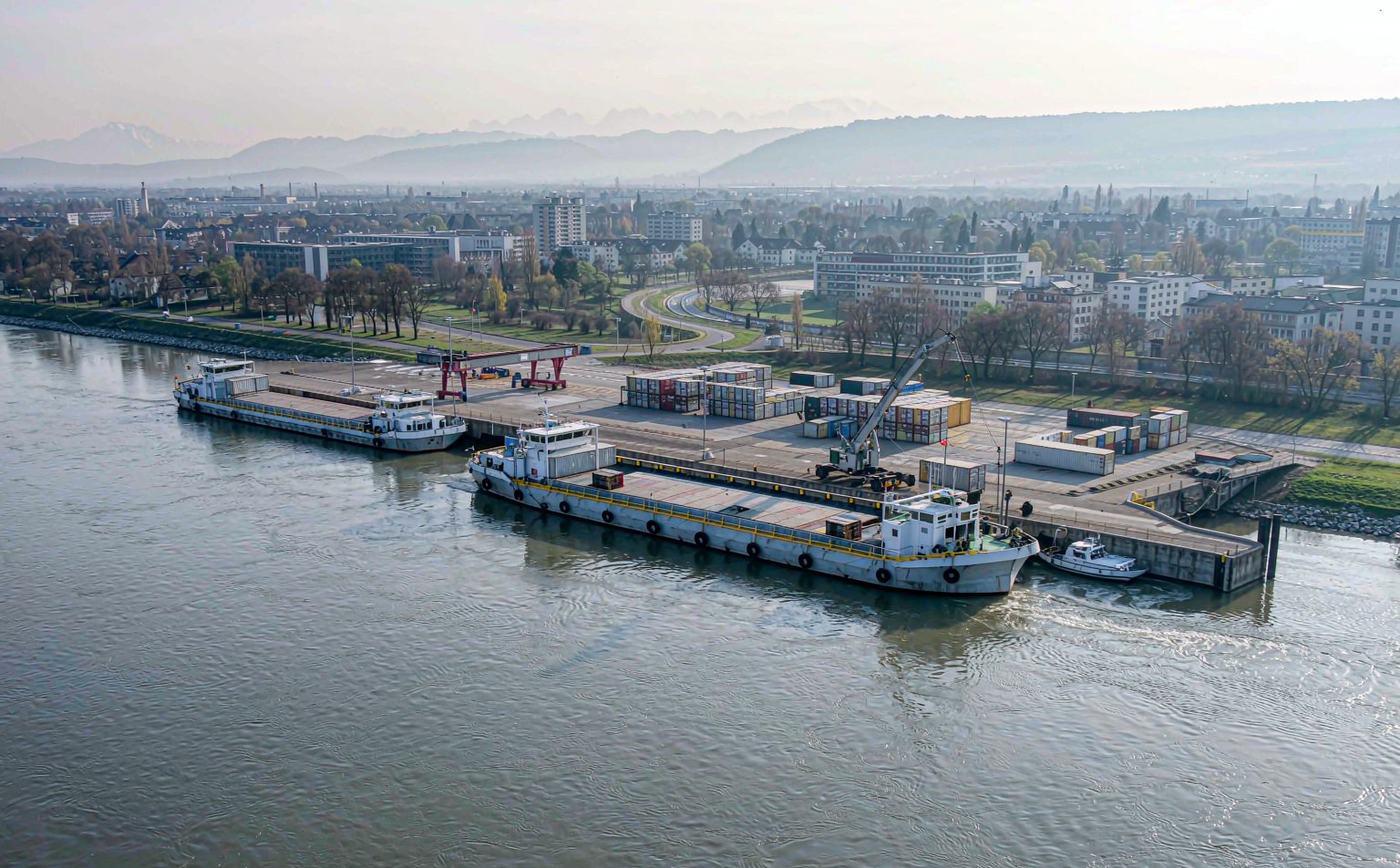
- No seaport. Containers arrive at Rotterdam, Antwerp, Hamburg or Genoa and move inland by Rhine barge to Basel, or by road and rail through the Gotthard and Lötschberg Alpine corridors.
- Not in the EU customs union. Customs authority is the Federal Office for Customs and Border Security (BAZG). Goods from an EU port need a transit procedure before Swiss clearance.
- Duty is mostly zero. Switzerland abolished duties on almost all industrial goods on 1 January 2024. Remaining duties are largely agricultural and are charged by weight, per 100 kg gross.
- VAT 8.1% standard, 2.6% reduced, 3.8% lodging. No tax is collected if the amount due is under CHF 5 — roughly CHF 62 of goods value at the standard rate.
- Free trade agreement with China in force since 1 July 2014, using the Form S certificate of origin. Upgrade negotiations were completed in August 2026.
- No EORI number. You need a Swiss customs account and, for companies, a UID number. Declarations are electronic only, through Passar.
- Swiss-specific compliance: a Swiss authorised representative for medical devices, SWICO or SENS recycling fees on electronics, and the Swiss Type J plug standard.
How your cargo moves: China to Switzerland
Eight steps from your supplier's door to yours. The last four are the ones shaped by local rules.
- Pickup from your supplierWe collect the goods anywhere in China and bring them to our consolidation point.
- Export clearanceChina customs declaration filed and released before the goods move to the port.
- Loading and departureContainer loaded, sealed and handed to the carrier at the Chinese port.
- Main carriageOcean, air or rail movement booked on the route agreed for your cargo.
- Arrival at the gatewayDischarge at the port or airport of entry, recorded on the carrier's manifest.
- Import clearanceCustoms declaration filed locally, with duty and tax assessed on the declared value.
- Customs releaseGoods released into free circulation once duty and tax are settled.
- Final deliveryOnward movement to your delivery address, warehouse or nominated depot.
Duty rates, VAT rates and clearance times move, and the figure that applies to your goods is the one set for your commodity code on the day of clearance. We check the current position against your code before your goods sail and confirm it to you in writing — ask for that check when you request a quote.
Why Switzerland is not a normal European delivery
Three facts about Switzerland trip up importers who have shipped into the EU before.
It is landlocked. There is no Swiss container terminal where an ocean vessel can berth. Your container is discharged at a North Sea or Mediterranean port and then moves inland by barge, truck or rail. The last leg is not a formality — it is a booked, priced, scheduled movement that can be delayed by low river levels, Alpine tunnel closures or a missing transit document.
It is not in the EU customs union. Switzerland is an EFTA member with its own customs territory, its own tariff, its own currency and its own VAT system, administered by the BAZG. When your container lands at Rotterdam it is inside the EU customs territory but outside Switzerland. Getting it to Basel is an international movement, not a domestic delivery.
Its duty and VAT logic is inverted compared with the EU. The EU charges duty as a percentage of value and VAT at 19% to 23%. Switzerland charges almost no duty on industrial goods, charges what duty remains by weight, and applies VAT at 8.1%. So the expensive part of importing into Germany is the VAT; the expensive part of importing into Switzerland is the inland logistics.
What this means practically: quote the whole door-to-door cost, not the ocean freight. On a China–Switzerland shipment the inland leg out of Rotterdam or Genoa is a larger share of the total than it is on a Rotterdam delivery, and it is where low quotes quietly fall apart.
Getting cargo into a landlocked country: Rotterdam, Genoa, Basel and the Alpine corridors
There are four sensible ways to get a container from a Chinese port to a Swiss address, and the right one depends on where in Switzerland you are and what is in the box.
| Route | How it works | When it suits |
|---|---|---|
| Rotterdam or Antwerp, then Rhine barge to Basel | Mainline vessel from China to the North Sea, then barge up the Rhine to the Swiss Rhine ports at Basel — Kleinhüningen, Birsfelden and Muttenz/Auhafen — then truck or rail onward | The default for full containers into north and central Switzerland. Barge capacity is cheap per unit and reliable, and Basel is Switzerland's only direct water access. |
| Genoa, then road or rail north | Mainline vessel into the Mediterranean, then truck or rail through the Gotthard or Lötschberg Alpine corridor | Best for southern Switzerland and Ticino, and when your supplier is in South China and Mediterranean routings are faster than Northern Europe. |
| Hamburg, then rail or road | Mainline into Germany, then onward rail or truck | Useful for eastern Switzerland and for cargo already moving on the Rhine–Alpine rail corridor. |
| Air into Zurich, Geneva or EuroAirport Basel | Direct or one-stop freighter, or consolidated air freight via a European hub | High-value, low-volume and time-critical goods. Switzerland's pharma, watch and precision-engineering sectors make its airports unusually well equipped for valuable cargo. |
Two corridor details are worth knowing. The Gotthard and Lötschberg Alpine crossings are the backbone of north–south freight through Switzerland, and both can be affected by works, incidents and seasonal traffic restrictions — ask your forwarder which corridor the routing uses. And the Rhine is subject to water levels: in prolonged dry periods barge capacity is restricted and surcharges appear. That is a reason to book the inland leg early, not at the last minute.
Crossing the EU before you can clear in Switzerland
This is the step newcomers miss, and it is the one that stops containers.
Your goods are discharged at Rotterdam. They are now in the EU customs territory, and Switzerland is somewhere else. To move them from Rotterdam to Basel without paying EU duty and EU VAT, they have to travel under a customs transit procedure — in practice an NCTS transit declaration, which Switzerland has used in its current form since 2024. Alternatively, the goods can be cleared into the EU at Rotterdam and then re-exported to Switzerland, but that means an EU import declaration, EU VAT handling and an export declaration, which is more work and more exposure for no benefit in most cases.
Clearing into Switzerland then happens at the Swiss border or at an inland Swiss customs office, and it is a separate declaration in a separate system with a separate authority. Swiss declarations are electronic only — there is no paper route.
Practically, this means the party who moves your goods out of Rotterdam must be able to open and close a transit document. That is normal for an experienced Swiss forwarder or broker and completely unfamiliar to a generalist. Ask the question before you book: who opens the transit, and who discharges it?
Transit times to Basel, Zurich and Geneva you can plan with
| Mode | Typical transit | What the clock includes |
|---|---|---|
| Sea FCL (20ft / 40ft / 40HQ) | 32–40 days to a Swiss address | Roughly 25–32 days on the mainline vessel from China to Rotterdam, Antwerp, Hamburg or Genoa, plus about 2–5 days for the barge, rail or truck leg into Switzerland and customs clearance. |
| Sea LCL | 38–48 days | The same sea and inland legs plus consolidation at the China warehouse and deconsolidation at the destination warehouse, which together often add one to two weeks. |
| Rail from China | 20–28 days to a European rail hub, plus the Swiss leg | China–Europe rail to Duisburg or another hub, then onward to Switzerland. Switzerland sits on the Rhine–Alpine corridor, so the onward leg is short and well served. Worth quoting when your supplier is inland. |
| Air freight | 3–7 days airport to airport | Into Zurich, Geneva or EuroAirport Basel, including origin handling. Faster and well suited to high-value Swiss cargo. |
| Express courier | 3–6 days door to door | Samples and small parcels, with the carrier acting as broker. |
Treat all of these as planning figures. The variables that actually move the date: the inland booking out of the European port, river conditions if you are barging, Alpine corridor disruption, and — most often — a document problem at clearance. See our rail freight page for how the rail option works.
Trade terms on a Swiss shipment: who pays, who clears, when risk moves
The trade term decides who pays for each leg, who is the importer of record in Switzerland, and the moment risk transfers. On a Swiss shipment the term matters more than usual, because the inland leg and the transit procedure are expensive and easy to leave unassigned.
| Term | Who arranges main carriage | Who clears in Switzerland | Risk transfers | Practical read |
|---|---|---|---|---|
| EXW (Ex Works) | You | You | At the factory door | Avoid for a first shipment. You take on Chinese export clearance and inland pickup you cannot manage from Zurich. |
| FOB (Free On Board) | You | You | When goods pass the ship's rail at the Chinese port | The safe default. The supplier clears export and loads; you control the vessel, the European port and the inland leg — which is where the money is on this route. |
| CIF (Cost, Insurance, Freight) | Seller, to the named port | You | On board at origin | Note what CIF does not include: it stops at the port. The barge to Basel, the transit procedure and Swiss clearance are all still yours. |
| DAP (Delivered At Place) | Seller, to your address | You | On arrival, before unloading | Door delivery with you as importer of record. Clear and usually the best balance for a company that already has Swiss VAT registration. |
| DDU (Delivered Duty Unpaid) | Seller, to your address | You | On arrival | The older wording for the same idea as DAP. Duty and VAT are yours. |
| DDP (Delivered Duty Paid) | Seller | Seller's agent | On arrival | Easiest to receive, easiest to get wrong. Check who is named as importer and whether you will receive the customs declaration — without one in your name you have no evidence of import VAT paid and nothing to reclaim. |
The Swiss-specific trap. A seller who quotes DDP "to Switzerland" may only have priced delivery to a Swiss address, not the Swiss customs clearance, or vice versa. Ask which customs declaration will be filed, in whose name, and who holds the Swiss customs account. Ask for the destination charges in writing: terminal handling at the European port, transit document fee, barge or Alpine haulage, Swiss clearance, and final delivery. See local charges.
The eight stages between a Chinese factory and a Swiss warehouse
Confirm the tariff lines and the trade term
Before production ends. Swiss duty is charged by weight rather than by value, so the tariff line and the gross weight both matter, and agricultural lines may need a quota allocation or an import permit.
Book the ocean leg and the inland leg together
Which Chinese port, which European port, and how the goods get from that port to Switzerland — barge, rail or truck, and through which Alpine corridor. Booking the inland leg separately is how containers end up waiting at Rotterdam.
Collect from the factory or consolidate
Full container loaded at the factory, or cartons into a consolidation warehouse alongside other suppliers' cargo. See warehouse and consolidation.
Chinese export declaration
Filed through China's single window. If a Form S certificate of origin is needed for your tariff lines, this is when it is issued — not after sailing.
Mainline to the European port
Roughly 25 to 32 days from China to Rotterdam, Antwerp, Hamburg or Genoa.
Transit across the EU
An NCTS transit declaration is opened so the goods can cross the EU customs territory without EU duty or VAT being paid. It must be discharged correctly at the Swiss end.
Swiss import declaration
Filed electronically through the BAZG system. Duty is assessed — usually zero on industrial goods — and import VAT at 8.1% is assessed on the customs value plus duty plus transport to the Swiss border. Registered importers can use a deferred customs account rather than paying at clearance.
Release and final delivery
Once BAZG releases the consignment, the goods move to your premises or into a bonded or duty-free warehouse if you would rather defer the tax. See import clearance documents.
Duty in Switzerland: charged by weight, and mostly already zero
On 1 January 2024 Switzerland abolished customs duties on almost all industrial goods. For an importer bringing machinery, electronics, textiles, chemicals, vehicles or most consumer goods from China, that means the duty line on the declaration is zero — and it is zero regardless of origin, so it does not depend on holding a preferential certificate.
What remains is mostly agricultural: meat, dairy, cereals and processed food. Those lines carry duties, quotas, seasonal rates and, for some products, import licences allocated by auction. Out-of-quota rates on meat and dairy can be very high.
The other distinctive feature is the basis of assessment. Where the EU charges duty as a percentage of customs value, the Swiss tariff (Tares, with roughly 8,200 tariff lines) charges per 100 kilograms of gross weight. That has a consequence worth internalising before you order: heavy, low-value goods—ceramics, castings, stone, some furniture—attract proportionally higher Swiss duty than light, high-value goods of the same invoice value. It also means your gross weight has to be accurate on the documents, not estimated.
Worked example, industrial goods. Machinery with a customs value of CHF 20,000 and CHF 2,400 of freight and insurance to the Swiss border. Duty: CHF 0. Import VAT at 8.1% on CHF 22,400: CHF 1,814. For a Swiss-registered business recovering input tax, the real cost is nil.
Worked example, processed food. 2,000 kg of processed food at CHF 15,000, with a duty of CHF 20 per 100 kg: duty is CHF 400. VAT at 2.6% on CHF 15,400: CHF 400. Note how much smaller both numbers are than the equivalent EU calculation — and note that the food may also need a permit and, depending on the line, a quota allocation.
Duty rates, quota rules and permit requirements should always be confirmed against the current Swiss tariff (Tares) with your Swiss broker before you place the order. We give you the shipping side accurately and tell you where to check the rest.
The China-Switzerland free trade agreement and when Form S still matters
Switzerland has a genuine free trade agreement with China — signed in July 2013 and in force since 1 July 2014 — which is unusual among European destinations and is worth understanding properly.
The agreement uses the Form S certificate of origin, issued in China by the customs authority or the Council for the Promotion of International Trade. It is valid for 12 months from issue, the new-format version allows up to 50 item lines, and shipments below a modest value threshold may be exempt from presenting one. The agreement also contains a direct transport rule: goods travelling through a third country must remain under customs supervision and not enter trade or commerce there, with a through transport document to prove it. Customs retains the right to verify origin retrospectively for up to 36 months.
Here is the nuance that saves money, and it is the opposite of what most guides tell you. Because Switzerland already applies zero duty to almost all industrial goods, a Form S usually changes nothing on those lines — the duty is already nil without it. Where the certificate still earns its keep is on agricultural and processed food lines that continue to carry duty, and as origin evidence if customs asks.
So the correct approach is to check the tariff lines first. Ask your broker which lines on your shipment still carry duty, and only then decide whether to obtain the certificate. Paying for a full origin documentation exercise on a shipment of electronics is money spent on nothing.
One forward-looking note: China and Switzerland completed the upgrade negotiations for this agreement in August 2026 and signed a memorandum of understanding, with both sides then completing domestic procedures before formal signature and implementation. The upgrade covers rules of origin, trade facilitation and further tariff coverage. — confirm the entry-into-force status with your broker before relying on any change it makes.
8.1% VAT, the CHF 5 collection rule and the deferred customs account
Swiss import VAT, the Einfuhrsteuer, is collected by the BAZG at the border. The standard rate is 8.1%, raised from 7.7% at the start of 2024 to fund the old-age and survivors' insurance system. A reduced rate of 2.6% covers food, books, newspapers and medicines, and a special rate of 3.8% applies to lodging services. A further increase that had been discussed for 2026 is now expected later.
The base is the customs value plus duty plus transport and insurance costs to the Swiss border. For a Swiss-registered business, import VAT is recoverable as input tax on the periodic VAT return, exactly as it is elsewhere — but at 8.1% rather than 20-odd percent, which is a materially smaller cash-flow problem than an EU import.
The CHF 5 rule is a genuinely useful Swiss quirk. Import tax is only collected when the amount due reaches CHF 5. At 8.1% that means a goods value of roughly CHF 62; at the 2.6% reduced rate it is closer to CHF 190. Below those levels no VAT is charged at all. This is why small Swiss e-commerce consignments often arrive with no tax bill. Be clear about what it does not do: the consignment still has to be declared, and carriers and brokers normally charge a clearance fee for doing so, which on a small parcel can exceed the tax saved.
Deferred payment. Regular importers can use a Swiss customs account (Zollkonto), which aggregates duty and VAT over a settlement period — typically a month — and issues a single invoice, rather than paying at each clearance. It usually requires a bank guarantee or a cash deposit. For a business importing more than occasionally, this is worth setting up; it removes a payment step from every arrival.
Paying at clearance
Simplest for a first shipment. Duty and VAT are settled at the border before release. No guarantee or deposit needed, but cash leaves the business each time.
Deferred customs account
One monthly invoice covering all arrivals. Requires a guarantee or deposit and a relationship with the BAZG. Worth it once you are importing regularly.
Passar, e-dec and the 2027 switchover your broker must be ready for
Switzerland is in the middle of digitising customs under the DaziT programme, and the platform is called Passar. If you are reading a guide that only mentions e-dec, it is out of date.
Export declarations have already moved to Passar. On the import side, e-dec Import is being replaced: Passar 2.0 has been piloting since the second quarter of 2026, e-dec Import is scheduled to be retired at the end of March 2027, and a parallel running phase continues to the end of September 2027. Transit declarations have used NCTS Phase 5 within Passar since 2024, and the GP-ID is replacing the older ZAZ account during 2026.
Why an importer should care: your broker has to be on the current system and able to declare electronically. A broker still working only on the legacy platform is a risk to your clearance times. When you interview one, ask what they use to lodge Swiss import declarations today.
One more Swiss note: there is no EORI number in Switzerland. EORI is an EU construct. Swiss importers use a Swiss customs account and, for companies, a UID business identification number. Most first-time importers do not need either immediately, because a licensed Swiss customs broker can declare under their own account — which is the normal route for a first shipment.
Swiss product rules: CH-REP, SWICO recycling, Type J plugs and food permits
Switzerland is not in the EU single market, so EU conformity marking is not automatically the whole answer. Some sectors are covered by mutual recognition agreements, but several rules are genuinely Swiss and catch importers out.
| Product | Swiss-specific requirement | When to arrange it |
|---|---|---|
| Medical devices | A Swiss authorised representative (CH-REP) established in Switzerland, registered with Swissmedic, plus Swiss labelling and instructions for use | Before the goods ship. Without a CH-REP the consignment can be refused entry — this is the single most common Swiss surprise for Chinese medical device buyers. |
| Electrical and electronic equipment | Registration and payment of the advance recycling fee under the SWICO or SENS schemes | Before import. The fee applies to the equipment you place on the Swiss market. |
| Anything that plugs in | The Swiss Type J plug and socket standard (SEV 1011), not the Europlug or the Schuko used in Germany | At the specification stage. Asking the Chinese factory for a "European plug" gets you the wrong one for Switzerland. |
| Food, animal and plant products | Permits and certificates from the Swiss food safety and veterinary authorities; agricultural lines may need a quota allocation | Before ordering, and before booking. These are the lines where Swiss duty and paperwork are genuinely heavy. |
| Chemicals | Notification and classification under Swiss chemicals law, and for certain hazardous substances a PIC permit | Before booking. See non-DG chemicals to Switzerland. |
| Dangerous goods | Dangerous goods declaration, UN specification packaging, and advance notification for road movements under ADR | Before booking, always. See dangerous goods to Switzerland. |
| Textiles | Fibre composition labelling, and if you are claiming preference, the origin rules require detail on where the fabric was woven | Before packing. |
| Wood packaging | ISPM-15 treatment with a visible stamp | Tell the supplier in writing before packing. |
| All consumer labelling | At least one Swiss national language — in practice German or French, Italian for Ticino | Before production of packaging. |
There is also a set of customs procedures that are unusually useful in Switzerland because of its role as a transit and high-value storage hub. A Zollfreilager is a duty-free warehouse where goods can be held without duty or import VAT, an open bonded warehouse gives an operator more flexibility, and the Geneva and Zurich free ports are well known for high-value storage. Inward and outward processing allow goods to be imported for processing and re-exported with duty suspended, but both require prior authorisation from the BAZG and are rarely granted retrospectively. If you plan to re-export a meaningful share of what you import, raise this early — it changes where you should clear.
When a private person can import, and when you need a Swiss company
A private individual can import into Switzerland and be the importer of record. There is no legal barrier. The issue is recoverability: without VAT registration you pay the 8.1% and cannot reclaim it. At 8.1% that hurts far less than it would in the EU, which is why Switzerland is one of the few places where small personal imports are genuinely painless — especially below the CHF 62 level where no tax is collected at all.
The moment you are importing to resell, a Swiss entity becomes the right structure. Two Swiss specifics:
- Registration threshold. Swiss VAT registration applies once worldwide turnover reaches CHF 100,000 in a year. Note "worldwide" — turnover generated outside Switzerland counts toward the threshold.
- Tax representative. A business with no domicile, registered office or permanent establishment in Switzerland must appoint a tax representative resident in Switzerland. This is a real obligation and differs from countries such as Ireland, which does not require a fiscal representative at all. Budget for it.
Filing is quarterly for most Swiss businesses, and the Federal Tax Administration administers VAT while the BAZG collects import VAT at the border. Confirm the current filing rhythm with your accountant — it is one of several areas where we will tell you to check rather than guess.
Buying from a marketplace versus buying from a factory you visited
Switzerland's small, high-value market produces a distinctive sourcing pattern, and how you found the supplier still changes how the shipment should move.
From a marketplace or sourcing platform, the first order is usually small and often spread across two or three suppliers. Air the samples so you can verify quality in days, then consolidate the first real order into a single LCL shipment from one Chinese port rather than paying three separate parcel clearances — at 8.1% VAT and with the CHF 62 threshold, the tax is rarely the issue, but three clearance fees on three parcels certainly are. Watch the declared value: a supplier who offers to ship "free" at a fraction of what you paid is creating a customs record that is your liability.
From a factory you visited — Canton Fair, a Hong Kong show, or a Yiwu market trip — orders are bigger, minimum quantities are real, and FCL becomes worth pricing against LCL. Two Swiss-specific cautions. First, a factory you met once still deserves a third-party inspection before the first container; Swiss buyers are exacting and returns across this distance are expensive. Second, if the goods will plug in or carry a medical or measurement function, confirm the Swiss variant of the plug, the labelling language and any CH-REP requirement before production — rework in China is cheap and rework in Switzerland is not.
In both cases, put the packing specification in writing: export cartons, ISPM-15 pallets, and the labelling language.
The two sides of the job: China and the Swiss border
The question of whether to deal with a shipping line directly comes up a lot. The line sells space from one port to another. It will not collect from your supplier's factory, consolidate three suppliers, file the Chinese export declaration, arrange the Rhine barge, open the transit document out of Rotterdam, or tell you that your medical devices need a Swiss representative before they are booked. Every one of those is the job that determines whether the shipment works.
What your Chinese forwarder does
Factory collection and consolidation, export declaration, carrier booking, routing design across the ocean and inland legs, cargo insurance, document preparation, and catching a compliance problem in China while it is still cheap to fix.
What your Swiss broker does
Lodges the electronic import declaration, opens and discharges the EU transit procedure, arranges the customs account, handles duty classification and agricultural permits, and knows which corridor and terminal the cargo is actually moving through.
Skipping either side fails in a predictable way. If the Chinese side mis-declares or mis-weighs the cargo — remember Swiss duty is assessed on gross weight — no Swiss broker can fix it after arrival. If you have no Swiss broker, nobody is going to open the transit document that gets your container out of Rotterdam.
Checks that separate a real Swiss-lane forwarder from a reseller
Ask these before you pay. A forwarder who actually works this lane will answer them in one email.
- Which European port, and how does the cargo get from there to Switzerland? Barge to Basel, or road and rail through which Alpine corridor? If they cannot say, they have not designed the route.
- Who opens the transit document out of the EU port, and who discharges it? This is the question that separates a Swiss-lane operator from a generalist.
- Is your Swiss broker on Passar? The import platform is being replaced on a fixed timetable and a broker on the legacy system is a clearance risk.
- Will you itemise the destination charges in writing? Terminal handling at the European port, transit fee, barge or Alpine haulage, Swiss clearance, final delivery. See local charges.
- Is the gross weight on the documents verified? Swiss duty is assessed per 100 kg, so an estimated weight is a real cost risk.
- Can you show me your NVOCC licence and business registration? Ours is NVOCC licence GD20230925153335, and we have operated since 2012.
- Do you check batteries, liquids, magnets and medical devices before booking? Discovering them after booking means the booking is already wrong.
- Will I get one named contact and one door-to-door number? You should never have to explain your shipment twice.
Red flags. A price far below the market that is "everything included"; an ocean-only quote on a landlocked destination; refusing to name the routing or the Swiss broker; asking for payment to a personal account rather than a company account; and a rate that changes after you have booked.
Three Swiss imports, three different borders to cross
These are illustrative composites drawn from the kind of work we do, with names and figures changed. They are here to show how the routing decision is actually made.
A Zurich engineering firm: 20ft of machine parts from Ningbo
Mainline to Rotterdam, Rhine barge to Basel, truck to Zurich. Duty zero under the 2024 industrial tariff abolition. Import VAT at 8.1% settled through a deferred customs account rather than at each clearance. What mattered: booking the barge at the same time as the vessel. The inland leg was a larger share of the total cost than the buyer expected.
A Geneva medical device startup: air freight, and a missing representative
A consignment of diagnostic devices flown to Geneva was held because there was no Swiss authorised representative registered with Swissmedic. Appointing one took longer than the flight. What mattered: the compliance item, not the transport. On Swiss medical devices the representative is a precondition, not a formality.
A Basel e-commerce seller: LCL from Yiwu via Genoa
Small homeware lines consolidated into LCL, routed through Genoa and north by road because the delivery point was in the south. Electronics in the same shipment attracted the SWICO recycling fee. Several small parcels fell under the CHF 62 tax threshold and were released with no VAT at all. What mattered: consolidating three suppliers into one declaration instead of paying three clearance fees.
Frequently asked questions
Does Switzerland have a seaport?
No. Switzerland is landlocked, so containerised cargo arrives at a North Sea or Mediterranean port — usually Rotterdam, Antwerp, Hamburg or Genoa — and then moves inland by barge up the Rhine to the Swiss Rhine ports at Basel, or by road and rail through the Gotthard and Lötschberg Alpine corridors. Air freight uses Zurich, Geneva and EuroAirport Basel.
How long does shipping from China to Switzerland take?
Plan on roughly 32 to 40 days for a full container from a Chinese port to a Swiss address, made up of about 25 to 32 days on the mainline vessel to a European port plus two to five days inland. LCL typically runs 38 to 48 days because of consolidation and deconsolidation. Air freight to Zurich or Geneva is about 3 to 7 days airport to airport and express courier about 3 to 6 days door to door.
What import VAT applies in Switzerland?
The standard rate is 8.1%, up from 7.7% at the start of 2024. A reduced rate of 2.6% covers food, books, newspapers and medicines, and a special rate of 3.8% applies to lodging services. Import VAT is calculated on the customs value plus duty plus transport and insurance to the Swiss border. Swiss-registered businesses recover it as input tax on their periodic return.
Is there a minimum value below which Swiss import tax does not apply?
Swiss import tax is only collected when the amount due reaches CHF 5. At the 8.1% standard rate that corresponds to a goods value of roughly CHF 62, and at the 2.6% reduced rate around CHF 190. Below those levels no VAT is charged, but the consignment still has to be declared, and carriers normally charge a clearance fee for doing it.
Do I pay customs duty importing from China into Switzerland?
Usually not much. Switzerland abolished customs duties on almost all industrial goods on 1 January 2024, so most non-agricultural imports from China enter at zero duty regardless of origin. Duties remain on agricultural products and foodstuffs, and those are charged by gross weight per 100 kilograms rather than as a percentage of value, with quotas and seasonal rates on some lines.
Do I need a Form S certificate of origin for Switzerland?
The China–Switzerland free trade agreement has been in force since 1 July 2014 and uses the Form S certificate of origin. Because Switzerland already applies zero duty to most industrial goods, a Form S rarely changes the duty outcome on those lines; it still matters for agricultural and processed food lines, and customs can request origin evidence. Ask your broker whether the specific tariff lines on your shipment still carry duty before paying for certificates.
Do I need an EORI number to import into Switzerland?
No. EORI is an EU number and Switzerland is not in the EU customs union. Instead you need a Swiss customs account for the declaration, along with a UID business identification number if you are importing as a company. Most first-time importers simply use a licensed Swiss customs broker, who declares under their own account.
Do I need a Swiss customs transit procedure for goods arriving at Rotterdam?
Yes, in most cases. Goods discharged at an EU port have to cross the EU customs territory before reaching the Swiss border, which they do under a transit procedure such as an NCTS transit declaration, or by being cleared into the EU and re-exported. Your broker or forwarder arranges this, and it is one of the reasons Switzerland needs a broker who knows the procedure rather than a generalist.
Can a foreign company import into Switzerland without a local entity?
Yes, but a foreign business with no domicile, registered office or permanent establishment in Switzerland must appoint a tax representative resident in Switzerland for VAT purposes. This is different from some EU countries. The Swiss VAT registration threshold is CHF 100,000 of worldwide turnover in a year.
What are the Swiss-specific product rules I should check before ordering?
Medical devices need a Swiss authorised representative registered with Swissmedic. Electrical and electronic equipment carries an advance recycling fee under the SWICO or SENS schemes. Electrical goods must meet the Swiss Type J plug and socket standard. Food, animal and plant products need permits from the Swiss food safety and veterinary authorities, and chemicals may need notification or a PIC permit. Labelling should be in a Swiss national language, usually German or French.
What Goodhope does before the goods reach the Swiss border
The whole route is quoted, not just the ocean leg
European port, inland mode, Alpine corridor and Swiss clearance priced as one door-to-door number with the transit procedure named. See our FCL and LCL services to Switzerland.
Compliance checked while it is still cheap to fix
Batteries, chemicals, wood packaging, medical devices and certification identified at quotation stage. See dangerous goods and non-DG chemicals to Switzerland.
Since 2012, NVOCC licensed
NVOCC licence GD20230925153335. One named contact from factory collection in China through to Swiss delivery, with the destination charges itemised before you commit.
We work with your Swiss broker, we do not replace them
We are not a Swiss customs broker. We make sure everything on the China side is right before the cargo leaves, and coordinate with your broker on documents, transit and timing.
Goodhope Freight handles sea, rail, air and express from China to Switzerland, including consolidation, export clearance and cargo insurance. Duty rates, quota and permit requirements, VAT registration and representative obligations should always be confirmed with the BAZG, the Federal Tax Administration or your Swiss broker — we give you the shipping side accurately and tell you where to check the rest.
Why importers use Goodhope on this lane
Six things that are different about working with us on China to Switzerland shipments.
Sending your first shipment into Basel, Zurich or Geneva?
Send us the commodity, tariff lines if you have them, gross weight, dimensions, the supplier's city and your delivery postcode — and tell us whether you already have Swiss VAT registration. We will price the modes side by side, name the routing and the transit procedure in writing, flag any Swiss compliance exposure, and itemise the destination charges.