
Home / Shipping to Togo / How to Ship from China to Togo
How to Ship from China to Togo
Togo is a small country with an outsized port. The deep-water harbour at Lomé is one of the few on the West African coast that can take the largest container ships, and it functions as the transhipment and transit gateway for landlocked neighbours to the north. For an importer shipping from China, that means good service frequency and modern handling - but it also means a documentation regime that is strict in one specific place, and getting that one item wrong is expensive.
This guide is for buyers importing from China for the first time. It covers the port, how to choose between container and roll-on options, air alternatives, realistic transit expectations, the cargo note that must be filed before your vessel loads, what the Togolese revenue office expects, how duty and TVA are calculated, and how transit cargo moves onward to the Sahel. We do not publish freight rates here; what follows is the structure you need to plan a shipment and read a quotation critically.
At a glance
Main gateway: Port of Lome, a deep-water container terminal and regional transhipment hub. Customs: Office Togolais des Recettes (OTR) on SYDONIA World, declarations by a licensed agent. Mandatory before loading: BESC cargo tracking note. Duty: WAEMU/ECOWAS bands including 0, 5, 10, 20 and 35 per cent. TVA: 18 per cent. Currency: CFA franc BCEAO (XOF), pegged to the euro.
How your cargo moves: China to Togo
Eight steps from your supplier's door to yours. The last four are the ones shaped by local rules.
- Pickup from your supplierWe collect the goods anywhere in China and bring them to our consolidation point.
- Export clearanceChina customs declaration filed and released before the goods move to the port.
- Loading and departureContainer loaded, sealed and handed to the carrier at the Chinese port.
- Main carriageOcean, air or rail movement booked on the route agreed for your cargo.
- Arrival at the gatewayDischarge at the port or airport of entry, recorded on the carrier's manifest.
- Import clearanceCustoms declaration filed locally, with duty and tax assessed on the declared value.
- Customs releaseGoods released into free circulation once duty and tax are settled.
- Final deliveryOnward movement to your delivery address, warehouse or nominated depot.
Duty rates, VAT rates and clearance times move, and the figure that applies to your goods is the one set for your commodity code on the day of clearance. We check the current position against your code before your goods sail and confirm it to you in writing — ask for that check when you request a quote.
Lomé is the whole story: why every Togolese import lands at one port
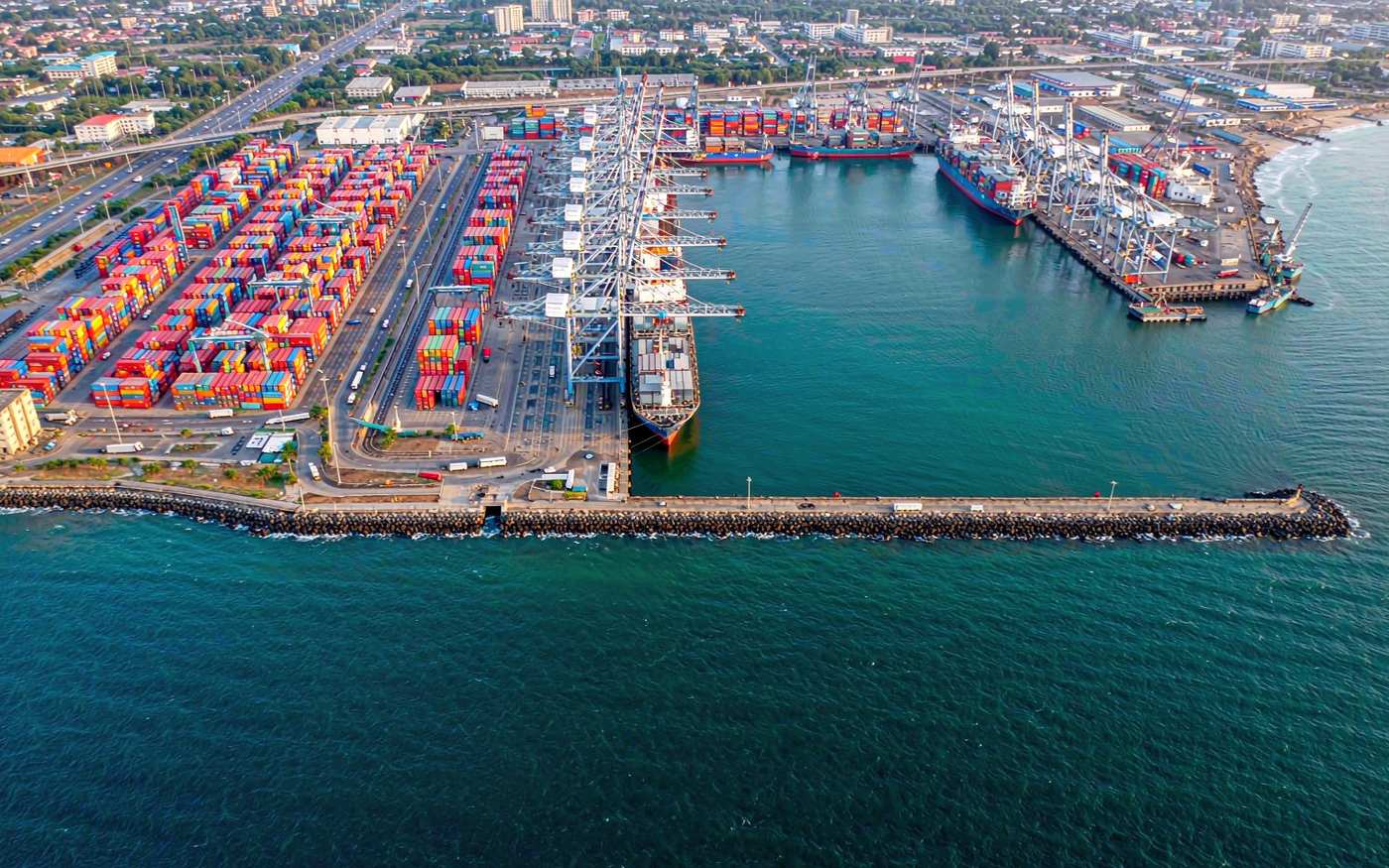
Togo has one commercial deep-water port, and it is a significant one. The Port of Lomé handles more than two million TEU a year and ranks among the largest container ports in Africa, with berths deep enough for the biggest vessels on the Far East to West Africa trades. For an importer, that translates into reasonably frequent sailings, modern gantry handling and a competitive transhipment market.
It also means your port choice is effectively made for you. There is no meaningful second container port to route around congestion, so if Lomé is busy, everything is busy. The practical answer is not to look for an alternative port but to build schedule buffer into your planning.
The second thing to understand is that a large share of what moves through Lomé is not destined for Togo at all. The Lomé-Ouagadougou corridor carries cargo onward to Burkina Faso, Niger and Mali, and re-export and transit trade is a major part of the port's business. If your consignee is in one of those countries, you are shipping through Togo rather than to it, and the customs procedure is a transit regime rather than an entry for home use. Say so clearly when you book, because the bond, the tracking and the inland arrangements all change.
There is one more local feature worth knowing: Lomé operates a free zone regime that allows goods to be imported without duty for re-export. If your business model is regional distribution rather than Togolese domestic sale, ask whether that regime applies to you.
FCL, LCL and RoRo into Lomé: matching the mode to your cargo
Three modes carry most cargo from China to Lomé, and they suit different things. A full container is the answer once you have the volume to fill one - typically above 15 to 18 cubic metres - and it gives you the fewest handling events. Consolidation is usually cheaper below that, because you pay only for the cubic metres you use and share the container's destination costs.
Roll-on/roll-off is the third option and it is more relevant here than on most routes. Vehicles, construction machinery, agricultural equipment and anything that drives or can be wheeled onto a vessel move efficiently by RoRo, and Lomé's vehicle trade is substantial. If you are shipping machinery on wheels or a batch of vehicles, ask for a RoRo quotation alongside the container one - it is sometimes materially cheaper and it avoids the cost of building cradles inside a container.
The caution with consolidation is schedule. Consolidated boxes are built to a cut-off in China and then travel on the service, and missing the cut-off usually means rolling to the next sailing rather than losing a day. Get the cut-off in writing and work backwards from it.
Whichever mode you pick, ask for the destination charges as a separate line - terminal handling, deconsolidation, documentation and delivery order. On West African routes these are a large share of the total landed cost, and a low ocean freight figure paired with heavy destination charges is not a cheap shipment.
Air freight to Lomé and when it beats the sea route
Air cargo into Togo lands at Lomé-Tokoin International Airport and is the right answer for a narrow set of shipments: high value relative to weight, urgent replacement parts, medical and pharmaceutical supplies, and anything tied to a deadline the sea route cannot meet.
It also earns its place when a previous sea shipment has gone wrong. A container held on a documentation error often costs more in lost sales than the air freight would have cost in the first place, and on this route the documentation risk is real enough that this is a genuine consideration rather than a theoretical one.
There is no regular direct freighter from China to Lomé in most schedules. Cargo typically moves via a European, Gulf or regional hub, so transit includes a handling stop and a connection. Ask which hub and what the onward frequency is.
Air does not reduce the paperwork. The document set is essentially the same, the declaration still runs through the Togolese system, and duty and TVA are still payable. Note that the mandatory cargo tracking note discussed below applies to sea freight; confirm with your broker whether any equivalent applies to your air shipment.
Transit time to Togo and the transhipment hub effect
Transit from Chinese ports to Lomé is typically measured in several weeks, and the exact figure depends on whether your service calls directly or relays through a hub. Because Lomé is itself a transhipment hub, some routings work well; others involve an additional relay that adds a week or more.
The variables that matter are the same ones that matter everywhere on this coast: the transhipment connection, the time to file and process the declaration, and the availability of transport out of the port. Published trade commentary describes routine clearance of roughly three to seven days where documents are complete, and considerably longer where they are not.
That gap is almost entirely within your control. A container whose documents were prepared while the vessel was still at sea clears on the short end of that range. One whose documents start being prepared on arrival does not.
If your cargo is going onward to Burkina Faso, Niger or Mali, add the corridor leg explicitly. It is a separate movement with its own border formalities, and in the Sahel it is subject to seasonal and security conditions that change. Get the current position from your forwarder rather than assuming a fixed number of days.
The BESC cargo note, and the rest of the Togolese document set
This is the section to read twice. Togo requires a cargo tracking note - the Bordereau Electronique de Suivi des Cargaisons, known as the BESC, and sometimes referred to in the same breath as an ECTN. It is filed on the export side, before the vessel loads, and it is issued through the appointed agent for the trade.
The consequence of not having one is not a delay. Published trade sources describe cargo without a valid BESC as liable to be refused discharge, or discharged only against a penalty running well into four figures. That is an expensive way to learn the rule.
Two practical steps follow. First, state explicitly in your booking instruction that the BESC is being handled, and by whom - do not assume it is included in a freight quotation. Second, supply the information it needs early: shipper and consignee details, vessel and voyage, container numbers, HS codes, cargo description and value, and the bill of lading reference. Processing takes working days, so a late application is a late departure.
The rest of the set is the standard one: commercial invoice, packing list, bill of lading or air waybill, certificate of origin, and insurance evidence. Documents in French are the working language of the customs administration, and an invoice in English alone is a friction point worth avoiding. Where the value or classification is complex, Togo offers binding advance rulings on tariff classification, origin and valuation under its trade facilitation commitments - worth using if your product is unusual.
Togolese duty bands, the TVA charge, and the levies behind it
Togo is a member of the West African Economic and Monetary Union and applies the regional common external tariff. That tariff is organised in bands - 0, 5, 10, 20 and 35 per cent depending on the product, with raw materials and capital equipment at the bottom and finished consumer goods at the top. Your HS code decides your band, which is why classification work pays for itself.
Duty is assessed on the customs value, built up from the transaction value under the standard valuation method with the costs of getting the goods to the port brought in. Practically, budget as though duty is charged on a CIF-equivalent figure rather than on the factory invoice. That single adjustment is the difference between a landed cost that matches your plan and one that does not.
On top of duty, Togo charges TVA at 18 per cent on the CIF value plus duty. Then come the smaller levies, which is where budgets quietly drift: a statistical fee, an ECOWAS community solidarity levy and an African Union import levy, each a fraction of a per cent of value, plus any applicable prepayment for commercial importers. Individually small, collectively they are real money, and they should be on your calculation.
Worked simply: on a CIF value of USD 12,000 with duty at 20 per cent, duty is USD 2,400; TVA at 18 per cent on USD 14,400 is USD 2,592; and the statistical and community levies add a further fraction on top. Your tax before port, handling, inspection and inland charges is a little over USD 5,000. Run this for your own commodity before you sign a purchase order.
Permits and pre-declarations for sensitive goods before they reach Lomé
Most general merchandise needs no permit - it needs a correct declaration and the payment of duty and TVA. The goods that need prior approval form a recognisable set: firearms and ammunition, medicines and pharmaceuticals, foodstuffs, hydrocarbons, and chemicals. A separate requirement obliges importers of certain sensitive products to pre-declare with the trade ministry before shipment.
The discipline is to check before you book, because permits are obtained in advance rather than at the port. Give your broker your complete commodity list and ask for written confirmation of what is needed. Doing that costs nothing before shipping and a great deal after.
Conformity verification also applies to regulated product categories, and vehicles are a specific case. Published trade sources describe pre-shipment verification of conformity by an appointed inspection company for vehicles above a certain age, alongside an age guideline and a minimum emission standard for imported vehicles. If you are shipping vehicles or machinery with engines, confirm the current rules before you buy rather than after the vessel sails.
Wood packaging - pallets, crates and dunnage - must meet the international phytosanitary standard and carry the corresponding mark. It is a cheap instruction at the factory and an expensive problem at the port.
Packing and paperwork in French for a Gulf of Guinea routing
Cargo to Lomé travels through the tropics and then sits outdoors in a hot, humid, salty port environment. Packing should assume heat, moisture and at least one handling event you did not plan for. Use export-grade cartons, palletise where volume justifies it, wrap against rain and condensation, and use desiccant for moisture-sensitive products.
Electronics, paper goods, textiles, adhesives and coated metal finishes are the categories that suffer most. If you are shipping any of these, tell your forwarder, and consider whether your supplier's domestic packaging is adequate for a multi-week tropical routing. Usually it is not.
On the paperwork side, the practical advice is straightforward: put your commercial documents in French, or at minimum bilingual French and English. The customs administration works in French, and an invoice that has to be translated is an invoice that waits.
Mark cartons clearly and consistently with the packing list. Where containers are opened for inspection, clear marking speeds reassembly and reduces the risk of a short shipment.
Incoterms and who pays the levies on a Togolese entry
Under FOB, the seller loads in China and you contract and pay for everything from there - ocean leg, destination handling, clearance and inland delivery. Under CIF to Lomé, the seller pays freight and insurance to the port, but risk still transfers at loading in China, which is a distinction many buyers miss. Under DAP or DDP, the seller carries more, and DDP includes clearing the goods and paying Togolese duty and TVA.
For a first-time importer, FOB with a forwarder who quotes the through move is usually the most transparent. You see each cost, you choose who clears the goods, and you are not relying on your supplier's agent at destination. If a supplier offers DDP, ask who is named as the declarant, because that party carries the customs liability, and confirm that the BESC is included.
Agree currency and payment mechanics in writing. Freight is typically quoted in US dollars and local costs in CFA francs, which is pegged to the euro and therefore stable against it. Confirm the transfer route with your bank and allow for the time it takes; on West African routes a payment that lands late can become a storage bill.
Finally, make sure the trade term matches what you actually agreed commercially. A quotation for ocean freight only is not a quotation for delivery, and a surprising number of disputes on this route are really disputes about which costs were included.
Transit cargo onward to Burkina Faso, Niger and Mali
A substantial share of cargo discharged at Lomé is bound for the Sahel. If that describes your shipment, two things change. The goods move under a customs transit regime rather than being entered for home use in Togo, which means a transit declaration, a guarantee or bond, and release only when the goods reach the inland destination or the inland customs office.
The second change is that the corridor becomes the dominant part of your cost and schedule risk. The road journey north crosses a border, and border formalities, road conditions, seasonal weather and security conditions all affect it. Ask your forwarder to price the inland leg as a separate line and to state whether it includes border clearance and the transit guarantee.
Check that the tracking arrangements are in place. Transit regimes in the region rely on electronic cargo tracking to give customs confidence that goods moving in bond actually arrive, and a mismatch between the tracked movement and the declaration causes problems at the destination.
Because conditions in the Sahel change, verify the current corridor position at the time you ship rather than relying on a figure quoted months earlier. If the corridor is constrained, the realistic alternatives - a different port, a longer route, or a staged delivery - all need to be identified before the vessel sails.
Where a first Togolese shipment usually goes wrong
First and worst: the BESC. It is filed before loading, it is not automatically included in a freight quotation, and the consequence of missing it is refusal of discharge or a heavy penalty. Confirm it explicitly, in writing, at booking.
Second: budgeting duty on the invoice value and TVA on the goods' value. Duty is assessed on a customs value that includes the costs of bringing the goods in, TVA is charged on the duty-inclusive figure, and then the statistical and community levies sit on top. Three errors compounding.
Third: documentation in the wrong language, or descriptions too vague to classify. Both convert a routine clearance into a query, an inspection and a delay.
Fourth: accepting a quotation that covers only the ocean leg and then discovering terminal handling, deconsolidation, documentation and delivery order were never included. Always ask for an all-in figure to your consignee's door, with the components shown separately.
Last: treating a Togolese shipment as a Sahel shipment, or the reverse. The port is the same; the customs procedure is not. Be explicit about where your consignee will clear.
Why importers use Goodhope on this lane
Six things that are different about working with us on China to Togo shipments.
Straight cases through Togo
Five shipments bought in China and delivered into Togo, told end to end — where the order came from, how it moved, where it nearly went wrong, and how it finished. Client names are withheld at their request; the situations and the handling are what we deal with on this lane.
The tracking note · before loading · Shenzhen to Lome
The purchase. A buyer new to importing treated the cargo tracking note as something the port would ask for later.
The move. Full container with the tracking note filed before loading, referenced on the bill of lading.
Where it nearly went wrong. The note is mandatory and it has to exist before the goods are loaded. Cargo that sails without it does not acquire one on the way, and the shortfall is discovered at discharge rather than at booking.
How it finished. We file it with the booking. No container of his has arrived without it since.
One port · the whole story · Ningbo to Lome
The purchase. A first-time buyer asked whether there was a nearer port to his consignee upcountry.
The move. Full container discharged at the deep-water terminal, with the inland leg arranged from there.
Where it nearly went wrong. This country's trade runs through a single deep-water port that also serves the landlocked neighbours. The choice is not which Togolese port, it is how the cargo moves inland once it has landed.
How it finished. He plans the inland leg from the terminal now. His upcountry deliveries have been realistic ever since.
Bands, not an average · costing · Guangzhou to Lome
The purchase. A buyer applied an average duty figure to a mixed consignment.
The move. Consolidated cargo with each line placed in its regional band before the order was confirmed.
Where it nearly went wrong. Duty runs in set bands with a wide spread between the lowest and the highest. Averaging across an invoice is accurate for no line on it, and it is wrong by more on the expensive ones.
How it finished. We rate line by line now. His landed costs have matched the assessment every time.
French paperwork · at the desk · Yiwu to Lome
The purchase. A buyer submitted documents in English and had them returned.
The move. Consolidated cargo with the document set prepared in the working language of the clearance.
Where it nearly went wrong. The paperwork for a Gulf of Guinea clearance is prepared in French, and documents in another language are returned rather than translated for you. That is a delay measured in days rather than a formality.
How it finished. We prepare the set in French now. Nothing of his has been returned since.
Transit onward · the neighbours · Shanghai to Lome
The purchase. A buyer imported for a consignee in a landlocked neighbouring country and entered the goods for local consumption.
The move. Cargo entered as transit and moved onward under the transit regime rather than as a local import.
Where it nearly went wrong. A large share of what lands here is going on to the landlocked neighbours. Entering it for local consumption first pays duty on goods that were never meant to stay, and undoing that costs more than doing it right.
How it finished. He enters transit cargo correctly now. Duty on onward lines stopped being a cost.
Why importers use Goodhope on this lane
Six things that are different about working with us on China to Togo shipments.
Get a Togo shipping plan with the BESC handled
Tell us the commodity, volume and whether the cargo is for Togo or onward to the Sahel. We will confirm the BESC handling before you book, set out what the OTR will expect, and give you a landed cost that includes duty, TVA, the levies and the inland leg.
Get a quote Talk to usRelated pages
Frequently asked questions
Which port does cargo from China arrive at in Togo?
The Port of Lomé. It is a deep-water container terminal handling well over two million TEU a year and is one of the larger container ports in Africa, with the depth to take the biggest vessels on the Far East to West Africa trades.
Is a BESC required for shipping to Togo?
Yes, for sea freight. The Bordereau Electronique de Suivi des Cargaisons is a cargo tracking note filed on the export side before the vessel loads, issued through the appointed agent. Published trade sources describe cargo without one as liable to be refused discharge or discharged only against a penalty. Confirm at booking who is filing it.
How long does shipping from China to Togo take?
Sea transit is measured in several weeks depending on whether the service calls directly or relays through a hub. Clearance of roughly three to seven days is commonly cited where documents are complete, and longer where they are not. Cargo going onward to the Sahel needs the corridor leg added separately.
What duty rates apply to imports into Togo?
Togo applies the WAEMU common external tariff, organised in bands of 0, 5, 10, 20 and 35 per cent depending on the product, with raw materials and capital equipment at the low end. Your HS classification determines your band.
What is TVA and how is it calculated in Togo?
TVA is the value added tax, charged at 18 per cent on the CIF value plus duty. Additional levies - a statistical fee, an ECOWAS community solidarity levy and an African Union import levy - apply on top, each a fraction of a per cent of value.
Do I need an import permit for Togo?
Most general merchandise does not. Prior approval is typically needed for firearms, medicines and pharmaceuticals, foodstuffs, hydrocarbons and chemicals, and certain sensitive products must be pre-declared with the trade ministry before shipment. Check your commodity before booking rather than after arrival.
Should I ship FCL, LCL or RoRo to Togo?
Consolidation usually costs less below roughly 15 to 18 cubic metres, and a full container usually wins above that. RoRo is worth pricing separately for vehicles, construction machinery and agricultural equipment, because Lomé has a substantial vehicle trade and wheeled cargo avoids the cost of cradling inside a container.
Is air freight to Togo practical?
Yes for high-value, urgent or pharmaceutical cargo, and it lands at Lomé-Tokoin International Airport. There is rarely a direct freighter from China, so cargo moves via a European, Gulf or regional hub. Air does not remove the customs process - duty and TVA still apply.
Can you ship onward from Lomé to Burkina Faso, Niger or Mali?
Yes, and it is a major part of the port's business. Be explicit at booking, because transit cargo moves under a customs transit regime with a guarantee and tracking rather than entering Togolese home use. Ask for the inland leg to be priced as a separate line including border clearance.
What documents does the Togolese revenue office require?
A commercial invoice, a packing list reconciling with it, the bill of lading or air waybill, a certificate of origin and evidence of insurance, plus the BESC for sea freight and any permits for regulated goods. Documents in French are the working language of the administration, so a French or bilingual invoice is advisable.