
Home / Shipping to the Central African Republic / How to Ship from China to the Central African Republic
Shipping from China to the Central African Republic, step by step
Goodhope Freight is a licensed NVOCC based in Shenzhen, registered as GD20230925153335, and has been moving cargo out of China since 2012. To the Central African Republic we route full containers and shared containers by sea into Douala in Cameroon, and from there overland to Bangui. We also handle air freight into Bangui M'Poko International Airport and express parcels dispatched from our depot. Every service stops at the port, the airport or the depot. Your consignee arranges import clearance and collection.
The Central African Republic is a landlocked country of around five million people in the heart of the continent, rich in minerals, timber and agricultural land, and with almost no manufacturing of its own. Nearly everything in the shops has been imported, and almost all of it arrives on one road.
Two requirements catch out most first shipments. A cargo tracking note must be raised at origin before your goods leave China, without which the consignment does not clear. And value-added tax here is nineteen per cent, charged on a base that already includes duty.
This guide is written for a buyer who has never imported from China before. It explains the corridor and the seasonal river alternative, where the tariff bands sit, how the nineteen per cent tax is calculated, what the tracking note involves, and why inspection is not something that might happen but something that will.
At a glance
Landlocked, served overland from Douala in Cameroon, roughly fifteen hundred kilometres to Bangui · Seasonal alternative via Pointe-Noire and the Ubangi river, workable at high water · Inland destination: Bangui, a river port on the Ubangi · Airport: Bangui M'Poko International (BGF) · Currency: Central African CFA franc (XAF) · CEMAC common external tariff in four bands: 5, 10, 20 and 30 per cent · VAT at 19 per cent on the duty-inclusive value · Bordereau de Suivi de Cargaison cargo tracking note required before departure · Physical inspection is routine · Documentation in French
How your cargo moves: China to the Central African Republic
Eight steps from your supplier's door to yours. The last four are the ones shaped by local rules.
- Pickup from your supplierWe collect the goods anywhere in China and bring them to our consolidation point.
- Export clearanceChina customs declaration filed and released before the goods move to the port.
- Tracking note raised at originThe cargo tracking note is applied for and issued while the goods are still in China.
- Loading and main carriageContainer loaded, sealed and shipped to Douala.
- Bonded transit and overland haulTransit across Cameroon and road haulage through the corridor to Bangui.
- Entry lodged at BanguiYour broker files the declaration with French documents, codes and the tracking note reference.
- Duty and VAT assessedThe band rate, the community levies and the 19 per cent tax are applied and settled.
- Examination and releaseConsignments are examined as a matter of course. Once satisfied your buyer collects.
Duty rates, VAT rates and clearance times move, and the figure that applies to your goods is the one set for your commodity code on the day of clearance. We check the current position against your code before your goods sail and confirm it to you in writing — ask for that check when you request a quote.
Landlocked, and served by one long road and one seasonal river
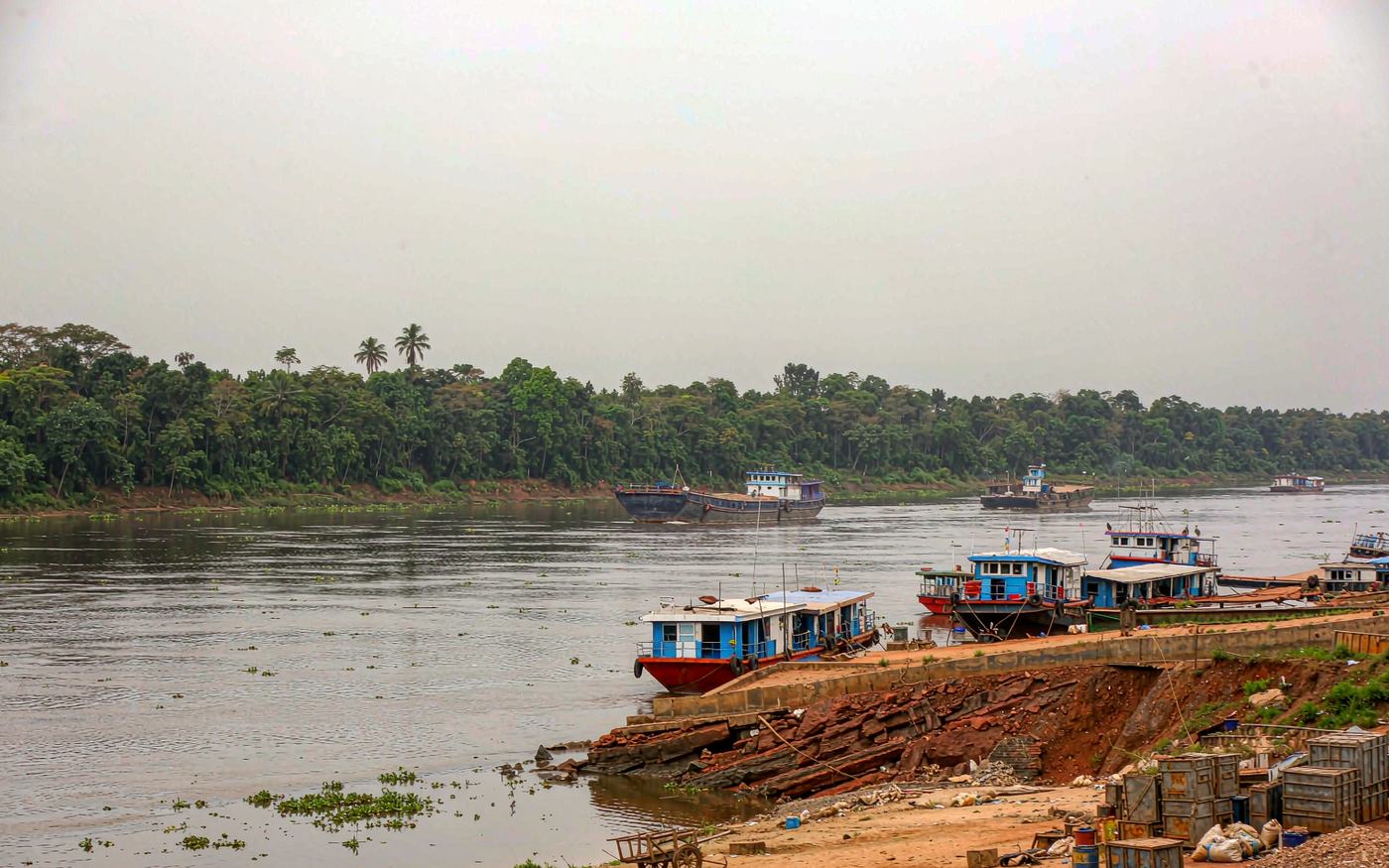
The Central African Republic sits far from any coast. Its imports travel through a neighbour's port and then inland, and for most commercial cargo that means Douala in Cameroon followed by a road journey of roughly fifteen hundred kilometres east to Bangui. There is a second route, through Pointe-Noire in the Republic of the Congo and then up the Ubangi river by barge to the Bangui river port. It is attractive in principle and genuinely useful in practice for heavy or bulky cargo, but it is seasonal, because the river carries barges reliably only at high water. Choosing between them is a decision about timing as much as cost. If your delivery window sits inside the high-water period and your cargo is heavy, the river is worth pricing. If it does not, the road is the answer and the river is a distraction.Douala or Pointe-Noire: choosing the corridor
Douala handles the great majority of the country's imports. The corridor runs east through Yaoundé and on toward the border at Garoua-Boulaï, then through Bouar to Bangui, and it is served by established transit and escort arrangements. The road is long and parts of it are poor, which means transit times are measured in weeks rather than days and vary with season, security conditions and how the border is performing. Building margin into your plan is not pessimism, it is accurate planning. We quote the corridor explicitly, name the border crossing, and tell you what we are seeing on it at the time of booking. A quotation that simply says Douala without describing the inland leg has not told you very much.Four tariff bands, set by the customs union
The Central African Republic is a member of the Economic and Monetary Community of Central Africa, and it applies the community's common external tariff rather than a schedule written in Bangui. The structure has four bands: five per cent for essential goods, ten per cent for raw materials and equipment, twenty per cent for intermediate goods and thirty per cent for consumer goods. Classification decides everything. The same consignment can contain a five per cent line and a thirty per cent line sitting side by side, and the difference between them is usually larger than the freight on the whole shipment. So the useful question is not what is the duty in the Central African Republic but what band does this code fall into. We check your codes against the current position before anything sails and we will tell you plainly if a line is more expensive than you expected.How the tax is arrived at, and the figure it lands on top of
Imports are subject to value-added tax at nineteen per cent. It is assessed on the customs value plus the duty, so the tax is charged on a figure that already includes the tariff rather than on your invoice amount. This is the most common costing error on the route. A buyer works out nineteen per cent of the invoice, budgets that, and then meets a charge calculated on a much larger base. The rate was right and the base was wrong, which is a more expensive mistake than getting the rate wrong by a point. Build the value up in order. Transaction value first, then freight and insurance to reach the customs value, then the band rate to get the duty, then nineteen per cent on the total. Doing it that way removes the largest single source of surprise.The tracking note, and the penalty for not having one
A Bordereau de Suivi de Cargaison, known in the trade as a cargo tracking note, is compulsory for all sea freight entering the country. It must be obtained at the port of origin before the shipment departs, and failing to obtain it delays or blocks customs clearance. The requirement is straightforward and the consequence of ignoring it is not. A consignment arriving without the note does not clear, and by then the goods are fifteen hundred kilometres inland sitting in a yard, accruing storage while someone tries to regularise the position from another country. We apply for the note as part of every booking on this route, and we confirm the reference before the vessel sails. If you are comparing quotations, ask whether it is included, because a quote leaving it out is not cheaper, it is incomplete.Inspection is not occasional here, it is the norm
Consignments are physically inspected as a matter of course rather than by random selection. What is in the container is checked against what was declared, and a declaration that cannot be reconciled will be found. That makes accuracy more valuable than speed. Packing goods so they can be examined and resealed without damage, and declaring them so that the paperwork matches the contents, turns inspection from an event into a formality. It also argues against the tempting shortcut of collapsing unrelated product lines into one vague description to simplify the paperwork. The simplification lasts until the container is opened, and the reconciliation afterwards is slower.French throughout, and the registration that has to come first
French is the language of the customs administration, and the declaration, the commercial invoice and the packing list are expected in it. Translation prepared at origin in China costs very little; translation arranged after arrival costs days. Importers need a tax identification number before an entry can be lodged. If your consignee is importing commercially for the first time, that registration should be in hand before the vessel sails rather than discovered as a prerequisite at the border. Descriptions carry as much weight as language. A generic description invites a clarification request, and on an inland consignment a clarification request means the goods stay where they are while correspondence goes back and forth.What the community levies add on top of duty
Beyond the tariff band and value-added tax, imports from outside the customs union carry a small group of community and statistical charges. The community integration tax and the business-law levy together come to a little over one per cent of value, and statistical and regional integration charges sit alongside them. Individually each is small and collectively they are not. A costing that accounts for the band and the nineteen per cent tax but ignores the levies will come in short by a margin worth having. We set those lines out separately on the quotation so you can see them. They are not our charges, they are the destination's, and you should be able to see exactly what is being applied to your goods.Packing for fifteen hundred kilometres of corrugated road
The inland leg is the hardest part of the journey. A container is discharged, trucked, held at a border, trucked again and then handled at Bangui, and the road surface over much of that distance is poor. Export-grade strapping, proper dunnage, filled voids and sealed inner packaging are baseline. Anything fragile should be packed as though it will be handled several more times than you expect, because it will be. Heat and humidity at the destination then do the rest. Corrosion protection for metal and moisture barriers for anything absorbent are worth specifying, and timber packaging must be treated and marked to the international standard with the certificate in hand before departure.The handover point: what stops at Bangui, and what carries on
We handle collection anywhere in China, export clearance, consolidation, the cargo tracking note, main carriage to Douala, and the transit documentation that carries the consignment inland. Your buyer handles arrival onward: appointing a licensed clearing agent, lodging the declaration in French, holding a tax identification number, paying the band rate, the levies and the nineteen per cent tax, satisfying inspection, and collecting at Bangui. We quote the sea leg and the inland leg as separate lines. On a route with this much distance after the port, that separation is the only way you can see where your money is going.Getting a first Central African Republic order moving
Send us the commodity in enough detail to classify it against the community tariff, the volume and weight, the pickup address in China, and whether your goods are essentials, raw materials and equipment, intermediate goods or finished consumer products. We will confirm the corridor, raise the tracking note, check your codes, and quote the sea leg, the inland leg and the destination levies separately. Ask us for the worked duty-and-tax example before you fix your selling price. Start with one shared container and a generous schedule. It tells you how your supplier packs for a road corridor this long, how quickly your clearing agent responds, and how much margin you actually need, for far less than learning it on a full one.Real orders to the Central African Republic
Five shipments bought in China and delivered into the Central African Republic, told end to end — where the order came from, how it moved, where it nearly went wrong, and how it finished. Client names are withheld at their request; the situations and the handling are what we deal with on this lane.
Milling equipment and spares for a Bangui workshop
The purchase. A food processor bought milling machinery, electric motors, drive belts and control gear from suppliers in Jiangsu and Shandong to refit a workshop in Bangui.
The move. We collected both lots, consolidated into one 40HC, raised the cargo tracking note in China and shipped to Douala with bonded transit through the corridor to Bangui.
Where it nearly went wrong. The control gear shipped in standard domestic cartons with no moisture barrier. After a long road leg in high humidity followed by examination at Bangui, two units arrived with corrosion on the terminal blocks.
How it finished. We specified sealed inner packaging with desiccant and vapour protection on the repeat. The second consignment arrived clean and passed inspection without a query.
A cargo tracking note raised at the wrong end of the journey
The purchase. A buyer treated the cargo tracking note as a destination formality and assumed it could be obtained once the goods reached Cameroon.
The move. One 20GP consolidated and shipped to Douala, with the note raised late once the requirement came to light.
Where it nearly went wrong. The note must be issued at the port of origin before departure and referenced on the transport documents. Without it clearance is blocked, and by then the goods were a long way inland accruing storage.
How it finished. We now raise the note as part of every booking on this route and confirm the reference before the vessel sails. Nothing since has been held for that reason.
Finished consumer goods costed at the middle band
The purchase. A trader imported finished household goods and furniture and costed duty at a single mid-range rate for the whole consignment.
The move. One 40HC shipped to Douala with overland transit to Bangui, declared line by line rather than as one lot.
Where it nearly went wrong. Finished consumer goods sit in the upper band of the community tariff while essentials and production equipment sit much lower. A single blended rate understated the duty materially on the lines that dominated the value.
How it finished. We checked the codes before sailing and set out the band for each line. The trader repriced while the goods were still in China rather than absorbing the difference inland.
A first-time importer with no tax number
The purchase. A consignee importing commercially for the first time arranged the shipment before registering with the tax administration.
The move. One 20GP routed through Douala with transit to Bangui, and the entry prepared by the consignee's agent on arrival.
Where it nearly went wrong. An entry cannot be lodged without a tax identification number, and registration had not been started. The consignment waited inland while it was obtained, which is the slowest and most expensive place to discover a prerequisite.
How it finished. We now flag tax-number registration at quotation stage for any first-time commercial importer on this route. Subsequent consignments have been lodged the day they arrived.
River timing that worked once the season was understood
The purchase. A contractor importing heavy steel sections and cement for a river-side project asked whether the Ubangi route was viable.
The move. We priced both corridors and quoted the road as the default, with the Pointe-Noire and river option costed separately against the high-water period.
Where it nearly went wrong. The river carries barges reliably only at high water. Quoting it without reference to the season would have produced a plan that looked cheaper and arrived months late.
How it finished. The project was scheduled so the heavy sections moved by river inside the high-water window and the balance went by road. Both arrived when the site needed them.
Why importers use Goodhope on this lane
Six things that are different about working with us on China to the Central African Republic shipments.
Get a Bangui shipment priced
Tell us the commodity in enough detail to classify it against the community tariff, the volume, the pickup address in China and which of the four bands your goods fall into. We will confirm the corridor, raise the cargo tracking note, check your codes, and quote the sea leg, the inland leg and the destination levies separately.
Get a quote Talk to usRelated pages
Frequently asked questions
How does cargo reach the Central African Republic?
By sea to Douala in Cameroon and then overland for roughly fifteen hundred kilometres to Bangui, which is the route used for the great majority of imports. A seasonal alternative runs through Pointe-Noire and up the Ubangi river by barge, workable when the river is at high water.
What is the Bordereau de Suivi de Cargaison?
It is the compulsory cargo tracking note for sea freight into the country. It must be obtained at the port of origin before the shipment departs, and failing to obtain it delays or blocks customs clearance rather than merely causing a paperwork delay.
What duty rates apply?
The country applies the CEMAC common external tariff in four bands: 5 per cent for essential goods, 10 per cent for raw materials and equipment, 20 per cent for intermediate goods and 30 per cent for consumer goods. Your commodity code decides the band.
How is VAT calculated?
Value-added tax is charged at 19 per cent on the customs value plus the duty. Build the figure up in order: transaction value, then freight and insurance to reach the customs value, then the band rate, then 19 per cent on the total.
Are there other charges beyond duty and VAT?
Yes. Imports from outside the customs union also carry a community integration tax and a business-law levy together amounting to a little over one per cent, plus statistical and regional integration charges. Each is small and collectively they are worth accounting for.
Will my consignment be inspected?
Physical inspection is the norm rather than a random occurrence. Declaring goods accurately and packing them so they can be opened and resealed without damage turns inspection into a formality rather than an event.
Do documents have to be in French?
French is the language of the customs administration, and the declaration, invoice and packing list are expected in it. Preparing bilingual documents at origin in China costs very little and removes an entire category of delay.
Does my consignee need anything before shipping?
Yes, a tax identification number, without which an entry cannot be lodged. First-time commercial importers should register before the vessel sails rather than discover the requirement once the goods are inland.
Do you offer door-to-door delivery?
No. Sea freight runs port-to-port to Douala with the inland movement quoted and arranged separately. Air freight is airport-to-airport to Bangui M'Poko International, and express courier dispatch ends at the depot.
How should cargo be packed for this route?
The inland leg is the hardest part of the journey. Export-grade strapping, dunnage, filled voids, sealed inner packaging, moisture barriers and corrosion protection for metal are baseline, and timber packaging must be treated and marked to the international standard before departure.