
Home / Shipping to the Cocos Islands / How to Ship from China to the Cocos (Keeling) Islands
Shipping from China to the Cocos (Keeling) Islands, step by step
Goodhope Freight is a licensed NVOCC based in Shenzhen, registered as GD20230925153335, and has been moving cargo out of China since 2012. To the Cocos (Keeling) Islands we move full containers and shared containers port-to-port into the anchorage off West Island, air freight airport-to-airport into Cocos Islands Airport, and express parcels dispatched from our depot. Every service stops at the anchorage, the airport or the depot. Your consignee arranges import clearance and collection.
Cocos is an Australian external territory of twenty-seven coral islands in the Indian Ocean, about halfway between the Australian mainland and Sri Lanka, with roughly six hundred residents across two inhabited islands. It has a remarkable lagoon, no deep-water harbour, and a supply chain that runs to its own rhythm.
Two things surprise almost everyone shipping here. First, no goods and services tax applies, because the territory sits outside Australia's indirect tax zone even though it is Australian. Second, Australian customs and biosecurity rules are applied with unusual thoroughness, because Cocos is a designated biosecurity first point of entry.
This guide is written for a buyer who has never imported from China before. It sets out how cargo physically gets ashore, what the tax position really is, how the Border Force treats goods arriving from China, what biosecurity will insist on, and how to plan against a resupply cycle measured in weeks.
At a glance
Port of entry: the anchorage and wharf at West Island, with no deep-water harbour · Airport: Cocos (Keeling) Islands Airport (CCK, also written YPCC) on West Island · Currency: Australian dollar · Customs authority: Australian Border Force, cleared through the Integrated Cargo System under the Customs Act 1901 · No goods and services tax, because the territory sits outside the Australian indirect tax zone · Australian tariff applies to goods from third countries · Goods from the Australian mainland enter duty free · Biosecurity controlled by the agriculture department as a designated first point of entry · Resupply by sea from Fremantle roughly every four to six weeks
How your cargo moves: China to the Cocos Islands
Eight steps from your supplier's door to yours. The last four are the ones shaped by local rules.
- Pickup from your supplierWe collect the goods anywhere in China and bring them to our consolidation point.
- Export clearanceChina customs declaration filed and released before the goods move to the port.
- Loading and departureContainer loaded, sealed and handed to the carrier at a Chinese port.
- Main carriage to FremantleCargo is relayed into Western Australia before the island leg begins.
- Onward sailing to CocosVessels call roughly every four to six weeks, and that call sets the timetable.
- Lightered ashore at West IslandWithout a deep-water harbour, cargo moves from ship to shore by barge rather than onto a quay.
- Cleared by the Border ForceYour broker lodges the entry through the Integrated Cargo System, Australian tariff is applied and duty is settled.
- Biosecurity check and releaseFood, plant, animal and soil-related lines are inspected. Once everything is satisfied your buyer collects.
Duty rates, VAT rates and clearance times move, and the figure that applies to your goods is the one set for your commodity code on the day of clearance. We check the current position against your code before your goods sail and confirm it to you in writing — ask for that check when you request a quote.
West Island, Home Island, and a port that is really an anchorage
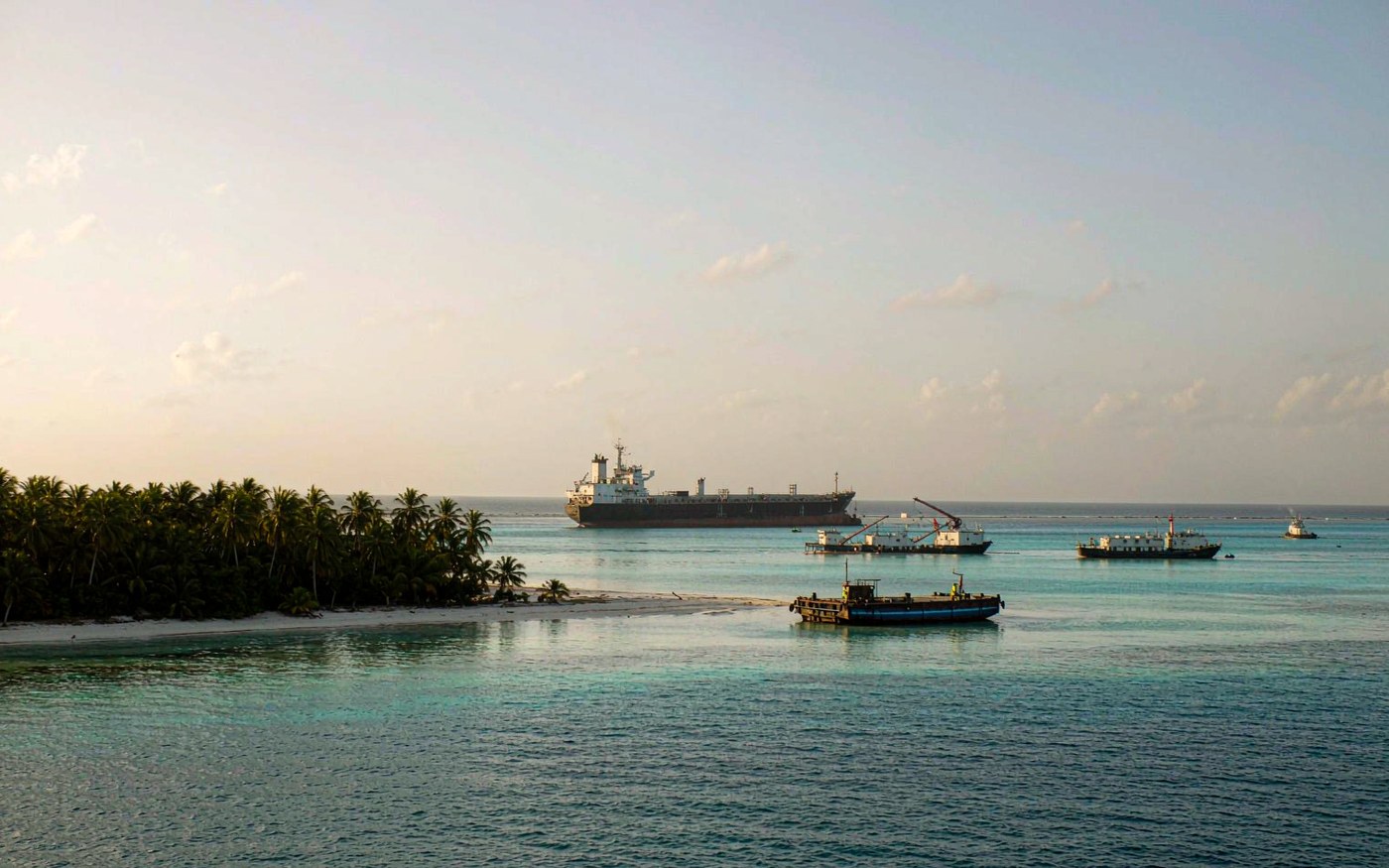
Cocos has no deep-water harbour. Supply vessels stand off and cargo is lightered ashore, with the working wharf on West Island handling what arrives. Anything large, heavy or awkward needs a handling plan agreed in advance rather than an assumption that port equipment exists. Two of the twenty-seven islands are inhabited. West Island holds the airport, the administration and the main wharf, while Home Island holds the Cocos Malay community. Road links between the wharf, the airport and the settlements are short, so once cargo is ashore, moving it is straightforward. This is a place of around six hundred people. Volumes are small, most commercial imports are project-related or resupply-driven, and nothing resembles a consumer distribution network. Planning should assume a single consignee collecting a single consignment rather than any onward distribution.What the six-week resupply cycle does to planning
Sea freight reaches Cocos from Fremantle in Western Australia on a cycle of roughly four to six weeks, with the inland commercial rules serving as the point of departure. That interval is the heartbeat of planning here, and every other decision hangs off it. Because the cycle is long and not perfectly predictable, a missed call costs weeks rather than days. If something has a hard deadline, it belongs on an aircraft, and if it does not, it should be booked with margin built in deliberately. The Australian Government has been examining freight pricing, port efficiency and food security for the Indian Ocean territories, with recommendations from a supply chain review being implemented. Improvements are coming, but shipments should still be planned against the cycle that exists today.Why the mainland GST stops short of this territory
Australia's goods and services tax applies within what tax law calls the indirect tax zone, and that zone is defined to exclude external territories. Cocos is an Australian external territory, so the ten per cent tax that applies on the mainland does not apply here, even though customs law is Australian. This is the single most commonly misquoted fact about shipping to Cocos. Generalised reference sources, and some freight guides, simply apply mainland Australian rates to the territory because it is Australian. Doing so overstates the tax on your consignment. Understanding why matters as much as knowing what. Income tax follows the Australian framework in these territories, while indirect tax does not, and goods arriving from the mainland enter duty free. None of this is a loophole, it is simply how the law defines its own scope.Australian tariff still applies to third-country cargo
Where the absence of the goods and services tax removes a charge, customs duty does not disappear with it. Goods arriving from outside Australia are third-country goods and attract the rates set out in the Australian tariff schedule for their commodity code. Goods arriving from the Australian mainland are treated differently and enter duty free regardless of quantity, while goods originating in the external territories benefit from their own preferential treatment under the customs act. None of those reliefs apply to cargo shipped from China. The result is a position worth stating carefully to your consignee. There is no consumption tax, but there is still duty on the right codes, and there are still port, lighterage and clearance charges that do not exist at a mainland terminal. Cocos is lightly taxed and expensive to serve.The Border Force, and how an island entry is cleared
Clearance is handled by the Australian Border Force, part of the home affairs department, with entries processed through the Integrated Cargo System under the Customs Act 1901. On paper that is a world away from the manual processes small island states rely on. In practice it means your declarations are scrutinised electronically, against Australian codes and Australian expectations, with very little tolerance for vague descriptions. A consignment described as general merchandise will be examined, and examination here means storage in a place with almost none. Documents follow the standard set: a commercial invoice with genuine detail and value, a packing list matching it carton for carton, the bill of lading or air waybill, and certificates for anything requiring them. Australian sanctions and export control rules also apply and are administered nationally. Because duty turns on your commodity code and the codes are Australian, confirming them before departure saves real money. We do that check while the goods are still in China.Biosecurity at a designated first point of entry
Cocos is a designated biosecurity first point of entry, and the agriculture department controls what arrives. Food, plants, animals, soil and anything carrying soil are all within scope, and a biosecurity declaration is required on import, with permits for anything that needs them. The controls are enforced rather than nominal. This is a small isolated ecosystem with an agricultural economy that cannot absorb a pest incursion, so the people inspecting your consignment have every reason to be meticulous. Timber packaging follows the international standard for treatment and marking, with the certificate in hand before departure. Cleanliness matters too: used agricultural equipment, machinery carrying soil residues and anything previously in contact with plants should arrive cleaned, because soil contamination alone will hold a consignment.Working backwards from the date goods must be usable
The most valuable thing you can do before ordering is work backwards from the date your goods need to be usable. Subtract clearance and biosecurity time, subtract the lighterage window, subtract the island leg, and then look at where the Fremantle sailing actually falls. That exercise usually produces one of two conclusions. Either there is enough margin to ship by sea comfortably, or there is not, in which case the air option via Perth is the correct answer and should be chosen early rather than as a rescue. If you are moving project material in stages, plan the sequence so that a late first shipment does not delay every following one. Stage critical path items by air and the bulk by sea, rather than putting the whole project behind a single six-week cycle.Packing for lighterage across a reef
Cargo lightered from a vessel standing off a reef is handled more often and less gently than cargo lifted onto a quay. Export-grade strapping, proper dunnage, filled voids and robust outer packaging are ordinary requirements here, not upgrades. Everything then sits in hot humid island conditions, often outdoors. Corrosion protection for metal, moisture barriers for anything absorbent, and sealed inner packaging give you a margin that pays for itself repeatedly at this distance from a replacement supplier. Treat, mark and certificate any timber packaging before departure. Given the biosecurity posture described above, this is the last place to gamble on uncertified timber, and it is one of the few things that can hold an otherwise perfect consignment.Who collects, who clears, who pays
We handle everything up to arrival: collection anywhere in China, export clearance, consolidation, loading, main carriage to Fremantle and the island leg, and the documentation the Border Force entry depends on. Your buyer handles arrival onward: appointing a broker, lodging the entry through the Integrated Cargo System, paying duty, satisfying biosecurity, paying port and lighterage charges, and collecting. Nothing moves door-to-door, and nothing moves between islands without local arrangement. We quote line by line so that freight, duty, port charges and lighterage can each be seen. Because the tax position here is unusual, comparing us against another forwarder is only meaningful if both quotes break out duty separately, and if neither assumes a mainland Australian consumption tax.Starting a first Cocos Islands consignment
Send us the commodity with enough detail to classify it against the Australian tariff, the volume and weight, the pickup address in China, and whether your consignee collects on West Island or Home Island. Mention any food, plant, animal, soil-contact or battery line specifically. We will confirm the Fremantle relay and the target sailing, set out the duty treatment we can see for your codes, and tell you plainly if something should go by air instead. If your goods are mainland Australian origin rather than Chinese, tell us, because that changes the duty answer entirely. Start small and early. One shared consignment tells you how long clearance and biosecurity actually take for your product, and on a four to six week cycle that knowledge is worth more than the freight saved by consolidating everything into one later shipment.Real examples across the Cocos Islands
Five shipments bought in China and delivered into the Cocos Islands, told end to end — where the order came from, how it moved, where it nearly went wrong, and how it finished. Client names are withheld at their request; the situations and the handling are what we deal with on this lane.
Guesthouse refurbishment on West Island
The purchase. A small accommodation operator bought case goods, outdoor furniture, lighting and bathroom fittings from three suppliers in Guangdong for a staged refurbishment.
The move. We collected all three, consolidated into one 40HC and shipped port-to-port to the Cocos anchorage, with the Fremantle relay and the target island sailing named at booking.
Where it nearly went wrong. The highest phased dependency was the bathroom fittings. Because they were booked sea-freight only, a schedule slip on the island leg would have delayed the whole refurbishment by another full resupply cycle.
How it finished. We moved the fittings by air into CCK on the Perth service and left the furniture to travel by sea. The refurbishment kept its sequence and nothing was held waiting for the following vessel.
Project material for Home Island
The purchase. A contractor working on Home Island ordered cement, timber-framed joinery, roofing material and hand tools from suppliers in Fujian.
The move. One 40HC relayed to Fremantle and onward to Cocos, lightered ashore and collected for the short transfer to Home Island.
Where it nearly went wrong. The joinery arrived crated on timber that had not been treated or marked. At a designated biosecurity first point of entry, packaging alone will hold an entire consignment regardless of the goods inside it.
How it finished. We made treated, marked and certified timber a condition of collection on the repeat order and checked it before sealing. The second container cleared without a biosecurity hold.
Marine spares flown in from Perth
The purchase. An operator needed hydraulic hoses, filters and electrical spares for a vessel working in the lagoon, well after the relevant sailing had closed.
The move. Roughly 120 kg booked as air freight from China connecting through Perth onto the service to CCK, collected at the airport on West Island.
Where it nearly went wrong. The parts arrived in a crate far larger than the contents, and air freight is charged on whichever is greater, actual or volumetric weight, so the buyer paid rates for air freight on a substantial volume of nothing.
How it finished. On the repeat we had the supplier repack to minimum practical volume before collection. The chargeable weight fell sharply and the freight cost came down with no change to what was shipped.
Machinery with soil residue held at the border
The purchase. A buyer imported second-hand garden and grounds equipment together with new tools from Guangdong.
The move. One 20HC relayed through Fremantle and lightered ashore at West Island, declared as machinery and hand tools.
Where it nearly went wrong. The used equipment carried soil residues on tyres and undersides. Soil is squarely within the scope of biosecurity controls at a designated first point of entry, and the used machines were held for cleaning at the importer's cost.
How it finished. We now ask any buyer sending used machinery here to have it cleaned to export standard before collection. Subsequent consignments have been steam-cleaned in China, which is cheaper and faster than cleaning at the destination.
Duty costed as though mainland rules applied
The purchase. A buyer pricing a consignment of fittings and equipment took his figures from a mainland Australian shipping calculator and built a ten per cent consumption tax into the landed cost.
The move. One 20HC consolidated to the Cocos anchorage, with the codes checked against the Australian tariff before departure.
Where it nearly went wrong. Cocos sits outside Australia's indirect tax zone, so the ten per cent goods and services tax does not apply, while duty on third-country goods does. Assuming mainland treatment got one part of the costing wrong in each direction.
How it finished. We set out both positions side by side before the goods sailed. The buyer corrected the pricing model and has used the same treatment for every consignment since.
Why importers use Goodhope on this lane
Six things that are different about working with us on China to the Cocos Islands shipments.
Get a West Island consignment priced
Tell us the commodity in enough detail to classify it against the Australian tariff, the volume, the pickup address in China and which island your consignee collects on. We will confirm the Fremantle relay and target sailing, set out duty for your codes, and advise honestly whether the air option via Perth is the better answer.
Get a quote Talk to usRelated pages
Frequently asked questions
Is goods and services tax charged on imports into Cocos?
No. Australia's goods and services tax applies within the indirect tax zone, which is defined to exclude external territories. Cocos is an Australian external territory, so the ten per cent mainland tax does not apply, even though customs law here is Australian.
Does Australian customs duty still apply?
Yes. Goods arriving from China are third-country goods and attract the rates set out in the Australian tariff for their commodity code. Mainland Australian goods enter duty free and goods originating in the external territories have their own preferential treatment, neither of which applies to cargo shipped from China.
Who clears the goods?
The Australian Border Force, part of the home affairs department, with entries processed through the Integrated Cargo System under the Customs Act 1901. Australian sanctions and export control rules also apply and are administered nationally.
How often does sea freight arrive?
Supply vessels run from Fremantle in Western Australia roughly every four to six weeks, sometimes supplemented by air freight via Perth. Because a missed call costs weeks rather than days, anything with a hard deadline should generally be flown.
How does cargo get ashore?
There is no deep-water harbour. Vessels stand off and cargo is lightered ashore to the working wharf on West Island, so large, heavy or awkward pieces need a handling plan agreed in advance.
Which airport handles air freight?
Cocos (Keeling) Islands Airport (CCK, also written YPCC) on West Island, served from Perth. It carries a substantial runway and accepts scheduled and charter freight capacity.
What are the biosecurity requirements?
Cocos is a designated biosecurity first point of entry. Food, plants, animals and soil are controlled by the agriculture department, a biosecurity declaration is required on import, and permits apply where needed. Timber packaging must be treated and marked to the international standard with the certificate in hand, and used machinery should arrive free of soil residue.
Do you offer door-to-door delivery?
No. Sea freight ends at the anchorage and wharf, air freight ends at CCK, and express courier dispatch ends at the depot. Your consignee appoints a broker, pays duty and local charges, satisfies biosecurity and collects.
Can lithium batteries be shipped?
Built-in and packed-with lithium batteries can be carried with proper declaration, documentation and packaging. Standalone battery shipments and other dangerous goods classes are assessed individually and must be declared at quotation stage so we can book with a carrier that accepts the class.
What documents are needed?
A commercial invoice with genuine detail and value, a packing list matching it carton for carton, the bill of lading or air waybill, and any certificate required by the commodity. Because the codes are Australian and assessed electronically, vague descriptions lead to examination, and examination here means storage in a place with very little of it.