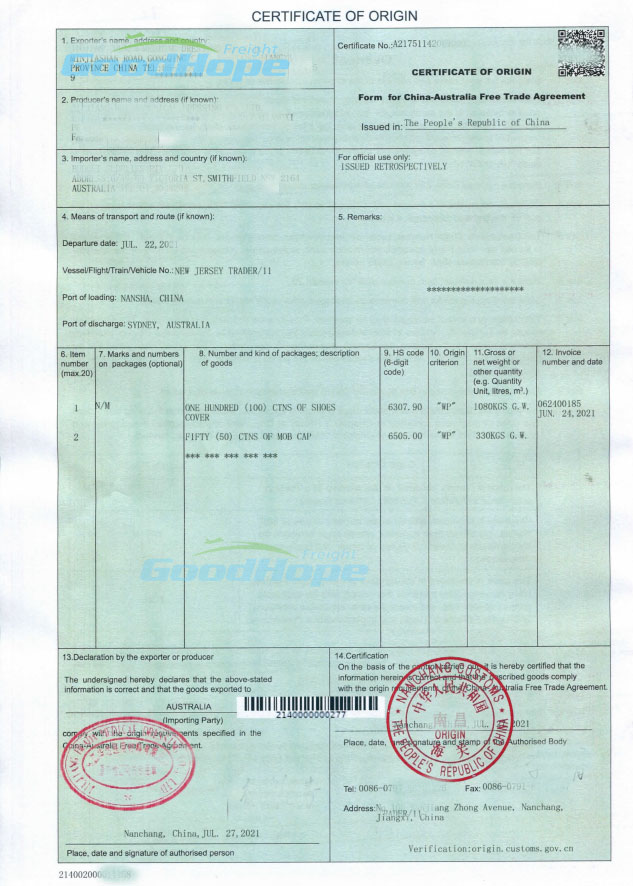
The certificate follows the format in Annex 3-A of the agreement and is completed in English: fourteen boxes, one certificate to one consignment, with a continuation sheet in the accepted format when the invoice carries more line items than fit. The header reads CERTIFICATE OF ORIGIN — China-Australia Free Trade Agreement, which is nothing like the GSP Form A layout.
On the Chinese side the rulebook is the Measures on the Administration of Origin for Import and Export Goods under the China–Australia Free Trade Agreement — GACC Order No. 228, in force since December 20, 2015 and amended by Order No. 273 of October 28, 2024. The export visa procedure follows the Measures on the Administration of Certificate of Origin Visas for Export Goods, GACC Order No. 270, in force since September 1, 2024. How the origin fields are keyed on a Chinese declaration is set by GACC Announcement No. 34 of 2021.
On the Australian side the ABF states the position plainly: for goods imported into Australia, the authorized issuing bodies in China are China Customs and CCPIT; the certificate has to meet Article 3.14 and Annex 3-A, correspond to the consignment, come from an authorized body, and leave no doubt about origin. Going the other way — Australian goods into China — the issuing bodies are the Australian Chamber of Commerce and Industry (ACCI), Ai Group, Ozdocs (IECS) and Trade Window Origin, and the exporter or producer may sign an origin declaration instead.
Origin is settled one of three ways. Wholly obtained (WO) — live animals born and raised in a party, plants harvested there, minerals extracted there, fish taken by a registered vessel flying that party's flag. Wholly produced (WP) — made entirely from originating materials; Chinese materials used in Australian production count as Australian, and the reverse also holds. Product-specific rule (PSR) — non-originating materials are used, but the tariff classification change, the regional value content or the specified manufacturing process in Annex 2 is satisfied for that heading.
Four supporting rules decide the arithmetic. Direct consignment: cargo routed through a third country stays outside trade and consumption there, gets no processing beyond unloading, splitting the consignment or keeping it in condition, and stays under customs control for no more than 12 months. Regional value content: RVC = (value of the goods − value of non-originating materials) ÷ value of the goods × 100, with the value of the goods adjusted on an FOB basis under the customs valuation rules and non-originating materials counted at import cost plus freight and insurance to the port of arrival. The threshold is not one number for the whole agreement; it is whatever Annex 2 sets for that heading. Minimal operations: preserving the goods for transport or storage, repacking, sifting and sorting, bottling and boxing, labeling and marking, simple dismantling — singly or in combination, these do not confer origin. De minimis: where a tariff classification change is the rule and the non-originating materials that fail it are worth no more than 10% of the FOB value, they can be disregarded. That allowance applies to classification-change rules only, not to value tests or process rules.
The distinction that matters: a ChAFTA certificate proves the goods qualify as originating and may be entered under the agreement. The Australian tariff schedule decides the rate; the origin rule decides eligibility; the certificate is what lets your broker claim the first while satisfying the second. A certificate that clears one test and fails the other gets refused at the counter.