China and Singapore signed the free trade agreement on October 23, 2008, and it took effect on January 1, 2009. A modification protocol followed in 2011. The upgrade protocol signed on November 12, 2018 entered into force on October 16, 2019. A further upgrade was signed in December 2023 and took effect on December 31, 2024; its new commitments sit mainly in services and investment, and the rules of origin for goods did not change with it.
The rules that decide whether your cargo qualifies are set out in the Measures on the Administration of Origin for Import and Export Goods under the China–Singapore Free Trade Agreement, published as GACC Announcement No. 205 of 2019 and in force since January 1, 2020. Read them as the current rulebook, not the 2011 text that still circulates on some websites.
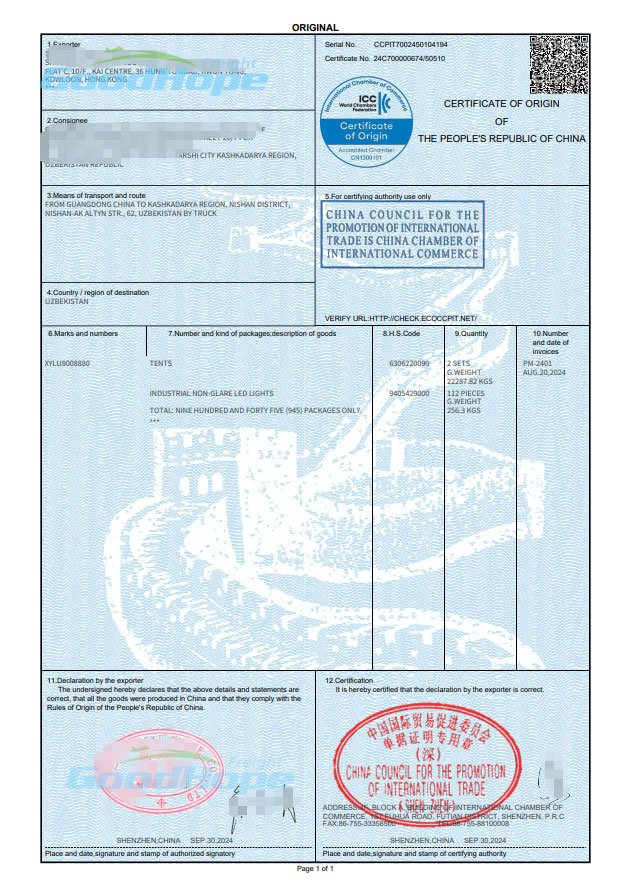
The certificate itself is straightforward: it is issued in English, the exporter signs and seals it, and one certificate can cover one or more products in a single consignment against a single importation. Your broker presents it with the entry. Without it, the same goods are assessed at the MFN rate where a duty is charged at all.
In China's import declaration system, agreement code 11 identifies the China–Singapore FTA. That code belongs to an entry filed into China for goods of Singapore origin; it is not a TradeNet field and it is not the number your Singapore broker keys into the entry. Do not let a supplier put “code 11” on a commercial invoice as if it were a Singapore requirement.
Origin is decided in one of three ways. Wholly obtained in China or Singapore — grown, harvested, mined, caught or produced there. Produced entirely from Chinese or Singapore originating materials. Or, where non-originating materials are used, the goods meet the product-specific rule for their heading. Goods not listed in the PSR schedule fall back to a regional value content of at least 40%, calculated as (FOB value − value of non-originating materials) ÷ FOB value × 100.
Four supporting rules decide the arithmetic. Cumulation: Chinese and Singapore originating materials both count as originating. De minimis: where a tariff-classification change is the rule, non-originating materials that fail the change may still be ignored if their value does not exceed 10% of FOB. Minimal operations: packing, sorting, labeling, simple assembly and repacking do not confer origin. Direct consignment: the cargo must move from China to Singapore without entering trade or consumption in a third country; where it passes through one, it may stay no longer than 3 months and only for unloading, reloading, storage or operations needed to keep it in condition.
The distinction that matters: Form X proves the cargo qualifies as Chinese origin and may be entered under the agreement. It does not prove that duty is zero. The Singapore tariff schedule decides the rate; the origin rule decides eligibility. A certificate that clears one test and fails the other is a certificate that gets refused at the counter.