
Home / Shipping to The Gambia / How to Ship from China to The Gambia
Shipping from China to The Gambia, step by step
Goodhope Freight is a licensed NVOCC based in Shenzhen, registered as GD20230925153335, and has been moving cargo out of China since 2012. To The Gambia we run full containers and shared containers port-to-port into the Port of Banjul, air freight airport-to-airport into Banjul International, and express parcels dispatched from our depot. Every service stops at the port, the airport or the depot. Your consignee arranges import clearance and collection.
The Gambia is the smallest country on mainland Africa: a narrow strip of land either side of the Gambia River, almost completely surrounded by Senegal, with a short Atlantic coastline and around two and a half million people. The river is the reason the capital sits where it does, and it is why almost everything arrives through one port.
Two things separate this destination from its neighbours. English is the working language, so documents do not need translating, which is rarer in this part of West Africa than you would expect. And commercial imports must be cleared by a licensed clearing agent rather than by the importer directly.
This guide is written for a buyer who has never imported from China before. It sets out how the five-band regional tariff works, how the import tax is calculated on a base built up in layers, what the declaration fee and the smaller levies add, and why the agent requirement changes how you should plan a first shipment.
At a glance
Main port: the Port of Banjul, on the Gambia River · Airport: Banjul International (BJL) · Currency: Gambian dalasi (GMD) · Customs authority: the Gambia Revenue Authority, through ASYCUDA · ECOWAS common external tariff in five bands: nil, 5, 10, 20 and 35 per cent · Import tax at 15 per cent on a base including duty, excise and other charges · Import declaration fee of 2.25 per cent of value, with a minimum in dalasi · ECOWAS levy, processing fee and African Union levy applied alongside · A licensed clearing agent is compulsory for commercial entries · Documents in English
How your cargo moves: China to The Gambia
Eight steps from your supplier's door to yours. The last four are the ones shaped by local rules.
- Pickup from your supplierWe collect the goods anywhere in China and bring them to our consolidation point.
- Export clearanceChina customs declaration filed and released before the goods move to the port.
- Loading and main carriageContainer loaded, sealed and shipped to Banjul.
- Discharge at the river portCargo worked ashore at the Port of Banjul and entered on the manifest.
- Agent lodges the declarationYour licensed clearing agent files the entry on the administrative document with codes.
- Tariff, levies and tax assessedThe band rate, the declaration fee, the levies and the tax are applied and settled.
- Release and collectionOnce satisfied your buyer collects. There is no onward delivery service.
- Re-export onward, if that is the planA share of what lands here moves on into Senegal under the relevant transit arrangement.
Duty rates, VAT rates and clearance times move, and the figure that applies to your goods is the one set for your commodity code on the day of clearance. We check the current position against your code before your goods sail and confirm it to you in writing — ask for that check when you request a quote.
A port on a wide river, and a country that follows it
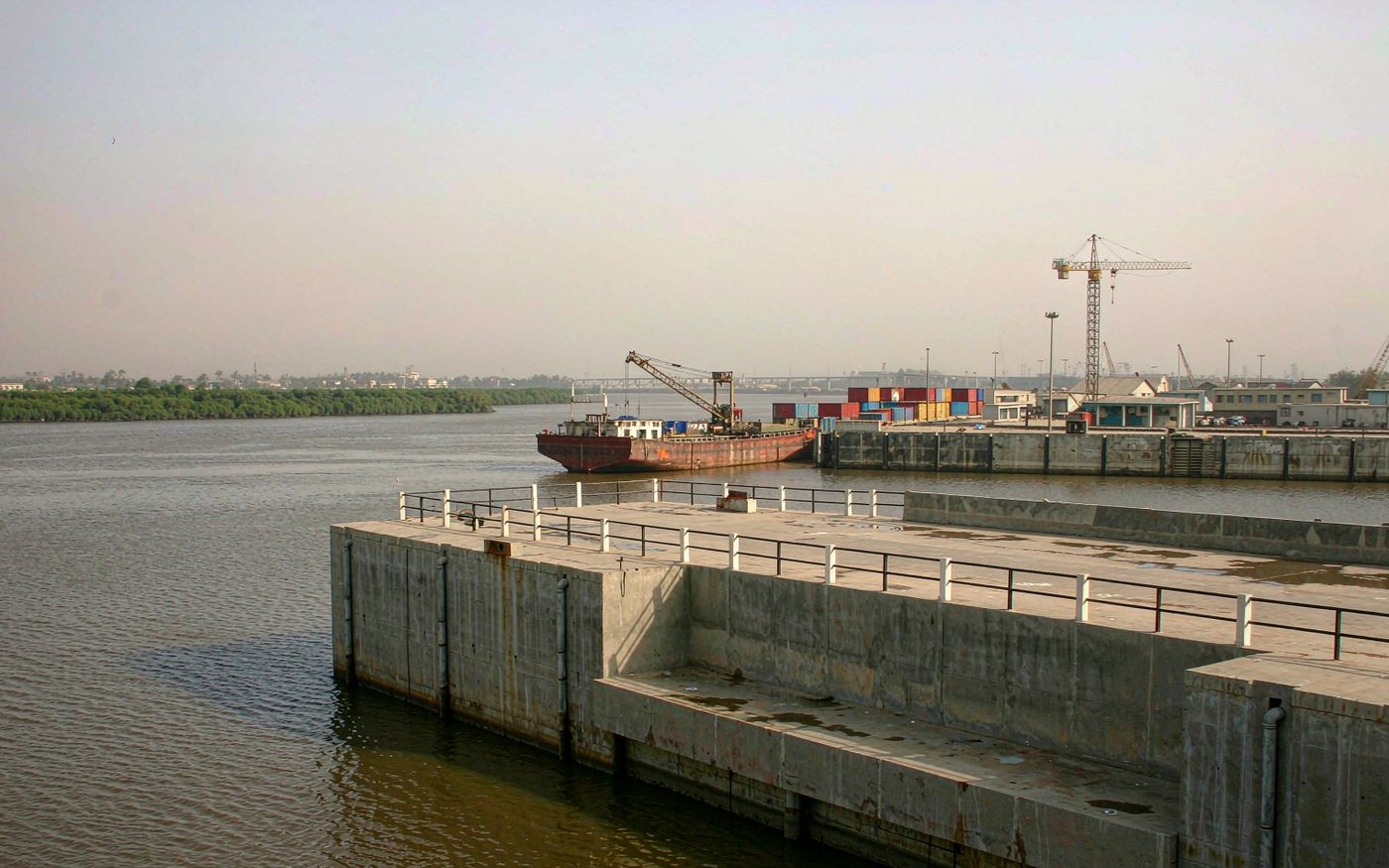
The Gambia follows the Gambia River inland for several hundred kilometres and is surrounded on nearly every side by Senegal. In practice that means there is one commercial port that matters, the Port of Banjul near the river mouth, and one international airport. It also means your goods are landing in a country that functions as a re-export hub. A meaningful share of what clears at Banjul is bound for Senegal or further inland, and if that is your plan it needs to be declared as transit at the outset rather than sorted out afterwards. For a first shipment the useful habit is to be specific about the final destination. Goods clearing for local use and goods moving onward are documented differently, and the difference is easier to build in at booking than to explain at the port.The five-band tariff the region shares
The Gambia applies the common external tariff of the Economic Community of West African States rather than a schedule written in Banjul. It has five bands: nil for certain basic social goods, five per cent for basic necessities, raw materials and some capital goods, ten per cent for intermediate products and production equipment, twenty per cent for many finished goods, and thirty-five per cent for certain protected goods. Classification decides the band, and the spread between the bottom and the top is wide. A consignment of production machinery and a consignment of finished retail goods of the same value can differ by a margin larger than the freight on either. So the question worth asking is which band your code falls into, not what the duty rate is. We check your codes against the current tariff position before your goods sail and tell you plainly if a line is going to cost more than you assumed.Working out the import tax, one layer at a time
Imports attract tax at fifteen per cent. It is not charged on your invoice figure but on a base built up in stages: the customs value, then the tariff, then any excise, then the other charges described below. The tax is applied to the total. Working it through in that order is the difference between a landed cost that holds and one that does not. The most common error is taking fifteen per cent of the invoice value, which understates the bill by a margin worth having. If your goods attract excise, the effect compounds. Excise is assessed before the tax rather than after it, so it raises both the duty line and the base the tax is charged on.The declaration fee, and the levies beside it
Alongside the tariff and the tax sits an import declaration fee of two and a quarter per cent of the customs value, with a minimum expressed in dalasi. It applies whether or not your goods attract much duty. Three smaller charges sit next to it: a regional community levy of one per cent, a processing fee of around one and a half per cent, and an African Union levy of a fifth of a per cent. Each is calculated on the customs value. Individually these are small and collectively they are not. A costing that accounts for the band and the tax but ignores the fee and the levies will come in short, and we set each one out on its own line so you can see exactly what is being applied.A licensed agent is not optional
Commercial imports must be cleared through a licensed clearing agent with access to the electronic declaration system. An importer cannot simply walk in and lodge an entry, and this is not a formality that can be worked around after arrival. That makes the agent a part of your planning rather than a detail of it. They need to be appointed before the vessel arrives, briefed on what is coming, and in possession of the documents in time to lodge. It is also why we pre-alert the agent before the vessel sails and send the document pack ahead of the container. On a route where the entry cannot be lodged without one named party, that single habit removes most of the delay that would otherwise accumulate.English throughout, which is rarer here than you would think
English is the working language of the customs administration, and the declaration, the commercial invoice and the packing list are prepared in it. For a buyer used to French or Portuguese documentation across this region, that removes an entire category of cost and delay. It does not remove the need for precision. A vague description still invites a clarification request, and a clarification request still means the goods stay where they are while it is answered. We reconcile your supplier's invoice and packing list at our consolidation point before departure, matching documents to cartons physically. Discrepancies found in China cost a phone call rather than a fortnight.Getting registered before the first entry is lodged
Importers need a tax identification number, and it appears on the declaration. If your consignee is importing commercially for the first time, registering for it belongs at the very start of your plan rather than after the vessel has sailed. Discovering the requirement once the container has been discharged is the slowest and most expensive way to learn it, because storage runs from arrival rather than from the day the paperwork is finally ready. Tell us at quotation stage if this is a first import for your buyer. We will flag it and build the timing around it rather than assuming the registration is already in hand.Clearing at Banjul, and what the schedule looks like
With documents in order, express consignments typically clear within a few working days and postal consignments rather longer. Those figures assume the entry was cleanly lodged, which brings you back to the agent and the documents. The port itself is small by regional standards, and capacity is finite. Congestion is not a daily event but it is not unknown either, and a consignment that arrives with its paperwork in order is the one that moves when things are tight. We name the discharge window on the quotation and tell you what we are seeing on the berth at the time of booking, so your buyer can plan collection against something rather than against hope.A re-export hub, and what that means for your documents
Because so much of what lands at Banjul moves onward into Senegal, the transit documentation matters more here than in a market where everything is consumed locally. If your consignment is bound for Senegal, the transit arrangement needs to be in place before the goods arrive, and the documents need to describe the onward movement rather than a local import. Getting this right at booking is straightforward; converting a local entry into a transit movement afterwards is not. We will ask you directly where the goods are ultimately going. It is a short question and it prevents a long problem.Packing for a river port and a humid coast
Banjul sits on a wide tropical river a short distance from the Atlantic, and cargo waits outdoors. Heat and humidity do most of the damage, and metal surfaces and absorbent packaging suffer first. Export-grade strapping, proper dunnage, filled voids, sealed inner packaging with desiccant and corrosion protection for metal are baseline rather than upgrades here. Timber packaging must be treated and marked to the international standard with the certificate in hand before departure. Quarantine is enforced, and remediating uncertified timber after arrival is slow and expensive.Where our service stops, and what your buyer does next
We handle collection anywhere in China, export clearance, consolidation, loading, the booking to Banjul or the airport, and the document set your agent needs to lodge a clean entry. Your buyer handles arrival onward: appointing a licensed clearing agent, holding a tax identification number, lodging the declaration, paying the band rate, the declaration fee, the levies and the tax, satisfying quarantine, and collecting. We quote each charge as its own line. With freight, tariff, fee, levies and tax each carrying real weight, a single bundled figure tells you nothing you can act on.Sending a first Gambian consignment
Send us the commodity in enough detail to classify it against the regional tariff, the volume and weight, the pickup address in China, and whether the goods are for local use or moving onward. Tell us too whether your consignee already holds a tax number. We will check your codes, confirm the band, and quote freight, tariff, declaration fee, levies and tax separately. Ask us for the worked example before you fix your selling price. Start with one shared container. It tells you how your supplier packs for a humid river port, how quickly your agent responds, and how much margin your schedule genuinely needs, for considerably less than a full container would cost you to learn the same three things.Working examples on the China to The Gambia lane
Five shipments bought in China and delivered into The Gambia, told end to end — where the order came from, how it moved, where it nearly went wrong, and how it finished. Client names are withheld at their request; the situations and the handling are what we deal with on this lane.
Shopfitting material for a Banjul retailer
The purchase. A retail operator bought shelving, interior boards, lighting, door furniture and fixings from two suppliers in Guangdong to fit out a store in the Serekunda area.
The move. We collected both lots, consolidated into one 20GP and shipped port-to-port to Banjul, with the clearing agent appointed and pre-alerted before the vessel sailed.
Where it nearly went wrong. One supplier packed to domestic rather than export standard, with light strapping and no dunnage. After handling at a river port and time in the open, several bundles arrived with broken strapping and scuffed finishes.
How it finished. We made export-grade strapping and dunnage a condition of collection on the repeat and inspected both lots before sealing. The second container arrived intact.
A first import with no tax number
The purchase. A consignee importing commercially for the first time booked the shipment before registering with the revenue authority.
The move. One 20GP consolidated and shipped to Banjul, with the entry prepared by a licensed agent on arrival.
Where it nearly went wrong. The tax identification number appears on the declaration, and registration had not been started. The container waited while it was obtained, and storage ran from arrival rather than from when the paperwork was ready.
How it finished. We now flag tax-number registration at quotation stage for any first-time commercial importer on this route. Subsequent consignments have been lodged the day they arrived.
Excise that raised both the duty and the tax
The purchase. A distributor ordered a mixed consignment of beverages and general grocery lines, and costed the whole order at one blended rate.
The move. One 20GP to Banjul, declared line by line rather than under a general description.
Where it nearly went wrong. The beverage lines attract excise, and excise is assessed before the tax rather than after it. That raises the duty line and the base the tax is charged on, so a blended rate was wrong in both directions at once.
How it finished. We set out the treatment line by line while the goods were still in China. The distributor repriced before the container sailed rather than absorbing the difference at clearance.
Transit cargo declared as a local import
The purchase. A trader imported goods ultimately bound for Senegal and declared them as a straightforward local entry, on the assumption that the onward leg could be arranged afterwards.
The move. One 40HC shipped to Banjul, with the entry lodged by the consignee's agent.
Where it nearly went wrong. Because so much of what lands at Banjul moves onward, transit has to be declared at the outset. Converting a local entry into a transit movement after arrival meant the goods sat while the position was regularised.
How it finished. We now ask directly where goods are ultimately going at quotation stage. Since then, transit consignments have been documented correctly from the first entry.
Corrosion on metal parts after time in the open
The purchase. A workshop imported pumps, motors, bearings and hand tools from suppliers in Zhejiang for maintenance work along the river.
The move. One 20GP consolidated to Banjul, with metal parts shipped in standard domestic cartons.
Where it nearly went wrong. Cargo waits outdoors at a tropical river port, and the metal parts had no corrosion protection at all. Several arrived with surface rust on machined faces and bearing journals.
How it finished. We required vapour corrosion protection and sealed inner packaging on the repeat. The parts arrived clean and went straight into service.
Why importers use Goodhope on this lane
Six things that are different about working with us on China to The Gambia shipments.
Get a Banjul shipment priced
Tell us the commodity in enough detail to classify it against the regional tariff, the volume, the pickup address in China, and whether the goods are for local use or moving onward. We will check your codes, confirm the band, and quote freight, tariff, declaration fee, levies and tax separately.
Get a quote Talk to usRelated pages
Frequently asked questions
What duty rates apply in The Gambia?
The country applies the ECOWAS common external tariff in five bands: nil for certain basic social goods, 5 per cent for basic necessities, raw materials and some capital goods, 10 per cent for intermediate products and production equipment, 20 per cent for many finished goods and 35 per cent for certain protected goods. Your commodity code decides the band.
How is the import tax calculated?
It is charged at 15 per cent on a base built up in stages: the customs value, then the tariff, then any excise, then the other charges. Taking 15 per cent of the invoice value understates it, because the base is larger than the invoice.
What other charges apply?
An import declaration fee of 2.25 per cent of the customs value with a minimum in dalasi, a regional community levy of 1 per cent, a processing fee of around 1.5 per cent, and an African Union levy of 0.2 per cent. Each is small and collectively they are worth budgeting for.
Do I need a clearing agent?
Yes. Commercial imports must be cleared through a licensed clearing agent with access to the electronic declaration system. Importers cannot lodge entries directly, so the agent must be appointed and briefed before the vessel arrives.
Does my consignee need a tax number?
Yes. Importers need a tax identification number, which appears on the declaration. First-time commercial importers should register before the vessel sails rather than discover the requirement once goods have been discharged.
Do documents have to be translated?
No. English is the working language of the customs administration, and the declaration, invoice and packing list are prepared in it. That removes a cost most of the region carries, though descriptions still need to be precise.
How long does clearance take?
With documents in order, express consignments typically clear within a few working days and postal consignments longer. Those figures assume a cleanly lodged entry, which depends on the agent holding complete documents before the container arrives.
Can goods transit onward to Senegal?
Yes, and a meaningful share of what lands at Banjul does. Transit has to be declared at the outset rather than arranged afterwards, so tell us the final destination at quotation stage and we will structure the entry accordingly.
Do you offer door-to-door delivery?
No. Sea freight is port-to-port to Banjul, air freight is airport-to-airport to Banjul International, and express courier dispatch ends at the depot. Your consignee appoints an agent, pays the charges and collects.
Can lithium batteries be shipped?
Built-in and packed-with lithium batteries can be carried with proper declaration, documentation and packaging. Standalone battery shipments and other dangerous goods classes are assessed individually and must be declared at quotation stage so we can book with a carrier that accepts the class.