
Home / Shipping to the Marshall Islands / How to Ship from China to the Marshall Islands
Shipping from China to the Marshall Islands, step by step
Goodhope Freight is a licensed NVOCC based in Shenzhen, registered as GD20230925153335, and has been moving cargo out of China since 2012. To the Marshall Islands we run full containers and shared containers port-to-port into Majuro, air freight airport-to-airport into Marshall Islands International Airport, and express parcels dispatched from our depot. Every service stops at the port, the airport or the depot. Your consignee arranges import clearance and collection.
The Marshall Islands sits in the central Pacific about halfway between Hawaii and Australia, uses the United States dollar, and imports almost everything it consumes. Import duty follows the Import Duties Act 1989, which sets one general rate with a short list of exceptions rather than a long tariff book. There is no value-added tax on imports, which surprises buyers who have shipped to Fiji or Samoa first and budgeted for one.
This guide is written for a buyer who has never imported from China before. It walks through which gateway your cargo will use, how duty and the local taxes actually combine, which goods are exempt, what the Customs Division expects to see, and why the packing you accept from a Chinese factory decides whether your container clears or sits.
Everything below is port-to-port and airport-to-airport. There is no door-to-door service to the Marshall Islands, and it helps to accept that from the start rather than to plan around it.
At a glance
Main port: Majuro, with Ebeye on Kwajalein as the second entry of consequence · Main airport: Marshall Islands International (MAJ) on Majuro · Currency: United States dollar · Customs authority: Customs Division, Ministry of Finance, based in Majuro · General import duty 8 per cent of value, with most foodstuffs at 5 per cent · Motor vehicles 15 per cent, public transport vehicles 5 per cent · Specific rates on fuel, tobacco and alcoholic drinks · No national value-added tax or sales tax · Local sales tax levied by the Majuro and Kwajalein governments · Exemptions for fishing equipment, renewable energy and energy-efficient equipment
How your cargo moves: China to the Marshall Islands
Eight steps from your supplier's door to yours. The last four are the ones shaped by local rules.
- Pickup from your supplierWe collect the goods anywhere in China and bring them to our consolidation point.
- Export clearanceChina customs declaration filed and released before the goods move to the port.
- Loading and departureContainer loaded, sealed and handed to the carrier at a Chinese port.
- Relay through Guam, Hawaii or a Pacific hubThere is no nonstop cargo service from mainland China, so the connection sets your arrival window.
- Discharge at MajuroContainers are worked at the Majuro quay; air cargo is handled at the MAJ cargo building.
- Entry filed with the Customs DivisionYour broker lodges the declaration with the commodity codes and the value from your invoice. Processing is largely manual.
- Duty and local charges assessedThe general rate or an exemption is applied to your lines and the assessment is settled before release.
- Quarantine check and releasePlant, animal and food lines are inspected under the animal and plant inspection rules. Once everything is satisfied your buyer collects.
Duty rates, VAT rates and clearance times move, and the figure that applies to your goods is the one set for your commodity code on the day of clearance. We check the current position against your code before your goods sail and confirm it to you in writing — ask for that check when you request a quote.
Majuro and Ebeye: the only two entries that matter
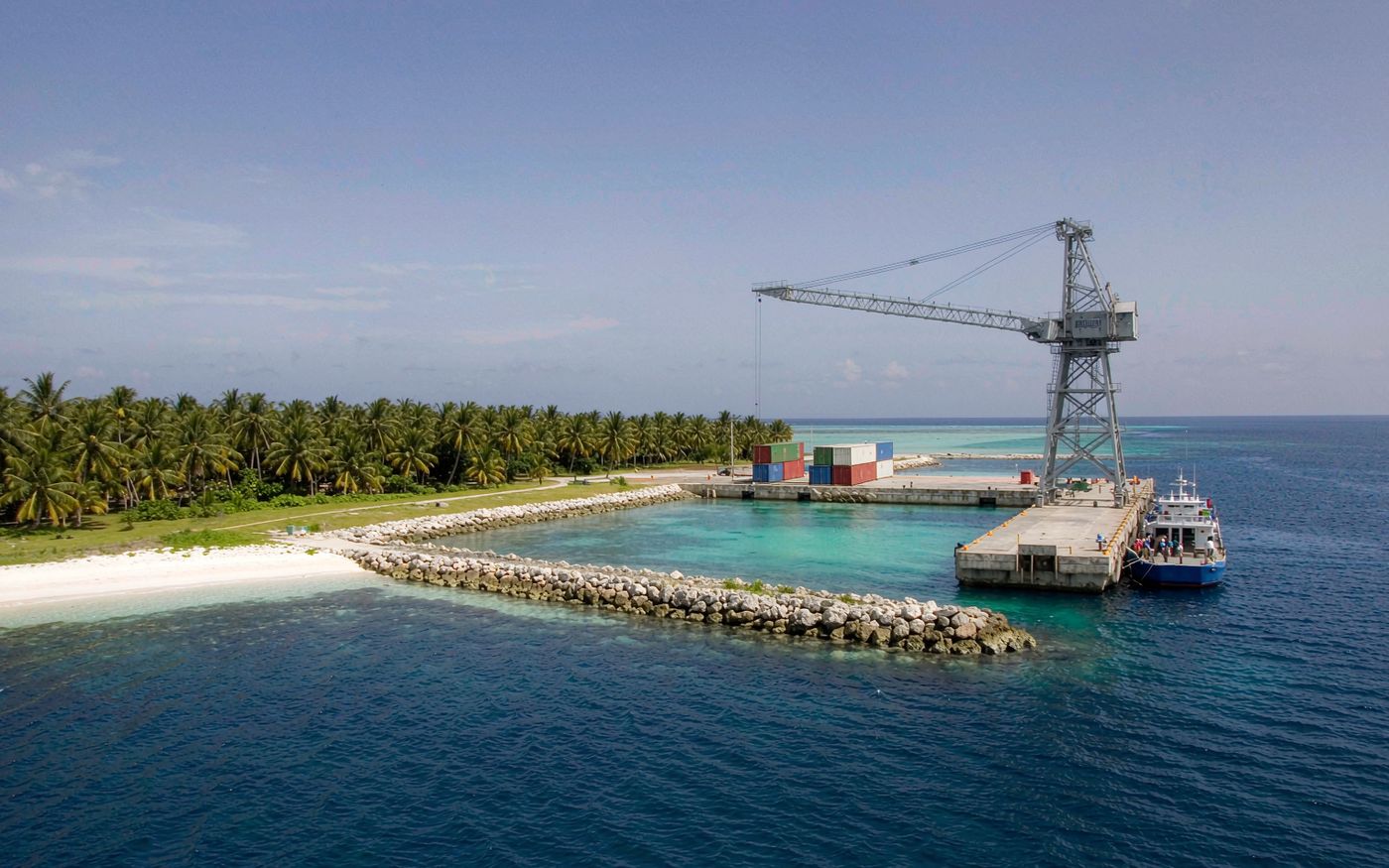
Almost everything arriving from China enters at Majuro. Majuro is a single narrow atoll carrying the capital, the main commercial quay, the airport and most of the population, and the Customs Division itself is based there. If your consignee is anywhere else in the country, the last leg is an inter-island movement you should price and plan separately. Ebeye, on Kwajalein Atoll to the north, is the only other settlement of real size. Kwajalein also hosts a United States military installation, and access to anything on that side of the atoll is controlled. Do not assume a second gateway exists just because a second island appears on the map. Air cargo arrives at Marshall Islands International Airport on Majuro. It is a short runway handling narrow-body aircraft, so air freight connects through Guam, Honolulu or a regional hub rather than arriving nonstop from China. For anything bulky, air is a supplement to the sea route rather than an alternative to it.Relays, and the timetable an atoll imposes
There is no nonstop container service from mainland China to Majuro. Your cargo moves from a Chinese port to a Pacific hub and then onto a feeder vessel, and a sea transit that looks short on a map routinely runs past five weeks door to quay. Sailings on the final leg are spaced weeks apart rather than weekly, which is the single fact that most reshapes a first-time importer's plan. That spacing changes how you should think about a missed document. If the feeder has already sailed, the wait is the next scheduled call, not the next available vessel. We name the hub and the target feeder on the quotation, because waiting until something is late to ask which vessel you are on is how a two-week slip becomes a six-week one. The Marshall Islands sits in the typhoon belt and its land rarely rises more than a couple of metres above sea level. King tides, storm swell and heavy rain can slow work on the quay regardless of what any schedule says. Building a buffer into a project timeline costs nothing and is worth more here than the freight saving it might displace.The 8% baseline, and where it reaches
The Import Duties Act 1989 takes a simple approach. One general rate of eight per cent applies to imported goods, with a lower rate for food and a short schedule of special lines. The act does not publish thousands of tariff lines because it does not need to; the general rate is the answer for most ordinary cargo, and the exceptions are the part worth knowing. The rate applies to the customs value of the goods, meaning the value the Customs Division accepts for the entry. Because the whole assessment turns on one rate and one value, the quality of your commercial invoice matters more here than almost anywhere else. An invoice that understates or vaguely describes the goods invites a reassessment that a clearer document would not. Goods in transit to another international destination are outside the charge, as are imports under a defined set of exemptions. Anything destined onward rather than for local consumption should be described that way on the paperwork from the start, because retrofitting a transit claim after an entry has been accepted is an uphill task.Food at five, vehicles at fifteen, and the specific lines
Most imported foodstuffs attract five per cent rather than eight, and a defined group of staples is exempt altogether. Milk, rice, flour, vegetables, fruit, poultry and canned fish all sit on the exempt list. For a buyer importing food, the difference between the general rate and the exempt treatment is usually worth more than any freight negotiation. Motor vehicles are treated separately. Vehicles whose value can be established attract fifteen per cent on the higher of an accepted valuation guide or the invoice value, with a floor below which the duty will not fall. Vehicles used for public transport attract five per cent. Used vehicles carry their own minimum charge, so an older vehicle does not escape duty by virtue of age. For fuel, tobacco and alcohol the act uses specific rates rather than percentages. Diesel carries cents per gallon rather than a percentage, cigarettes carry a charge per pack, and spirits are assessed per gallon. Cigars attract their own punitive percentage. Specifying exactly what is in the container matters, because these charges do not scale politely with value.Why no consumption tax reaches your bill of entry
The Marshall Islands has no national value-added tax and no national sales tax on imports. Goods arriving at Majuro are assessed for import duty and then released, without a consumption tax layered on top. Buyers moving from a destination that charges fifteen or twenty per cent often over-budget here by a wide margin. That is not to say nothing else applies. Major employers pay a gross revenue tax on business turnover rather than on individual imports, and the Majuro and Kwajalein local governments levy their own sales taxes on retail activity inside their boundaries. Those are charges your business encounters downstream, not lines added to your bill of entry. The practical consequence for costing is that your landed cost is freight plus duty plus local handling, with the largest single variable being whether your goods qualify for one of the exemptions. It follows that classification, not negotiation, is where the money is.What arrives free of duty
The exemption list is short and specific, and it is worth reading before you classify anything. Renewable energy equipment, energy-efficient equipment, solar-powered equipment imported for power generation and fishing equipment are all outside the charge, as are inputs imported by local manufacturing industries. Aviation fuel and components are also exempt. Exemptions are claimed by classification and supported by evidence, not granted automatically. A container of mixed general merchandise containing one exempt line still needs that line identified separately on the declaration. A single generic description across a whole container forfeits relief on the lines that would otherwise have qualified. The exemption on goods destined onward is separate again. Cargo genuinely passing through Majuro to another destination is not subject to import duty, but should be documented as transit at the point of booking rather than explained at the quay.Clearing through the Customs Division in Majuro
The Customs Division sits within the Ministry of Finance, alongside Treasury, Revenue and Taxation, and its officers rotate between the airport, the seaport and other places goods enter, including post offices and private courier representatives. Clearance is handled substantially on paper. Planning around a fully automated online portal will lead you astray. Entry rests on the usual set of documents: a commercial invoice with a proper description and value, a packing list that matches it to the carton, the bill of lading or air waybill, and any certificate needed for the commodity. Additional permits apply to firearms, alcohol, tobacco and certain agricultural lines. A consignment with a mismatched document set is the most common reason an entry stalls in a manual environment. We reconcile your supplier's invoice and packing list at our consolidation point before sailing, because once a container is on the water a discrepancy becomes a correspondence problem rather than a phone call. Goods may also be examined physically. Because there is no bonded warehouse of consequence at the port and very little covered storage, anything held is exposed to salt air and rain. That is a strong argument for packing well rather than packing cheaply.Quarantine, and the plant and food list
The Animal and Plant Inspection Act gives agricultural quarantine inspectors authority over animals, plants and plant parts entering or moving within the country. That includes seeds, cuttings, fruit and vegetables, and it includes the packaging those things travel in. Shipments can be refused entry or refused onward movement. Timber packaging is the practical tripwire. Wooden pallets and crates should be treated and marked to the agreed international standard, with the treatment certificate in hand before the vessel sails. Consignments that arrive on untreated timber are held at your expense, and the remedies at a remote atoll are expensive. Food consignments need appropriate health documentation, and food arriving alongside non-food lines in a mixed container will be examined on the food line regardless of what the rest of the container contains. Keeping food clearly separated and separately documented inside a mixed shipment avoids one line holding up the rest.Packing for two legs and an open quay
Your container will be lifted at least twice more than a container going to a major hub, and possibly three times, with a vessel-to-vessel transfer somewhere in between. Every lift is a chance for a badly-strapped pallet to open. Export-grade strapping, proper dunnage and correctly-filled voids are not optional on this route. Humidity is relentless and open-air storage happens. Goods packed in thin woven sacks or unprotected cartons arrive damaged at a rate that looks like bad luck but is really bad packing. If the cargo matters, pack it as though it will be rained on, because at some point it probably will be. Weight distribution inside the container also carries more consequence than usual. Small island quays are worked by equipment with limited reach, and a container loaded badly out of balance is slower and riskier to place than one loaded squarely.Our side of the line, and your buyer's
We handle everything up to the point of arrival. That covers collection anywhere in China, export customs clearance, consolidation, loading, the booking through to Majuro or MAJ, and the documentation that an accurate entry depends on. It also covers telling you which relay your container is on and when it is due. Your buyer handles what happens after arrival: appointing a broker, presenting the entry, paying duty and local charges, satisfying quarantine, and collecting from the quay or the cargo building. There is no delivery to a door anywhere in this country, and no inland haulage network to fall back on beyond the island your cargo lands on. We quote every charge as its own line so you can see where the money goes. Freight to Majuro is a small part of landed cost; the parts that surprise people are always destination charges and duty, not the ocean leg.Starting a first Marshall Islands consignment
Send us the commodity, the volume and weight, the pickup address in China, and which island your consignee will collect on. Tell us whether any line is food, contains timber packaging, involves batteries, or could be argued into an exemption, because those four questions change the whole plan. We will confirm the relay route, name the feeder we are targeting, and set out what we can see about duty on your codes before anything sails. If your goods are exempt, that is worth knowing before you sign the purchase order rather than after the container arrives. Start smaller than you think you should. A first shipment to Majuro teaches you more about your own documents and your consignee's arrangements than any amount of reading, and a single shared container is a cheaper lesson than a full one.What we see into the Marshall Islands
Five shipments bought in China and delivered into the Marshall Islands, told end to end — where the order came from, how it moved, where it nearly went wrong, and how it finished. Client names are withheld at their request; the situations and the handling are what we deal with on this lane.
Hardware for an atoll builder, 40HC out of Foshan
The purchase. A contractor rebuilding storm-damaged buildings on Majuro ordered cement board, roofing sheet, fixings, hand tools and plumbing fittings from three separate suppliers around Foshan.
The move. We collected all three lots, consolidated into one 40HC, shipped port-to-port to Majuro with the relay named at booking, and pre-alerted the consignee's broker before the feeder sailed.
Where it nearly went wrong. Two of the suppliers had never exported. Their goods arrived in thin woven sacks and unbanded cartons that opened at the first lift, and nobody had arranged treatment for the timber used to crate the roofing.
How it finished. We made export-grade packing and treated, marked timber a condition of the second collection and checked both before the container was sealed. The repeat shipment landed complete and cleared without a query.
Solar and battery equipment that qualified for relief
The purchase. A contractor tendered for a solar-plus-storage installation on Majuro and priced panels, lithium storage units and mounting hardware from Jiangsu and Guangdong.
The move. Two 40HC booked port-to-port to Majuro, with the battery lines declared properly at quotation stage so we could place them with a carrier that accepts the class.
Where it nearly went wrong. The factory's own paperwork described the batteries as ordinary machinery, which risks pulling a container at any transfer point on the relay. Separately, the bid had costed duty at the general rate without knowing that renewable energy equipment sits outside the charge.
How it finished. We corrected the declaration for the battery class before booking, built extra time into the schedule for screening, and flagged the exemption position in writing while the panels were still in China. The bid was repriced on the corrected duty and both containers cleared.
A hotel fit-out held on quarantine
The purchase. A small hotel refitting rooms bought mattresses, synthetic rattan furniture, kitchen equipment and packaged food service lines from suppliers in Guangdong and Zhejiang.
The move. One 40HC plus roughly 300 kg of urgent linen and smallware by air into MAJ, connecting through the Pacific hub.
Where it nearly went wrong. The container used untreated timber for crate bracing and one food-service line arrived without health documentation. Under the plant inspection rules the entry was held on the packaging before anyone looked at the value.
How it finished. Release came once a treatment certificate was produced and the affected bracing was replaced. On the repeat we required treated and marked timber up front and made health documentation part of the pre-sealing check.
A first online order, reconciled before it sailed
The purchase. A shop owner on Majuro bought four pallets of phone accessories and small appliances from two Shenzhen sellers found through an online marketplace.
The move. We collected both lots, consolidated them onto four export-grade pallets and moved them as shared container cargo to Majuro with the relay named.
Where it nearly went wrong. Neither seller could produce a packing list matching their own invoice, and the two sets disagreed by eleven cartons. At a largely manual customs office, a document mismatch is the most reliable way to stall an entry.
How it finished. We counted both lots at our consolidation point, issued one reconciled set of documents and matched it to the pallets physically. The container cleared without the consignee being asked a single question.
Fishing supplies entered at the wrong rate for years
The purchase. A fishing services company operating from Majuro ordered netting, refrigeration spares, fuel hose and workshop consumables from suppliers in Ningbo and Qingdao.
The move. One 20GP port-to-port to Majuro, timed around the next call of the vessel being serviced.
Where it nearly went wrong. Fishing equipment sits outside the general charge, but only when it is identified as such on the declaration. The company's previous broker had entered every line at the eight per cent rate and simply paid it.
How it finished. We raised the classification before the goods sailed and the consignee's broker re-entered the exempt lines separately. The treatment has since been written into their annual supply contract, which is where it belonged all along.
Why importers use Goodhope on this lane
Six things that are different about working with us on China to the Marshall Islands shipments.
Price a shipment to Majuro
Tell us the commodity, the volume, the pickup address in China and which atoll your consignee collects on. We will name the relay, check whether your lines sit on the exemption list, and set out import duty and destination charges as separate lines.
Get a quote Talk to usRelated pages
Frequently asked questions
Is there a direct sea freight service from China to the Marshall Islands?
No. There is no nonstop container service from mainland China. Cargo moves from a Chinese port to a Pacific hub such as Guam or Hawaii and onto a feeder vessel to Majuro, and we name the hub and the target sailing on the quotation.
What import duty applies on arrival?
The Import Duties Act 1989 sets a general rate of eight per cent of the customs value for most goods, with most imported foodstuffs at five per cent and a defined list of staples exempt entirely. The rate that applies to your goods is the one for your commodity code on the day of clearance.
Is there value-added tax on imports?
No. The Marshall Islands levies no national value-added tax and no national sales tax on imports. Duty is assessed and the goods are released, although local governments levy sales taxes on retail activity inside their own boundaries, which is a downstream business cost rather than an entry charge.
Are motor vehicles treated differently?
Yes. Vehicles whose value can be established attract fifteen per cent on the higher of an accepted valuation guide or the invoice value, with a minimum below which the charge will not fall. Public transport vehicles attract five per cent, and used vehicles carry their own minimum charge.
Which imports are exempt?
Fishing equipment, renewable energy equipment, energy-efficient equipment and solar-powered equipment imported for power generation are exempt, along with certain staple foods, aviation fuel and components, inputs for local manufacturing industries, and goods genuinely in transit to another destination.
Which port does sea freight arrive at?
Majuro. It carries the Customs Division, the main commercial quay and the airport. Ebeye on Kwajalein is the only other settlement of real size, and part of that atoll is a controlled military installation, so it should not be assumed as a routine alternative gateway.
Does air cargo arrive directly from China?
No. Marshall Islands International Airport on Majuro is a short runway served by narrow-body aircraft, so consignments connect through Guam, Honolulu or a regional hub, and the connection drives the transit time rather than the flight itself.
Do you offer door-to-door delivery?
No. Sea freight is port-to-port to Majuro, air freight is airport-to-airport to MAJ, and express courier dispatch ends at the depot. Your consignee appoints a broker, settles duty and local charges, satisfies quarantine and collects.
Can lithium batteries be shipped?
Built-in and packed-with lithium batteries can be carried subject to proper declaration, documentation and packaging. Standalone battery shipments and other dangerous goods classes are assessed individually and must be declared at quotation stage so we can book with a carrier that accepts the class.
What packing requirements matter most on this route?
Your container is lifted several times and transferred between vessels, so export-grade strapping and dunnage are essential. Timber packaging must be treated and marked to the agreed international standard with a certificate in hand before sailing, and goods should be packed as though they will sit exposed to salt air and rain, because sometimes they do.