
Home / Shipping to Nauru / How to Ship from China to Nauru
Shipping from China to Nauru, step by step
Goodhope Freight is a licensed NVOCC based in Shenzhen, registered as GD20230925153335, and has been moving cargo out of China since 2012. To Nauru we run full containers and shared containers port-to-port into Aiwo, air freight airport-to-airport into Nauru International Airport, and express parcels dispatched from our depot. Every service stops at the port, the airport or the depot. Your consignee arranges import clearance and collection.
Nauru is the smallest independent republic in the world, a single raised coral island of about twenty-one square kilometres with roughly twelve thousand residents. Almost everything the country consumes arrives by sea, and there is no deep-water berth to receive it, which shapes routing, cost and packing more than the duty rates do.
On tax the picture is straightforward once stated correctly. A general import duty of ten per cent applies to taxable goods, necessities enter free, and a defined group of products carries rates far higher than that. There is no value-added tax, and understanding the difference is the difference between a landed cost that works and one that quietly does not.
This guide is written for a buyer who has never imported from China before. It covers how cargo physically reaches the island, where the duty bands sit, what excise adds, how the tariff is amended in practice, and why the sailing schedule deserves more of your attention than the distance.
At a glance
Main port: Aiwo, worked without a deep-water berth, with landing craft and shore handling doing the work · Main airport: Nauru International (INU) at Yaren · Currency: Australian dollar · Customs authority: Nauru Customs · General import duty 10 per cent of the customs value · Basic necessities including water and fresh produce enter free · Higher ad valorem rates on tobacco, alcohol, sugar and sugary products, fuel and cosmetics · Excise on cigarettes, tobacco, alcohol and fuel · No value-added tax on imports · Supply from Australia and Fiji on scheduled rather than frequent sailings
How your cargo moves: China to Nauru
Eight steps from your supplier's door to yours. The last four are the ones shaped by local rules.
- Pickup from your supplierWe collect the goods anywhere in China and bring them to our consolidation point.
- Export clearanceChina customs declaration filed and released before the goods move to the port.
- Loading and departureContainer loaded, sealed and handed to the carrier at a Chinese port.
- Relay through Australia, Fiji or a Pacific hubThere is no direct service from China, so the connection determines your arrival window.
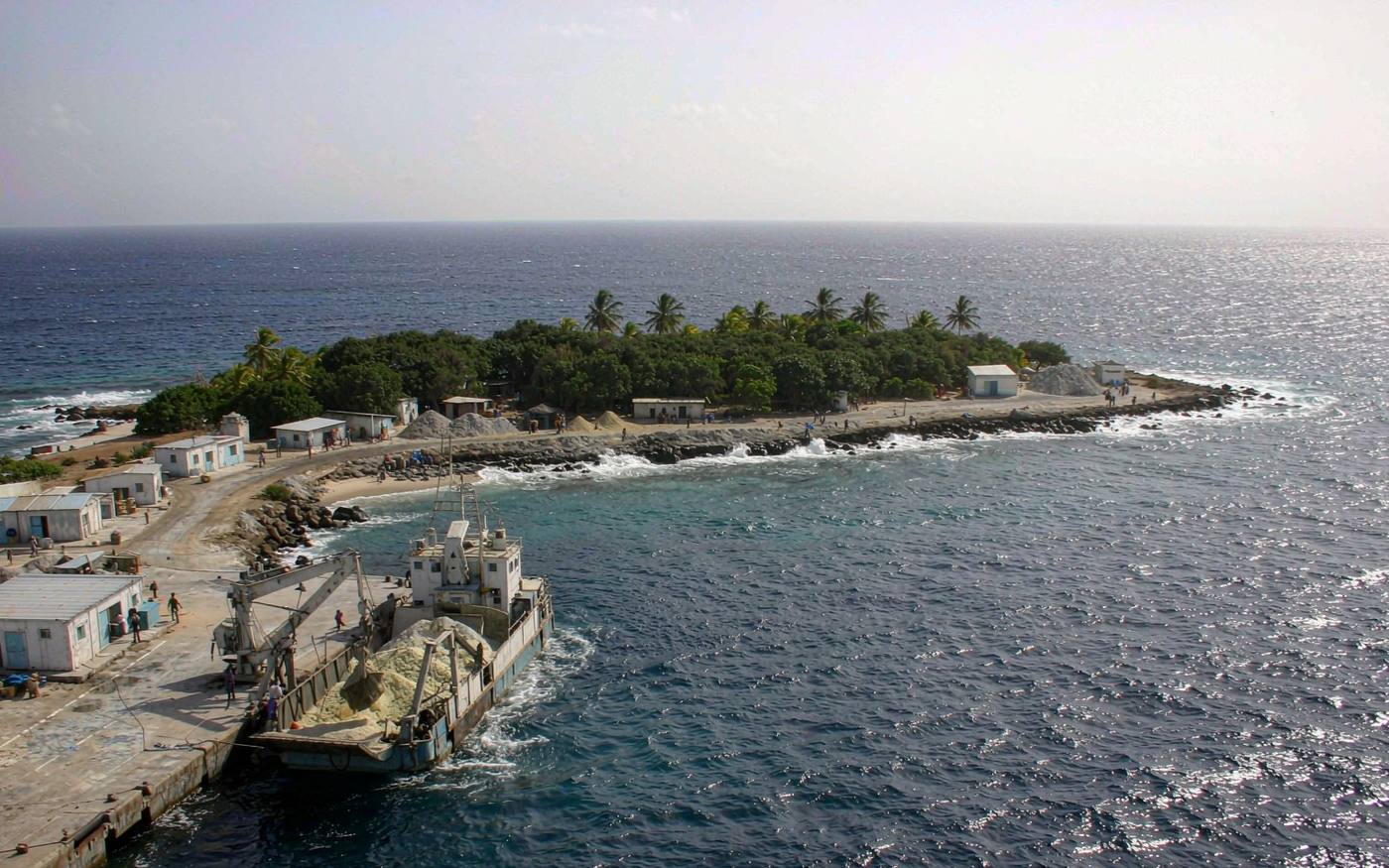
- Discharge at AiwoWithout a deep-water berth, cargo is worked ashore rather than lifted straight onto a quay.
- Entry filed with Nauru CustomsYour broker lodges the declaration with codes, values and any excise classification.
- Duty and excise assessedThe general rate, a higher band or a zero line is applied and settled before release.
- Release and collectionOnce everything is satisfied your buyer collects. There is no onward delivery service.
Duty rates, VAT rates and clearance times move, and the figure that applies to your goods is the one set for your commodity code on the day of clearance. We check the current position against your code before your goods sail and confirm it to you in writing — ask for that check when you request a quote.
Aiwo, Yaren and a coastline with no deep-water berth
Nauru has no deep-water harbour. Cargo is worked at the Aiwo boat harbour on the western side of the island, using a cantilevered structure and shore handling rather than the container gantries a mainland port would offer. That constraint decides what can sensibly be shipped, how it must be packed, and how much time to allow for discharge. Nauru International Airport sits inland near Yaren district and handles the limited air service that exists, principally from Australia. For urgent spares, documents and light high-value goods it is genuinely useful. For anything bulky it is expensive, because every kilogram arrives on an aircraft that is primarily carrying passengers. Once ashore, everything is within a short drive. The island ring road is roughly nineteen kilometres, so inland transport is the least of your problems here. The difficulty is entirely in getting goods onto the island in the first place, and that is what your planning should focus on.Why the schedule, not the distance, decides your transit
Supply arrives on scheduled services that call every few weeks rather than on a weekly liner rotation. A consignment missing its intended sailing does not wait three days for another ship; it waits for the next scheduled call, and everything downstream moves with it. This is the single most important planning fact about Nauru. A purchase decision made late, a document error discovered after departure, or a container pulled for examination can each cost weeks rather than days. Buffering your schedule costs nothing up front and is worth far more than any small freight saving it might displace. We name the target sailing and the relay on the quotation so you can see the chain rather than take reassurance on faith. If something slips, you should hear it early enough to change something that still matters.The 10% starting point, and why it does not hold everywhere
Nauru applies a general import duty of ten per cent on taxable goods, set out in the schedule to the Customs Tariff Act 2014. For most ordinary merchandise that is the starting point, and it is a single flat rate rather than a finely-graded tariff book, which makes costing simpler than it is in larger markets. Ten per cent is only the general answer. Certain lines carry higher ad valorem rates, some carry specific rates charged by quantity rather than value, and a defined list enters free of duty entirely. Treating ten per cent as universal will produce a budget that is wrong for exactly the lines where being wrong costs most. The rate applies to the customs value of the goods, built up from the transaction value in the accepted way. Because freight forms part of that value on this route, import duty assessed correctly is higher than the same goods would attract landing somewhere closer to China.Water, fresh produce and the lines that enter free
Basic necessities are deliberately kept free of duty. Water and fresh fruit and vegetables are the clearest examples, and the logic is easy to understand on an island that imports essentially all of its food and all of its bottled water. The practical consequence for a mixed grocery order is that it must be declared line by line. A generic description covering water, produce and general grocery will be resolved against you, meaning everything attracts duty rather than only the lines that should. This cuts the other way too. Buyers sometimes assume everything food-related is free and then meet a charge on processed lines that were never on the exempt list. The exempt group is specific, not thematic.Tobacco, sugar, cosmetics and fuel: the steep end of the schedule
A short group of products carries far higher rates, applied for health and environmental reasons rather than for revenue alone. Cigarettes and tobacco products, alcohol, sugar and sugary products, fuel and cosmetics are the categories that sit here, attracting ad valorem rates well above the general rate and in some cases specific rates charged by weight or volume. These are the lines that turn a routine order into an expensive one. An importer who costed a mixed shipment at ten per cent across the board and included a tobacco or sugary-drinks line will find that single line dominating the total tax. The answer is not to avoid these products but to classify them precisely and cost them before purchase. Because such products also attract excise, they compound rather than merely add.Excise on those goods, and no VAT afterwards
Excise applies to a small number of products, principally cigarettes and tobacco products, alcohol and fuel, reflecting the same health and environmental policy that drives the higher duty rates. Where a line attracts both, excise is assessed alongside duty rather than instead of it. There is no value-added tax in Nauru, for companies or for individuals. That is worth stating plainly because a great deal of published reference material asserts one, usually generated by assuming Nauru follows its neighbours. It does not, and a landed cost built from those sources will be wrong. So the structure is duty plus excise with no consumption tax layered above. Once you know that, costing is simple; the mistakes come almost entirely from classification and from applying rate assumptions carried over from elsewhere.A tariff that gets amended, and how to read the position
The tariff schedule is amended from time to time by regulation published in the government gazette, and recent amendments have moved rates in both directions. Lines have gone from free to ten per cent, and others from ten per cent to free, sometimes with an excise rate applied in exchange. Related product groups move together. Because those amendments are made by reflecting policy priorities, including health-related ones, the array of lines for the same commodity can change between two orders placed within a year. The practical takeaway is that a duty rate should be confirmed against your commodity code at the time you place the order, not carried forward from last year's costing. We build that check into the quotation rather than leaving it to the consignee to discover at clearance.Clearing customs, and the documents that decide how long it takes
Clearance runs through Nauru Customs and rests on the usual document set: a commercial invoice with a genuine description and value, a packing list matching it carton for carton, the bill of lading or air waybill, and any certificate the commodity requires. Processing is substantially manual. In a manual environment the quality of the paper decides the pace. A description that does not match the codes, an invoice whose total disagrees with the packing list, or a commodity with no code at all will each stop an entry until someone writes to someone else. Every day spent doing so is a day of storage at the port. We reconcile supplier documents at our consolidation point before anything sails, because discrepancies found in China cost a phone call and discrepancies found at Aiwo cost weeks. Importers should also expect physical examination to happen sometimes. With limited covered storage, examination is another reason to pack for exposure rather than to pack to a warehouse standard.Packing for lighterage and for weather
Cargo moved ashore by landing craft and shore handling is handled more roughly and more often than cargo lifted straight onto a quay. Export-grade strapping, proper dunnage, filled voids and moisture protection are baseline, not upgrades. Salt air and equatorial heat do the rest. Unprotected metal surfaces will corrode, cartons soften, and anything hygroscopic takes up moisture during a long relay. If it matters, protect it as though it will sit outside in the rain, because there is a real chance it will. Timber packaging must meet the international standard for treatment and marking with a certificate in hand before departure. Plant quarantine authorities here have every reason to be strict, and remediating timber packaging on Nauru is slow and expensive.Handing over at Aiwo: who does what next
We handle everything up to arrival: collection anywhere in China, export clearance, consolidation, loading, the booking through to Aiwo or INU, and the document set that lets your broker lodge a clean entry. Your buyer handles arrival onward: appointing a broker, presenting the entry, paying duty and excise, satisfying any quarantine requirement, paying port charges, and collecting. There is no door-to-door service and no delivery network beyond the short road around the island. We list every charge separately. With freight, duty, excise and local port charges each carrying real weight, comparing quotations by headline freight alone is the wrong way to judge anything on this route.Starting a first Nauru consignment
Send us the commodity in enough detail to classify it, the volume and weight, the pickup address in China, and whether your consignee will collect at Aiwo or INU. Tell us specifically about any tobacco, alcohol, sugar, cosmetic, fuel or battery line, because those six categories carry almost all the additional liability. We will name the target sailing, set out the duty treatment we can see for your codes, and quote each charge on its own line. Check the rate against your order rather than against memory. Start with something modest. A first Nauru consignment teaches you how long your supplier takes to pack export-grade, how quickly your consignee's broker responds, and how forgiving your timeline really is, and it is cheaper to learn all three on one container.Real moves for new Nauru buyers
Five shipments bought in China and delivered into Nauru, told end to end — where the order came from, how it moved, where it nearly went wrong, and how it finished. Client names are withheld at their request; the situations and the handling are what we deal with on this lane.
Building materials for a guesthouse rebuild
The purchase. A small accommodation operator bought timber-framed window units, roofing sheet, interior fitting boards and fixings from two suppliers in Guangdong to rebuild storm-damaged units.
The move. We collected both lots, consolidated into one 20GP and shipped port-to-port to Aiwo, with the relay named at booking and the consignee's broker pre-alerted before departure.
Where it nearly went wrong. Handling at Aiwo involves movement ashore rather than a straight lift onto a quay, and one supplier had packed to domestic standards. Several bundles arrived with broken strapping and the timber used for bracing was untreated.
How it finished. We made export-grade strapping and treated, marked timber conditions of collection on the repeat. The second container was handled ashore cleanly and cleared without a quarantine hold.
A mixed grocery order costed at the wrong rate
The purchase. A retailer costed a mixed grocery order including bottled water, fresh-style produce, canned goods and sugary drinks on a flat ten per cent across every line.
The move. One 20GP consolidated to Aiwo, with the lines declared individually rather than under one grocery description.
Where it nearly went wrong. Water and fresh produce enter free, while sugary products attract a far higher rate and excise on top. Costing every line alike overstated one part of the bill and badly understated the part that dominated it.
How it finished. We set out the treatment line by line while the goods were still in China. The retailer adjusted the order mix before it shipped rather than absorbing the difference on arrival.
Aircraft spares flown in from Brisbane
The purchase. An operator needed aircraft and workshop spares urgently, far too late for the next scheduled sailing.
The move. Roughly 180 kg booked as urgent air freight to Nauru International, connecting through Brisbane, collected at the airport.
Where it nearly went wrong. Air freight is rated on chargeable weight, whichever is greater, actual or volumetric, and several pieces arrived in oversized cartons that inflated the chargeable weight well beyond the true weight of the parts.
How it finished. On the repeat we asked the supplier to repack to the minimum practical volume before collection. The chargeable weight dropped materially and the freight cost fell with it, with no change to the goods.
Lithium batteries declared properly, booked properly
The purchase. A supplier shipped solar lighting units with integrated lithium batteries for a small community installation.
The move. One 20GP booked port-to-port to Aiwo, with the battery content declared at quotation stage rather than after collection.
Where it nearly went wrong. The factory's own paperwork described the units as ordinary lighting, which risks a container being pulled at a transfer point on a route where the next sailing is weeks away rather than days.
How it finished. We booked the class correctly with a carrier that accepts it and built extra time into the schedule for screening. The container moved without incident and the installation went ahead.
A consignment that waited a month for the next call
The purchase. A hardware buyer placed the order late and then asked for the fastest possible routing once the goods were ready.
The move. We quoted the earliest target sailing honestly, naming the relay and the scheduled call, and flagged what would happen if it was missed.
Where it nearly went wrong. The supplier needed an extra four days to finish packing. The container missed the intended sailing, and because this route runs on scheduled calls rather than a weekly rotation, that four-day delay became a wait for the following call.
How it finished. On the next order we agreed a collection date with the supplier in writing at quotation stage and built four extra days into the plan as a matter of course. Nothing has missed a sailing since.
Why importers use Goodhope on this lane
Six things that are different about working with us on China to Nauru shipments.
Get a Nauru shipment priced
Tell us the commodity in enough detail to classify it, the volume, the pickup address in China and whether your consignee collects at Aiwo or INU. We will name the target sailing, set out duty and excise for your codes, and quote each charge on its own line.
Get a quote Talk to usRelated pages
Frequently asked questions
What import duty applies in Nauru?
A general rate of ten per cent applies to taxable goods under the schedule to the Customs Tariff Act 2014. Basic necessities including water and fresh fruit and vegetables enter free, while higher ad valorem rates apply to tobacco, alcohol, sugar and sugary products, fuel and cosmetics.
Is there value-added tax or GST on imports?
No. Nauru levies no value-added tax on imports, for companies or for individuals. Much published reference material asserts otherwise by assuming the country follows its neighbours, so a landed cost taken from a generic source should always be checked against your own codes.
What is excise and when does it apply?
Excise applies to a small group of products, principally cigarettes and tobacco products, alcohol and fuel, and it is assessed alongside duty rather than instead of it. Those same categories also attract the higher duty rates, so the two charges compound rather than adding politely.
Where does sea freight arrive?
At Aiwo on the western side of the island. Nauru has no deep-water harbour, so cargo is worked ashore rather than lifted straight onto a quay, which affects how it should be packed and how long discharge takes.
Which airport handles air cargo?
Nauru International Airport (INU) near Yaren district. Service is limited and principally from Australia, so bulky or heavy cargo is expensive by air and consignments generally connect rather than arrive nonstop.
How often do ships call, and what happens if I miss one?
Supply arrives on scheduled services calling every few weeks rather than on a weekly rotation. A consignment that misses its intended sailing waits for the next scheduled call, so a small supplier delay can become several weeks.
Do you offer door-to-door delivery?
No. Sea freight is port-to-port to Aiwo, air freight is airport-to-airport to INU, and express courier dispatch ends at the depot. Your consignee appoints a broker, pays duty and excise, satisfies quarantine and collects.
Can lithium batteries be shipped to Nauru?
Built-in and packed-with lithium batteries can be carried with proper declaration, documentation and packaging. Standalone battery shipments and other dangerous goods classes are assessed individually and must be declared at quotation stage so we can book with a carrier that accepts the class.
Does the tariff change often?
The schedule is amended by regulation published in the government gazette, and recent amendments have moved rates both up and down, sometimes introducing excise where duty was removed. Rates should be confirmed against your commodity code when you place the order rather than carried forward.
What packing matters most here?
Cargo handled ashore is handled more roughly and more often than cargo lifted onto a quay, so export-grade strapping, dunnage, filled voids and moisture barriers are essential. Timber packaging must be treated and marked to the international standard with the certificate in hand before departure.