
Home / Shipping to Niger / How to Ship from China to Niger
Shipping from China to Niger, step by step
Goodhope Freight is a licensed NVOCC based in Shenzhen, registered as GD20230925153335, and has been moving cargo out of China since 2012. To Niger we route full containers and shared containers by sea into Cotonou in Benin, Lomé in Togo, Tema in Ghana or Abidjan in Côte d'Ivoire, and from there overland to Niamey. We also handle air freight into Diori Hamani International Airport and express parcels dispatched from our depot. Every service stops at the port, the airport or the depot. Your consignee arranges import clearance and collection.
Niger is a large, landlocked Sahelian country of around twenty-seven million people, more than twice the size of France and with almost no manufacturing. The economy rests on uranium, gold, livestock and agriculture, and since 2024 it has also exported crude oil through a pipeline running to a terminal in Benin.
Three things decide whether a first shipment works. Which corridor is actually operating at the time you ship, which is a question we check rather than assume. A tax of nineteen per cent charged on a base that includes the duty. And documents in French, in which every figure stated in words must agree with the figure stated in numbers.
This guide is written for a buyer who has never imported from China before. It sets out how corridor choice is checked, where the tariff bands sit, how the tax and the smaller charges are applied, what the single window requires, and why document consistency carries more weight here than on almost any comparable route.
At a glance
Landlocked, served overland from Cotonou in Benin, Lomé in Togo, Tema in Ghana and Abidjan in Côte d'Ivoire · Inland destination: Niamey · Airport: Diori Hamani International (NIM) · Currency: CFA franc BCEAO (XOF) · Customs authority: the customs directorate, working through SYDONIA World and the single window · UEMOA common external tariff in five bands: nil, 5, 10, 20 and 35 per cent · Import tax at 19 per cent on the customs value plus duty · Statistical tax, community levy and customs stamp duty applied alongside · A confederal charge applied since 2025 on imports from third countries · Documentation in French · Road transport dominates, with no commercial rail service
How your cargo moves: China to Niger
Eight steps from your supplier's door to yours. The last four are the ones shaped by local rules.
- Pickup from your supplierWe collect the goods anywhere in China and bring them to our consolidation point.
- Export clearanceChina customs declaration filed and released before the goods move to the port.
- Corridor confirmed against current conditionsWe check which crossings and corridors are operating before anything is booked.
- Loading and main carriageContainer loaded, sealed and shipped to the agreed seaport.
- Overland haul to NiameyRoad movement through the transit country and across the border into Niger.
- Entry lodged through the single windowYour broker files the declaration in French with codes, values and supporting papers.
- Tariff, charges and tax assessedThe band rate, the statistical and community charges, the confederal levy and the tax are applied.
- Release and collectionOnce satisfied your buyer collects. There is no onward delivery service.
Duty rates, VAT rates and clearance times move, and the figure that applies to your goods is the one set for your commodity code on the day of clearance. We check the current position against your code before your goods sail and confirm it to you in writing — ask for that check when you request a quote.
Landlocked, and a long way from every coast
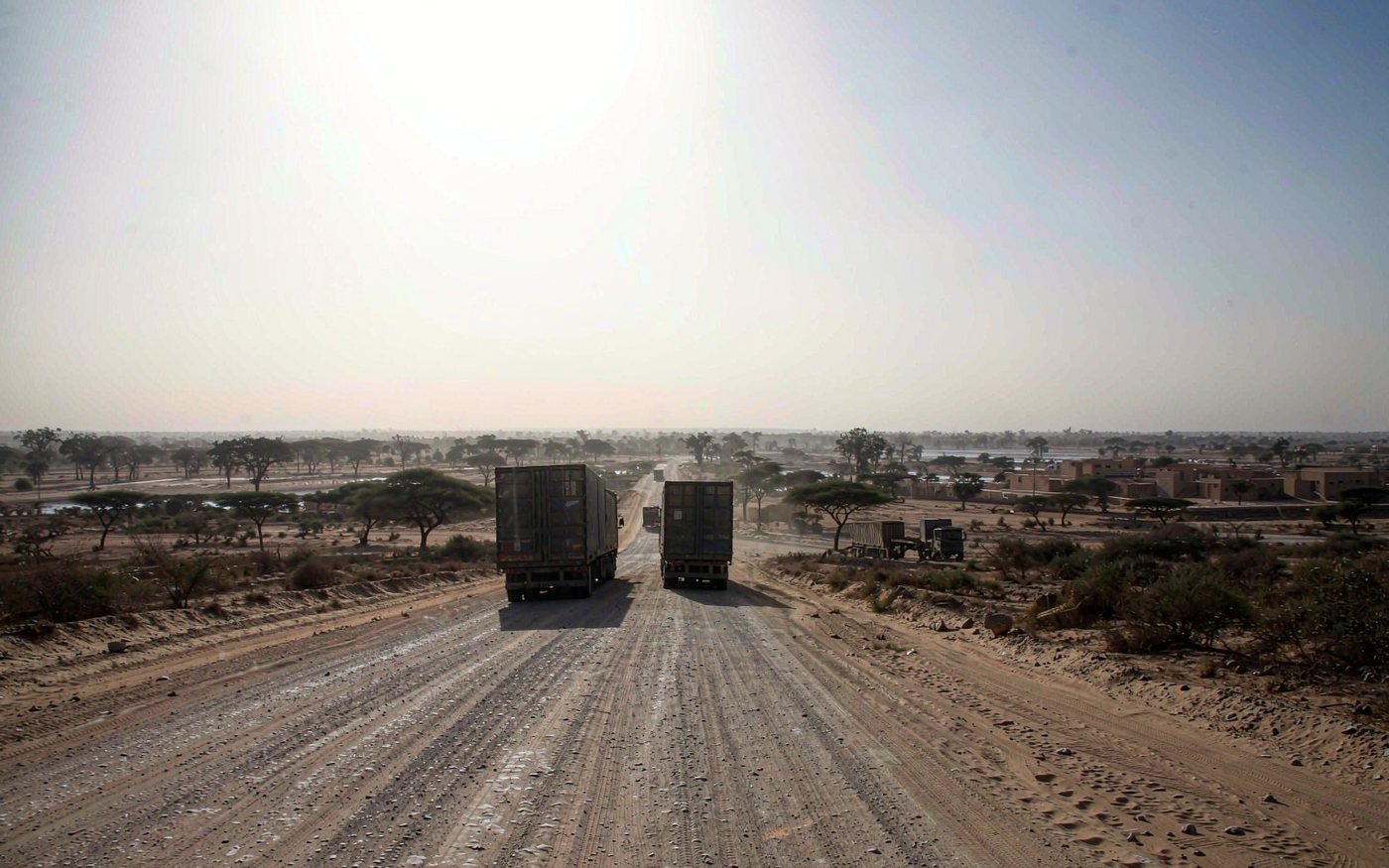
Niger sits deep in the Sahel, and its capital is around a thousand kilometres from the nearest working seaport. Everything arrives through a neighbour's port and then travels overland, and there is no commercial rail service to share the load. That distance is the defining fact of the route. The sea leg is the smaller half of both the cost and the risk, and the overland leg is the one that decides when your goods actually arrive. It also means the quotation you need is not a freight rate to a port. It is a rate to Niamey, built from a named port, a named corridor and a named crossing.Which corridor is usable right now, and how we check
The corridors in regular use run from Cotonou in Benin, Lomé in Togo, Tema in Ghana and Abidjan in Côte d'Ivoire, with Cotonou historically the principal route. They are not interchangeable in practice, and their operating condition is not fixed. We confirm which corridors are operating and which crossings are open at the time of booking rather than assuming the position from the last consignment. That is a check, not an opinion, and we report what we find. If you are comparing quotations, check that both are quoting to the same point over the same corridor. A Cotonou price and a Niamey price are not the same thing, and neither is worth much without the crossing named.Five bands, set by the regional union
Niger applies the common external tariff of the West African monetary union rather than a schedule written in Niamey. It has five bands: nil for certain basic social goods, five per cent for basic necessities, raw materials and some capital goods, ten per cent for intermediate products and industrial inputs, twenty per cent for many finished goods, and thirty-five per cent for certain protected goods. Classification decides the band, and the spread between the bottom and the top is wide. Production equipment sits low, finished retail goods sit high, and the difference usually exceeds any freight saving available between carriers. So the useful question is which band your code falls into. We check your codes against the current tariff position before your goods sail and tell you plainly if a line is more expensive than you expected.The tax on imports, and the lines that are exempt
Imports attract tax at nineteen per cent, assessed on the customs value plus the duty rather than on your invoice amount. Several categories are relieved, including medicines, rice, and sorghum and maize flour. The reliefs are specific to the code rather than thematic. Rice is relieved, most prepared food is not. Medicines are relieved, most medical equipment is not. Assuming a category is relieved because part of it is will produce a costing that is wrong in the places that matter. Build the figure up in order: transaction value, then freight and insurance to reach the customs value, then the band rate, then the tax across the total. Doing it that way removes the most common costing error on the route.Statistical tax, community levy and the stamp duty
Alongside the tariff and the tax sit three smaller charges: a statistical tax of around one per cent, a community levy of around one per cent, and a customs stamp duty of a few tenths of a per cent. Each is calculated on the customs value. Individually they are trivial and collectively they are not. A costing built on the band and the tax alone will come in short by a margin you will notice when the assessment is issued. We set them out as their own lines on the quotation. They are the destination's charges rather than ours, and you should be able to see each one before you commit to a purchase price.The confederal charge added since 2025
Following the withdrawal of Niger, Mali and Burkina Faso from the West African economic community at the start of 2025 and the formation of the Alliance of Sahel States, a confederal charge of half a per cent has been levied on imports from third countries since late March 2025. It sits alongside the other charges rather than replacing any of them, and it is new enough that much of the reference material available online does not mention it at all. If you are costing against a table published before mid-2025, it is incomplete. We include the charge in the worked example we give you, and we flag it at quotation stage rather than letting your consignee discover it at clearance.French throughout, and figures that must agree
French is the official language and the language the customs administration works in. The declaration, the commercial invoice and the packing list are prepared in it, and where a figure is stated in words it must agree with the figure stated in numbers. That last requirement catches out more first shipments than any other single item. A rounding difference, a transposed digit or a currency written one way on the invoice and another on the packing list will stop an entry. Any correction on a document must be made properly rather than overwritten, because an unregularised amendment invites rejection. Preparing clean documents at origin in China costs very little and removes an entire category of delay.Declaring through the single window
Declarations are lodged electronically through SYDONIA World, working alongside the single window for external trade. The system handles the entry, the manifest and the transit documentation in one place. The document set is the standard one plus the import declaration, with a certificate of origin where a preference is claimed. The commercial invoice needs to state the terms of sale explicitly, because the declared basis affects how the taxable value is calculated. Electronic lodgement is not forgiving lodgement. The system checks consistency across documents, and a declaration whose papers disagree with one another is held until someone reconciles them.Inspection, and the documents that trigger it
Inspection is allocated by risk: a low-risk consignment is released on documents, a medium one is checked on paper, and a high one is opened. Which band your goods fall into is decided by the declaration, not by chance. That makes document quality the lever you actually control. A consignment with precise descriptions, correct codes and consistent figures moves through the lower bands; a vague one invites a physical examination. It also argues against collapsing unrelated product lines into one general description to simplify the paperwork. The simplification is temporary and the reconciliation afterwards is not.Packing for a thousand kilometres of desert road
The overland leg is long, hot and dusty, and a container is handled several times between the port and Niamey. Export-grade strapping, proper dunnage, filled voids and sealed inner packaging are baseline rather than upgrades. Heat and fine dust do the rest. Anything absorbent or sensitive needs sealing, and metal surfaces need protection before they spend a week crossing the Sahel. Timber packaging must be treated and marked to the international standard with the certificate in hand before departure. There is no cheap remedy for uncertified timber once a consignment has been refused.The line between our job and your importer's
We handle collection anywhere in China, export clearance, consolidation, main carriage to the agreed seaport, and the transit documentation and French document set that carry the consignment inland. Your buyer handles arrival onward: appointing a licensed broker, lodging the entry through the single window, paying the band rate, the statistical and community charges, the confederal levy and the tax, satisfying any inspection or permit requirement, and collecting at Niamey. We quote the sea leg and the overland leg as separate lines. On a route where the road is the dominant part of both cost and risk, that separation is the only honest way to show you where the money goes.Getting a first Niger order moving
Send us the commodity in enough detail to classify it, the volume and weight, the pickup address in China, and whether your goods are basic necessities, raw materials and capital goods, intermediate products or finished goods. We will confirm which corridors are operating, check your codes against the current tariff, and quote the sea leg, the overland leg and the destination charges separately. Ask us for the worked example including the confederal charge before you fix your selling price. Start with one shared container and a generous schedule. It tells you how your supplier packs for a long desert haul, how responsive your broker is on the single window, and how much margin the corridor genuinely needs, for far less than learning it on a full one.End to end for new Niger buyers
Five shipments bought in China and delivered into Niger, told end to end — where the order came from, how it moved, where it nearly went wrong, and how it finished. Client names are withheld at their request; the situations and the handling are what we deal with on this lane.
Solar pumping equipment for a regional installer
The purchase. An installer bought solar pumps, panels, control units, cabling and mounting steel from suppliers in Jiangsu and Guangdong for borehole schemes outside Niamey.
The move. We collected both lots, consolidated into one 40HC and shipped via Cotonou with the overland leg to Niamey quoted separately and the corridor confirmed before booking.
Where it nearly went wrong. The control units shipped in standard domestic cartons with no dust sealing. After a long road leg across the Sahel, several arrived with fine dust ingress into the enclosures.
How it finished. We required sealed inner packaging and dust sealing on the repeat. The second consignment arrived clean and was released without examination.
A figure written two ways on one invoice
The purchase. A supplier's commercial invoice stated the total in words in one place and in figures in another, and the two did not agree after a late partial substitution.
The move. One 20GP routed through Cotonou with overland movement to Niamey, with the entry lodged through the single window.
Where it nearly went wrong. French-language declarations require figures stated in words to agree with figures stated in numbers. A discrepancy of that kind stops an entry rather than being noted and waived.
How it finished. We now check both representations against each other at our consolidation point before departure. Nothing since has been held for that reason.
A costing missing the charge introduced in 2025
The purchase. An importer budgeted using a table published before the confederal charge came into force.
The move. One 40HC routed through Lomé with overland movement to Niamey, declared line by line.
Where it nearly went wrong. A confederal charge of half a per cent on imports from third countries has applied since late March 2025, and it sits alongside the other charges rather than replacing them. Tables published before then omit it entirely.
How it finished. We now include it in the worked example at quotation stage. The importer has budgeted accurately on every consignment since.
Relief claimed on a line that did not qualify
The purchase. A buyer imported a mixed consignment including rice and prepared food lines, and assumed the whole order attracted the same relief.
The move. One 20GP routed through Cotonou with the overland leg to Niamey, later re-declared line by line.
Where it nearly went wrong. Reliefs here are specific to the code rather than thematic. Rice is relieved and most prepared food is not, so one blended assumption got both directions wrong.
How it finished. We now require line-by-line declarations for mixed food orders as a condition of booking. The buyer has used the same treatment since.
A corridor check that changed the routing
The purchase. A regular importer had always routed through one corridor and did not want to reconsider it.
The move. We quoted the alternative corridors on the same consignment and reported which crossings were operating at the time of booking.
Where it nearly went wrong. Habit had kept the routing on a corridor whose operating position had changed. The difference did not show up in a freight rate but showed up clearly in transit time.
How it finished. The importer moved to the corridor that was actually running and has had the position checked on every consignment since.
Why importers use Goodhope on this lane
Six things that are different about working with us on China to Niger shipments.
Get a Niamey shipment priced
Tell us the commodity in enough detail to classify it, the volume, the pickup address in China and whether your goods are basic necessities, raw materials and capital goods, intermediate products or finished goods. We will confirm which corridors are operating, check your codes, and quote the sea leg, the overland leg and the destination charges separately.
Get a quote Talk to usRelated pages
Frequently asked questions
How does cargo reach Niger?
By sea to Cotonou in Benin, Lomé in Togo, Tema in Ghana or Abidjan in Côte d'Ivoire, then overland to Niamey. There is no commercial rail service, so road transport carries effectively all of it across roughly a thousand kilometres.
Which corridor should I use?
It depends on which crossings are operating at the time, which we check at quotation rather than assume. Cotonou has historically been the principal route. Always confirm that two quotations are for the same corridor and to the same point before comparing them.
What duty rates apply?
The UEMOA common external tariff in five bands: nil for certain basic social goods, 5 per cent for basic necessities, raw materials and some capital goods, 10 per cent for intermediate products and industrial inputs, 20 per cent for many finished goods and 35 per cent for certain protected goods.
How is the import tax calculated?
It is charged at 19 per cent on the customs value plus the duty. Build the figure up in order: transaction value, then freight and insurance to reach the customs value, then the band rate, then the tax across the total.
What other charges apply?
A statistical tax of around 1 per cent, a community levy of around 1 per cent, a customs stamp duty of a few tenths of a per cent, and since late March 2025 a confederal charge of 0.5 per cent on imports from third countries. Each is small and collectively they are worth budgeting for.
Are any goods relieved from tax?
Yes, including medicines, rice, and sorghum and maize flour. The reliefs are specific to the commodity code rather than to a category, so a mixed food order needs declaring line by line.
Do documents have to be in French?
Yes. French is the working language of the customs administration, and where a figure is stated in words it must agree with the figure stated in numbers. Corrections must be made properly, because an unregularised amendment invites rejection.
How are declarations lodged?
Electronically through SYDONIA World alongside the single window for external trade. The system checks consistency across documents, so papers that disagree are held until reconciled.
How is inspection decided?
By risk. A low-risk consignment is released on documents, a medium one is checked on paper and a high one is opened. Precise descriptions, correct codes and consistent figures are what move a consignment into the lower bands.
Do you offer door-to-door delivery?
No. Sea freight runs port-to-port with the overland leg quoted and arranged separately. Air freight is airport-to-airport to Diori Hamani International, and express courier dispatch ends at the depot.