
Home / Shipping to Sao Tome and Principe / How to Ship from China to Sao Tome and Principe
Shipping from China to Sao Tome and Principe, step by step
Goodhope Freight is a licensed NVOCC based in Shenzhen, registered as GD20230925153335, and has been moving cargo out of China since 2012. To Sao Tome and Principe we run full containers and shared containers by sea into the island's two working quays, and we handle air freight into Sao Tome International Airport and express parcels dispatched from our depot. Every service stops at the port, the airport or the depot. Your consignee arranges import clearance and collection.
Sao Tome and Principe is a two-island country in the Gulf of Guinea, some three hundred kilometres off the coast of Central Africa, with a population of roughly a quarter of a million. The economy runs on cocoa, coffee, palm oil, fishing and a small but growing tourism trade. It is the second smallest country in Africa by population, and almost everything its shops and building sites use arrives by sea.
One thing makes this route genuinely different from its neighbours, and it is worth knowing before you ask for a quote. Most of West and Central Africa demands an electronic cargo tracking note before a container is allowed to sail, and this country does not. Gabon, Equatorial Guinea, Cameroon, Angola and the Republic of the Congo all do. Sao Tome does not.
This guide is written for a buyer who has never imported from China before. It sets out how a container actually reaches the islands, what the tax system looks like after the 2023 rebuild, why the language of your paperwork matters more than it usually does, and which two documents catch out a first shipment.
At a glance
Two main islands in the Gulf of Guinea, about 300 km off the Central African coast · Quays at Neves and Ana Chaves on Sao Tome, with a smaller landing at Santo Antonio on Principe · Port operator: ENAPORT · Main airport: Sao Tome International (TMS) · Currency: Sao Tome dobra (STN), pegged to the euro · Customs authority: the Customs Directorate, through ASYCUDA World · Tariff bands at five, ten and twenty per cent, with a charge by the litre on drink · Value-added tax at fifteen per cent since June 2023, reduced at seven and a half on staples · No cargo tracking note required · Documents in Portuguese
How your cargo moves: China to Sao Tome and Principe
Eight steps from your supplier's door to yours. The last four are the ones shaped by local rules.
- Pickup from your supplierWe collect the goods anywhere in China and bring them to our consolidation point.
- Export clearanceChina customs declaration filed and released before the goods move to the port.
- Main carriage to a hubContainer shipped to the West African or European hub that feeds the islands.
- Feeder to the islandsTranshipment onto a feeder service and the short passage to Sao Tome.
- Discharge at the quayContainers landed at Neves or Ana Chaves by the port operator.
- Entry lodged in PortugueseYour broker files the declaration on the electronic customs platform.
- Tariff and tax assessedThe band rate, the charge by the litre where it applies, and the tax are settled.
- Release and collectionOnce satisfied your buyer collects. There is no onward delivery service.
Duty rates, VAT rates and clearance times move, and the figure that applies to your goods is the one set for your commodity code on the day of clearance. We check the current position against your code before your goods sail and confirm it to you in writing — ask for that check when you request a quote.
Two islands, and a coast that decides the routing
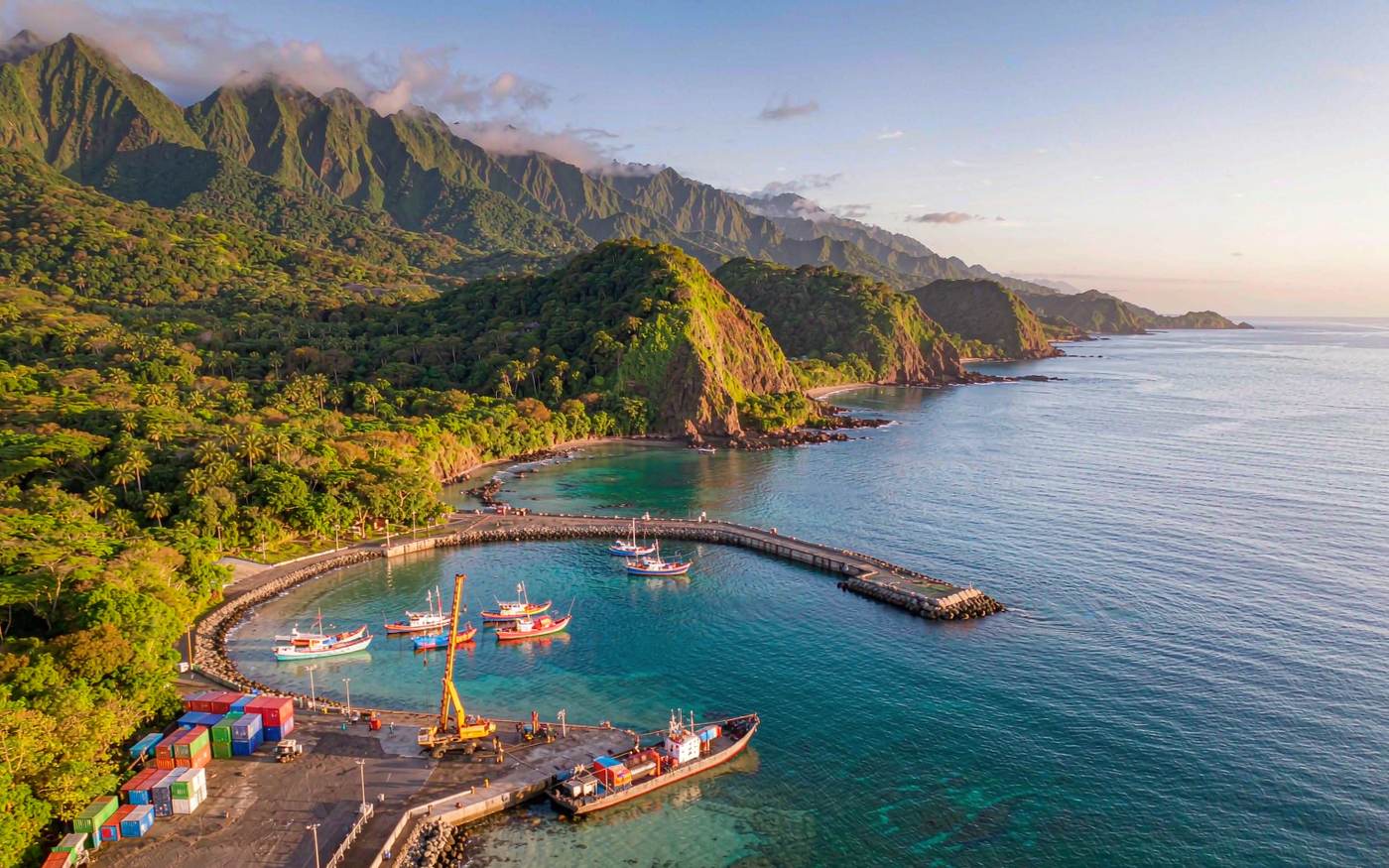
The country is made up of two inhabited islands, Sao Tome and Principe, sitting about one hundred and fifty kilometres apart, plus a scattering of uninhabited islets. Almost all commercial cargo lands on Sao Tome, the larger and more populated of the two. That island has two working quays. Neves, on the west coast, handles most containerised and general cargo. The Ana Chaves quay sits in front of the capital and handles lighter traffic. Principe has a small landing at Santo Antonio, and cargo moving there is transferred between the islands. Which quay your container uses is decided by the service you are booked on rather than by you, so it is worth knowing both names. They sit a short distance apart by road and a misrouted container is an inconvenience rather than a disaster, but it does add a local movement.Why nearly every container arrives on a feeder
The islands are too small a market to justify a direct service from China. In practice your container travels on a main service to a hub — Libreville or Lome in West Africa, or a European port such as Antwerp or Lisbon — and is then transhipped onto a feeder that works the Gulf of Guinea. This has a direct consequence for planning. Your transit time has two halves, and the second one depends on a feeder schedule that is thinner and less frequent than the trunk service feeding it. A delay in making the connection costs more here than it would on a direct call. We tell you which hub a quote is built on and what the feeder is doing at the time of booking. Where the choice between a European and a West African hub is open, we say which one is connecting more reliably rather than picking whichever is marginally cheaper this week.The certificate this route does not ask for
Across most of West and Central Africa, a cargo tracking note has to be applied for and validated before a container sails, and the number has to appear on the bill of lading and the manifest. It goes by a different name in almost every country — the tracking note, the advance declaration, the loading certificate — but the obligation is the same substance. Sao Tome and Principe is not on that list. We checked the published country lists before writing this, and it does not appear on them. There is no tracking note to raise, no fee to pay, and no number to pass to the carrier. We say this carefully, because rules in this region change and because a broker who works mostly on neighbouring lanes may assume the requirement applies here too. Confirm it at quotation stage for your sailing rather than treating any guide, including this one, as permanent.Three tariff bands, and a charge counted by the litre
The tariff runs on a common external structure with three working bands. Basic goods sit at five per cent. Raw materials and capital goods sit at ten per cent. Intermediate goods and most finished consumables, including cosmetics, sit at twenty per cent. Drink is treated separately and is the one line that regularly surprises people. Alcoholic beverages carry the duty plus an additional charge applied by the litre — spirits, wine and beer are each rated differently — and further surcharges apply on top. A pallet of bottled drink can cost more in duty than the goods did. Classification decides the band, and the spread between five and twenty is fourfold. We check your codes against the current tariff position before your goods sail and say plainly if a line is going to cost more than you assumed.The tax that was rebuilt in 2023
Value-added tax came into force on the first of June 2023, replacing a general consumption tax and a set of specific excise charges that had applied before it. This is a recent rebuild rather than a long-settled system, which is why older reference material describes taxes that no longer exist. The standard rate is fifteen per cent. A reduced rate of seven and a half applies to a short list of staples including rice, flour, pasta, bread, milk and beans. Exports sit at nil. Businesses below a turnover threshold are taxed on a simplified basis instead. The tax is assessed on a base that includes the customs value and the duty rather than on your invoice amount alone. A costing that multiplies the invoice by fifteen per cent understates the bill, and this is the single most common arithmetic error on the route.Portuguese on every page
Portuguese is the official language and it is the working language of customs. Declarations, product descriptions and supporting correspondence are prepared in Portuguese, and an entry built in English is one an officer can decline to assess. In practice the way to handle this is simple: your broker translates. It is not your job to produce Portuguese invoices, and a good broker will not ask you to. What matters is that the underlying information they are translating is accurate and consistent, because translation moves errors rather than removing them. Send us commodity descriptions that are specific enough to translate precisely. "Machine parts" is not a description anybody can classify or translate with confidence, and vagueness at this stage becomes delay at the quay.Filing through the platform that replaced the old one
The customs directorate runs declarations through ASYCUDA World, and the country moved to version 4.4 of that system on the first of May 2025. The previous version had been in use since 2011, so this was a substantial change rather than a patch. One of the additions is a document that manages transfers between the two islands. It was introduced because the port operator had trouble distinguishing goods that had already cleared customs from goods arriving from Sao Tome still under customs control, and misclassification was causing delays and extra handling at Principe. If your consignee is on Principe rather than Sao Tome, say so at quotation stage. The inter-island leg is a separate movement with its own paperwork, and it is cleaner to plan it than to discover it.Registration first: the tax number an importer holds
Importers hold a tax identification number issued by the tax authority, and it appears on the declaration. Without it, a broker cannot produce an entry no matter how well the rest of the paperwork is prepared. If your consignee is importing commercially for the first time, this belongs at the very start of the plan rather than alongside it. It is the item that most often holds a first consignment up, and it is the one that is cheapest to deal with early. Commercial shipments are cleared by a licensed customs broker. An importer can in principle act directly, but the declaration system is not designed for occasional use and most first-time importers who try it spend longer on it than the broker's fee would have cost.Packing for a tropical crossing and a short quay
A container travelling to Sao Tome is transhipped at least once, and usually handled by a mobile crane at a quay with limited stacking space. It is handled more often per tonne than a container delivered to a mainland deep-water terminal. Heat and humidity are constant on this route and salt air is a factor at the quay. Corrosion protection, sealed inner packaging, filled voids and proper dunnage are baseline rather than upgrades, and thin woven sacks split during transhipment. Timber packaging must be treated and marked to the international standard with the certificate in hand before departure. There is no cheap remedy for uncertified timber once a consignment has been refused, and on a route with feeder connections the cost of a refused container compounds quickly.What we carry to the quay, and what your buyer takes from there
We handle collection anywhere in China, export clearance, consolidation, main carriage to the hub, the feeder booking and transhipment, and the document pack that travels with the container. Your buyer handles arrival onward: appointing a broker, holding a tax identification number, lodging the declaration in Portuguese, paying the band rate and the tax, and collecting from the quay. We quote the sea leg and the feeder leg as separate lines. On a route where the connection decides the transit time, that separation is the only honest way to show you where the time and the money go.Sending a first consignment to the islands
Send us the commodity in enough detail to classify it, the volume and weight, the pickup address in China, and which island your consignee operates on. That last answer determines whether there is an inter-island leg. Tell us the declared value, because it sets the tax base, and whether your consignee already holds a tax identification number. We will check your codes, confirm the hub and the feeder, and quote the sea leg and the feeder leg separately. Start with one shared container. It tells you how your supplier packs for transhipment, how quickly your broker responds on the electronic platform, and what the feeder is actually doing in that month, for considerably less than a full container would cost you to learn the same three things.True stories for new Sao Tome and Principe buyers
Five shipments bought in China and delivered into Sao Tome and Principe, told end to end — where the order came from, how it moved, where it nearly went wrong, and how it finished. Client names are withheld at their request; the situations and the handling are what we deal with on this lane.
Building materials for a small contractor
The purchase. A contractor bought ceramic tiles, cement admixture, PVC conduit and fixings from two suppliers in Foshan and Guangzhou for a housing project near the capital.
The move. We collected both lots, consolidated into one 20GP and shipped it to a West African hub for transhipment onto a Gulf of Guinea feeder service.
Where it nearly went wrong. The tiles arrived in cartons with no edge protection, and two pallets shifted during transhipment. Roughly a tenth of the tiles were chipped beyond use.
How it finished. We made edge protection and strapped pallets a condition of collection on the repeat. The second container arrived with breakage under one per cent.
A costing built on the invoice rather than the base
The purchase. A trader costed a general goods consignment by multiplying the invoice value by the tax rate alone.
The move. One 20GP routed through a European hub with feeder movement to Neves, declared line by line.
Where it nearly went wrong. The tax is assessed on a base that includes the customs value and the duty, not on the invoice amount. Multiplying the invoice alone understated the bill by several percentage points.
How it finished. We set out how the base is built at quotation stage once the codes were declared. The trader reworked the landed cost while the goods were still in China.
A broker who assumed the region's usual rule applied
The purchase. A consignee's agent asked for a cargo tracking note number before the container sailed, as their other Central African lanes require.
The move. We checked the published country lists and confirmed the requirement does not cover this destination, then re-confirmed it for that sailing.
Where it nearly went wrong. Most of West and Central Africa requires a tracking note validated before departure. Assuming the same here would have added a fee and a delay that the route does not impose.
How it finished. The container sailed without one and cleared normally. We now confirm the position for the specific sailing rather than relying on either party's assumption.
Drink in a mixed container
The purchase. A wholesaler added cases of spirits to a general goods container without declaring them separately at quotation stage.
The move. One 20GP, mixed cargo, routed through a West African hub with feeder movement to Sao Tome.
Where it nearly went wrong. Alcoholic beverages carry duty plus an additional charge applied by the litre, rated differently for spirits, wine and beer, and further surcharges apply on top. The duty on that line approached the cost of the goods.
How it finished. We now ask about drink, tobacco and fuel explicitly at quotation stage. The wholesaler moved those lines to a separate booking and priced them properly.
A first import with no tax identification number
The purchase. A consignee importing commercially for the first time arranged the shipment before registering with the tax authority.
The move. One 20GP routed through a European hub with feeder movement to the capital quay.
Where it nearly went wrong. Importers must hold a tax identification number, which appears on the declaration. Without it a broker cannot produce an entry, and the container waited while registration was completed.
How it finished. We now flag registration at quotation stage for any first-time commercial importer on this route. Subsequent consignments have been lodged the day they arrived.
Why importers use Goodhope on this lane
Six things that are different about working with us on China to Sao Tome and Principe shipments.
Get a Sao Tome shipment priced
Tell us the commodity in enough detail to classify it, the volume, the declared value, the pickup address in China and which island your consignee operates on. We will confirm the hub and the feeder, check your codes, and quote the sea leg and the feeder leg separately.
Get a quote Talk to usRelated pages
Frequently asked questions
Does this route require a cargo tracking note?
No. Most of West and Central Africa requires an electronic tracking note validated before the vessel sails, but Sao Tome and Principe does not appear on the published country lists for that requirement. Rules in the region do change, so confirm the position for your specific sailing at quotation stage.
How does a container reach the islands?
Usually on a main service to a hub such as Libreville, Lome, Antwerp or Lisbon, then transhipped onto a feeder working the Gulf of Guinea. There is no direct service from China, so transit time has two halves and the feeder connection decides the second one.
Which ports are used?
Neves on the west coast of Sao Tome handles most containerised and general cargo. The Ana Chaves quay in front of the capital handles lighter traffic. Principe has a small landing at Santo Antonio, reached by an inter-island transfer.
What duty rates apply?
Three working bands: five per cent on basic goods, ten per cent on raw materials and capital goods, and twenty per cent on intermediate goods and most finished consumables. Drink is treated separately, with an additional charge applied by the litre.
What is the tax on imports?
Value-added tax at fifteen per cent, which came into force in June 2023 replacing a general consumption tax. A reduced rate of seven and a half applies to staples including rice, flour, pasta, bread, milk and beans. It is assessed on a base that includes the customs value and the duty.
Do documents need to be in Portuguese?
Yes. Portuguese is the working language of customs, and declarations and product descriptions are prepared in it. In practice your broker handles the translation, but the underlying descriptions need to be specific enough to translate and classify accurately.
What customs system is used?
ASYCUDA World. The country moved to version 4.4 on the first of May 2025, replacing a version that had been in use since 2011. One addition is a document managing transfers between the two islands.
Does my consignee need to register first?
Yes, for a tax identification number issued by the tax authority. It appears on the declaration, and without it a broker cannot produce an entry. Commercial shipments are cleared by a licensed customs broker.
How long does clearance take?
Typically within one to two weeks once documents are in order, though a consignment selected for physical inspection will take longer. We pre-alert the broker before the container sails and send the document pack ahead of it.
Do you offer door-to-door delivery?
No. Sea freight runs port-to-port to the quay. Air freight is airport-to-airport to Sao Tome International, and express courier dispatch ends at the depot.