
Two deep-water gateways in Fujian, one clearance desk. We file, clear and load your export cargo at Xiamen — Dongdu, Haicang, Songyu, Xiang'an — and at Fuzhou's Jiangyin, Mawei and Songxia terminals, and keep drayage, manifest and cut-off on the same clock. FCL · LCL · Breakbulk | HS classification · Declaration filing · Examination support · Export tax refund · Cross-customs transit
Get a clearance quote See the 7 stepsExport customs clearance is the step where your cargo is declared to China Customs, examined if selected, and released so it can be gated in and loaded. At Xiamen and Fuzhou it starts with the right terminal, not the right city: the declaration has to name the actual supervised terminal, and the filing has to land before the carrier's document cut-off.
We handle the whole chain — HS classification, declaration elements, filing, examination support, export tax refund copy, fumigation and quarantine papers, drayage and gate-in — for both ports from one account, and we tell you which port to use based on your sailing, your factory location and your cargo.
Fujian does not have one export gateway, it has two with different economics. Xiamen carries the deep-sea trunk volume; Fuzhou carries near-sea, regional and sea-rail cargo. That split decides your booking, your cut-off and how much slack you have when a document needs a second look.
Direct calls to Europe, the US East and Gulf coasts, the Mediterranean and the Middle East. Deep water, heavy-lift experience and an automated Haicang yard make it the natural port for batteries, energy-storage cabinets and out-of-gauge cargo.
Jiangyin runs a near-sea network into Southeast Asia, Oceania and the South Pacific, plus feeders that connect inland cargo to the trunk lines. Smaller batches, tighter truck turnaround and a high on-site X-ray release rate.
One declaration desk covers both ports, so a booking change does not become a document rebuild. If the sailing moves from Jiangyin to Haicang, the file moves with it — same broker, same document set, same cut-off owner.
Xiamen is a top-20 container port and the province's trunk gateway. In 2025 it moved 12.5077 million TEU of containers and 211 million tons of cargo, with 184 liner services — 151 international — reaching 53 countries and 141 ports as of September 2026.
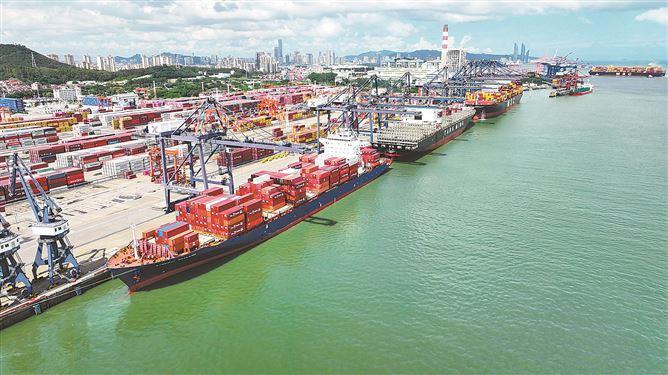
The main channel is dredged to 16.6–17.1 m, so 200,000 dwt ships at 15.5 m draft get in and out on any tide. The port runs 192 production berths, 82 of them 10,000 dwt or larger, with container capacity of 11.339 million TEU.
For export customs clearance this means fewer transshipments and fewer handoffs where a seal, a carton count or a declaration element can go wrong — and a terminal system that can absorb a late gate-in when a factory run slips.
| Port area | Where it sits | Good for | Clearance note |
|---|---|---|---|
| Dongdu | West side of Xiamen Island | Near-sea and some deep-sea, LCL consolidation, smaller lots | Urban surroundings, so daytime truck windows are tighter; handover is fast once released |
| Haicang incl. Songyu and Jiaomei | Mainland side, deepest water | Deep-sea trunk calls, batteries, energy-storage cabinets, out-of-gauge | Automated yard; book the CY window early on heavy cargo |
| Xiang'an | Xiang'an Island, new terminals | Container volume growth, less congestion | Longer truck windows; confirm which supervised terminal your declaration names |
| Zhaoyin | Zhangzhou side, opposite Xiamen | Near-sea containers, bulk and breakbulk | Cross-district trucking; build transit time into the cut-off |
| Houshi | Deep-water bulk zone, Zhangzhou | Bulk, project and heavy-lift cargo | Terminal-specific handling rules; inspection is usually on-site |
Swipe the table sideways to see all columns.
Sources: Xiamen Port Authority port profile (2026); Fujian Provincial Department of Transport; Xiamen Customs public releases.
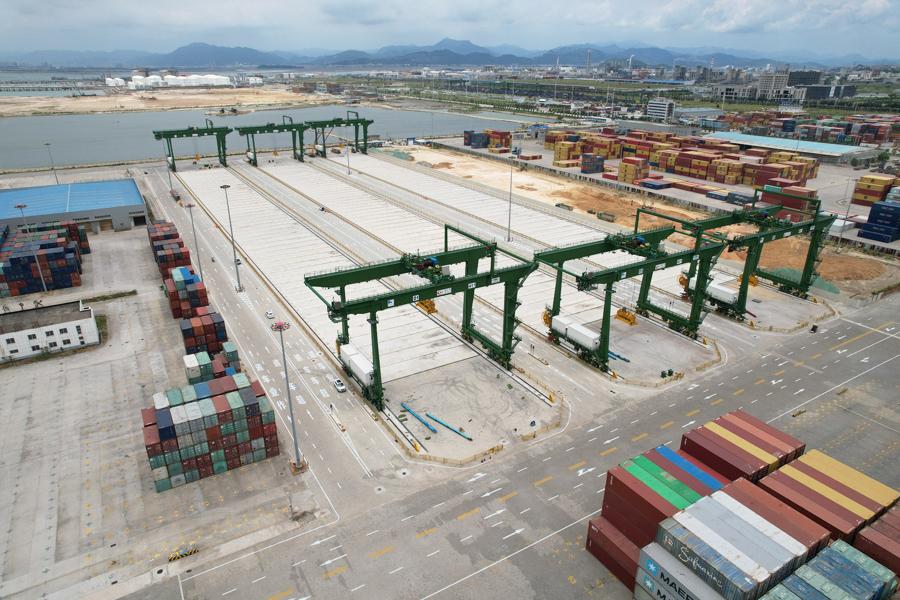
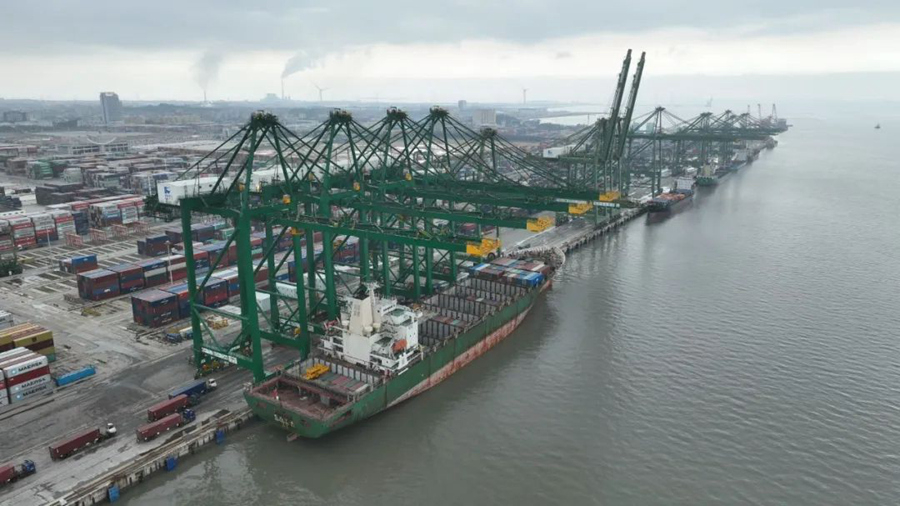
Fuzhou handled 335 million tons of cargo and 3.809 million TEU in 2024, ranking in the world's top 20 container ports. Jiangyin is the container core: berths 1–9 run nearly 3 km in one line, design capacity is above 3 million TEU a year, and two 200,000 dwt ships can berth at the same time.
Jiangyin moved 48.23 million tons and 2.4518 million TEU in 2024, up 12.49% and 7.22%. It runs 60 services to 46 countries, including 13 Silk Road-named services that made 324 calls and carried 195,000 TEU in 2024.
Fuzhou Customs has pushed supervision onto the terminal itself: on-site X-ray direct release went from 10% to 80%, average truck turnaround dropped 25%, and import release for empty containers went from 36 hours to 0.5 hours.
| Port area | Positioning | Services and cargo | Clearance handling |
|---|---|---|---|
| Jiangyin | Fujian's core container hub, 3 km of contiguous berth | Southeast Asia, Oceania, South Pacific, Middle East; feeders into trunk services | 60 services; advance filing and direct loading; X-ray release is the default path |
| Mawei | Minjiang river port, bonded and whole-container business | Near-sea lines, whole-container, bonded export | One declaration, multiple trucks, release on arrival, applied per cargo and vehicle plan |
| Songxia | Facing the Taiwan Strait, bulk and project berths | Piece cargo, steel, equipment | Piece-by-piece scheduling; declaration aligned with stevedoring sequence |
| Luoyuanwan | Deep-water north bank, bulk-led | Ore, coal and other bulk | Bulk declaration with weight and draft survey, tied to the terminal's cargo plan |
Swipe the table sideways to see all columns.
Sources: Fujian Provincial Department of Transport (2025); Fuzhou Municipal Government releases; Fuzhou Area of the China (Fujian) Pilot Free Trade Zone; Fuzhou Customs.
The gap between the two ports is not "big versus small". It shows up in sailing structure, cut-off pressure, landside behavior and cargo fit — and each of those changes how you build the filing timeline.
| Dimension | Xiamen | Fuzhou |
|---|---|---|
| Sailing structure | Dense trunk services; direct calls to Europe, the Americas, the Mediterranean and the Middle East; 151 international services | Near-sea led: Southeast Asia, Oceania, South Pacific, Middle East; 60 services, feeders into trunk lines |
| Cut-off pressure | Frequent sailings, tight document and port cut-offs; a single missing element can cost a week | Fewer sailings but more schedule elasticity per vessel; batch filing works if you commit early |
| Landside | Dongdu sits in city traffic; Haicang and Xiang'an run automated yards with higher throughput | Contiguous berths, deep-reach yard; high X-ray direct-release rate, truck turnaround down 25% |
| Cargo fit | Batteries, energy-storage cabinets, out-of-gauge and heavy project cargo | Wind blades and other oversize pieces, sea-rail and inland consolidation, whole-container and bonded export |
| Hinterland | Sea-rail block trains to Jiangxi, Wuhan, Nanchang and the west; 163,900 TEU by rail in 2025 | Largest rail container yard in Fujian; feeds Jiangxi, Hunan, Hubei, Chongqing and Sichuan |
| Where the work goes | Focus on cut-off control and first-time filing accuracy | Focus on advance filing, direct loading and online examination booking |
Swipe the table sideways to see all columns.
Ordered by what actually drives the decision, based on public port and customs information for both clusters.
This is the sequence we run at both ports. The statutory rule — declaration after the cargo enters the supervised area and at least 24 hours before loading — forces the first four steps to be built backwards from cut-off, not forwards from the booking.
Confirm vessel, doc cut-off, port cut-off and CY gate-in window; lock the truck plan
Factory loading with photos, seal number and VGM; counts matched to the packing list
Invoice, packing list, contract, declaration elements, HS codes, permits where required
Filed to China Customs; queries answered same day; duty-free export code checked
X-ray or physical exam support, re-pack if called for, release logged
Gated in before cut-off, manifest matched, loaded, B/L confirmed
Export tax refund copy, certificate of origin if needed, file archived for audit
Export customs clearance is not one action, it is a sequence of dependent filings. Take any item on its own, or hand us the whole chain.
FCL and LCL declarations for general trade, with HS classification, declaration elements, terms-of-trade check and freight/insurance split on the invoice.
The refund copy, matching invoice trail and declaration details kept consistent, so your finance team is not reconciling discrepancies six months later.
Pre-filing against the booking, manifest and declaration synced, gate-in slot reserved before the terminal closes.
Exam booking, container devanning, on-site attendance, corrective documents and re-filing where a query lands.
Factory to terminal, empty pickup and return, CY storage, and gate scheduling that respects the terminal's own truck windows.
Clear at one port, load at another under a customs seal; or route inland cargo by rail block train into the terminal.
UN38.3, MSDS, dangerous-goods packing certificate and maritime declaration checked before the container is booked, not after.
ISPM-15 heat treatment or methyl bromide fumigation with IPPC marking, plus phytosanitary certificates for plant products.
Certificate of origin, Form E and RCEP certificates, insurance certificate, and a B/L that matches the declaration line by line.
Transit is the answer when the factory, the customs office and the vessel are not in the same place. A declaration is filed and released in one customs district, then the cargo moves under a customs seal to the port where it actually sails.
Cargo is cleared where the goods and the documents are, then trucked or railed under seal to the departure terminal. Useful when a factory sits far from the coast, or when the sailing you need is at the other port.
The transit application must be filed within 14 days of the vessel's entry declaration, and the import declaration at the destination within 14 days of the cargo arriving there. Both clocks run in parallel with demurrage, so the paperwork cannot wait.
Most delays at Xiamen and Fuzhou are not caused by customs policy. They are caused by a document set that does not line up with the cargo, the licence or the invoice.
If your company holds no China import-export rights, or you would rather not file in-house, we can declare under our own customs registration — the market calls it buy-for-name declaration. The declaration and release documents then carry our name, while you stay the commercial shipper on the invoice and B/L. It is a compliance arrangement, not a workaround: cargo details, values and licences still have to be true, and the arrangement is confirmed in writing before filing.
China's declaration elements are specific: product name, model, material, function, brand, specification and origin, in the order the system expects. A generic description such as "spare parts" is a query waiting to happen. We classify first, then write the elements to match the code.
The invoice value, Incoterm, freight and insurance split and currency must all be internally consistent. A CIF invoice declared as FOB, or a freight charge left inside the goods value, is the most common cause of a value query at release.
Some goods need an export licence, a dual-use declaration or a commodity inspection certificate before the declaration is accepted. Batteries need UN38.3 and an MSDS; chemicals may need a transport appraisal; food and plant products fall under quarantine.
Solid-wood pallets, crates and dunnage need heat treatment or fumigation and a visible IPPC mark. The US, Australia, New Zealand and the EU all enforce it on arrival, and a missing mark is an on-arrival hold, not a China-side problem.
The refund copy has to tie back to the VAT invoice and the export declaration line by line. We keep the full set — declaration, packing list, invoice, gate-in record and B/L — archived so an audit three years later is a lookup, not an investigation.
Tell us the cargo, the destination, the volume and where the factory is. We will come back with a port recommendation, a cut-off plan and a document list for Xiamen or Fuzhou — before you commit the booking.
