Mainland China and Taiwan signed the Economic Cooperation Framework Agreement on June 29, 2010, and it took effect on September 12, 2010. Instead of opening everything at once, the two sides picked a first batch of products and cut tariffs on those alone — the early harvest program, which started on January 1, 2011. On the 2009 tariff schedule the list ran to 806 products: the mainland cut duties on 539 Taiwan-origin products (557 eight-digit lines in the 2011 tariff), and Taiwan cut duties on 267 mainland products (268 eight-digit lines). The cuts came in three steps — straight to zero where the rate was 5% or less, 5% then zero for lines between 5% and 15%, and 10%, then 5%, then zero above that. By January 1, 2013, all 806 early harvest lines were at zero.
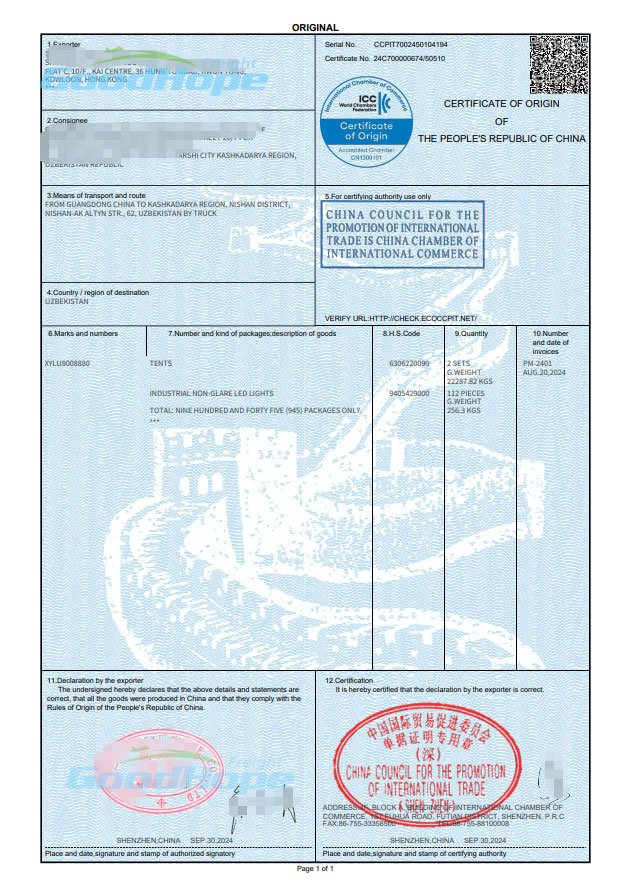
Two instruments run the filing side. The Measures on the Administration of Origin for Import and Export Goods under the ECFA, issued as GACC Order No. 200 and in force January 1, 2011, set the origin tests and the certificate requirements. The Measures on the Administration of Certificate of Origin Visas for Export Goods, GACC Order No. 270, in force September 1, 2024, govern acceptance, review, retroactive issuance and amendments.
Origin is settled one of three ways, and box 12 has to say which. Wholly obtained in the exporting side — grown, harvested, mined, caught — is WO. Goods produced entirely from originating materials of one or both sides are WP. Everything else has to meet the product-specific rule for its line, shown as PSR, usually through a regional value content test — (FOB value − value of non-originating materials) ÷ FOB value × 100 — a required change in tariff classification, or a specific manufacturing process. The threshold belongs to each product line, not to the agreement as a whole.
Four supporting rules decide the arithmetic. Cumulation: mainland material used in Taiwan counts as Taiwanese, and the reverse. De minimis: non-originating material that fails the tariff-shift test but stays at or under 10% of the FOB value does not disqualify the goods. Minimal operations: handling to preserve the goods in transit, simple packing, labeling and display do not confer origin. Neutral elements: fuel, tools and molds consumed in production are not counted as materials. The goods must also move directly, and box 12 can carry the markers ACU, DMI or FG where cumulation, de minimis or fungible materials were relied on.
The distinction that matters: Form H proves the cargo qualifies for the ECFA rate. It does not prove the cargo is duty-free. The Taiwan tariff schedule decides the rate; the origin rule decides eligibility. A certificate that clears one and fails the other gets refused at the border, and a certificate for a suspended line changes nothing at all.