
Home / Shipping to Palau / How to Ship from China to Palau
Shipping from China to Palau, step by step
Goodhope Freight is a licensed NVOCC based in Shenzhen, registered as GD20230925153335, and has been moving cargo out of China since 2012. To Palau we run full containers and shared containers port-to-port into Malakal Harbor near Koror, air freight airport-to-airport into Roman Tmetuchl International Airport, and express parcels dispatched from our depot. Every service stops at the port, the airport or the depot. Your consignee arranges import clearance and collection.
Palau is unusual in a way that matters a great deal to your costing. Import duty on ordinary goods is set at zero, so the headline answer to what duty will I pay is usually nothing. The money comes from somewhere else: a goods and services tax at ten per cent assessed on the imported value, and an excise schedule on a narrow group of products that is severe enough to reshape a business case on its own.
This guide is written for a buyer who has never imported from China before. It sets out which gateway your cargo uses, how the zero duty and the ten per cent tax combine, where excise bites, where the line between a personal shipment and a commercial import sits, and what Palau's unusually strict environmental rules mean for the goods you can send.
Everything described here is port-to-port and airport-to-airport. There is no door-to-door service into Palau, and planning as though there were is the fastest route to a disappointed consignee.
At a glance
Main port: Malakal Harbor near Koror · Main airport: Roman Tmetuchl International (ROR) at Airai on Babeldaob · Currency: United States dollar · Customs authority: Bureau of Customs and Border Protection, working with the Bureau of Revenue, Customs and Taxation · Import tax set at zero on ordinary product lines, with vehicles and chassis at five per cent · Palau Goods and Services Tax at 10 per cent on the import value · Excise on cigarettes, tobacco, alcohol, soft drinks and bottled water · Non-commercial consignments up to 400 dollars exempt · Very strict biosecurity and environmental controls
How your cargo moves: China to Palau
Eight steps from your supplier's door to yours. The last four are the ones shaped by local rules.
- Pickup from your supplierWe collect the goods anywhere in China and bring them to our consolidation point.
- Export clearanceChina customs declaration filed and released before the goods move to the port.
- Loading and departureContainer loaded, sealed and handed to the carrier at a Chinese port.
- Relay through Guam or a regional hubPalau is served from the Pacific rather than directly from China, so the connection sets your arrival window.
- Discharge at MalakalContainers are worked at the Malakal quay; air cargo is handled at the ROR cargo building on Babeldaob.
- Entry filed with the Bureau of CustomsYour broker lodges the declaration with codes, values and any excise classification.
- Excise and the 10 per cent tax assessedExcise is assessed first where it applies, then the goods and services tax on that combined figure.
- Biosecurity check and releaseFood, plant and animal lines are inspected. Once everything is satisfied your buyer collects.
Duty rates, VAT rates and clearance times move, and the figure that applies to your goods is the one set for your commodity code on the day of clearance. We check the current position against your code before your goods sail and confirm it to you in writing — ask for that check when you request a quote.
Malakal and Airai: the two gateways you will use
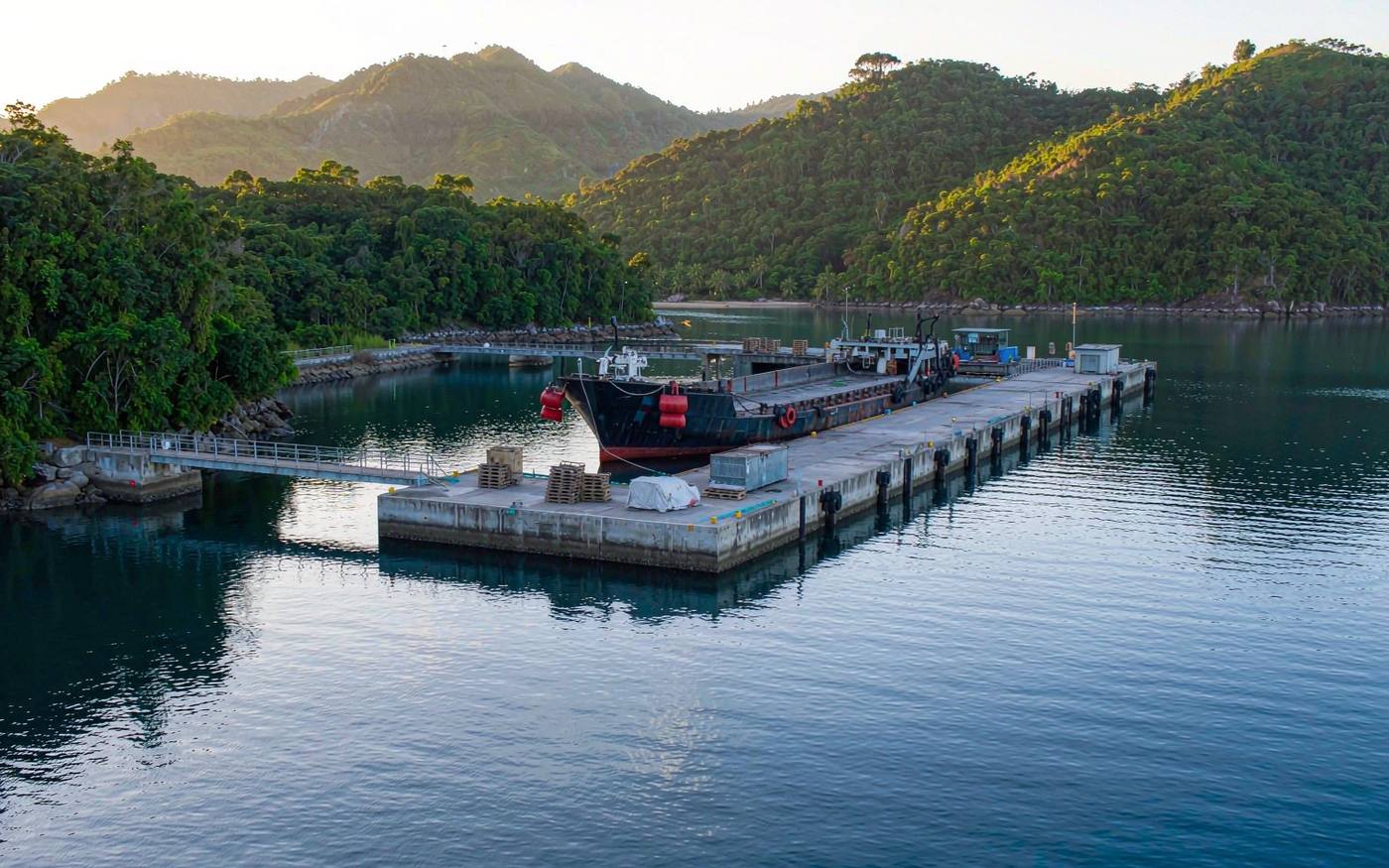
Sea cargo enters at Malakal Harbor, a short distance across the water from Koror, which remains the commercial centre of Palau. It is a working port for containers and general cargo, not a deep-water terminal with long quays, so heavy or oversized pieces need their own handling plan rather than an assumption that standard equipment is available. Air cargo arrives at Roman Tmetuchl International Airport at Airai, on the island of Babeldaob, which is connected to Koror by bridge. If your consignee is based in Koror, add a road transfer across that bridge to your collection plan. Palau's air links exist because the country is a visitor destination, which is why air capacity is better than the population would suggest. Everything you do in Palau runs through one small corridor. There is no second commercial port worth planning around and no rail or inland alternative. That concentration is efficient when things go well and unforgiving when they do not, so accuracy on documents pays twice.Why ordinary imports enter free, and motor vehicles do not
Under the current import tax law, every person importing into Palau is assessed at a rate of zero per cent on ordinary product lines. That is the starting point for nearly every entry, and it is the reason the total tax on a Palau import often looks surprisingly low to buyers used to tariff schedules running into double digits. Vehicles and vehicle chassis are the main exception at five per cent. Other specified product categories carry their own treatment, so the answer for an unusual line is never assume the general position applies; it is check the code before you commit to a price. Zero duty does not mean zero paperwork. The classification still has to be right, because the same codes drive excise and the goods and services tax. A description vague enough to hide a duty liability will also hide an excise liability, and excise is where Palau's real charges sit.Working out the 10% PGST on your entry
The Palau Goods and Services Tax applies to imports at ten per cent. For ordinary goods it is calculated on the CIF value, which means the customs value including freight and insurance rather than the invoice value alone. Buyers who work out what they owe from the factory invoice consistently understate it. For goods that also carry excise, the tax is assessed on the CIF value plus the excise already charged. The two compound, so a consignment of excisable goods does not simply attract ten per cent and then stop. On a high-excise line the resulting figure is far larger than a buyer who only looked at the duty rate expects. The practical method is straightforward but must be done in order. Establish the CIF value. Apply any excise to the lines that carry it. Then apply the ten per cent to each line's correct base. Doing it backwards, or from an invoice value, is how a landed cost model ends up wrong by a margin that erases the deal.The excise lines that dwarf the duty
Excise is where the real money is. Cigarettes carry a specific charge per pack. Other tobacco products are charged per kilogram at a rate that will astonish anyone who has costed tobacco elsewhere. These are specific charges, not percentages, so they do not reduce politely when the value of the goods does. Drinks carry their own scale. Beer, liquor, wine and wine coolers each attract a specific charge per ounce or per fluid ounce, mixed alcoholic products attract their own rate, and carbonated soft drinks are charged per unit volume. Bottled water attracts a percentage of its excisable value, which is deliberately steep given how much of it Palau would rather not import. Two more charges sit alongside those. A carbon tax applies per gallon of fuel, and the excise on any line within the schedule feeds forward into the base used for the ten per cent tax. A mixed container containing even one excisable line therefore has to be declared line by line, because a single generic description will be resolved against you.Personal gifts, and the 400 dollar line
The law draws a clear distinction between a commercial import and personal goods arriving outside commerce. An import of goods in a single consignment, not for commercial use or sale, where the value does not exceed four hundred dollars, is an exempt import. Above that value the normal treatment applies. That distinction catches two groups repeatedly. Buyers assume a small consignment is automatically exempt, which is true only below the value threshold and only when the goods genuinely are not for sale. Sellers split orders into several smaller consignments to stay under the line, which is the kind of arrangement customs officers look for specifically. Personal effects arriving with a traveller carry their own small allowances, including tobacco and alcohol quantities. Those allowances apply to people arriving, not to cargo sent ahead of them, and confusing the two is a reliable way to have a shipment held.Biosecurity and the environmental bans Palau enforces
Palau protects its marine environment seriously, and that commitment shows up at the border. It was the first country to ban sunscreens toxic to coral, and restrictions on single-use plastics and on e-cigarettes have followed. If your product falls into any of those categories, confirm its position before you buy it, not after it lands. Food, plant and animal products are inspected and may require permits or health documentation. The island ecology is genuinely vulnerable and inspections are performed accordingly, so a phytosanitary certificate is not a formality here. Timber packaging follows the international standard for treatment and marking, with a certificate in hand before departure. Consignments arriving on untreated timber are held, and the remedies available at Malakal and ROR are expensive and slow.Clearing through the Bureau of Customs and Border Protection
Imports are handled by the Bureau of Customs and Border Protection, working alongside the Bureau of Revenue, Customs and Taxation. Entry rests on a commercial invoice with a genuine description and value, a packing list that matches it carton for carton, the bill of lading or air waybill, and certificates where the commodity requires them. Because so much of the liability turns on classification rather than rate, description quality matters more than usual. A container described as mixed merchandise invites a physical examination, and every day of examination at a small port costs storage rather than merely time. We reconcile supplier documents at our consolidation point before your goods sail. The reason is practical: a mismatch discovered in China is a phone call, while the same mismatch discovered at Malakal is a correspondence problem with a vessel schedule running in the background.Relay routes, and why Guam dominates your transit
Palau is supplied from the Pacific rather than from mainland China, and Guam sits at the centre of most practical routings for sea cargo. Container lines serve the region through Guam, and the onward leg to Malakal is a scheduled feeder rather than a continuous service, so missing one connection costs you the interval to the next rather than a few days. Air freight generally connects through Guam as well, sometimes via Taipei or Manila, depending on carrier space. Since aircraft serving Palau carry passengers and their baggage first, freight capacity on a given flight is finite and worth booking early rather than assuming it exists. Because the whole route depends on scheduled connections, we name the relay and the target sailing on the quotation. If plans change, you know early, and the difference between knowing early and knowing late on this route is usually a matter of weeks.Packing against humidity, salt and rough lifts
Your cargo is lifted more often than it would be on a trunk route, spends time in a hot humid climate, and may wait on an open quay. Packaging that would survive Shanghai to Los Angeles without comment can fail here. Export-grade strapping, proper dunnage, moisture protection for anything susceptible and correct void filling are baseline requirements. Corrosion is the specific enemy. Metal goods, fasteners and electronics shipped without adequate vapour protection arrive with surface damage that no amount of care at the destination can undo. If a line is valuable and metal, protect it as though it will be stored outside, because it may well be. Pallets should be treated and marked to the international standard. This is both a quarantine requirement and a practical one, since a shipment held over pallet timber blocks everything on the same entry, including the lines that had nothing to do with the problem.Where our service stops, and your broker's role starts
We handle everything up to arrival. That covers collection anywhere in China, export customs clearance, consolidation, loading, the booking through to Malakal or ROR, and the documentation that makes an accurate entry possible. Keeping documents correct while the goods are still in our hands is where most downstream problems are prevented. Your buyer handles arrival onward: appointing a broker, presenting the entry, paying excise and the ten per cent tax, satisfying biosecurity, and collecting from the port or the airport. There is no door-to-door service, and no inland distribution network beyond the road network between Airai and Koror. We quote every charge separately. Because duty is usually nil, the useful comparison between two forwarders here is built from freight, destination handling, excise and tax accuracy rather than from the headline rate.Starting a first Palau consignment
Send us the commodity with enough detail to classify it, the volume and weight, the pickup address in China, and whether your consignee will collect at Malakal or ROR. Mention any food, plant, alcohol, tobacco, cosmetic or battery line specifically, because those six words carry most of the compliance risk. We will confirm the relay, set out whether your codes carry excise, and show how the ten per cent tax applies to each line with its correct base. For any product with an environmental restriction we will tell you plainly if it is not worth shipping. A first consignment by shared container is worth more than a larger one. It tests your supplier's packing, your documents and your consignee's broker once, cheaply, and gives you a template to repeat for years.Working examples to Palau
Five shipments bought in China and delivered into Palau, told end to end — where the order came from, how it moved, where it nearly went wrong, and how it finished. Client names are withheld at their request; the situations and the handling are what we deal with on this lane.
Resort refurbishment booked into Malakal
The purchase. A resort outside Koror was refurbishing rooms and bought case goods, outdoor furniture, lighting and bathroom fittings from four suppliers in Guangdong and Zhejiang.
The move. We collected from all four, consolidated into two 40HC and shipped port-to-port to Malakal with the relay named at booking, timed so neither container arrived during the peak visitor season.
Where it nearly went wrong. One supplier shipped the bathroom fittings with visible mould starting inside the cartons, which a humid relay always finds and amplifies. Another used untreated timber to brace the lighting.
How it finished. We made moisture protection inside the carton and treated, marked timber conditions of collection on the repeat order. The second pair of containers arrived clean and the fit-out stayed on schedule.
A small order with no duty and a large tax bill
The purchase. A retailer in Koror bought a mixed consignment of household goods and small electronics from two suppliers found online, expecting duty to be the dominant cost.
The move. Seven pallets consolidated and moved as shared container cargo to Malakal, then collected by the consignee's broker.
Where it nearly went wrong. Import duty on those lines is genuinely zero, so the buyer budgeted close to nothing for taxes, entirely missing the ten per cent goods and services tax that is assessed on the import value instead.
How it finished. We set out the calculation while the goods were still in China. The buyer rebuilt the retail pricing around the correct figure before the order shipped rather than discovering the shortfall at clearance.
Water and soft drinks taken off the order
The purchase. A new shop in Koror planned to import bottled water and carbonated soft drinks alongside a larger grocery range, on the assumption that all grocery lines are treated alike.
The move. The original plan was a single 20GP covering the whole range, including several hundred cases of water.
Where it nearly went wrong. Bottled water attracts a steep percentage excise, soft drinks a specific volume charge, and both payable lines then attract the ten per cent tax on top. The water alone threatened to exceed the margin on the entire remainder of the range.
How it finished. We flagged the treatment before the purchase was signed, and the shop dropped both categories in favour of sourcing them locally. The container went forward as dry grocery only and cleared on ordinary terms.
Sunscreen that could not legally enter
The purchase. A resort gift shop ordered a wholesale line of sunscreen from a Chinese manufacturer as part of a wider stock order.
The move. The line was consolidated with toiletries and general retail stock into one shared container consignment into Malakal.
Where it nearly went wrong. Palau bans sunscreens judged toxic to coral. Any line in the consignment found to be restricted would hold the whole entry, not just the cartons it sat in.
How it finished. We raised it at quotation stage and the buyer substituted a compliant formulation. The rest of the stock shipped as planned, and the entry cleared without an environmental query.
Project cargo for a solar installation
The purchase. A contractor installing rooftop solar across several buildings sourced panels, mounting hardware, cabling and lithium storage units from suppliers in Jiangsu and Guangdong.
The move. Two 40HC plus critical spares by air into ROR, collected on Babeldaob and moved by road over the bridge to Koror.
Where it nearly went wrong. The batteries were described on the factory's paperwork as electrical equipment, which risks the whole consignment at the screening point. Also, some of the hardware was matched at lower stuffing weights to save handling, which then failed in the long humid wait.
How it finished. We corrected the battery declaration and booked the class properly, then required export-grade strapping and moisture protection across the whole lot before sealing. Both containers landed intact and the installation proceeded.
Why importers use Goodhope on this lane
Six things that are different about working with us on China to Palau shipments.
Get a Palau shipment priced
Tell us the commodity in enough detail to classify it, the volume, the pickup address in China and whether your consignee collects at Malakal or ROR. We will confirm the relay, flag any excise or restricted line, and set out excise and the 10 per cent goods and services tax as separate lines.
Get a quote Talk to usRelated pages
Frequently asked questions
What import duty applies in Palau?
The current import tax law sets the rate at zero per cent on ordinary product lines, so most goods attract no import duty at all. Vehicles and vehicle chassis attract five per cent, and a few other specified categories carry their own treatment, so the code should always be checked rather than assumed.
Why is there still a tax bill if duty is zero?
Because Palau levies a goods and services tax at ten per cent on imports. It is assessed on the CIF value, meaning the customs value including freight and insurance, not merely on the invoice value. For goods that also carry excise it is assessed on the CIF value plus the excise already charged.
How is excise applied and to what?
Excise applies to a narrow group: cigarettes by the pack, other tobacco products by the kilogram, beer, liquor, wine and wine coolers by volume, carbonated soft drinks by volume, and bottled water as a percentage of its excisable value. A carbon tax per gallon applies to fuel.
Is there a value threshold below which nothing is charged?
Yes, narrowly. An import in a single consignment, not for commercial use or sale, with a value not exceeding four hundred dollars, is an exempt import. Commercial goods above that value follow the normal treatment, and splitting orders to stay under the threshold is treated as evasion rather than planning.
Which port does sea freight arrive at?
Malakal Harbor, a short distance from Koror. It handles containers and general cargo but should not be treated as a deep-water terminal, so heavy or oversized pieces need their own handling plan arranged in advance.
Which airport handles air cargo?
Roman Tmetuchl International Airport (ROR) at Airai, on Babeldaob, which is connected to Koror by bridge. Your consignee should plan for the road transfer between the airport and Koror as part of collection.
Are there products Palau will not allow in?
There are. Palau banned sunscreens judged toxic to coral and has applied further restrictions on single-use plastics and on e-cigarettes. Food, plant and animal products face inspection and may need permits. If your product sits in any of those categories, confirm the position before you place the order.
Do you offer door-to-door delivery to Palau?
No. Sea freight is port-to-port to Malakal, air freight is airport-to-airport to ROR, and express courier dispatch ends at the depot. Your consignee appoints a broker, pays any excise and tax, satisfies biosecurity and collects.
Can lithium batteries be shipped to Palau?
Built-in and packed-with lithium batteries can be carried with proper declaration, documentation and packaging. Standalone battery shipments and other dangerous goods classes are assessed individually and must be declared at quotation stage so we can book with a carrier that accepts the class.
What documents are needed to clear goods?
A commercial invoice with a genuine description and value, a packing list matching it carton for carton, the bill of lading or air waybill, and any certificate required by the commodity. Because liability turns on classification rather than rate, generic descriptions are the single most common cause of examination and delay.