
Home / Shipping to Saint Barthelemy / How to Ship from China to Saint Barthelemy
Shipping from China to Saint Barthelemy, step by step
Goodhope Freight is a licensed NVOCC based in Shenzhen, registered as GD20230925153335, and has been moving cargo out of China since 2012. To Saint Barthelemy we route full containers and shared containers by sea to a regional hub and then onward by barge or feeder into Gustavia, and we handle air freight routed through Sint Maarten and express parcels dispatched from our depot. Every service stops at the port, the airport or the depot. Your consignee arranges import clearance and collection.
Saint Barthelemy is a French overseas collectivity in the north-eastern Caribbean with a population of roughly ten thousand. It separated from Guadeloupe in 2007 and holds the status of an overseas country and territory associated with the European Union. The economy runs on high-end tourism, yachting and luxury residential property.
Two physical facts shape every shipment here, and they matter more than anything on the paperwork. The harbour at Gustavia cannot take a container ship. The runway at Gustaf III cannot take a freighter. So cargo arrives by way of somewhere else, twice, and the planning has to be built around that rather than around a direct service that does not exist.
This guide is written for a buyer who has never imported from China before. It sets out how cargo actually reaches the island, why there is no value-added tax to calculate even though the currency is the euro, what the local collectivity charges instead, and which two transfers your consignment will make before it lands.
At a glance
A French overseas collectivity in the north-eastern Caribbean · Separated from Guadeloupe in 2007; an overseas country and territory associated with the European Union since 2012 · Population roughly ten thousand · Currency: the euro · Language: French · Outside the European Union value-added tax area, with its own local charges set by the collectivity · Main harbour: Gustavia, a small commercial quay with no deep-water container berth · Container cargo routed via Pointe-a-Pitre in Guadeloupe or Philipsburg in Sint Maarten, then transferred · Main airport: Gustaf III (SBH), short runway; larger air freight routed via Sint Maarten (SXM) · French customs administration present on the island
How your cargo moves: China to Saint Barthelemy
Eight steps from your supplier's door to yours. The last four are the ones shaped by local rules.
- Pickup from your supplierWe collect the goods anywhere in China and bring them to our consolidation point.
- Export clearanceChina customs declaration filed and released before the goods move to the port.
- Main carriage to a regional hubContainer shipped to Pointe-a-Pitre in Guadeloupe or Philipsburg in Sint Maarten.
- Transfer to the islandCargo moved onward by barge, feeder or roll-on vessel into Gustavia.
- Discharge at the quayCargo landed at the commercial quay and moved into customs control.
- Entry lodged in FrenchYour agent files the declaration with the customs administration on the island.
- Local charges assessedThe charges set by the collectivity are applied and settled.
- Release and collectionOnce satisfied your buyer collects. There is no onward delivery service.
Duty rates, VAT rates and clearance times move, and the figure that applies to your goods is the one set for your commodity code on the day of clearance. We check the current position against your code before your goods sail and confirm it to you in writing — ask for that check when you request a quote.
A harbour built for yachts, not container ships
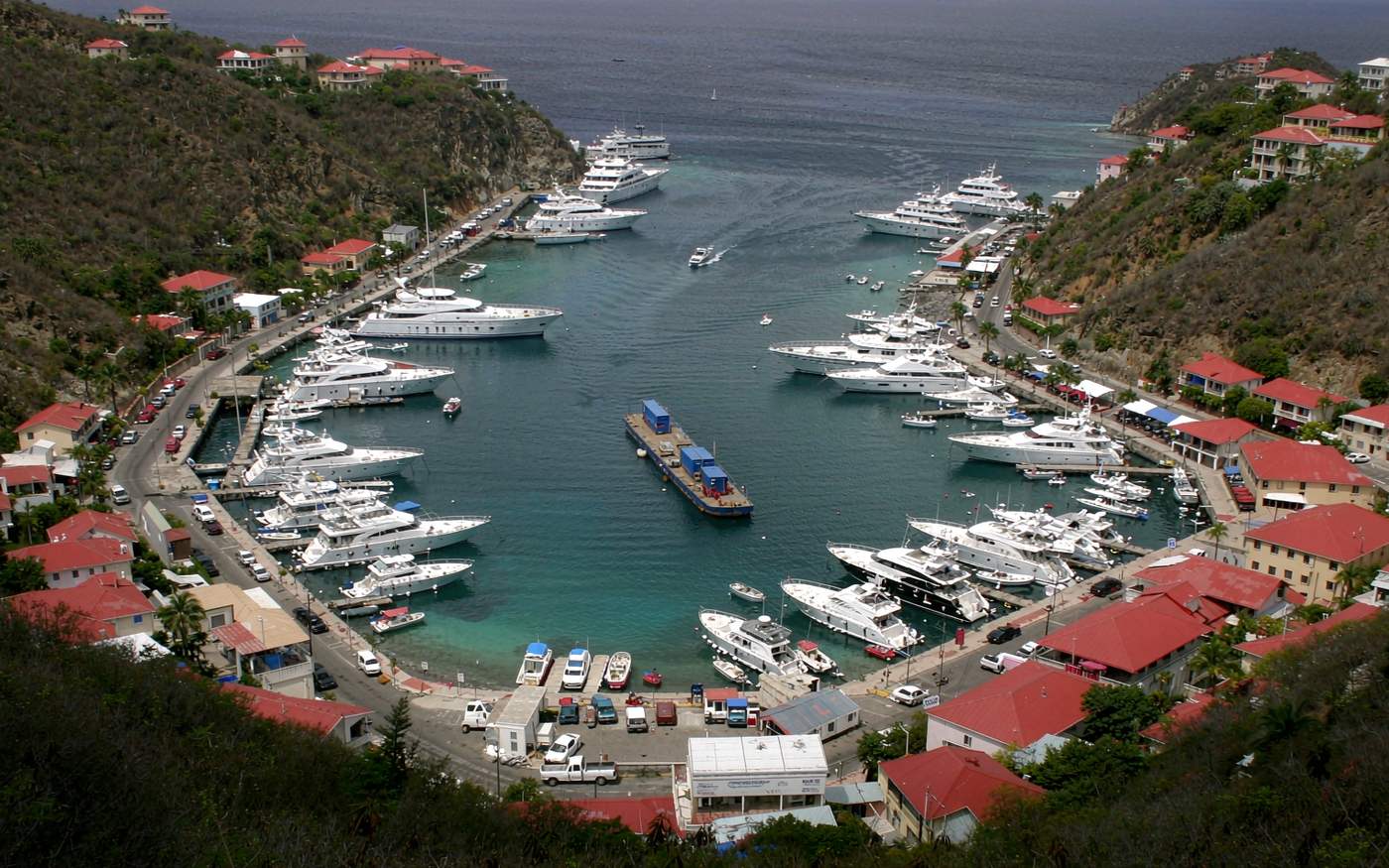
The port at Gustavia is a sheltered horseshoe bay with a small commercial quay. It handles the island's supplies and a great deal of yacht traffic, and it does not have a deep-water berth capable of taking a container vessel alongside. That single fact determines the whole routing. Containerised cargo is discharged at a regional hub — Pointe-a-Pitre in Guadeloupe or Philipsburg in Sint Maarten — and moved the last stretch by barge, feeder or roll-on vessel into the bay. It also means handling. Your cargo is lifted more often here than on almost any other route we run, and the packaging has to be specified with that in mind rather than with an eye on the ocean crossing alone.A runway built for small aircraft
Gustaf III Airport serves the island, and its runway is short and approached over a hill. It takes small aircraft and nothing larger, which makes it ideal for the regional traffic it was built for and unusable for a freighter. Air freight above a modest size is therefore routed through Sint Maarten and brought across on a smaller aircraft or by sea. Express courier works the same way: it reaches the island, but by way of the neighbouring one. If your consignment is urgent, say so at quotation stage and tell us the dimensions and weight. The answer may be air to Sint Maarten plus a short sea leg, and that is a different plan from the one a shipper would build for a mainland destination.Outside the European tax area, despite the euro
The island left the European Union's outermost region category at the start of 2012 and holds the status of an overseas country and territory associated with the Union. It uses the euro, and it does not apply value-added tax. That combination confuses people, and it is worth stating plainly: the currency tells you nothing about the tax. The Union's tax directives do not apply automatically here, and the French mainland rate is not the rate charged on this island. What is charged instead is set by the collectivity under the fiscal autonomy it has held since 2007. The rates and the basis are the island's own, and the reliable way to establish them for a specific consignment is through the licensed broker handling the entry rather than through any general reference table.Who sets the charges, and how to establish them
Fiscal matters are administered by the collectivity, the local governing body seated in Gustavia, which manages its own budget and local taxation. Customs formalities on the ground are carried out by the French customs administration. That split is unusual and worth understanding. The authority you deal with at the quay and the authority that determines what you owe are not the same body, and your broker will normally be the one dealing with both. Because the rates are local and can be revised by the collectivity, we treat them as something to confirm for your specific codes at quotation stage rather than as a fixed figure to be quoted from memory. Ask us and we will establish the current position before your goods sail.French on the paperwork, French at the quay
French is the official language and the working language of the paperwork. Declarations, invoices and product descriptions are prepared in French, normally by your broker. This is not a formality. A declaration built in English is one an officer can decline to assess, and on a route with two transfers behind it and limited storage at the far end, a refusal costs more here than it would on a mainland lane. Send us commodity descriptions specific enough to translate and classify precisely. Vagueness at this stage becomes delay at the quay, and there is nowhere on this island to put a delayed container cheaply.Packing for two transfers and a small quay
A container travelling to Saint Barthelemy is discharged at a hub, broken down or transhipped, moved by barge or feeder, and landed at a quay with limited space. It is handled more often per tonne than cargo delivered to almost anywhere else we serve. Salt air, tropical humidity and sun each do their part. Sealed inner packaging, corrosion protection, filled voids and proper dunnage are baseline rather than upgrades, and thin packaging simply does not survive the transfer. Timber packaging must be treated and marked to the international standard with the certificate in hand before departure. On a route where the cargo changes hands twice and storage at the destination is scarce, a refused container is an expensive problem.Limited space, and what that costs you
The island is small and built up, and storage at the quay and on the island generally is finite. A consignment that sits while paperwork is resolved is occupying space somebody else needs. That is the practical reason to have the documents right the first time on this route. We pre-alert the agent before the cargo leaves the hub and send the document pack ahead of it. It is also a reason to think about consolidation. Sending two half-empty shipments a fortnight apart usually costs more here than sending one consolidated one, both in freight and in the handling at the far end.The handover at the quay, and what your buyer does from there
We handle collection anywhere in China, export clearance, consolidation, main carriage to the regional hub, the transfer into Gustavia, and the document pack that travels with the cargo. Your buyer handles arrival onward: appointing a licensed broker, lodging the declaration in French, paying the charges set by the collectivity, and collecting from the quay. We quote the main carriage and the transfer as separate lines. On a route where the cargo changes vessel twice, that separation is the only honest way to show you where the time and the money go.Sending a first Saint Barthelemy consignment
Send us the commodity in enough detail to classify it, the volume and weight, the pickup address in China, and the delivery address on the island. That last one matters: the island is small but the roads are steep and some addresses need a smaller vehicle. Tell us the declared value and whether your consignee has imported before. We will confirm the hub and the transfer, establish the current charge position for your codes, and quote the main carriage and the transfer separately. Start with one shared container. It tells you how your supplier packs for two transfers, how quickly your broker responds to the customs administration on the island, and what the connection is doing in that season, for considerably less than a full container would cost you to learn the same three things.What we see for new Saint Barthelemy buyers
Five shipments bought in China and delivered into Saint Barthelemy, told end to end — where the order came from, how it moved, where it nearly went wrong, and how it finished. Client names are withheld at their request; the situations and the handling are what we deal with on this lane.
Furniture for a villa completion
The purchase. A contractor bought outdoor furniture, lighting, textiles and kitchen fittings from three suppliers in Guangdong and Fujian for a villa above the harbour.
The move. We collected all three lots, consolidated into one 40HC and shipped to Pointe-a-Pitre, with the barge transfer to Gustavia quoted separately.
Where it nearly went wrong. The outdoor furniture arrived in thin cartons with no moisture protection, and two pieces were damaged during the barge transfer. The villa completion date was fixed and there was no time to reorder.
How it finished. We made export-grade crating and sealed moisture protection a condition of collection on the next project. Nothing arrived damaged.
A tax assumption carried over from France
The purchase. A buyer costed a consignment using the French mainland rate of value-added tax, on the basis that the island is French and uses the euro.
The move. One 20GP routed via Pointe-a-Pitre with transfer into Gustavia.
Where it nearly went wrong. The island left the European Union's outermost region category in 2012 and does not apply value-added tax. What is charged is set by the local collectivity under the fiscal autonomy it has held since 2007.
How it finished. We now establish the current charge position for the specific codes at quotation stage rather than letting anyone carry a figure over from mainland practice.
Air freight that could not land
The purchase. A client booked air freight direct to the island for a consignment that included several long crates.
The move. We re-quoted the routing through Sint Maarten with a short onward leg, and flagged the constraint at booking rather than after departure.
Where it nearly went wrong. The runway at Gustaf III is short and approached over a hill, and takes small aircraft only. A freighter cannot land there, and oversized pieces cannot be carried on the aircraft that can.
How it finished. The consignment moved via Sint Maarten without a hitch. We now check dimensions against the runway constraint before quoting any air routing to this island.
Two half-shipments instead of one
The purchase. A retailer sent two separate part loads a fortnight apart rather than waiting to consolidate them.
The move. We quoted both options side by side, showing the freight and the handling at the quay for each.
Where it nearly went wrong. Storage at the quay and on the island is finite, and every consignment that arrives separately is handled separately. The two shipments cost materially more than one consolidated one would have.
How it finished. The retailer now consolidates to a single monthly shipment. The saving showed up in handling rather than in freight, which is where it usually does on this route.
A first import held on documents
The purchase. A consignee importing commercially for the first time had the cargo arrive before the declaration was prepared in French.
The move. One 20GP routed via Philipsburg with transfer into Gustavia.
Where it nearly went wrong. French is the working language of the paperwork, and a declaration built in English is one an officer can decline to assess. With limited space at the quay, the hold was expensive.
How it finished. We now prepare the document pack in French and send it ahead of the cargo. Subsequent consignments have been lodged the day they arrived.
Why importers use Goodhope on this lane
Six things that are different about working with us on China to Saint Barthelemy shipments.
Get a Gustavia shipment priced
Tell us the commodity in enough detail to classify it, the volume, the declared value, the pickup address in China and the delivery address on the island. We will confirm the hub and the transfer, establish the current charge position for your codes, and quote the main carriage and the transfer separately.
Get a quote Talk to usRelated pages
Frequently asked questions
Can a container ship berth at Gustavia?
No. The harbour is a sheltered bay with a small commercial quay and no deep-water container berth. Containerised cargo is discharged at Pointe-a-Pitre in Guadeloupe or Philipsburg in Sint Maarten and moved the last stretch by barge, feeder or roll-on vessel.
Can air freight land on the island?
Only small aircraft. The runway at Gustaf III is short and approached over a hill, so it cannot take a freighter. Air freight above a modest size is routed through Sint Maarten and brought across on a smaller aircraft or by sea.
Is VAT charged on imports?
No. The island has held overseas country and territory status since 2012 and does not apply value-added tax, even though the currency is the euro. What is charged instead is set by the local collectivity under the fiscal autonomy it has held since 2007.
Who decides what I pay?
The rates are set by the collectivity, the local governing body seated in Gustavia, which manages its own budget and local taxation. Customs formalities on the ground are carried out by the French customs administration. Confirm the position for your specific codes at quotation stage.
Do documents need to be in French?
Yes. French is the official language and the working language of the paperwork, and declarations, invoices and product descriptions are prepared in it, normally by your broker.
How many times is my cargo handled?
More often than on almost any other route we run: discharge at the regional hub, transfer onto the onward vessel, and landing at a small quay. Packaging should be specified for that rather than for the ocean crossing alone.
Is storage a problem at the destination?
Yes. The island is small and built up, and space at the quay is finite. A consignment that sits while paperwork is resolved is occupying space somebody else needs, which is why we send the document pack ahead of the cargo.
Should I consolidate?
Usually. Sending two part loads a fortnight apart costs more here than one consolidated shipment, and the difference shows up in handling at the quay rather than in the freight rate.
How long does the whole route take?
Longer than a direct service would, because there is no direct service: main carriage to the hub, then the transfer. We confirm the hub and what the connection is doing at the time of booking rather than quoting from a table.
Do you offer door-to-door delivery?
No. Sea freight runs port-to-port to the quay at Gustavia, with the transfer from the hub quoted separately. Air freight is airport-to-airport, normally via Sint Maarten, and express courier dispatch ends at the depot.