
Routing
Rail sits between sea and air on cost and between them on time. Whether it is worth the middle position depends on what your cargo is, not on how fast you want it.
Contents
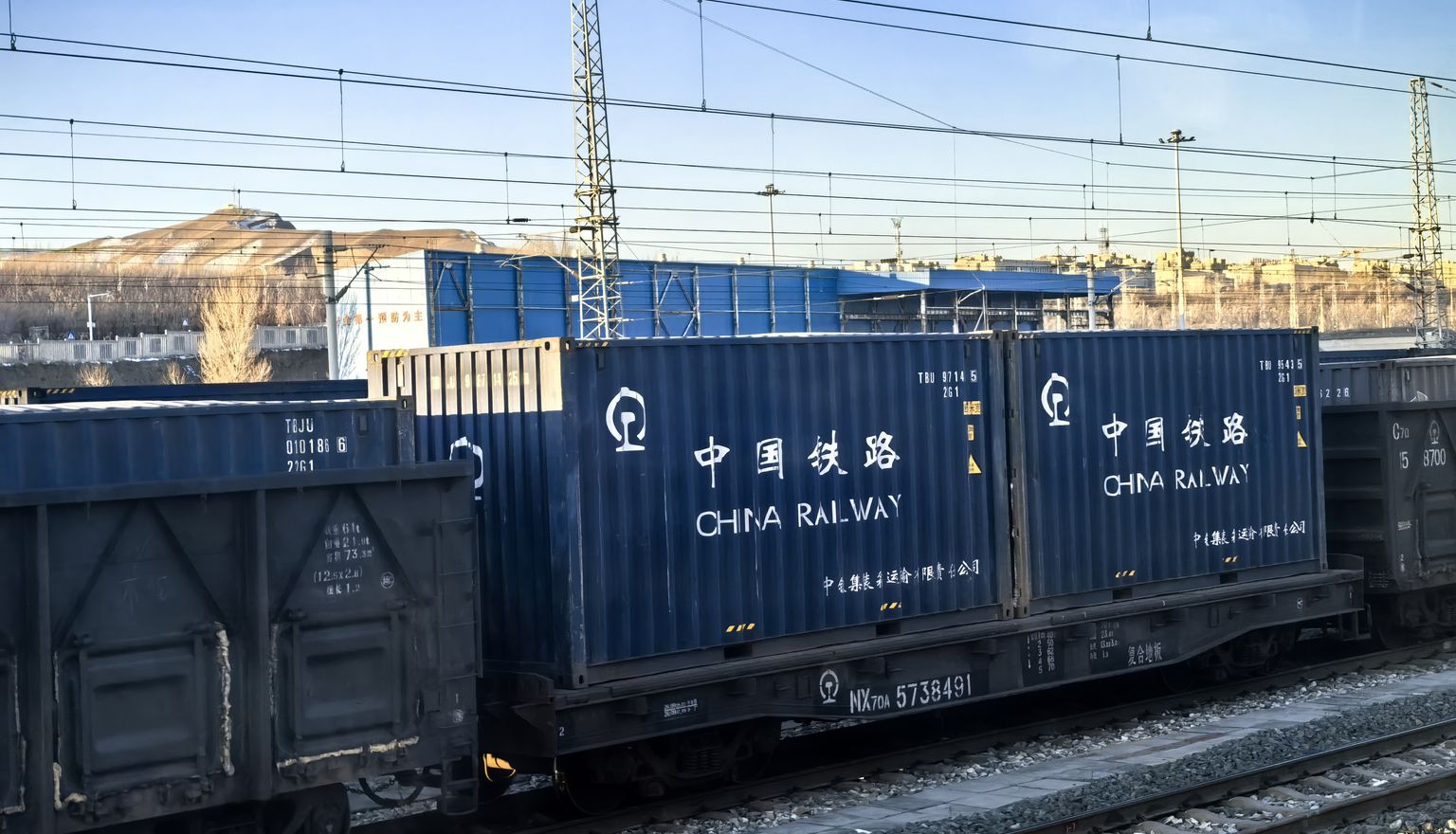
A block train is a scheduled container service on rails: a fixed number of flat wagons, a fixed departure, a fixed route and a published transit. It is not a general freight service for anything that happens to fit on a train.
Most Europe-bound trains load at inland Chinese terminals — Xi'an, Chengdu, Chongqing, Zhengzhou — rather than at a seaport. Your container is trucked or railed from the factory to that terminal, loaded onto a wagon, and travels as part of a block that is assembled before departure and broken up at the far end.
That structure is why the product behaves more like a scheduled liner service than like a truck. You book space on a departure, you have cut-offs, and the container moves on a plan somebody else set.
The main corridor leaves China at Alashankou or Khorgos in Xinjiang, crosses into Kazakhstan at Dostyk or Altynkol, runs through Kazakhstan and onwards through Russia and Belarus, and enters the European Union at Brest, where the train hands over to Malaszewicze in Poland.
Two gauge changes sit on that line. China and Europe use 1,435 mm track; the former Soviet network uses 1,520 mm. At each break, containers are lifted from one train and set on another, or the wagons have their bogies exchanged. Either way it is a physical transfer with a queue attached, and it is where most of the schedule variance originates.
A second corridor runs south of the Caspian through Kazakhstan, Azerbaijan, Georgia and Turkey. It avoids the northern route but adds water crossings and more handovers, and it is generally slower and less predictable.
Which corridor a train takes is a commercial and compliance question, not a preference. Border practice, documentation requirements and accepted commodities differ between them, and the routing is settled with the rail operator before the container is accepted.
Terminal to terminal, a well-run block train reaches Poland or Germany in roughly eighteen to twenty-five days. Sea freight on the same origin-destination pair runs about thirty to forty-five days port to port, depending on routing and whether services run via Suez or around the Cape.
The comparison is not quite fair in either direction. The rail figure usually starts when the container is loaded at the Chinese inland terminal, and the sea figure starts when it is loaded at the port. Getting cargo from a Guangzhou factory to Xi'an adds two to four days, and getting it from Malaszewicze to a German warehouse adds a few more.
Even after those adjustments, rail typically lands a week or two ahead of sea and a week or more behind air, at a cost that sits between them. The variance is also lower: a rail departure that misses its slot waits for the next block, but it does not wait for a vessel to complete a rotation through six ports.
Rail pricing is quoted per container, like FCL, and it is typically a multiple of the sea freight on the same trade and a fraction of the air rate. How large that multiple is depends on the season and on how much capacity the operator has released.
Three cost lines are easy to underestimate.
The inland leg in China. A container trucked from Guangzhou to Xi'an is a long domestic move, and it is not cheap. On some routings it erases the advantage over sea freight entirely.
The European leg. Rail terminals in Poland and Germany are inland, which is an advantage if your warehouse is inland too, and a cost if your customer is at a seaport.
Terminal and handling charges at both rail terminals, which are separate from the freight and are not always in the first number quoted.
Ask for the quote door to door, not terminal to terminal. The middle figure is the one that flatters rail.
Rail rewards cargo that is valuable enough to care about two weeks, dense enough to fill a container economically, and not so urgent that air is the only answer.
It suits: machinery and spare parts, automotive components, electronics that are not time-critical, home appliances, furniture in flat pack, and industrial materials where a fortnight of working capital is worth the freight premium.
It suits less well: heavy bulk where sea is dramatically cheaper per tonne, low-value goods where the premium cannot be recovered, and anything with a hard retail date that a border queue could break.
It is also poor for cargo that needs temperature control. Reefer containers do travel on some rail services, but the equipment and the monitoring are not equivalent to a reefer vessel, and a delay at a border crossing in winter is a different problem from a delay at sea.
Containers only. Block trains carry containers on flat wagons. Breakbulk, out-of-gauge pieces and anything that will not fit a standard box is not a rail product.
Weight limits per wagon. Rail has axle-load limits, and a dense commodity that maxes out a container's payload may need to be spread across two boxes or declared differently. This is a planning input, not a surprise to discover at the terminal.
Border queues. The gauge-change points are the bottlenecks. A train that arrives when several others do waits, and the wait is measured in days. Transit guarantees on rail are softer than on sea for this reason.
Compliance. What may travel on which corridor changes, and the rules concern the origin, destination and route rather than only the goods. Certain commodities and certain origins are restricted, and the restriction is applied by the operator before booking. Confirm acceptance in writing before you commit a production date to a rail departure.
Rail is not a shortcut around customs. The cargo still enters the EU through a customs office, still needs a declaration, still attracts duty and import VAT. The difference is where the entry happens, not whether it happens.
A buyer at the Canton Fair is usually shipping from Guangdong, and no block train leaves from there. The container has to reach an inland terminal first, which means a domestic truck move of roughly 1,500 kilometres to Xi'an or a comparable distance to Chengdu or Chongqing, or a feeder arrangement to a coastal rail terminal.
That leg is bookable, insured and trackable, but it adds days and cost. It also means the container is loaded twice — once at the factory and once at the rail terminal if the goods are consolidated — so packing has to survive an extra handling cycle.
GoodHope holds a branch in Xi'an, one of the main consolidation points for Europe-bound trains, which is useful for exactly this reason: the container can be received, checked and handed to the rail operator without a third party in the middle.
For a buyer shipping from several Guangdong factories, the sequence is the same as any consolidation: goods gather at a warehouse, load into one container, and that container begins its journey north.
Rail is worth pricing when the value of arriving two weeks earlier exceeds the premium it costs. Put a number on both sides rather than arguing about speed.
On the benefit side: two weeks of working capital tied up in the goods, plus whatever the earlier delivery earns. A retail window, a contract with a delivery penalty, a season that closes on a fixed date. Those are real and calculable.
On the cost side: the difference between the rail rate and the sea rate, plus the inland leg in China and the inland leg in Europe. All three are quotable.
As an illustration rather than a quotation: a container of goods worth fifty thousand dollars, moved by rail for three thousand dollars more than sea, is paying six percent of the goods value for a fortnight. If arriving early protects a season or a contract, six percent is cheap. If the container would sit in your warehouse either way, it is six percent spent on nothing.
That calculation is the whole case for rail. Everything else about the mode is operational detail.
Q How long does rail take from China to Europe?
Roughly 18 to 25 days terminal to terminal on the main corridor to Poland or Germany, plus the inland legs at each end. Sea freight on the same trade typically runs 30 to 45 days port to port, and air runs 3 to 6 days door to door.
Q Is rail cheaper than air?
Yes, by a wide margin. It is also more expensive than sea freight, often by a multiple rather than a percentage. The case for rail rests on the fortnight it saves, not on the rate.
Q Can I ship from Guangzhou by rail?
Not directly. The container is trucked to an inland terminal such as Xi'an, Chengdu or Chongqing, then loaded onto a block train. That domestic leg adds two to four days and a cost that belongs in the comparison.
Q What can travel on a China-Europe train?
Containersed cargo, subject to the operator's acceptance rules for the commodity and the corridor. Breakbulk and out-of-gauge cargo are not part of the product, and some commodities are restricted on some routes. Confirm acceptance before booking.
Q Why does rail transit vary so much?
The two gauge changes at Alashankou or Khorgos and at Brest are the bottlenecks. Trains queue there, and a queue is measured in days. Weather in winter and congestion at the Polish terminal add to the variance.
Q Does rail clear customs in Europe?
Yes. The cargo enters the EU through a customs office, usually in Poland, and duty and import VAT apply as they would at a seaport. Rail changes the route and the timing, not the obligation.
Related pages
Send the factory location, the destination city and the ready date. We will price rail against sea and air on a door-to-door basis so the middle option is actually comparable.
Email sales8015@goodhopefreight.com | WhatsApp & phone +86 133 9216 2503