
Home / Shipping To USA / Hazardous Liquid Air Freight Rates China to USA
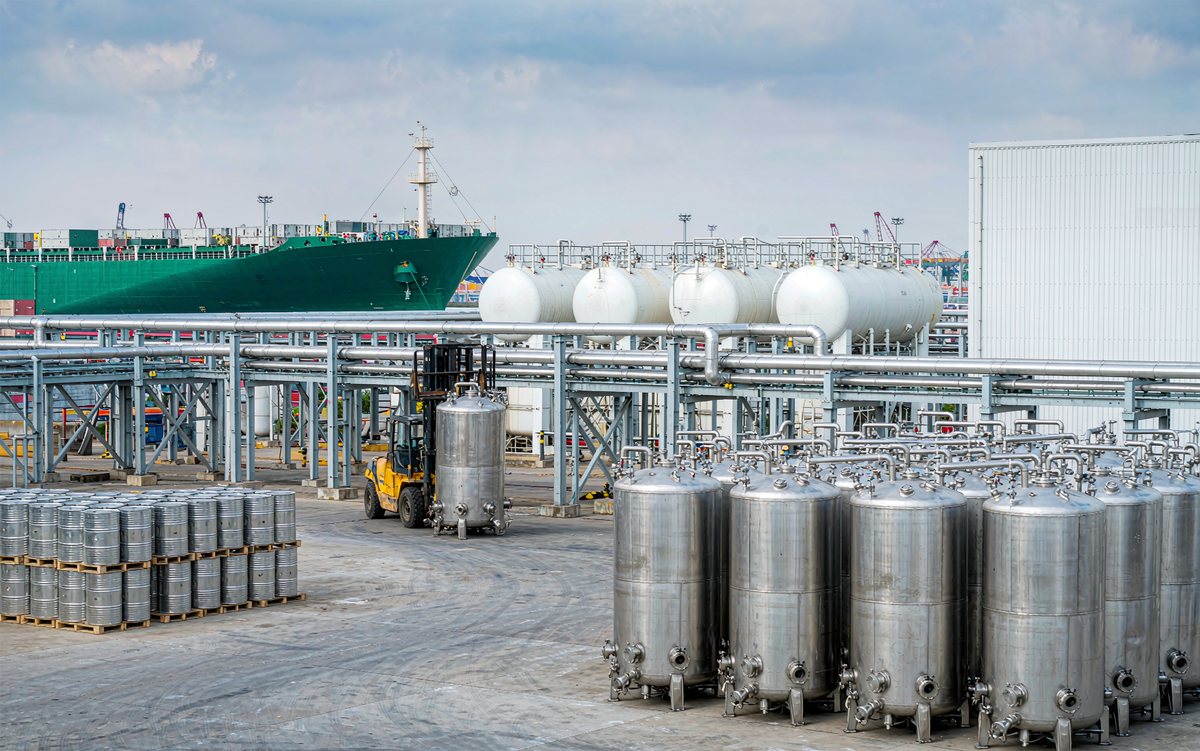
Hazardous Liquid Air Freight from China to the USA, Door to Door DDP: Tube, Can and Drum Formats and Their Rates
Shenzhen Bao'an Fuhai warehouseHong Kong / Korea to Los Angeles (LAX)UPS to 48 statesDDP — duty and clearance included
- Channel 1 · Tube, under 30 ml — US10-AKR
- Channel 2 · Can, under 300 ml — US10-BKR
- Channel 3 · Drum, over 300 ml — US10-CKR
- Four weight breaks: 21 / 71 / 101 / 501 kg
- ZIP-zone pricing for West, Central and East
- Tube, can and drum packed in three separate channels
- Rates valid to 31 October 2026
What moves a hazardous liquid booking is paperwork, not capacity. If the flash point, boiling point or ingredient percentages on the safety data sheet do not line up with the product, the cargo fails verification at the receiving warehouse. If the inner packaging volume does not match the channel, the whole batch is re-classified and re-declared.
The rates below cover mainland China origin, transfer through Korea, pickup at Los Angeles (LAX) and UPS delivery to a US address, in RMB per kilogram. Export declaration, US import clearance and duty are inside the rate — DDP, Delivered Duty Paid — so the receiver is not asked for a bond or an importer number.
Channels split by inner packaging volume rather than by product type: tubes up to 30 ml, cans up to 300 ml, and drums above 300 ml. Only the first is currently priced on a rate table. The second is quoted per shipment, and the third is not being accepted while capacity for bulk liquids remains restricted.
Three channels compared at 21 kg and above
The three channels share one pricing structure — four weight breaks, three ZIP zones — but not one price basis. Tube-packed goods carry a published rate, can-packed goods are quoted against the actual formulation, and drum cargo has no open rate at present. Start with the 21 kg break to see where a shipment sits.
| Channel | Typical cargo | US West 21 kg+ | US Central 21 kg+ | US East 21 kg+ | Pickup | Minimum billed |
|---|---|---|---|---|---|---|
| Hazardous, tube US10-AKR | Nail polish, perfume, adhesives, paint and ink (under 30 ml) | 71.0 | 72.0 | 73.0 | 5–7 days | 21 kg |
| Hazardous, can US10-BKR | Goods with adhesive, low-alcohol pigment or dye (under 300 ml) | Quote | Quote | Quote | 6–8 days | 21 kg |
| Hazardous, drum US10-CKR | Bulk chemical raw materials, additives, reagents (over 300 ml) | Not accepted | Not accepted | Not accepted | 7–9 days | 21 kg |
US10-CKR is closed in all three zones: bulk liquid above 300 ml cannot move on this rate set and needs a per-shipment feasibility check. US10-BKR is quoted per shipment, priced against the formulation and the packaging.
Why hazardous liquids are vetted before the warehouse
A dangerous goods booking that reaches the terminal without a workable safety data sheet does not become a cheaper booking; it becomes a returned truck. Most of the value sits in screening early.
Screening before cargo arrives
Ingredient list, flash point, boiling point and UN number are reviewed by our team before a booking is confirmed. Low-boiling solvents are declined at quotation stage instead of being discovered at the cargo terminal.
Three packaging formats, three channels
Inner packaging of 30 ml, 300 ml and above 300 ml each carry their own channel and billing method. Classifying on the actual retail unit avoids being re-priced at the higher tier after inspection.
Dangerous goods capacity through Korea
Hazardous liquids are boarded under dangerous goods acceptance rules, and passenger aircraft carry a per-package volume limit. The Korea-to-Los Angeles combination accepts a wider product range than most direct options.
One price with duty inside
Export declaration, US clearance, duty and the UPS leg are all inside the per-kilogram rate, so the receiver does not need US importer status.
Leak-proofing with a method, not a promise
Bulk liquid is packed in three layers — leak containment, shock absorption, moisture barrier — with MDF crates sized to 10–22 kg per piece to limit the consequence of a failure in transit.
Inspection cost stated up front
Where an inspection follows from the cargo itself or from its declaration, the inspection fee and night storage rest with the shipper. Saying so before the booking avoids the argument afterwards.
How hazardous liquids are classified for air transport
A hazardous liquid is declared as dangerous goods; it is not general cargo. Liquids with a flash point fall into Class 3, flammable liquids; corrosive liquids into Class 8; the rest are handled as Class 9 miscellaneous. The class is taken from section 14 of the safety data sheet, not from the product category. Passenger aircraft apply a per-package volume limit to Class 3 liquids, and anything above it moves on a freighter — which is why the same bottle of perfume can change rate when the packaging volume changes.
Three documents decide acceptance. The safety data sheet says what the product is and where the hazard lies; a UN38.3 report applies only where a lithium battery travels with the liquid; a letter of guarantee is the shipper's written statement that the declared name and the ingredients match the cargo. A cosmetic declared as cosmetics while the formulation is solvent-based is the most common gap between declaration and reality.
| Check | What is read | Usual reason for rejection |
|---|---|---|
| Flash point | Section 9 of the safety data sheet, closed-cup value | Below the channel floor: re-classified and priced as a flammable liquid |
| Boiling point | Section 9, initial boiling point | Too low to be treated as low-volatility; most channels decline |
| Inner packaging volume | Actual capacity of the retail unit | Marked 30 ml but filled to 35 ml: whole batch re-classified |
| UN number and class | Section 14, transport information | Section 14 blank: class cannot be determined |
| Production licence number | The official number printed on the packaging | Unlicensed product with no traceable manufacturer is refused |
Channel 1: tube-packed hazardous liquids up to 30 ml
This channel takes retail units packed in small formats: nail polish, nail glue, perfume, adhesives, low-alcohol pigments and dyes, paint and printing ink. The test is the actual capacity of one retail unit, not the total in the carton. Anything above 30 ml moves to US10-BKR or US10-CKR.
| Delivery area | ZIP zone | 21 kg+ | 71 kg+ | 101 kg+ | 501 kg+ | Pickup | UPS delivery |
|---|---|---|---|---|---|---|---|
| US West | ZIP 89xxx | 71 | 66 | 64 | 63.5 | 5–7 days | 1–3 days |
| US Central | ZIP 45/6/7xxx | 72 | 67 | 65 | 64.5 | 5–7 days | 3–4 days |
| US East | ZIP 0/1/2/3xxx | 73 | 68 | 66 | 65.5 | 5–7 days | 4–6 days |
Rates are in RMB per kilogram and include export declaration, US import clearance, duty and the UPS delivery leg. Surcharges are charged on top.
- Inner packaging up to 30 ml; above that, the shipment belongs on US10-BKR or US10-CKR
- Explosives and very low melting or boiling point chemicals are not accepted; a safety data sheet, UN38.3 report where a battery travels with the goods, and a letter of guarantee are required before receipt
- No delay compensation on this channel; if cargo is not picked up 9 business days after departure, the inspection sheet or air waybill number can be supplied
Channel 2: can-packed hazardous liquids up to 300 ml
Cargo carrying adhesive, low-alcohol pigment, low-alcohol dye, paint or ink sits here, with a ceiling of 300 ml of liquid inside the smallest commercial pack. The rate is confirmed per shipment against the formulation and packaging, so the table carries no fixed price.
| Delivery area | ZIP zone | 21 kg+ | 71 kg+ | 101 kg+ | 501 kg+ | Pickup | UPS delivery |
|---|---|---|---|---|---|---|---|
| US West | ZIP 89xxx | Quote | Quote | Quote | Quote | 6–8 days | 1–3 days |
| US Central | ZIP 45/6/7xxx | Quote | Quote | Quote | Quote | 6–8 days | 3–4 days |
| US East | ZIP 0/1/2/3xxx | Quote | Quote | Quote | Quote | 6–8 days | 4–6 days |
No fixed rate on this channel: pricing is confirmed after the formulation and packaging are reviewed, and includes export declaration, clearance, duty and UPS delivery to the same standard as channel 1.
- Smallest commercial pack up to 300 ml of liquid; above that the cargo goes to US10-CKR
- Quoted against the ingredient list and packaging specifications; send the safety data sheet and product photos with the enquiry
- Same document set and acceptance check as channel 1, and no delay compensation
Channel 3: drum-packed hazardous liquids above 300 ml
Bulk organic and inorganic raw materials, chemical additives, reagents, non-flammable adhesives, water-based coatings, alcohol-free pigments and dyes, organic agricultural preparations and non-flammable paint sit in this channel. It is currently closed in all three zones: drum cargo has to be confirmed per shipment rather than booked straight off a rate table.
| Delivery area | ZIP zone | 21 kg+ | 71 kg+ | 101 kg+ | 501 kg+ | Pickup | UPS delivery |
|---|---|---|---|---|---|---|---|
| US West | ZIP 89xxx | Not accepted | Not accepted | Not accepted | Not accepted | 7–9 days | 1–3 days |
| US Central | ZIP 45/6/7xxx | Not accepted | Not accepted | Not accepted | Not accepted | 7–9 days | 3–4 days |
| US East | ZIP 0/1/2/3xxx | Not accepted | Not accepted | Not accepted | Not accepted | 7–9 days | 4–6 days |
All three zones are marked not accepted, so no rate applies. The pickup column shows the operating standard for this channel; it does not mean orders are being taken.
- Closed in all three zones at present: drum cargo above 300 ml needs a per-shipment feasibility check
- Where a route is found, three-layer packing applies — leak containment, shock absorption, moisture barrier — in MDF crates sized to 10–22 kg per piece
- Cargo containing white powder, white granules or white crystals needs a safety data sheet review first, and a surcharge applies once cleared
Billed weight and minimum charge
All three channels bill on chargeable weight, the greater of actual and volumetric weight, with volumetric calculated as length × width × height in centimetres divided by 6,000. A liquid shipment usually sits close to its volumetric weight, so estimating from carton count is not far off — but any single piece above 21 kg crosses the overweight line.
- The rate table starts at 21 kg; anything billing below 21 kg is charged as 21 kg
- A single piece reaching 21.85 kg triggers the overweight surcharge, independent of volumetric weight
- 10–22 kg per piece is the practical range, and drum cargo repacked into that band moves more easily
- A single piece above 67.85 kg leaves the rate table and is quoted separately
Surcharges
Weight and dimension surcharges are calculated per piece and stack with each other. Running the worst case across the whole shipment at quotation stage is clearer than a supplementary invoice after departure.
Weight and dimensions
| Condition | Surcharge |
|---|---|
| Single piece reaching 21.85 kg (volumetric within 29.85 kg) | +RMB 215 per piece |
| Single piece above 39.85 kg | +RMB 460 per piece |
| Single piece above 67.85 kg | Quoted separately |
| Longest side above 119 cm, second-longest above 75 cm, or girth 266–329 cm | +RMB 215 per piece, stacked with the overweight charge |
| Girth 330–415 cm | +RMB 425 per piece, with piece weight at or below 68 kg and length at or below 174 cm |
| Girth above 415 cm, weight above 68 kg, or length above 175 cm | Billed from 100 kg minimum, quoted separately |
Girth runs as the longest side plus twice the sum of the second-longest and the shortest side, in centimetres. Measuring in the factory, before sealing, is the cheap version of this conversation.
Delivery coverage and remote-area charges
Delivery covers the 48 contiguous states. PO boxes, military addresses and the offshore islands are not served; ZIP ranges 006–009 (Puerto Rico, US Virgin Islands), 966–969 (Hawaii, Guam) and 995–999 (Alaska) fall outside the network. Payment does not open them: the options are pickup at Los Angeles or another transport mode, which makes a ZIP check part of booking.
Fulfilment centres and commercial addresses carry no delivery charge; charges exist at residential and remote addresses only. The decision rests on UPS zone data, not on how the receiver describes the address, and an address that is both residential and remote pays both charges.
| Address type | Charge |
|---|---|
| Amazon FBA and commercial addresses | No delivery surcharge |
| Residential address | +RMB 35 per piece, minimum RMB 350 per shipment; above 350 kg billed at RMB 1.0 per kg |
| FBA or commercial address, remote | RMB 25 per piece, RMB 30 for super-remote, minimum RMB 150 per shipment |
| Residential address, remote | RMB 35 per piece, RMB 45 for super-remote, minimum RMB 200 per shipment; charges stack |
| Extreme remote | RMB 95 per piece, minimum RMB 200 per shipment |
The delivery leg is UPS throughout. How a UPS service of its own prices and what it accepts is covered under air freight to the USA.
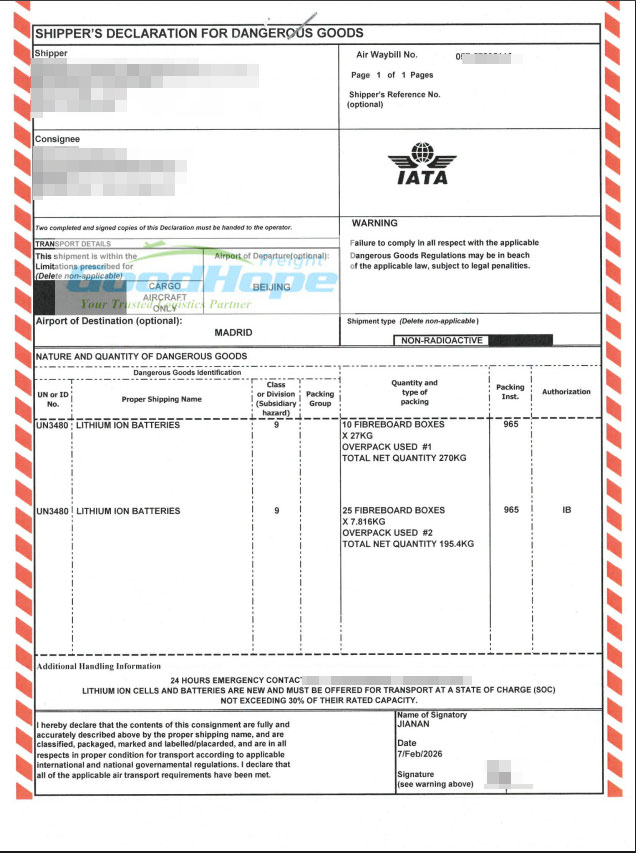
Three documents required before the cargo is accepted
The boundary for a dangerous goods channel is set by documents, not by volume. One missing sheet and the cargo fails at the receiving warehouse, well before anyone thinks about a flight. Each of the three does a different job and none replaces another.
- Safety data sheet (MSDS) — all sixteen sections complete, with a flash point and boiling point in section 9 and the UN number plus transport class in section 14. A sheet missing those two sections is worth nothing at the counter.
- UN38.3 test report — only where a lithium battery travels with the liquid, such as a battery-powered spray device. A pure liquid does not need one, but the channel will still ask whether a battery is present.
- Letter of guarantee — issued by the shipper, confirming that the declared name and ingredients match the cargo. Under-declaration and a wrong description sit with the shipper, and the letter is the written basis for that allocation of responsibility.
Packing and marking
Liquid cargo has one packing objective: keep the product inside the carton. Once it leaks, everything in the same carton and on the same pallet is affected, and the claim terms exclude exactly that.
- Each retail unit sealed independently, with a sealing film over the neck to stop leakage in transit
- Liquid and absorbent material in the same carton, with voids filled so nothing shifts
- Drum cargo in MDF crates, 10–22 kg gross per piece
- Outer cartons rigid and square; UN boxes and soft bags are not accepted
- Where a battery travels with the liquid above 95 Wh, check the channel limit first; standard built-in batteries and magnetised cargo carry no extra charge
Before the cut-off
From receipt to cut-off the steps are fixed, and doing them early removes most of what would otherwise be argued later. They apply as written.
Warehouse receipt, labelling and cut-off
- Chargeable weight is volumetric divided by 6,000, whichever is greater against actual weight. The weight break follows chargeable weight, not declared weight.
- After cut-off, returns, holds and address changes are refused. A change after cut-off waits for the next shipment.
- At least two valid FBA labels per carton plus a Made In China mark. Marks and labels are checked once, at receipt.
- No bill of lading data is released before the destination releases the cargo, including shipments with an open inspection.
- Inspection fees and night storage arising from the cargo or its declaration rest with the shipper.
- No delay compensation applies on any of the three channels. Where cargo is not picked up 9 business days after departure, we supply the inspection sheet or air waybill number for tracing.
Three changes on the US import side in 2026
The USD 800 de minimis allowance is gone
The low-value exemption was suspended for all countries on 29 August 2025 under Executive Order 14324 and extended by a further order on 20 February 2026. CBP has suspended 19 U.S.C. §1321(a)(2)(C) indefinitely by regulation. Cosmetic samples and decanted perfume now need an entry and pay duty; entries under USD 2,500 can use informal entry. Splitting a shipment into small parcels to stay under the threshold is no longer a workable plan.
Misdeclaring dangerous goods has become expensive
A dangerous good declared as general cargo is a false declaration. Once security screening or the destination port catches it, the usual outcome is return of the whole shipment, a penalty and a carrier blacklist — not a supplementary freight invoice. Channel operators have moved safety data sheet review forward to the quotation stage for that reason, and would rather decline a booking than carry an uncertain one.
Why the DDP rate includes duty
Under DDP the carrier files the import entry, as importer of record or through a designated one, and pays the duty. The receiver pays nothing further and needs neither US importer status nor a customs bond, which is why dangerous goods have shifted to DDP. The trade-off is that value and description must be truthful, and the tolerance for a loose declaration is narrower than for general cargo.
What the transit time actually measures
Pickup time counts from the flight landing at Los Angeles and the cargo being available to UPS; customs inspection is not included. UPS delivery adds 1–3 business days in the West, 3–4 in the Central zone and 4–6 in the East. Tube-packed cargo is typically 5–7 days to pickup; drum cargo stretches to 7–9 days plus 4–6 business days, when a route is available.

Typical shipments
Four product shapes, each mapped to a channel and a price. Where a shipment does not fit, the cause is usually inner packaging volume or a flash point that sits below the channel floor.
Retail perfume and nail polish
Perfume, nail polish, nail glue and lash adhesive in 10–30 ml retail units. RMB 71.0 per kg at 21 kg+ to the West, falling to RMB 63.5 at 501 kg+. A batch with a retail unit above 30 ml moves to the can channel.
Low-alcohol pigments and printing ink
Craft pigments, stamp pad ink and low-alcohol marker refill in 30 ml packs. The flash point has to appear on the safety data sheet, or verification simply stops there.
Industrial consumables carrying adhesive
Glue, sealant and water-based coating in commercial packs up to 300 ml. No fixed rate: pricing follows the formulation and packaging, confirmed per shipment.
Bulk chemical raw material
5 L and 20 L drums are not being accepted at present and need a per-shipment check. Where a route is confirmed, cargo is repacked into MDF crates at 10–22 kg per piece with leak containment.
Claims on the hazardous liquid channel
A claim starts either from a shipment that was never picked up, which begins with an FBA inventory check, or from cargo already with UPS, which begins with a carrier trace. The deadlines differ, and filing the wrong one gets the file returned.
How to file
- Where part of a shipment is not picked up or not signed for, check FBA inventory first, within 7–10 business days
- From business day 10, submit a screenshot of the FBA inventory showing the units are not received, with the real clock time visible on screen, and the claim can be opened
- Nothing is accepted beyond 20 business days
- Once UPS holds the cargo, the carrier trace window is 120 days and the result follows the carrier's reply
What is paid
| Situation | Settlement |
|---|---|
| Lost in transit, whole shipment never picked up by UPS | Declared value, capped at RMB 40 per kg, with freight refunded |
| Lost after handover to UPS | Freight not refunded; declared value under the UPS terms, capped at USD 100 per shipment |
| Carton or product damage, shortage, or natural disaster during delivery | Not compensated |
| Held by customs for 40 business days or more | Declared value, capped at RMB 40 per kg, with freight refunded |
High-value cargo should be insured separately; the carrier does not cover it. A whole shipment that UPS missed scanning is a known gap and rests with the shipper by the terms in force. Duty or seizure arising from under-declaration, a wrong description, anti-dumping exposure, missing certification or infringement rests with the shipper and sits outside the table above.
Customs seizure: a claim opens only after 40 business days from the seizure date. Seizures from under-declaration, a wrong description, anti-dumping, missing certification or infringement are excluded.
How the terms take effect: accepting the booking confirms the rate sheet and its notes.
Rate validity: 31 October 2026.
Frequently asked questions
Can hazardous liquids be flown to the USA?
Yes, but not every product and not on every channel. Acceptance depends on the flash point, boiling point and ingredients on the safety data sheet, and on which inner packaging volume the product falls into. Explosives and very low melting or boiling point chemicals are not accepted here.
How much does hazardous liquid air freight cost per kilogram?
Tube-packed hazardous liquids under 30 ml are RMB 71.0 per kg at 21 kg+ to the US West, falling to RMB 63.5 at 501 kg+; to the East, RMB 73.0 falling to RMB 65.5. Can-packed cargo up to 300 ml is quoted per shipment and drum cargo above 300 ml is not accepted, so neither carries a published rate.
How are the 30 ml and 300 ml limits measured?
On the actual capacity of one retail unit, not on the carton total and not on net weight. A unit marked 30 ml but filled to 35 ml is treated as over the limit and the whole batch is re-classified.
Is a safety data sheet mandatory, and can another document replace it?
It is mandatory, and all sixteen sections are required, with a flash point and boiling point in section 9 and a UN number in section 14. Test reports, ingredient tables and manufacturer certificates cannot replace it.
How is a liquid with a battery declared?
Both attributes are declared. The liquid part moves on the dangerous goods channel here, and the battery needs a UN38.3 report. Where battery capacity exceeds 95 Wh, the channel limit is checked before booking.
Are perfume and nail polish dangerous goods?
Perfume and nail polish containing alcohol or solvent are declared as flammable liquids and are dangerous goods. Low-alcohol toners and solvent-free skincare can move as general or cosmetic cargo, but the safety data sheet decides, not the label.
Can a 20 L drum be shipped?
The drum channel is closed in all three zones at present, so bulk liquid above 300 ml needs a per-shipment check. Where a route is confirmed, cargo is packed in leak-proof crates at 10–22 kg gross per piece.
How long does it take to reach the USA?
Tube-packed cargo is 5–7 days to pickup and 6–8 days for the can channel, measured from landing at Los Angeles to handover to UPS and excluding inspection. UPS adds 1–6 business days depending on the zone.
What happens if customs inspects the cargo?
Inspection fees and night storage arising from the cargo or from its declaration rest with the shipper. None of the three channels accepts a delay claim; where cargo is still not picked up 9 business days after departure, the inspection sheet or air waybill number can be supplied.
Can the declared value be set lower?
No. Under-declaration, a wrong description, anti-dumping exposure and infringement sit with the shipper, and they trigger inspection and seizure rather than a lower duty bill. A dangerous goods channel is more sensitive to a declaration gap than general cargo.
Can this move on a general air channel to save money?
No. Hazardous liquids are boarded under dangerous goods rules, and a general channel holds no Class 3 or Class 8 acceptance authorisation. Declaring them as general cargo is a false declaration, and detection usually means the whole shipment is returned.
Can you deliver to a residential address?
Yes, at RMB 35 per piece with a RMB 350 minimum per shipment, or RMB 1.0 per kg above 350 kg. Remote charges stack on top: RMB 35 per piece for remote, RMB 45 for super-remote, minimum RMB 200 per shipment.
Do you deliver to Hawaii, Alaska or Puerto Rico?
No. ZIP 006–009, 966–969 and 995–999 are outside the delivery area, as are PO boxes and military addresses.
Does the rate include duty?
Yes. DDP covers export declaration, air freight, US import clearance and duty, and the UPS delivery leg. Outside the rate are overweight and oversize surcharges, residential and remote delivery, inspection fees and night storage.
Which warehouse receives the cargo?
Only our Shenzhen Bao'an Fuhai warehouse. Cargo received in Guangzhou, Quanzhou, Yiwu or Langfang carries an additional domestic transfer charge.
How long are these rates valid?
To 31 October 2026. Air capacity and tariff treatment both move the per-kilogram rate directly, so a shipment crossing the month end is re-confirmed at the rate then in force.
Need a hazardous liquid shipment screened?
Send the safety data sheet, the retail unit volume, the destination ZIP code and the monthly volume. We will confirm the class, the channel and the rate within 24 hours, or say plainly which part of the product cannot move by air.
Get a Free QuoteExplore China–USA Services