
The Port of New York and New Jersey (UN/LOCODE USNYC) is the largest container gateway on the US East Coast, managed by the Port Authority of New York and New Jersey and spread across both the New York and New Jersey sides of the harbor, covering Newark Bay, the Arthur Kill and Kill Van Kull waterways, Staten Island and Brooklyn. Most containers moving from China to the US Northeast and the Great Lakes region discharge here. The port's defining traits are terminals split across both states, a dense rail network for inland distribution, and gate appointments, free-storage periods and fee schedules that run separately by terminal. CBP port of entry code 4601 covers the New York/Newark area, including both the seaport container business and Newark Liberty International Airport's air side.
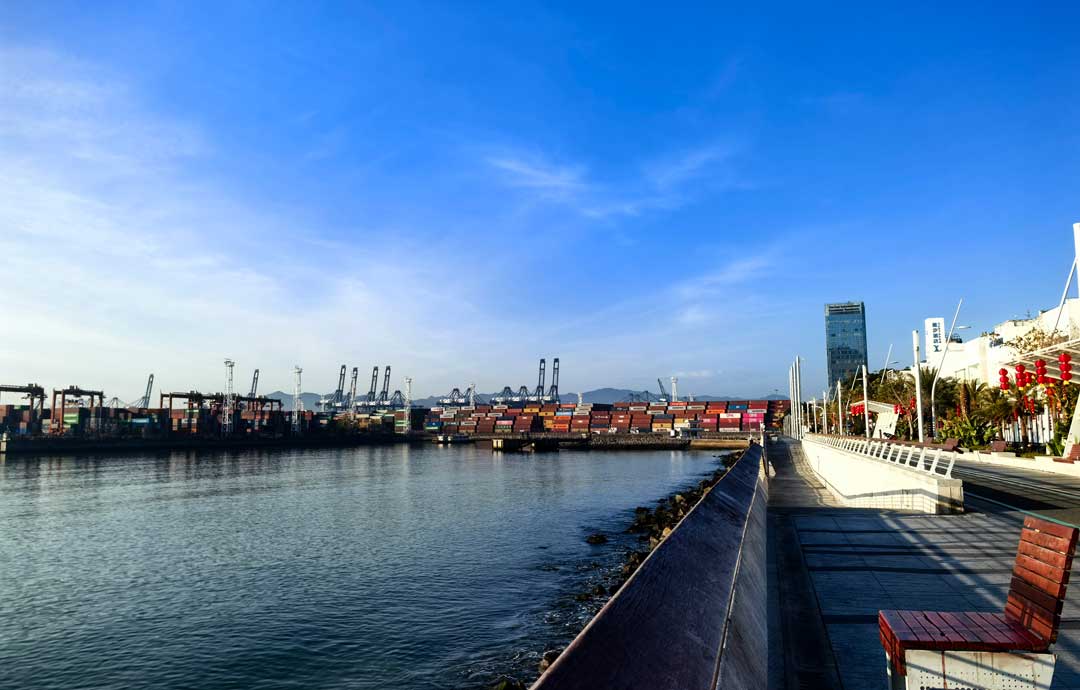
The harbor sits at the mouth of the Hudson River. Its core waters are Newark Bay, the Arthur Kill and the Kill Van Kull, extending west to the Newark Bay shoreline and east out to sea via the New York Harbor channel. The main channel was dredged to 50 feet and is designed for 18,000 TEU class vessels.
The harbor's layout drives its operating character. Container terminals cluster on the New Jersey side along the west bank of Newark Bay; the New York side has only Howland Hook on Staten Island and Red Hook in Brooklyn, reached by cross-harbor bridge or tunnel. A pickup or drayage plan that looks only at the terminal name and not the state can easily miscalculate cross-state drive time. Each terminal's location and operator is listed in the terminal table below.
The Port Authority handles terminal leases, channel dredging and cross-harbor rail and road infrastructure, but does not touch individual shipments. Terminal rates are published centrally by the New York Terminal Conference, yet each terminal still sets its own free-storage period, appointment rules and working windows, so operations follow each terminal's published schedule.
| Item | Detail |
| Chinese name | Port of New York and New Jersey |
| English name | Port of New York and New Jersey |
| Port code | USNYC (UN/LOCODE) |
| Port authority | The Port Authority of New York and New Jersey (PANYNJ) |
| Official website | www.panynj.gov/port |
| Tariff publisher | New York Terminal Conference (NYTC), tariffs filed under FMC Agreement No. 008005-009 |
| Truck service center | (908) 354-4044, handles gate, pass and operations issues |
| Port truck pass | Port Truck Pass, 877-822-9296 |
| Terminal access credential | TWIC card general enrollment, 855-347-8371 |
| Customs port code | 4601 (New York/Newark Area) |
Carrier service scope on China-US lanes spans operators such as COSCO, ONE and Hapag-Lloyd; each publishes its own berth and terminal plan per sailing.
The harbor has six active container terminals. They are listed below with operator, berths and the contact details each terminal publishes.
| Terminal | Location | Operator | Berths | Address and telephone | Notes |
| APM Terminals Elizabeth | Elizabeth, New Jersey | APM Terminals Elizabeth, LLC (Maersk group) | 88, 90, 92, 94, 96, 98 | 5080 McLester Street, Elizabeth, NJ 07207, (908) 558-6000 | Second-largest terminal in the port, about 350 acres, lease extended to 2062, over USD 500 million planned to raise handling capacity |
| Maher Terminals | Elizabeth, New Jersey | Maher Terminals, LLC (Macquarie Infrastructure fund) | Per terminal publication | 1210 Corbin Street, Elizabeth, NJ 07201, (908) 527-8200 | Largest and highest-volume terminal; a public terminal serving Ocean Alliance members and other independent carriers; lease extended to September 2063 |
| Port Newark Container Terminal (PNCT) | Port Newark, New Jersey | Ports America | 51, 53, 55, 57, 59, 61 | 241 Calcutta Street, Port Newark, NJ 07114, (973) 522-2200 | One of the port's oldest container terminals, lease through 2050, linked directly by ExpressRail to CSX and Norfolk Southern |
| Port Liberty Bayonne (formerly GCT Bayonne) | Jersey City, New Jersey | Port Liberty Bayonne, LLC | Per terminal publication | 302 Port Jersey Boulevard, Jersey City, NJ 07305, (201) 451-5200 or (646) 461-4515 | Deepwater berths able to take post-Panamax and ultra-large container vessels, absorbing part of the port's volume, lease through 2047 |
| Port Liberty New York (formerly GCT New York, Howland Hook) | Staten Island, New York | Port Liberty New York, LLC | Per terminal publication | 300 Western Avenue, Staten Island, NY 10303, (718) 568-1700 or (646) 461-4515 | Main New York-side container terminal, on the Kill Van Kull, also handles breakbulk and project cargo, lease through 2047 |
| Red Hook Container Terminal (RHCT) | Brooklyn, New York (with a Port Newark depot) | Red Hook Container Terminal, LLC | Newark depot berths 2, 4, 6 | 70 Hamilton Avenue, Brooklyn, NY 11231, (718) 875-0777; Newark depot 138 Marsh Street, Port Newark, NJ 07114, (973) 522-0999 | Multi-purpose terminal handling both containers and breakbulk; the Red Hook Brooklyn operation was transferred by the Port Authority to the NYC Economic Development Corporation in June 2024 |
Elizabeth and Newark terminals both sit on the west bank of Newark Bay close together, so a truck can complete pickup at one terminal and empty return at another in a single trip. Bayonne is across the Arthur Kill, and Staten Island requires a cross-harbor bridge or tunnel. Actual drive time between the three areas can be disproportionate to straight-line distance in peak season.
Loaded volume and total throughput are two different measures. By total throughput including empties the port ranks third in the United States behind Los Angeles and Long Beach; by loaded containers it ranks second nationally and first on the East Coast, which means its empty repositioning share is lower than the West Coast ports and its import and export loaded mix is relatively balanced. In 2025 full-year loaded imports rose 1.7 percent and loaded exports rose 6.5 percent. The port sustains more than 580,000 industry jobs in the US Northeast.
| Year | Throughput | Note |
| 2024 | About 8.7 million TEU | Up about 11 percent year on year, the port's third-highest year on record |
| 2025 | 5,955,798 loaded TEU | Up 2.8 percent; second in loaded TEU nationally, first on the East Coast |
Among East Coast ports, New York and New Jersey, Savannah, the Virginia port complex and Charleston form the four main container gateways. In 2024 New York and New Jersey handled about 44 percent of the four ports' combined volume, making it the primary East Coast gateway and the first US East Coast call for most trans-Atlantic services.
There are two basic routings from China to the US East Coast, with clearly different cost and time profiles.
| Routing | Ocean and intermodal time | Total transit | When to use |
| All-water direct (via Panama Canal) | Ocean 25 to 30 days | 30 to 40 days | Cost-first, bulk cargo with ample inventory cycle |
| West Coast discharge plus rail | Ocean 14 to 18 days plus rail 3 to 7 days | 20 to 28 days | Time-first cargo that can absorb rail surcharges |
Panama Canal capacity is the main uncertainty on this lane. The 2023 drought cut transit slots and lengthened waits, pushing some vessels onto other routes and directly lifting all-water East Coast time and cost; water levels have since recovered but seasonal risk remains. Cargo bound for the East Coast should build canal conditions and port congestion into the delivery buffer together. The broader East versus West Coast port picture is covered in the US ports overview section.
| Origin port | All-water arrival | West Coast rail total | Note |
| Shanghai to New York | About 28 to 32 days | 22 to 28 days | Industry public measured reference value |
| Ningbo to New York | About 29 to 33 days | 22 to 28 days | East China load, dense all-water sailings |
| Shenzhen Yantian to New York | About 30 to 35 days | 25 to 28 days | South China sea-rail advantage more visible |
| Qingdao to New York | About 30 to 35 days | 24 to 30 days | North China port, confirm weekly Panama-direct sailings |
Transit figures need a stated basis. The all-water arrival above counts sail date to vessel berthing at New York and New Jersey, excluding both ends' handling; door-to-door total also adds origin consolidation and customs, discharge and availability, clearance, pickup and inland delivery. On the West Coast rail routing the rail leg swings with inland ramp congestion, and its peak-season swing is larger than the ocean leg. Transport mode and quote basis are covered in the China-US freight section and the FCL ocean freight section.
| Carrier | Main service | Typical berth | Note |
| Maersk | Trans-Pacific and trans-Atlantic | Elizabeth (APM terminal) | Terminal and carrier under one group, stable berthing |
| MSC | Independent trans-Pacific | Per sailing | Largest global fleet, high East Coast call frequency |
| COSCO | Ocean Alliance trans-Pacific (via Panama) | Public terminals such as Maher | Direct New York sailings from East and South China |
| CMA CGM | Ocean Alliance trans-Pacific | Public terminals such as Maher | Both all-water and sea-rail products |
| Evergreen | Ocean Alliance trans-Pacific | Public terminals such as Maher | Stable weekly structure |
| OOCL | Ocean Alliance trans-Pacific | Public terminals such as Maher | East Coast mostly Panama-direct |
| Hapag-Lloyd | THE Alliance trans-Pacific | Per sailing | European owner, trans-Atlantic and trans-Pacific networks combined |
| ONE | THE Alliance trans-Pacific | Per sailing | Good schedule reliability |
| Yang Ming | THE Alliance trans-Pacific | Per sailing | Calls at East and South China |
| ZIM | East Coast express | Per sailing | Panama-direct East Coast express product |
Maher Terminals is the port's largest public terminal, where Ocean Alliance members and other independents berth, so one terminal can hold boxes from several carriers. APM Terminals Elizabeth's flow is tied closer to Maersk's own services. Terminal ownership decides the appointment platform, free-storage period and empty-return point, so confirming the carrier and berthing terminal at booking matters more than confirming the destination port alone. Carrier service scope on these lanes is described on the COSCO, CMA CGM, Evergreen and MSC carrier pages.
| Item | Note |
| Appointment method | Each terminal runs its own appointment system, no shared platform. Truckers must register and schedule per terminal. |
| Gate requirement | Driver must hold a TWIC card; the vehicle needs a valid appointment record and confirmed chassis availability. |
| Cross-area travel | Elizabeth and Newark terminals sit adjacent and can share one trip; Bayonne and Staten Island need a cross-harbor bridge or tunnel, timed separately. |
| Working window | Typically weekday day shifts; each terminal publishes its weekly gate sheet; some terminals open off-peak night gates. |
| Empty return | Return point set by the carrier per box type and owner; the pickup terminal and empty point for one shipment often differ. |
| Chassis | Several chassis pools in the port; pool availability swings with daily volume and must be confirmed before pickup. |
Because terminal appointment systems do not interconnect, the port has no single booking platform but does run a unified truck service center and port pass mechanism for gate and operations exceptions. Cross-area dispatch needs a separate appointment per leg, so the drayage plan should be set per terminal, not once for the whole shipment. The full post-arrival sequence is in the pickup process section below.
Inland distribution at New York and New Jersey runs mainly on rail, with the port-side rail network built by the Port Authority and called ExpressRail.
For inland-delivery cargo, choosing sea-rail removes one in-port transfer and shifts the terminal free-storage pressure onto the rail leg. Rail-leg time swings mainly with inland ramp congestion and needs buffer in peak season. Inland rail delivery is outside the destination-port service scope and must be confirmed at booking as including the rail leg.
| Item | Detail |
| Authority | US Customs and Border Protection (CBP) |
| Port code | 4601 (New York/Newark Area, covering New York and New Jersey seaport container business) |
| Port office | 1210 Corbin Street, Elizabeth, NJ 07201 |
| Telephone | (201) 443-0250 |
| Office hours | Monday to Friday 07:00 to 16:00 Eastern Time |
| Electronic filing | ACE |
| Advance manifest | ISF 10+2, must be filed at least 24 hours before loading |
| Air side | Newark Liberty International Airport (EWR) shares port 4601; John F. Kennedy International Airport is port 4701 |
The New York and New Jersey port's coverage includes both seaport and Newark airport air cargo, so sea-air cargo is filed within one customs-port system. The entry must be filed at the actual arrival port; a mismatch between the port code and the actual discharge port causes rejection. Filing steps, documents and common rejection reasons are in the US customs information section; the scope of tariff and additional duties is in the 2026 US customs policy and additional tariff section.
Elizabeth and Newark terminals sit adjacent; if one trip can combine pickup and empty return, truck round trips drop sharply. In practice this depends on whether the empty-return point is in the same area and whether appointment slots align. Destination-port service scope is described in the FCL ocean freight section and the LCL ocean freight section.
| Item | Basis |
| Terminal free storage | Set by each terminal's published tariff; dry boxes commonly 3 to 5 days, reefers shorter |
| Last Free Day (LFD) | Past this day without pickup, the terminal starts charging storage (demurrage) per day |
| Carrier free time | After the box leaves the terminal without timely empty return, detention accrues from pickup to empty return |
| Relation of the two | Independent, with different start dates; one shipment can incur both at once |
| Tariff publisher | Terminal tariffs published by the New York Terminal Conference; each terminal sets free days and step charges in its tariff |
| Extending free time | A service contract can set a longer free period; if customs hold blocks pickup, a written extension can be filed with the terminal using the hold document |
Federal Maritime Commission rules on demurrage and detention billing took effect on May 28, 2024, stating that a carrier or terminal may issue a bill to only one party, the contracting party or the consignee, not both; the invoice must be issued within 30 days of the charge; the billed party has a 30-day dispute window; and if the invoice lacks required information the billed party has no payment obligation. When a bill arrives, first check the billed party and whether the invoice information is complete, which is the standard way to handle disputes.
CBP examines import containers on a risk basis; the exam instruction goes through ACE to the broker, who then notifies the cargo owner.
Common exam triggers include description mismatched to goods, low declared value, categories needing FDA or USDA pre-clearance, unclear origin marking and random selection. A container held by CBP that cannot be picked up within free time can apply for a free-time extension per terminal rules using the hold document, submitted before the Last Free Day. Exam and policy basis are in the US customs information section and the US customs import and export policy section.
When cargo cannot clear at destination or the consignee gives up pickup, return is one option, moving the exported goods back to China or another country.
Besides return, there are resale, destruction and abandonment. Resale is usually lower cost but needs a buyer and a destination change; destruction suits low-value or unsellable goods and must follow US environmental rules. When clearance fails, compare the landed cost of each option before deciding, rather than defaulting to return.
Terminal work stops or scales back on US federal legal holidays. In 2026 there are 11 federal legal holidays in total.
| Date | Day | Holiday |
| January 1 | Thursday | New Year's Day |
| January 19 | Monday | Martin Luther King Jr. Day |
| February 16 | Monday | Washington's Birthday |
| May 25 | Monday | Memorial Day |
| June 19 | Friday | Juneteenth National Independence Day |
| July 3 | Friday | Independence Day observed (July 4 falls on Saturday) |
| September 7 | Monday | Labor Day |
| October 12 | Monday | Columbus Day |
| November 11 | Wednesday | Veterans Day |
| November 26 | Thursday | Thanksgiving Day |
| December 25 | Friday | Christmas Day |
East Coast ports must also watch hurricane season. From June to November each year, when a hurricane makes landfall or approaches, the port may close temporarily and gate and rail work stop together. This risk overlaps the August to October peak, so shipment plans need buffer. The overall US holiday schedule is in the US holidays overview section.
The East Coast peak roughly tracks the West Coast peak, but the East adds a layer of rail-leg pressure. Cargo going West Coast plus rail can see inland ramp waits stretch markedly in peak season, with a larger swing than all-water direct. So in peak season, path choice should weigh not just average transit but that path's peak-season stability.
The limits must be seen too. Terminals spread across New York and New Jersey sides with no shared appointment system, so cross-area dispatch needs separate planning; empty-return points set by the carrier often differ from the pickup terminal, easily causing chassis separation and extra driving; Panama Canal capacity hits all-water timing directly and is hard to predict. When planning East Coast shipments, these limits deserve more attention than comparing sail-day counts alone.
Yes, one harbor. All three belong operationally to the Port of New York and New Jersey (USNYC), managed by the Port Authority of New York and New Jersey. Newark is a district name inside the harbor, where container terminals cluster on the New Jersey side of Newark Bay.
UN/LOCODE is USNYC; the CBP filing port code is 4601 (New York/Newark Area), covering both New York and New Jersey seaport container business and Newark Liberty International Airport's air side.
All-water via the Panama Canal: Shanghai about 28 to 32 days to arrival, Ningbo about 29 to 33, Shenzhen Yantian about 30 to 35; door-to-door is usually 30 to 40 days. West Coast discharge plus rail is usually 20 to 28 days total, 5 to 12 days faster than all-water.
It depends on the inventory cycle and cost structure. All-water costs less and needs no transshipment but is longer and exposed to Panama Canal capacity; West Coast rail is 5 to 12 days faster but adds inland rail surcharges with larger peak-season swing. Cargo with ample inventory and cost sensitivity suits all-water; tight replenishment suits sea-rail.
Six active: APM Terminals Elizabeth, Maher Terminals, Port Newark Container Terminal, Port Liberty Bayonne, Port Liberty New York (Howland Hook) and Red Hook Container Terminal. Elizabeth and Newark are on the New Jersey side, Bayonne is in Jersey City New Jersey, and Howland Hook and Red Hook are in New York State.
No. Each terminal runs its own appointment system with no shared platform, so truckers must register and schedule per terminal. The port runs a unified truck service center and port pass mechanism for gate and operations exceptions.
The driver must hold a TWIC card, the mandatory access credential for entering seaport terminals. The vehicle needs a valid appointment record for that terminal and confirmed chassis availability.
The empty-return point is set by the carrier per box type and owner, so the pickup terminal and empty point for one shipment often differ. Terminals sit on both harbor sides, and cross-area return adds drive distance and risks chassis separation, so the return point must be confirmed before dispatch.
Free storage is set by each terminal's published tariff; dry boxes commonly 3 to 5 days, reefers shorter. Terminal tariffs are published by the New York Terminal Conference, but the exact days differ per terminal in its tariff, so operations follow the actual berthing terminal's tariff.
Demurrage is the charge for a container past free time in the terminal yard, accruing from discharge to pickup and exit; detention is the charge for a container taken from the terminal but not returned empty on time, accruing from pickup to empty return. The two are calculated independently with different start dates and can occur together.
Yes. Federal Maritime Commission demurrage and detention billing rules took effect May 28, 2024: a carrier or terminal may bill only one party, the contracting party or the consignee, not both; the invoice must be issued within 30 days, and the billed party has a 30-day dispute window; if the invoice lacks required information the billed party has no payment obligation.
Mainly return, resale, destruction and abandonment. Return needs a US export declaration and a China import declaration; original-condition return for quality or specification reasons can claim relief from Chinese import duty and related taxes within the prescribed period. Resale is usually lower cost but needs a buyer and a destination change. Compare landed cost before deciding.
Shipping from China to USA
Planning a shipment or just comparing options? Contact our freight experts to get a tailored rate within 24 hours.
