
San Diego, California sits at the southern tip of the state, next to the US-Mexico border, and San Diego Bay is a natural deep harbor. In the US port system its identity is a specialized seaport: it does not take Asia-direction trunk container services, and its main business is vehicle roll-on/roll-off, refrigerated cargo and break-bulk. For China exporters the value concentrates in three places: dedicated ro-ro and vehicle facilities, the location facing the US Southwest market, and the position right next to the border customs crossing.
| State | California |
| Bay | San Diego Bay, a natural deep harbor |
| Time zone | Pacific Time (PST / PDT) |
| Distance to Los Angeles | About 190 km by road, about 2 to 3 hours' drive |
| Distance to US-Mexico border | Tenth Avenue Terminal about 15 miles; National City Terminal about 10 miles |
| Main highways | I-5, I-8, I-15, I-805 |
| Local port nature | Specialized seaport, mainly vehicle ro-ro, refrigerated and break-bulk cargo |
San Diego Bay is a long, narrow natural harbor with a limited entrance and calm water inside, suited to berth work. The bay divides into a north and a south section: the north side near downtown is cruise and leisure piers, and the south side near National City is the cargo piers. This layout puts San Diego's cargo facilities on the south section, away from the downtown core, avoiding conflict between cargo traffic and city traffic.
San Diego's customs port code is 2501, with the office on the west side of Terminal 2 of San Diego International Airport, handling local import filing, exam and release. The port's supervisory unit is the San Diego Field Office; administrative office hours and terminal operating hours are set separately.
| Port name | San Diego, California |
| Port code | 2501 |
| Office address | 3835 N. Harbor Drive, Terminal 2 West, San Diego, CA 92101 |
| Telephone | +1 619-491-2600 |
| Fax | +1 619-491-2624 |
| Port director | Mariza Marin |
| Supervising field office | San Diego Field Office |
| Administrative hours | Monday to Friday 09:00 to 17:00 |
| Airport and seaport operating hours | 06:00 to 22:00, seven days a week |
| After-hours contact | (619) 550-9079 (on-duty supervisor) |
The port's trade and customs support window is inside Terminal 2 of the airport, open Monday to Friday 09:00 to 17:00, at the Global Entry lane. Import cargo to be filed at the San Diego port can use this window or the port's unified channel to submit documents. Aircraft landing-permit applications and inquiries are handled on the landing-permit line.
The San Diego waterfront is managed by the San Diego Unified Port District, a special district established by the California State Legislature on December 18, 1962. Its jurisdiction covers the bay waters and the adjacent land, with about 34 miles of shoreline, 2,404 land acres and 3,677 water acres.
| Managing agency | San Diego Unified Port District |
| Established | December 18, 1962 (by the California State Legislature) |
| Governance | Seven-member Board of Port Commissioners |
| Member cities | San Diego, Coronado, National City, Chula Vista, Imperial Beach |
| Shoreline length | About 34 miles |
| Land area | About 2,404 acres |
| Water area | About 3,677 acres |
| Operating funds | Terminal tenant, real-estate and parking revenue; no tax reliance |
The district does not rely on taxes; operating funds come from terminal tenant rents, real estate and parking revenue. This financial structure means the district also runs a large amount of commercial and leisure property beyond cargo business, including the cruise terminal, hotels, museums and parks. Cargo business is concentrated at the two south-bay terminals, leased and managed by the district, while day-to-day terminal operations are run by tenants or operators.
Tenth Avenue Marine Terminal is San Diego's main multi-purpose cargo terminal, on the north bay side near downtown, about 96 acres. Its main cargo types are refrigerated and break-bulk cargo and project cargo, with mobile harbor cranes.
| Area | About 96 acres |
| Terminal nature | Multi-purpose cargo terminal |
| Berth depth | About 42 feet |
| Main imports | Refrigerated and fresh cargo, fertilizer, cement, break-bulk, forest products |
| Refrigerated warehouse | About 300,000 square feet (on terminal) |
| Cranes | Electric mobile harbor cranes |
| Other facilities | Covered storage, open yards, shore power and bunkering |
| On-site exam | Customs and agriculture on-site exam service |
The terminal's refrigerated capacity directly supports the local cargo mix: fruit, vegetables and seafood can be held in the on-terminal refrigerated warehouse after arrival, then distributed by sales rhythm. Break-bulk and project cargo are handled by mobile cranes, suited to irregular goods such as wind components and large equipment. The terminal has shore-power connections; berthed vessels can use shore power where available, cutting auxiliary-engine emissions in port.
National City Marine Terminal is on the south bay, about 135 acres, operated by the Pasha Group, handling vehicle import-export and ro-ro, with a berth depth of 35 feet. The terminal connects directly to Class I rail and sits next to I-5, I-8, I-15 and I-805.
| Area | About 135 acres |
| Operator | Pasha Group |
| Main cargo | Vehicle import-export (ro-ro), lumber, project cargo |
| Berth depth | About 35 feet |
| Rail access | Direct to Class I rail |
| Highway link | I-5, I-8, I-15, I-805 |
| Brands covered | Audi, Bentley, Chrysler, Fiat, Ford, GM, Honda, Hyundai, Isuzu, Lamborghini, Porsche, Toyota, Volkswagen and others |
Vehicle ro-ro is a distinctive San Diego business. Under ro-ro, vehicles are carried by specialized ro-ro ships and drive on or off via the stern ramp after berthing, with no containers or cranes needed. The terminal has vehicle handling facilities and yards for loading, unloading, inspection, fitting and temporary storage, then rail or road distribution by dealer spread. This model makes San Diego one of the vehicle distribution points for the US Southwest and West markets.
| Bay mouth | Natural deep harbor with a limited entrance width |
| Tenth Avenue berth depth | About 42 feet |
| National City berth depth | About 35 feet |
| Main vessel types | Ro-ro ships, reefer ships, break-bulk ships, project-cargo ships |
| Channel maintenance | By the US Army Corps of Engineers to federal channel standard |
| Trunk container service | Does not take Asia-direction trunk container services |
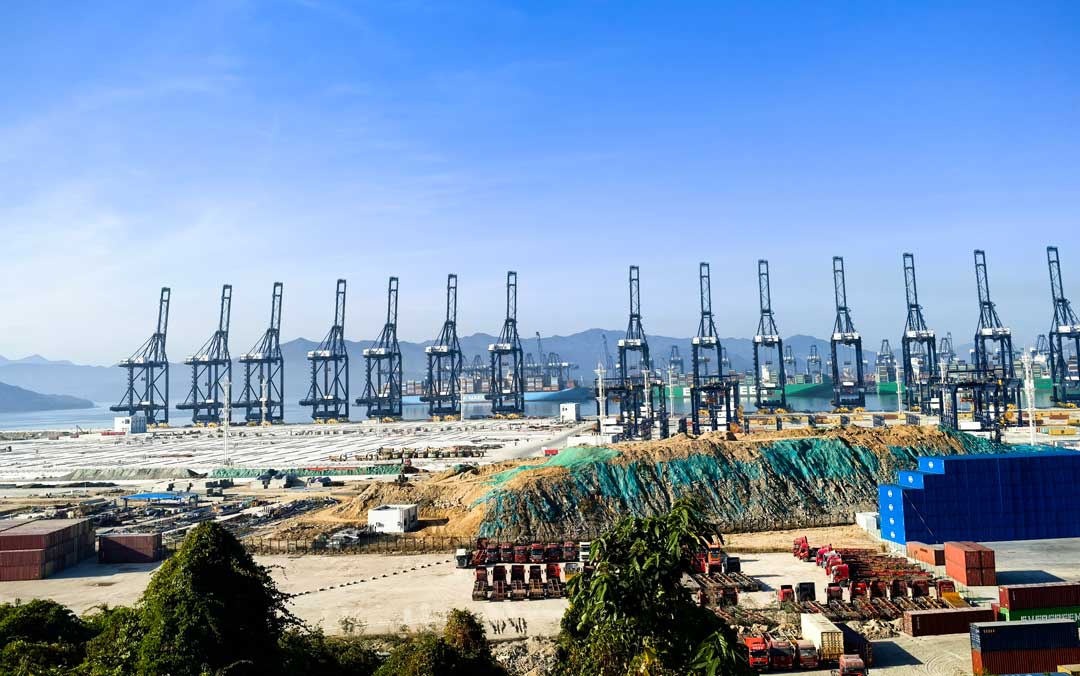
San Diego Bay's depth can take ro-ro and reefer ships, but the terminal's facilities and yard scale are not suited to continuous operation of large trunk container ships. China-direction container cargo therefore mostly enters via Los Angeles and Long Beach, then moves into San Diego by rail or road; vehicle ro-ro cargo can berth directly at San Diego. This division of labor is the core feature of San Diego's port structure.
National City Marine Terminal connects directly to Class I rail, taking whole trains or block loads of vehicles and break-bulk. Rail serves two local functions: first, vehicle distribution from the terminal inland, and second, medium-to-long-haul transport to the US central and eastern markets.
| Railroad | Access |
| Class I rail | National City Marine Terminal connects directly |
| Cargo handled | Vehicles, break-bulk and project cargo |
| Regional network | Into the US West and Midwest network via the Southern California corridor |
| Port linkage | Los Angeles and Long Beach container cargo transfers by land-bridge rail |
San Diego sits at the end of the Southern California rail and road corridor, joining the transcontinental rail network via the Los Angeles metro to the north and reaching Arizona via I-8 to the east. For container cargo moved by land bridge, the common practice is to discharge at Los Angeles or Long Beach and rail on to San Diego; vehicle cargo can be loaded and distributed at the local terminal directly.
| Highway | Course and role |
| I-5 | North-south trunk; north to Los Angeles, south to the US-Mexico border |
| I-8 | East-west trunk; east to Arizona |
| I-15 | Northeast arterial to the Inland Empire and Las Vegas direction |
| I-805 | City bypass, diverting through cargo traffic |
San Diego's highway network centers on I-5, linking north to Los Angeles and Long Beach and south to the US-Mexico border crossing. I-8 and I-15 reach east and northeast, forming road access across Southern and Southwestern California markets. From San Diego, a one-day drive covers the Los Angeles metro, the Inland Empire and Western Arizona; a two-day drive reaches a much wider area. This position lets San Diego serve Southern California and act as a node for Southwestern border trade.
San Diego has Foreign-Trade Zone 153, with the City of San Diego as grantee, covering all of San Diego County and western Riverside County; imported cargo can be stored, sorted and non-duty-processed without duty paid.
| Zone number | FTZ 153 |
| Approved | October 14, 1988 |
| Grantee | City of San Diego |
| Service area | All of San Diego County and western Riverside County |
| Activation cap | 2,000 acres (about 37 acres activated) |
| On-site firms | DHL Global Forwarding, Audio-Technica, Domo Manufacturing and others |
| Subzone firms | Callaway Golf, National Steel and Shipbuilding Company (NASSCO) and others |
Goods in the zone are stored, sorted, labeled or re-exported without duty paid; duty payment is deferred until the goods leave the zone into the US market. San Diego's zone firms are mostly warehousing-logistics, electronics and manufacturers, with shipbuilders using zone arrangements to store imported equipment and parts. Applicability and any rate-choice benefit need a per-shipment check against commodity and HS code.
China-export container cargo to San Diego has two common paths: one is ocean to Los Angeles or Long Beach, then rail or road into San Diego; the other is ocean to San Diego's local port, taking ro-ro and refrigerated cargo. Container cargo mainly uses the first path.
| Route | Ocean leg | Inland leg | Door-to-door common range |
| China major ports to Los Angeles or Long Beach, then rail or truck to San Diego | About 13 to 20 days | About 2 to 4 days | About 20 to 28 days |
| China major ports to San Diego local terminal (ro-ro and refrigerated cargo) | About 15 to 22 days | About 2 to 4 days | About 22 to 30 days |
| Ocean LCL (with consolidation and devanning) | About 16 to 24 days | About 4 to 7 days | About 26 to 34 days |
| Air to San Diego or Los Angeles hub | -- | -- | About 4 to 8 days |
The above ranges are the common overlap after cross-checking several forwarders' transit tables; they exclude cut-off, clearance and peak queue time and are not a delivery commitment. The West Coast ocean leg is short, so the total transit is favorable among US ports. In peak, space and inland capacity on the Los Angeles-Long Beach side are tight, and San Diego-bound cargo can be affected by upstream nodes.
San Diego International Airport (SAN) is the local air port and one of the fewer single-runway commercial airports in the US. The port office sits inside Terminal 2 of the airport. Per the airport authority FY2025 report, the airport handled 25,175,598 passengers and 116,703 tons of mail and cargo for the fiscal year.
| Item | Detail |
| Airport | San Diego International Airport (SAN) |
| Port office location | West side of Terminal 2, marked with international-arrival signage |
| FY2025 passengers | 25,175,598 (calendar-year 2025 about 25,320,000, a record high) |
| FY2025 mail and cargo | 116,703 tons (of which 103,722 tons freight) |
| Aircraft movements | 230,613 (FY2025) |
| Main transfer | Large and palletized cargo usually via the Los Angeles hub |
SAN is mainly a passenger airport, with belly capacity concentrated on domestic and long international routes. International air large and palletized cargo usually transfers via hubs such as Los Angeles, then trucks in. High-value cargo needing air time can clear at the hub first, then transfer, or move in-bond sealed to the San Diego port for filing.
| Metric | Condition |
| Industrial inventory | About 117.3 million square feet |
| Vacancy | About 9.2% (Q2 2025, third-party research basis) |
| Average asking rent | About USD 16.42 per square foot per year |
| Main submarkets | Otay Mesa, Chula Vista, San Ysidro, Miramar directions |
| Border advantage | Next to the US-Mexico border crossing, suited to cross-border supply chains |
San Diego's industrial vacancy is at a middle level; land constraints limit new supply. Rent is above the US South markets and close to the overall California coastal-market level. The southern Otay Mesa area concentrates much warehousing and manufacturing, near the border crossing, suited to supply chains using both US and Mexican capacity. Long-term tenants usually lock space months ahead; choice is thinner around peak.
| Step | How |
| Pickup location | Terminal yard, or carrier-designated yard |
| Gate hours | Per the terminal's same-day published gate window; book ahead |
| Documents needed | Arrival notice, released bill of lading, customs release receipt, pickup authorization |
| Chassis | Provided per carrier and yard arrangement |
| Empty return | At the carrier-designated yard |
| Overdue fees | Beyond free storage, per carrier and yard rules |
Pickup needs advance booking and the carrier's authorization documents. Box free storage at the yard follows carrier and yard rules; overdue incurs storage. The empty-return point may differ from the pickup point; confirm per carrier instruction before handoff. Ro-ro and refrigerated cargo pickup differs from containers and needs separate confirmation with the terminal and operator plan.
The San Diego port can file, exam and release; imported cargo can be entered and released at the port of entry then moved in, or moved in-bond sealed to this port and filed here. In-bond needs filing and bond at entry and arrival at the destination port within the set period.
| Step | Note |
| Filing method | File at port of entry, or in-bond sealed to this port then file |
| Exam site | Designated by port, using terminal, yard and bonded-warehouse conditions |
| Exam types | Document review, NII scan and physical exam, by risk rating |
| On-site exam service | Tenth Avenue Terminal has customs and agriculture on-site exam |
| Pickup after release | By release receipt |
Exam ratio follows risk rating; consistency of name, value and origin affects selection. Inconsistent documents between papers are a common delay; commercial invoice, packing list and bill of lading names, quantities and amounts need line-by-line check. Wood-packaged goods need IPPC fumigation marks; agricultural and food cargo must meet agriculture quarantine rules.
| Party | Hours |
| Port administration | Monday to Friday 09:00 to 17:00 |
| Port trade and customs support | Monday to Friday 09:00 to 17:00 |
| Airport and seaport operations | 06:00 to 22:00, seven days a week |
| After-hours contact | (619) 550-9079 (on-duty supervisor) |
| Terminal gate | Per the terminal's same-day published window |
The port's administration and terminal operating hours are set separately; airport and seaport on-site work runs 06:00 to 22:00, seven days a week. US federal holidays affect office and terminal work; New Year, Independence Day, Thanksgiving and Christmas are usually full-day closures; MLK Day, Presidents Day, Memorial Day, Labor Day and Columbus Day follow federal holiday scheduling. The Friday after Thanksgiving and the days around Christmas see some warehouses and yards shorten hours or rotate; count this in year-end planning.
The import peak usually lands August to October, in sync with West Coast ports, when space and inland capacity are tight. November and December are a fall after the pre-holiday rush; January to February is low season with lower volume. March volume starts to recover; April to June is a relatively steady window. Agricultural and fruit cargo, affected by the Southern Hemisphere season, swings on a different cycle from container cargo.
Peak and off-peak mainly hit upstream nodes: ocean rate swings follow carrier capacity, while Los Angeles-Long Beach space and inland capacity tighten in peak. In peak, submit pickup booking three to five days ahead and buffer one or two days. Vehicle ro-ro sailings are relatively independent and should be scheduled by the carrier's ro-ro sailing plan.
Together, San Diego suits two needs: first, vehicle and ro-ro cargo import-export, and second, refrigerated and break-bulk distribution for the Southern and Southwestern California markets. For importers needing large FCL volumes, container cargo still must arrange the inland leg from trunk ports such as Los Angeles and Long Beach; San Diego's local role is a specialized complement.
It has cargo terminals, but the main business is ro-ro, refrigerated and break-bulk cargo. San Diego runs two cargo facilities, Tenth Avenue Marine Terminal and National City Marine Terminal, and does not take Asia-direction trunk container services. Container cargo mostly enters via Los Angeles and Long Beach, then moves into San Diego.
Per the cross-checked published transit tables of several forwarders, ocean to Los Angeles or Long Beach is commonly about 13 to 20 days, and door to door after the inland leg about 20 to 28 days; direct to San Diego local terminal for ro-ro and refrigerated cargo is about 22 to 30 days. Air is commonly about 4 to 8 days. Actual time follows the carrier's basis at booking.
Vehicle business is concentrated at National City Marine Terminal, operated by the Pasha Group. After the ro-ro ship berths, vehicles drive on or off via the stern ramp, with no containers or cranes needed. The terminal has vehicle handling facilities and yards for loading, unloading, inspection and temporary storage, covering Audi, Toyota, Porsche and other brands.
Yes. San Diego port code 2501 has filing, exam and release capability. Cargo can be entered and released at the port of entry then moved in, or moved in-bond sealed to this port and filed here; in-bond needs filing and bond at entry.
The waterfront is managed by the San Diego Unified Port District, a special district established in 1962 with about 34 miles of shoreline, 2,404 land acres and 3,677 water acres. Day-to-day terminal operations are run by tenants or operators, with vehicle business at National City handled by the Pasha Group.
Pickup is at the terminal yard or the carrier-designated yard. The trucking company books a slot with the arrival notice, released bill of lading, customs release receipt and pickup authorization; gate hours follow the terminal's same-day window. Ro-ro and refrigerated cargo pickup differs from containers and needs separate confirmation with the terminal and operator plan.
Yes. National City Marine Terminal connects directly to Class I rail, taking whole trains or block loads of vehicles and break-bulk. Los Angeles-Long Beach container cargo usually transfers by land-bridge rail into San Diego, while vehicle cargo can be loaded and distributed at the local terminal directly.
FTZ 153 has the City of San Diego as grantee, covering San Diego County and western Riverside County, with a 2,000-acre activation cap. Goods in the zone can be stored, sorted and re-exported without duty paid, deferring duty to when they enter the US market. Applicability needs a case-by-case check against commodity and HS code.
Local industrial inventory is about 117.3 million square feet, vacancy about 9.2%, average asking rent about USD 16.42 per square foot per year. Otay Mesa concentrates much warehousing and manufacturing, near the border crossing, suited to supply chains using both US and Mexican capacity.
The import peak is usually August to October, when space and inland capacity are tight. November and December are a fall; January to February is low season. In peak, submit pickup booking three to five days ahead and buffer one or two days; vehicle ro-ro cargo is scheduled by the carrier's ro-ro sailing plan.
Shipping from China to USA
Planning a shipment or just comparing options? Contact our freight experts to get a tailored rate within 24 hours.
