
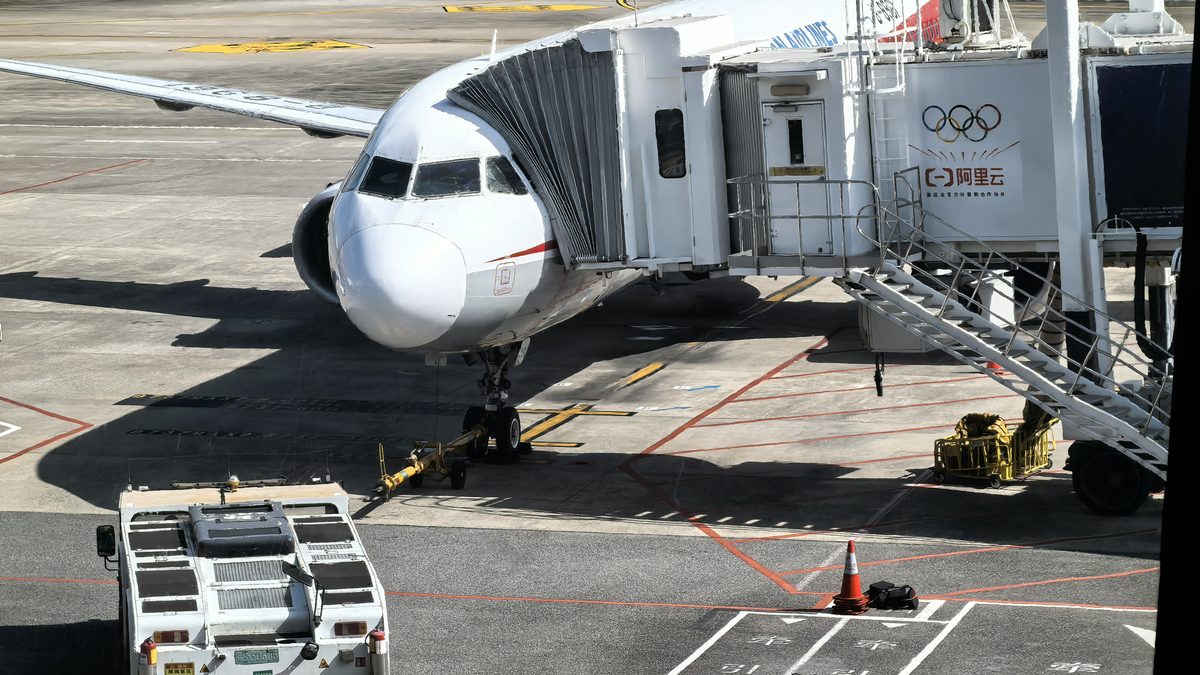
China Airport to US Airport Air Freight Service
Airport-to-airport is the traditional form of international air freight: a Chinese forwarder books the space and tenders the cargo at the Chinese airport, and a US forwarder clears it at the American airport. It is the cheapest of all China–USA air services, and it is what most commercial importers use.
How the airport-to-airport service works
Under this service the Chinese air freight forwarder is responsible for everything up to uplift: booking the airline space, preparing and checking the air waybill, arranging delivery of the cargo from the factory to the airport customs supervision warehouse, security screening, build-up and China export customs declaration. The US air freight forwarder takes over on arrival and handles import clearance, airport handling and inland delivery if required.
The commercial trigger for this split is almost always the trade term. When a Chinese seller and a US buyer agree FOB — FOB Shanghai, FOB Shenzhen, FOB Guangzhou and so on — the seller's obligation ends when the cargo is handed over at the named Chinese airport. The US buyer, who is usually a company with a long-standing relationship with a US forwarder, only needs a Chinese forwarder to book the uplift, and normally pays the air freight directly to that Chinese forwarder by bank transfer from the United States.
On the Chinese side the forwarder selects the flight and the routing, agrees the air freight rate, liaises with the supplier or trading company to get the cargo to the airport warehouse on time, verifies the air waybill against the commercial documents, and settles the airline and airport charges.
Partial load-in: the most common surprise
Air freight is not always a single flight. When a consignment is large, the airline may not be able to lift it all on one departure and will split it across several flights. A worked example from our own files:
A consignment of 1,000 cartons tendered at Shanghai Pudong for Indianapolis (IND) on China Southern. CZ's routing is PVG – ORD – IND, and on a combi aircraft the carrier accepts a maximum of about 10 CBM per departure. The 1,000 cartons therefore need three flights to reach Chicago, with the final leg trucked from O'Hare to Indianapolis. In practice the first part arrives a day or two before the rest, and the US forwarder has to clear and deliver the early cartons rather than wait for the complete consignment.
This is normal, not a service failure — but it is the reason a competent US forwarder matters: somebody has to be ready to clear partial arrivals and deliver them as they land.
Why two local forwarders beat one remote one
Because air freight is time-critical, only a genuinely local operation on both ends can handle the handover without delay. Each side brings something the other cannot:
- The Chinese forwarder knows the local export process, can palletise and build up cargo, and has working relationships with the airline cargo managers at each Chinese airport;
- The US forwarder provides professional import clearance, airport handling and warehouse and delivery services at the destination.
Used together, they deliver the fastest transit and the lowest total cost. Airport-to-airport is also the cheapest of all China–USA air services, because the customer is buying only the flight and the two ends' handling — not door delivery, not duties, not brokerage.
The main cargo airports on the lane
Airport-to-airport service is essentially a network of large hub airports. On the Chinese side the principal gateways are Shenzhen (SZX), Guangzhou (CAN), Shanghai (PVG), Hong Kong (HKG) and Beijing (PEK). The United States has more major cargo airports than China, including Los Angeles (LAX), New York (JFK), Chicago (ORD), Houston (IAH), San Francisco (SFO), Miami (MIA), Newark (EWR), Washington Dulles (IAD), Atlanta (ATL) and Honolulu (HNL), plus Canadian gateways such as Vancouver (YVR) and Montreal (YUL) that are frequently served on the same rotations.
Frequently asked questions
What does airport-to-airport air freight include?
It includes airline booking, the air waybill, delivery to the Chinese airport customs supervision warehouse, export security screening, build-up and China export customs declaration on the origin side, and airline handling on arrival. Import clearance, duties and inland delivery in the USA are separate services.
Which trade term normally goes with airport-to-airport air freight?
FOB. Under FOB the Chinese seller delivers the cargo to the named Chinese airport and the US buyer arranges and pays for the international air freight, usually through its own US forwarder and a Chinese forwarder acting as the booking agent.
Who pays the air freight on an airport-to-airport shipment?
Normally the US consignee, by bank transfer from the United States directly to the Chinese booking forwarder. Some shippers pay on the consignee's behalf; either way the forwarder requires payment before uplift.
Why did only part of my air freight arrive in the USA?
Airlines split large consignments across several flights when the load exceeds the capacity of one departure, and combi aircraft have limited hold space. The balance follows on the next departure, usually one or two days later.
Is airport-to-airport the cheapest way to ship air freight from China to the USA?
Yes. It buys only the flight and the two ends' handling, so it is cheaper than door-to-door, airport-to-door or any express product. The trade-off is that you or your US broker must handle the import clearance and the inland delivery.
Book this China – USA air freight service
Goodhope Freight is a China-based international air freight forwarder and NVOCC (license GD20230925153335) moving air cargo from every major Chinese gateway to the United States since 2012. Send your commodity, gross weight, volume and packing list, plus the US airport or ZIP code, and we will confirm the airline, routing, cut-off and all-in rate: sales007@goodhopefreight.com or WhatsApp / WeChat +86 18938691638.