
Hunan’s only airport-side customs district, with international cargo handled at Cargo Terminal No. 3. Export cargo fails on cutoff times and belly space. Import cargo fails on inspection-site eligibility and release speed. Same airport, same broker, two different clocks — and Goodhope Freight works both.
If your import is fresh fruit, live or chilled seafood, or pharmaceuticals, Changsha Huanghua is one of the strongest airport gateways in central China — more than 70% of China’s imported lobster passes through here, and its import volumes for fruit, live aquatic products and chilled seafood all sit in the national top ten among airports. If your export is general cargo, machinery parts, electronics or e-commerce parcels, the airport works well but direct freighter capacity is thin: only four international cargo routes were operating in 2025, so most shipments move on passenger belly space or connect through Guangzhou, Shenzhen, Shanghai or Zhengzhou. Plan the routing before you plan the customs filing.
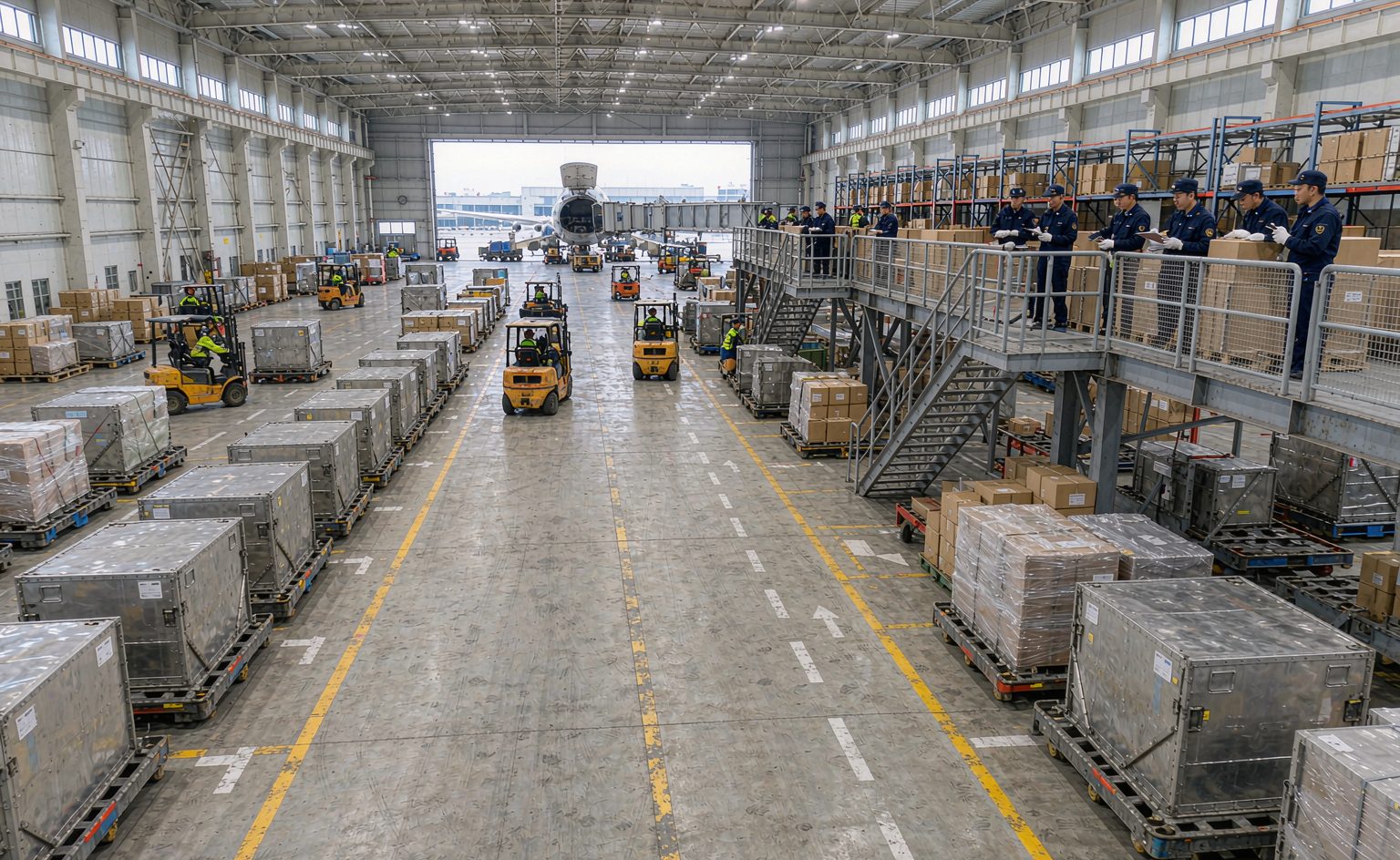
Cargo tonnage, international share and inspection-site designations are drawn from Hunan Provincial Department of Commerce, Changsha Port Office, Hunan Airport Logistics and General Administration of Customs publications covering 2025 and 2026. Designated sites are subject to the latest GACC published list; space, cutoffs and handling arrangements follow current carrier and terminal notices.
Cargo at this airport is not one building. Terminals, the e-commerce and express centers, and the bonded zone form one chain. Cargo type picks the area; the area sets the procedure.
Airport Cargo Terminal · Jichang Avenue
Best for: general air cargo, perishables, oversize pieces and charter freight
Site codes for the airport cargo terminal inspection areas: CNCSX491014 and CNCSX491067.
Four cargo terminals · 82,471 m²
Best for: charter and palletized freight, out-of-gauge equipment, cargo needing a bespoke loading plan
Oversize and heavy pieces need terminal and carrier sign-off on the load plan before the cargo is accepted.
Cross-border supervision center · International express center
Best for: e-commerce parcels, B2C direct mail, express consignments, returns and exchanges
The manifest and the declaration must share one source; order, payment and logistics data are matched line by line at inspection.
1.99 km² planned · both phases enclosed
Best for: import stocking, bonded repair, duty-deferred processing and distribution
The zone also holds a separate import live-aquatic inspection site, site code CNCSX49S306.
| Item | Export filing | Import release |
|---|---|---|
| Filing deadline | Filed after cargo reaches the supervised area and at least 24 hours before loading; advance filing opens 3 days before arrival | Filed within 14 days of the carrier declaring entry; perishables are filed on landing |
| Precondition | Space confirmed, manifest pre-built, screening passed, HS code locked | Manifest transmitted, delivery order exchanged, import permits and market access in place |
| Site work | Receiving, X-ray, pallet build, weighing, manifest close-out | Break bulk, document-to-goods check, inspection or quarantine, gate release |
| Typical failure | Cutoff earlier than assumed, actual weight above declaration, lithium cargo refused at receiving | Quarantine permit not obtained before shipment, labeling or certificate mismatch, cold chain lost during inspection |
| After release | Load and depart, close the manifest, archive the export tax-refund documents | Pickup and delivery, destination inspection, follow-up supervision |
| Who slips up | First-time air shippers who budget time the way they do for ocean freight | First-time perishable importers who treat permits as a post-arrival task |
Statutory time limits follow the Customs Law and current declaration rules. Cargo filed in advance must reach the supervised area within the permitted window or the entry is voided. Local practice may be stricter than the statute.
Air cargo here is concentrated: machinery parts, electronics and lithium batteries outbound; perishables, pharmaceuticals and bonded stock inbound. Each line has its own paperwork and its own clock.
Freighter and belly-hold channels: space booking, manifest pre-build, entry preparation, terminal receiving, release tracking through to manifest closure.
9610 retail export and 9710 / 9810 export, with the manifest and entry kept in sync, three-way data matching and exception handling at the sorting line.
Classification under the IATA Dangerous Goods Regulations: UN38.3 test summary, MSDS, air transport condition report, packaging certificate and a shipper’s declaration, checked against carrier acceptance rules.
Refund copy of the entry, release data and manifest records collected after closure. Shippers without foreign trade rights can export through a licensed entity with the paper trail kept complete.
Delivery order exchange, entry filing, duty and guarantee handling, inspection attendance, release and pickup, plus onward transit to a local customs office where needed.
Quarantine permits, certificate checks, on-site inspection and cold-chain pickup for import fruit, chilled seafood and live aquatic products, using the priority perishable channel and 24/7 appointments.
1210 bonded stocking, direct-purchase import manifests, class B express and personal items, with returns and exchanges routed back on the same data path.
Account books for bonded processing, logistics, repair and R&D; duty deferral on zone entry, internal transfers and declaration on shipment out of the zone.
Two deadlines govern everything: file at least 24 hours before loading on export, file within 14 days of entry declaration on import. Every other task is scheduled backwards from those two numbers.
Decide freighter or belly hold first. Belly space follows the passenger schedule and gets squeezed in peak season; freighter space is fixed but tight. Cutoffs differ.
Product name, HS code, declaration elements and terms of sale settled before filing. Classification disputes over machinery parts and electronics are cheaper to resolve at a desk than at an inspection bay.
With space confirmed and cargo ready, the entry can be filed up to 3 days before the cargo reaches the supervised area. Advance filing leaves no room for a correction.
Receiving, X-ray, weighing and pallet build. Lithium and liquid cargo is most often stopped here, and a refusal means a new flight.
Declared data is matched on arrival and release follows if no inspection is ordered. With an order, expect half a day to two days.
Failures fall into three groups: quantity or weight mismatch, product name or code mismatch, undeclared contents. Correction windows are short.
The manifest must match the entry data for closure. Split and consolidated shipments need reconciling at this point.
Collect the refund copy, release notice, warehouse receipts and terminal records, and archive them for the tax refund and foreign exchange write-off.
Manifest data transmits after departure. The importer needs the master and house numbers plus piece, weight and dimension data to start the delivery order and filing.
The arrival notice and bill of lading are exchanged for a delivery order. Freight collect, missing documents and mismatched consignee details all stall here.
Within 14 days of entry declaration. Perishables do not wait: file on landing, with code, value, origin and preferential certificates settled beforehand.
Pay against the assessment, or release first against a guarantee such as aggregate duty payment or a duty guarantee policy. Perishables routinely trade the guarantee fee for hours.
Fruit gets label and phytosanitary checks, seafood gets packaging and viability checks, pharmaceuticals get the customs release slip and import approval. Inspection orders are issued before landing.
Fumigation, laboratory sampling or disinfection happens at the designated site. This is the least predictable block, and cold-chain cargo needs slack here.
Release notice, pickup formalities, gate out. Perishables can use conditional release — cargo leaves before the lab result, and the result follows.
Move to the registered warehouse or destination and complete destination inspection where required. Unclosed supervision follows the importer to the next shipment.

Export paperwork fails when one page is missing and the cargo cannot be received. Import paperwork fails when a permit should have been obtained before the goods left the origin airport.
The time window in air freight is narrow. Choosing a mode is really choosing where to park the risk — before filing or after release.
File up to three days before the cargo reaches the supervised area so release and receiving run in parallel. Works for shippers with stable documents; unstable data plus advance filing equals a voided entry and a missed flight.
A summary filing gets the cargo released for pickup, with the full declaration completed inside the allowed window. Good for urgent imports: some data is traded for time, and the completion deadline is not optional.
Transit declared at the airport, inspection and release handled near the factory. Common for inland Hunan importers; the trade-off is one supervised transport leg.
Cargo entering the zone is treated as exported, so the refund can start immediately. Imports enter duty-deferred and ship out in the batches actually sold. Built for stocking and distribution.

Machinery parts and live lobster share an airport but not a procedure. One is a document accuracy problem; the other is an hours problem.
Hunan’s main export category. Many small lots with mixed part numbers — declare function and material per item, never as generic “machine parts”.
Fast model turnover and frequent brand or licensing issues. Earbuds and power banks move as battery cargo, not as ordinary electronics.
Class 9 dangerous goods. Standalone cells generally need a freighter; installed cells may fly belly hold within limits. Incomplete files are refused at receiving.
Manifest and entry from one source, with order, payment and logistics data aligned. Returns go back on the original path or the data breaks.
Market access by country and variety, phytosanitary certificate, packaging marks. Broken cold chain and labeling errors are the two common refusal reasons.
Live cargo is judged on survival rate and water condition; chilled on temperature and hours. Site experience matters more than paperwork here.
Port designation, NMPA approval and cold chain — all three, every time. Temperature excursions must remain traceable after delivery.
Aircraft type and loading plan first, customs second. Anything beyond normal terminal handling needs terminal and carrier sign-off before booking.
Never declare dangerous goods as general cargo. Screening at the terminal and acceptance by the carrier are two separate gates; a false declaration that gets caught means refused cargo and a record that follows every future shipment.
Never read “can be imported” as “can be imported freely”. Fruit, live aquatic products, seafood and pharmaceuticals sit behind three layers — market access lists, overseas manufacturer registration and quarantine permits. Fail any one and the cargo does not enter.
Never bring ocean-freight habits to an air shipment. Ocean gives you days of slack; air often gives hours. After cutoff, the only remaining option is a different flight.
Air cargo rarely fails because nobody knew the process. It fails on one number, one certificate, one ordering mistake.
These scenarios are assembled from publicly reported operations at this gateway and from recurring problems in the trade, de-identified and combined. They do not describe any specific company.
Half export, half import. Deadlines, eligibility and perishables come up most.
The airport holds four designated customs inspection sites: import fruit, chilled seafood, live aquatic products and pharmaceuticals. Fruit, chilled and live seafood are the strength here, with more than 70% of China’s imported lobster distributed through this gateway. Meat is not covered by the current sites — the airport is still working through the application for a meat inspection site, so meat imports need a different port of entry until that is approved. Specific products and permitted origins follow the GACC published lists.
The legal floor is after the cargo reaches the supervised area and at least 24 hours before loading. Under advance filing you may file up to three days before arrival, but the cargo must then reach the supervised area within three days or the entry is voided. In practice, work further upstream: terminal cutoff lands several hours before departure, and cargo released after cutoff still misses the flight.
Three options. Passenger belly space, which covers parts of Southeast Asia, Northeast Asia and Africa and follows the passenger schedule. Trucking or air-road combination to a larger gateway such as Guangzhou, Shenzhen, Shanghai or Zhengzhou. Or air-to-air transit through Changsha, where cargo already screened at a foreign airport does not need a second screening. The choice depends on value, deadline and destination.
Yes, as dangerous goods. The baseline file set is a UN38.3 test summary, MSDS, air transport condition report and packaging certificate, plus the shipper’s dangerous goods declaration. Standalone cells generally require a freighter; installed cells may travel as general cargo with conditions when the parameters allow. Packaging must prevent short circuit and compression, and the outer box needs the Class 9 label with the UN number. Incomplete documents mean refusal at receiving, with no appeal at the counter.
Same day when everything lines up. The airport runs 24/7 appointments for clearance and inspection, with a priority lane for perishable agricultural and food products covering priority approval, inspection, release and certification. Where laboratory testing is required, conditional release lets the cargo leave first and the result follow. End to end, the process from customs clearance to pickup can be held under 5.5 hours. Actual timing depends on inspection orders, the tests required and when the reefer truck arrives.
Transit is declared at the airport, and inspection and release happen at the customs office covering your factory. It suits importers inland from Changsha who want inspection close to home, at the cost of one supervised transport leg. Clearing directly at the airport skips that leg but demands tighter documents and pickup planning. Perishables rarely transit — the hours do not allow it.
Huanghua is the only airport-side comprehensive bonded zone in Hunan, with both phases enclosed and running. It covers bonded processing, logistics, R&D and repair, and e-commerce runs 9610 export, 1210 import and 9710 / 9810 export. Port linkage means the airport’s functions extend inside the fence: imports enter duty-deferred, and exports entering the zone can start the refund process immediately.
Express goes on the express channel as class B express or personal postal items, with the recipient’s identity, item description and value. Personal items carry a duty-free allowance, and anything above it is taxed. Business e-commerce parcels go through 9610 or 9710 with order, payment and logistics data aligned. Mail, express and e-commerce are supervised in one compound, but the channels are not interchangeable — the wrong one gets the shipment sent back for re-filing.
Inspection orders are usually issued before the cargo arrives, and the bay opens and checks the cartons against the manifest. Typical findings are piece count mismatch, product name not matching the goods, or undeclared contents. Minor issues are explained and amended on site; anything larger goes to formal handling and the flight is gone. The real defense is document and physical checks before filing, not argument at the bay.
Three things at once: port designation and product scope, the NMPA import approval and customs release slip, and an unbroken cold chain with temperature records. The approval must correspond to the actual batch. Biologics carry additional requirements. Confirming approval, labels and the temperature plan before shipment is far cheaper than fixing them on arrival.
There is no “wait a bit longer” option. You make this flight or you make the next one.
Export filing, import release, transit and bonded work are handled by the same group, so nothing gets handed off to a colleague who has never seen the file.
Every task is placed on a clock that starts at departure or touchdown, turning “should be fine” into a document with times on it.
Permits verified in advance, priority lane booked, conditional release used, reefer trucks and holding tanks sequenced. Measured in hours.
Classification is done before acceptance. If the cargo cannot fly, we say so instead of burning a flight and a customer relationship to find out.
9610, 1210, 9710, 9810, bonded repair and bonded R&D account books, matched to what the business actually does.
Inspection attendance, amendment delivery and pickup coordination happen on site, not through a chain of phone calls.
For export, tell us the flight and cutoff. For import, tell us the landing time and the commodity. We confirm whether the shipment can make your window before we discuss price.
Request a quote