
Since 2012 NVOCC GD20230925153335 24h Response
+86 13392162503 sales8015@goodhopefreight.com Login
Goodhope Freight

Dangerous Goods Declaration (DGD)

Dangerous Goods Declaration (DGD) is a core document in the transportation of dangerous goods, completed and submitted by the shipper to the carrier. It serves as the formal declaration of the hazardous nature of the consignment and provides instructions for its safe transport.

Dangerous Goods Declaration Form (DGD): A formal declaration document submitted by the shipper to the airline. It must include detailed information such as the UN number, packaging description, and SOC value. The form must be stamped with the official seal of the declaring entity, and the information must be completely consistent with the bill of lading and the actual goods.

The key information is summarized below:
Item Description
Purpose To provide the carrier (airline, shipping line, etc.) with complete and accurate transport information about the dangerous goods. It is the primary document used by operational and safety personnel for handling, storage, and emergency response.
Issued By The shipper (or their designated, qualified agent) is responsible for completing, signing, and assuming legal liability. All information must precisely match the actual goods, packaging, and markings.
When Used Must be completed and submitted before the goods are handed over to the carrier for transport. For example, it must be submitted to the airline before aircraft loading and to the shipping line before vessel loading.
Key Details:
  1. Legal Document: The DGD is a legally binding declaration; the shipper is fully responsible for the accuracy of its contents.
  2. Information Source: The data entered is based primarily on the test results from the Dangerous Goods Transport Identification Report.
  3. Accompanying Document: The DGD must accompany the shipment so that all parties in the transport chain have access to critical safety information.
In essence, the Identification Report is the "product specification sheet" that defines what the dangerous goods are, while the DGD serves as the "operation order" that tells the carrier how to transport them safely. Both are essential for compliant and safe transport.

SHIPPER'S DECLARATION FOR DANGEROUS GOODS

Additional Handling Information:
24 HOURS EMERGENCY CONTACT: _______________
LITHIUM ION CELLS AND BATTERIES ARE NEW AND MUST BE OFFERED FOR TRANSPORT AT A STATE OF CHARGE (SOC) NOT EXCEEDING 30% OF THEIR RATED CAPACITY.

I hereby declare that the contents of this consignment are fully and accurately described above by the proper shipping name, and are classified, packaged, marked , labelled, placarded, and are in all respects in proper condition for transport according to applicable international and national governmental regulations. I declare that all air transport requirements have been met.
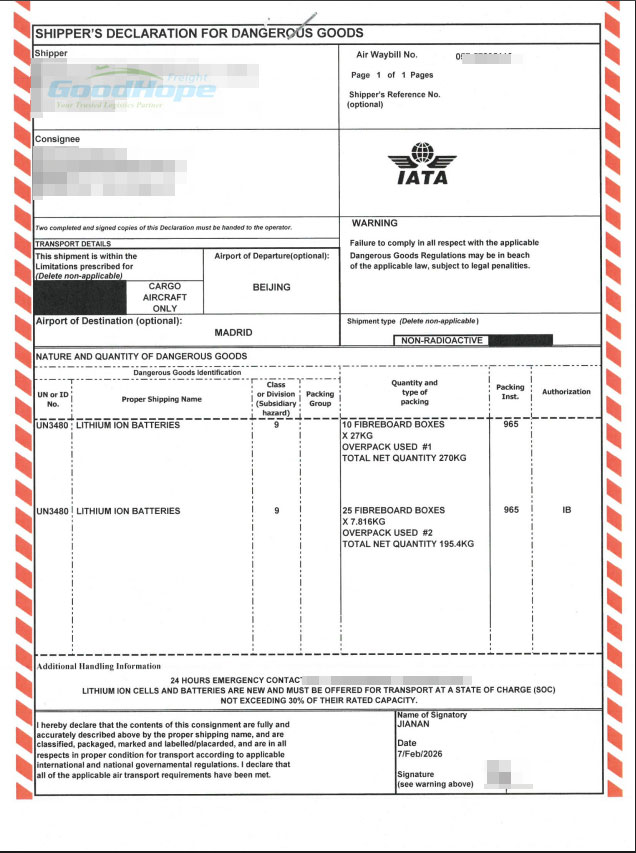
Dangerous Goods Declaration (DGD)

Some Chinese airports require airlines to provide DGD (Dangerous Goods Declaration) documentation when transporting dangerous goods, such as Beijing Daxing International Airport, Chengdu Shuangliu International Airport, Xi'an Xianyang International Airport, Zhengzhou Xinzheng International Airport, and Changsha Huanghua International Airport.

Frequently asked questions about shipping Dangerous Goods Declaration (DGD)

Which rule set applies when shipping Declaration Dgd from China?
The mode decides the rule set: the IMDG Code for sea, the IATA DGR for air, and the ADR or local road rules for the inland leg. Each set carries its own entries, packing instructions and labels, so a product accepted by one mode can be refused by another. The page explains how the classification is reached, and the shipper confirms the current edition before booking.
Which documents must accompany a dangerous goods shipment of Declaration Dgd?
For Declaration Dgd the core set is a shipper declaration for dangerous goods, a safety data sheet for the current formulation, and packing certificates for the packaging used. Sea freight adds the container packing certificate, and air freight adds the signed 24-hour emergency contact on the declaration. Inconsistent paperwork is the usual reason a booked DG consignment is refused at the gate, so the documents are checked before the cut-off rather than after.
What packaging does Declaration Dgd require?
Packaging follows the packing instruction for the entry, which sets the package type, the quantity limits per inner and outer package and the tests behind the UN mark. Combination packaging covers most small-lot exports, while IBCs and tank containers carry bulk volume. A package without a valid UN specification mark is refused regardless of what it contains.
Can Declaration Dgd go by sea, by air, or both?
Sea freight carries most DG volume under the IMDG Code, with the class, packing group and stowage category deciding where the container sits on board. Air is possible for smaller quantities where the IATA DGR entry and operator variations allow, but the per-package limits are far tighter. Rail and road follow their own rule sets, so a mode change means a fresh check rather than a re-used declaration.
Can the cargo move as LCL, or does it need a full container?
Low-hazard classes can move LCL where the co-loading warehouse and the carrier both accept them, provided the consolidation stays compatible. Classes that react with one another, or that need segregated stowage, are pushed to FCL so the container stays dedicated. In practice volume and class decide it: a few pallets of a low-hazard product usually go LCL, while reactive or high-hazard cargo goes FCL.
Which labels and marks are required on the packages?
Each package carries the hazard label for its class, the subsidiary risk label where the entry requires one, plus the UN number and the proper shipping name. Overpacks and containers take the matching placards, and a container gets them on both sides and both ends. Labels are checked at the gate and at the terminal, and a missing or mismatched label stops the shipment where it stands.
How much lead time should I allow for a DG booking?
The booking goes in with the product name, UN number, class, packing group, weight and package type, and the carrier confirms acceptance before the cut-off. Allow several working days beyond a general cargo booking, because the DG desk reviews the declaration and the route restrictions separately. Vessels and aircraft cap how much of each class they carry, so a late request can miss the sailing even where space exists.
How long does the shipment from China take?
Transit depends on the routing and on how quickly the carrier accepts the DG booking, so it is quoted with the sailing or flight rather than from a table. DG review, screening and clearance sit outside the pure transit time.
How should the cargo be stored and handled before loading?
Storage follows the class: flammable entries stay clear of ignition sources and oxidisers, and reactive entries are kept dry and segregated. The warehouse needs the safety data sheet before the cargo arrives so the receiving staff can place it correctly. Damaged or leaking packages are quarantined rather than loaded, because one leak inside a shared container turns into a carrier claim.
What information do you need in order to quote this shipment?
Send the product name and UN number, the class and packing group, the package type and count, the gross weight and CBM, and both addresses. The safety data sheet speeds up the review, and an existing declaration or a previous shipment reference helps match the entry. With those in hand the mode, the route and the DG surcharge can be priced rather than guessed.

Ready to Ship from China?

Planning a shipment or just comparing options? Contact our freight experts to get a tailored rate within 24 hours.

Get A Quote