
Guide to Lithium Battery Export Customs Clearance
I. Packaging Compliance: The Foundation of Safe Transport

Common Challenge
During export preparation, an inadequate understanding of marking and labeling requirements often leads to incorrect hazard communication, resulting in cargo detention, heavy fines, or costly returns at the port of origin.
International Regulatory Frameworks
Lithium battery shipments must strictly adhere to the IMDG Code (Maritime) and the ICAO Technical Instructions / IATA DGR (Air). All shipments must be contained in UN-Specification Packaging, with mandatory labels and marks durably affixed to the outer surface.
Key Compliance Requirements:
- Testing: All lithium-ion and lithium-metal batteries must successfully pass the UN38.3 test series to be eligible for transport.
- External Marking & Labeling:
- UN Specification Mark: (e.g.,
4G/Y145/S/23/CN/...)—Indicates the packaging's design type and performance rating. - Class 9 Lithium Battery Hazard Label: Required for fully regulated shipments.
- Lithium Battery Mark: Required for shipments under specific exceptions (e.g., Section 188).
- UN Number & Proper Shipping Name (PSN): Must be clearly displayed (e.g., UN3480, Lithium Ion Batteries).
- UN Specification Mark: (e.g.,
UN Number Classification Matrix
Per the UN Model Regulations (TDG), identification depends on chemistry and packaging configuration:
| UN Number | Applicable Configuration |
|---|---|
| UN3480 | Lithium-Ion Batteries (standalone) |
| UN3481 | Lithium-Ion Batteries contained in or packed with equipment |
| UN3090 | Lithium Metal Batteries (standalone) |
| UN3091 | Lithium Metal Batteries contained in or packed with equipment |
II. Documentation: The Key to Seamless Clearance
Common Challenge
Absence of the Dangerous Goods Packaging Performance Certificate remains the leading cause of customs rejections. This document is a legal necessity; without it, shipments are ineligible for export declaration and cannot be released from the warehouse.
Mandatory Documentation Portfolio:
- Manufacturer's Declaration of Conformity: Self-declaration of dangerous goods compliance.
- Inspection Certificate for Performance of Packaging of Exported Dangerous Goods: (Known as the "Performance Certificate"). Validates the physical strength of the empty boxes.
- Identification Certificate for Use of Packaging of Exported Dangerous Goods: (Known as the "Usage Certificate"). Validates that the batteries are correctly packed within the certified boxes.
- Hazardous Characteristics Classification Report: Issued by an accredited body (e.g., SRICI) to define the hazard class.
- UN38.3 Test Summary: A standardized 10-point summary required by carriers and authorities.
III. The Two-Step Customs Inspection Process
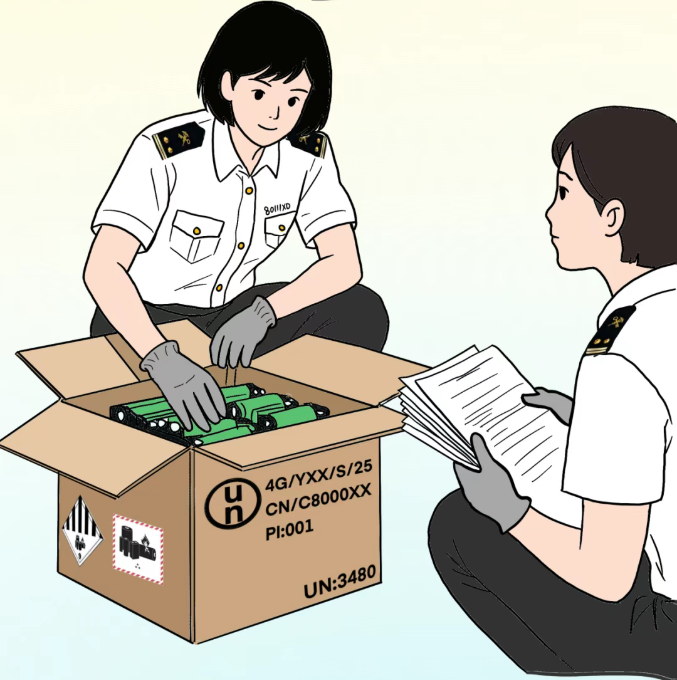
Common Challenge
Many shippers confuse the "Performance Certificate" with the "Usage Certificate." Both are required for fully regulated dangerous goods.
1. Performance Inspection (For Packaging Manufacturers)
The packaging supplier must obtain a certificate proving the boxes can withstand drops, stacking, and internal pressure.
2. Usage Appraisal (For Battery Shippers)
Once the batteries are packed, the shipper must apply to local Customs for a Usage Appraisal. An officer may conduct an on-site inspection to verify:
- The packaging matches the Performance Certificate.
- Interior cushioning and insulation prevent short circuits.
- Labels and marks are correctly applied.
Exemption Criteria (Section 188)
Small batteries may be exempt from the requirement for UN-specification packaging and the Usage Certificate if they meet these limits:
- Lithium-ion Cells: ≤ 20 Wh
- Lithium-ion Batteries: ≤ 100 Wh
- Lithium-metal Cells: ≤ 1 g (lithium content)
- Lithium-metal Batteries: ≤ 2 g (aggregate lithium content)
IV. Global Market Access: Beyond Transport Regulations

Strategic Considerations
Clearing Chinese Customs is only half the battle. You must ensure the product meets the specific technical and environmental standards of the destination country.
- Safety & EMC: UL (USA), CE (EU), PSE (Japan), KC (Korea).
- Environmental: RoHS (Restricted Substances), WEEE (Electronic Waste Disposal).
- Communication: FCC (USA) if the device includes wireless tracking (e.g., Bluetooth/Cellular).