
Critical Alert: Understanding Organic Peroxide Safety in Global Supply Chains – Insights from a Recent Port Incident
1. Incident Overview: A Container Fire and Explosion at Ningbo-Zhoushan Port
On August 9, 2024, a fire and explosion occurred in a container loaded with dangerous goods aboard the vessel Dong Ming (operated by Yang Ming Marine Transport) at the Ningbo-Zhoushan Port Beilun Terminal. The container was carrying an in-transit shipment of tert-butyl peroxybenzoate, classified under the United Nations (UN) number 3103 as an Organic Peroxide, Type C, liquid (per the UN Model Regulations and the IMDG Code 2022).
Fortunately, prompt emergency response ensured no casualties. This incident underscores the severe risks associated with transporting chemically unstable substances, especially under high-temperature conditions.
2. What Are Organic Peroxides?
Organic peroxides are derivatives of hydrogen peroxide (H₂O₂) in which one or both hydrogen atoms are replaced by organic groups. They contain the thermally unstable -O-O- bond, making them highly oxidizing and heat-sensitive.
They can decompose exothermically due to heat, friction, impact, or contact with catalytic impurities (e.g., metals, acids, or amines), potentially leading to spontaneous combustion or explosive decomposition.
Common Industrial Uses:
Initiators for free-radical polymerization; Cross-linking agents for rubber and plastics; Curing agents for unsaturated polyesters; Components in medical disinfectants, adhesives, and pharmaceuticals.
3. Regulatory Classification and Temperature Control Requirements
Under the UN Model Regulations and the IMDG Code, organic peroxides are divided into seven types (A–G), with B–F types linked to maximum allowable quantities in transport packaging.
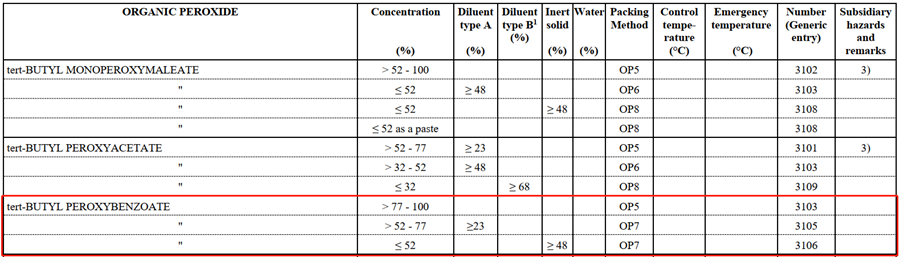
Key Temperature Parameters for Safe Transport:
Self-Accelerating Decomposition Temperature (SADT): The lowest temperature at which self-accelerating decomposition may occur within the transport packaging. It is the fundamental parameter for assessing thermal stability.
Control Temperature: The maximum temperature during transport to prevent hazardous decomposition. It must be maintained below the SADT.
Emergency Temperature: The threshold at which emergency procedures must be initiated if temperature control fails.
When Is Active Temperature Control Required?
Per IMDG Code, the following organic peroxides require temperature-controlled transport (UN3111–UN3120):
Type B & C: SADT ≤ 50°C
Type D: SADT ≤ 50°C (if medium effect in closed heating) or ≤ 45°C (if low/no effect)
Type E & F: SADT ≤ 45°C
Important: Even organic peroxides listed under non-temperature-controlled entries (UN3101–UN3110) may require temperature management if the ambient temperature during transport could exceed 55°C (as per IMDG Code 7.3.7.2.4).
4. Linking the Incident to Temperature Risk
While the official investigation is ongoing, preliminary analysis points to thermal runaway as a likely cause:
The port area recorded high temperatures (37–39°C, with localized peaks of 40°C) on the incident day.
Studies show that dry container interiors can reach 70°C when external temperatures hit 38°C.
The affected container was a "cold unit" used in place of a standard dry container ("cold-for-dry" substitution). Such units have insulation that may trap internal heat rather than dissipate it.
If the internal temperature exceeded the SADT of tert-butyl peroxybenzoate, a self-accelerating decomposition reaction could have been triggered, leading to explosion.
This highlights a critical takeaway: In summer or high-ambient conditions, even non-temperature-controlled hazardous materials may become high-risk if stowed in containers that trap heat.
5. SADT-Based Derivation of Control and Emergency Temperatures
The control and emergency temperatures are derived from the SADT based on the type of packaging used. Below is the summary table aligned with IMDG Code guidelines:
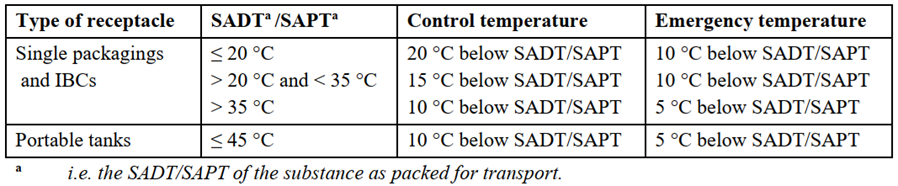
Source: Adapted from IMDG Code and UN Model Regulations.
6. Broader Implications for Hazardous Materials Logistics
Beyond organic peroxides, Class 1 explosives, Class 2.1 flammable gases, Class 3 flammable liquids, Class 4 self-reactive substances, Class 4.2 substances liable to spontaneous combustion, and lithium batteries are also highly sensitive to elevated temperatures.
With global warming increasing the frequency of heatwaves, operators must:
Validate the SADT and thermal stability data of all hazardous materials prior to shipment.
Monitor and forecast ambient temperature conditions along the entire transport route.
Avoid using insulated containers (e.g., "cold-for-dry") for heat-sensitive goods without rigorous risk assessment.
Implement real-time temperature tracking for high-risk shipments.
7. Conclusion: A Call for Proactive Risk Management
The Ningbo-Zhoushan incident is a stark reminder that temperature control is not a mere compliance checkbox but a critical operational safeguard. As climate change raises baseline temperatures and extreme weather events become more common, the logistics industry must adopt a more dynamic, data-driven approach to hazardous materials transport.
Recommendations for International Shippers and Procurement Teams:
Always request Safety Data Sheets (SDS) and verify the SADT for any organic peroxide or temperature-sensitive chemical.
Confirm transport conditions with your freight forwarder—especially whether active temperature control is needed, even for "non-temperature-controlled" entries.
Plan routes and seasons with climate data in mind, avoiding peak summer movements for high-risk goods where possible.
Ensure carriers and terminals are aligned on emergency response protocols for thermal runaway events.
Safe transport is a shared responsibility—from the chemical manufacturer to the end recipient. By understanding the science behind materials like organic peroxides and respecting their physical limits, we can build more resilient and secure global supply chains.
This advisory is based on preliminary reports and international dangerous goods regulations. For specific shipment evaluations, consult a certified dangerous goods safety advisor or refer to the latest IMDG Code.
Stay informed. Stay safe.