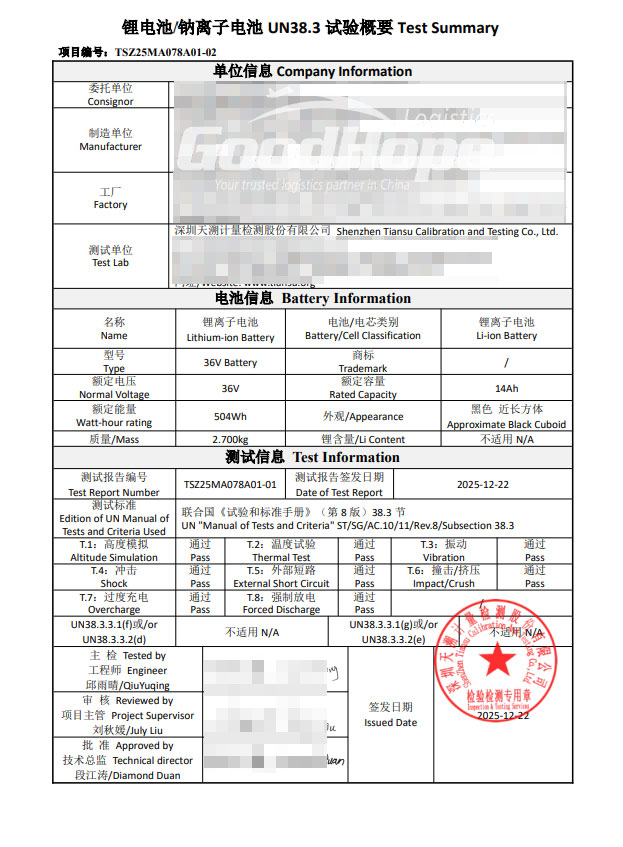
UN38.3 Test Summary – Sodium-ion Battery
Overview
The UN38.3 Test Summary is a mandatory safety document required for the transportation of lithium and sodium-ion batteries. It serves as an essential "safety passport," verifying that the battery has successfully passed the eight rigorous safety tests stipulated by the United Nations Manual of Tests and Criteria. The testing suite comprises a series of environmental and mechanical stresses, including altitude simulation, thermal cycling, vibration, and mechanical shock.
Key Requirements:
- The report must be issued by a qualified, accredited third-party laboratory.
- The test samples must be identical in model and specification to the actual products being shipped.
1. Function and Purpose
UN38.3 is a global safety standard outlined in the UN "Recommendations on the Transport of Dangerous Goods, Manual of Tests and Criteria." For sodium-ion batteries, the core functions of this certification are:
- Safety Verification: To confirm that sodium-ion batteries (cells or packs) can withstand hazardous conditions encountered during transit—such as altitude changes, thermal shock, vibration, external short circuits, overcharging, and forced discharge.
- Risk Prevention: To ensure transportation safety by preventing catastrophic incidents, such as fires or explosions.
- Regulatory Compliance: This certification is a mandatory prerequisite for domestic and international transport via air, sea, rail, and road.
2. Issuing Authorities and Accredited Institutions
A valid UN38.3 test report must be issued by a professional third-party testing body accredited by:
- China National Accreditation Service for Conformity Assessment (CNAS)
- China Inspection Body and Laboratory Mandatory Approval (CMA)
Key authoritative institutions in China providing these services include:
- China Certification & Inspection Group (CCIC)
- Guangzhou GRG Metrology & Test Group (GRG Test)
- Centre Testing International Group (CTI)
- Shenzhen Academy of Metrology & Quality Inspection (SMQ)
- CVC Testing Technology (CVC)
- China Industrial Association of Power Sources (CIAPS) and its accredited labs
- China General Certification (CGC / Jianheng) – specialized in energy storage systems
3. Timeline and Cost Estimates
The duration and cost of testing depend on the battery's specific parameters (e.g., energy density, capacity, size, and configuration).
Estimated Timeframe
- Standard Duration: Typically 3 to 6 weeks.
- Key Factors: Project lead times are primarily influenced by the duration of specific test cycles (e.g., extended thermal stability testing), the quality of sample preparation, and the laboratory's current operational throughput.
- Expedited: If testing proceeds without failure, some labs can complete the process in 2 to 3 weeks.
Estimated Cost Range
- General Range: Approximately ¥10,000 to ¥50,000 RMB (or higher).
- Cost Drivers:
- Configuration Complexity: Testing battery packs (with complex series/parallel circuits) is significantly more expensive than testing individual cells.
- Technical Specifications: Fees scale with the battery's energy capacity and the specific number of test items required.
- Institution Tier: Premium, globally recognized institutions typically charge higher fees for their authoritative endorsements.