
Navigating Dangerous Goods Logistics Compliance: A Critical Alert Based on a Recent Incident
As an international freight forwarder based in Shenzhen, China, this communication addresses a critical and frequently misunderstood aspect of global logistics compliance, particularly relevant for shipments of chemicals, batteries, and related products.
Many shippers and consignees primarily rely on the Material Safety Data Sheet (MSDS) or Safety Data Sheet (SDS) to classify their shipments. A widespread and costly assumption is: "If the MSDS indicates 'no chemical hazards,' the goods can be shipped as general cargo."
This is a potentially serious and non-compliant oversimplification.
I. Case Review: When "Safe" Batteries Fail Compliance
Recently, during a container inspection at a Chinese port, maritime authorities discovered a shipment of nickel-metal hydride batteries with a net weight exceeding 1.5 metric tons. The shipper provided the MSDS for the batteries, which clearly stated "Not Applicable" for all hazard pictograms, signal words, and hazard statements in the "Hazards Identification" section.
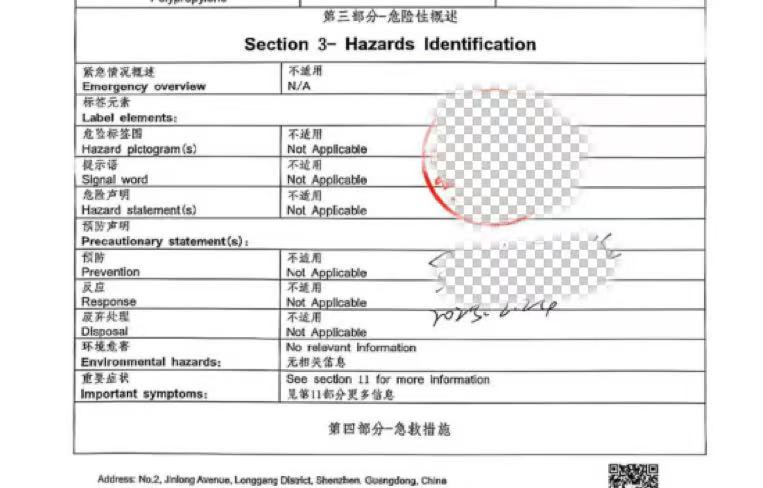
Based on this document alone, the company declared and tendered the shipment as general cargo.
The compliance failure stemmed from a misapplication of transport regulations. The authorities clarified that, according to the International Maritime Dangerous Goods (IMDG) Code, the proper shipping name for these items is "NICKEL-METAL HYDRIDE BATTERIES," assigned to UN 3496 and typically classified under Class 9 (Miscellaneous dangerous substances and articles).
Crucially, Special Provision 963 of the IMDG Code specifies that when such batteries are presented for transport in a single cargo transport unit (e.g., a container) with a net mass of 100 kg or more, they must be fully regulated as Class 9 dangerous goods. This requires a Dangerous Goods Declaration, proper packaging, marking, labeling, and compliance with stowage and segregation requirements.
By failing to declare the hazardous nature, the shipper violated applicable regulations.
II. Analysis: Why Relying Solely on MSDS Is Insufficient
This case highlights several key gaps in understanding:
Confusing "Chemical Hazard" with "Transport Risk"
The MSDS/SDS details the inherent chemical hazards of a substance. In contrast, transport regulations such as the IMDG Code (for sea freight) or IATA Dangerous Goods Regulations (for air freight) assess the comprehensive risk that goods pose within the specific context of the logistics chain—such as prolonged transit in a sealed container or pressure changes in an aircraft hold. For batteries, the primary risks are often physical (e.g., short circuit, thermal runaway), and these risks multiply significantly when large quantities are aggregated.
Overlooking Special Provisions and Excepted Quantities in Transport Regulations
Transport regulations contain numerous "Special Provisions" and exceptions for "Excepted Quantities" and "Limited Quantities." These provisions set specific conditions or modify classifications for particular items, such as batteries or equipment containing batteries. Relying solely on the MSDS and the main regulatory entries is insufficient and non-compliant.
Misunderstanding the Impact of Quantity Thresholds
Small quantities may qualify for exemptions, but the risk profile can change fundamentally at larger scales. The mass and quantity thresholds specified in the regulations—such as the 100 kg threshold in this case—are based on an assessment of aggregate risk.
III. Practical Guidance for Global Traders
To ensure smooth supply chain operations and avoid delays, fines, or liability at the port of origin, we recommend the following:
Obtain an Authoritative Transport Classification Assessment
The MSDS/SDS should not be the final determinant for transport classification. It is essential to obtain a "Transport Classification Assessment Report" or equivalent document from a professionally recognized agency, prepared in accordance with the latest IMDG Code or IATA DGR. This report is the definitive document for determining the correct transport classification for sea or air freight.
Maintain Transparency and Consult Experts Proactively
When booking cargo with a freight forwarder, proactively and accurately disclose all relevant information about the goods, such as chemical composition or the presence of batteries. A professional forwarder can then advise on the correct compliance pathway.
View Compliance as a Core Competency
Rigorous compliance with dangerous goods protocols is paramount to ensuring seamless global market access. It upholds the integrity of the entire supply chain, fortifies corporate reputation, and effectively minimizes legal and financial exposure arising from catastrophic incidents.
Conclusion
In international logistics, safety and compliance are non-negotiable. "No chemical hazard" does not equate to "no transport risk." The final transport classification of goods must be based on the applicable international transport regulations and supported by a formal classification report.
Partnering closely with your logistics provider at the initial planning phase is key to accurate hazard declaration. This approach not only ensures total regulatory compliance but also drives the safe and efficient movement of your cargo through international gateways.