
A Comprehensive Guide to the Safe Ocean Shipping of Lithium Batteries as Dangerous Goods

Introduction
The rapid growth in global demand for new energy vehicles, lithium batteries, and solar panels—collectively known as China's "new three" major export products—has significantly increased the volume of lithium battery shipments via international logistics. Ensuring the safe and compliant transportation of these products, classified as dangerous goods, is paramount for all stakeholders in the supply chain. This guide provides a detailed overview of the key regulations and operational requirements for shipping lithium batteries by sea, from classification to final declaration. The information is primarily based on the International Maritime Dangerous Goods (IMDG) Code and associated regulatory practices.
1. Classification of Lithium Batteries as Dangerous Goods
Under the IMDG Code, lithium batteries and related articles are classified under Class 9: Miscellaneous dangerous substances and articles. The specific classification depends on the battery chemistry and how it is presented for transport, as detailed in the table below:

| UN Number | Class | Proper Shipping Name (PSN) |
|---|---|---|
| UN 3480 | 9 | LITHIUM ION BATTERIES (including lithium ion polymer batteries) |
| UN 3481 | 9 | LITHIUM ION BATTERIES CONTAINED IN EQUIPMENT or LITHIUM ION BATTERIES PACKED WITH EQUIPMENT (including lithium ion polymer batteries) |
| UN 3090 | 9 | LITHIUM METAL BATTERIES (including lithium alloy batteries) |
| UN 3091 | 9 | LITHIUM METAL BATTERIES CONTAINED IN EQUIPMENT or LITHIUM METAL BATTERIES PACKED WITH EQUIPMENT (including lithium alloy batteries) |
| UN 3171 | 9 | BATTERY-POWERED VEHICLE or BATTERY-POWERED EQUIPMENT |
| UN 3166 | 9 | VEHICLE, FLAMMABLE GAS POWERED or VEHICLE, FLAMMABLE LIQUID POWERED or VEHICLE, FUEL CELL, FLAMMABLE GAS POWERED or VEHICLE, FUEL CELL, FLAMMABLE LIQUID POWERED (including electric vehicles powered by wet batteries, sodium batteries, lithium metal batteries, or lithium ion batteries) |
| UN 3536 | 9 | LITHIUM BATTERIES INSTALLED IN CARGO TRANSPORT UNIT |
Crucial Note: The selection of the correct UN number must be verified against the corresponding "Special Provisions" (SP) listed in the Dangerous Goods List of the IMDG Code. These provisions may contain critical exemptions, specific packaging instructions, or additional transport conditions.
2. General Safety Requirements for Lithium Battery Shipments
All lithium cells and batteries offered for transport must meet the following core safety requirements:
- Testing: Each cell and battery type must have passed the test series outlined in Section 38.3 of the UN Manual of Tests and Criteria (commonly referred to as UN 38.3 testing).
- Design Safety: Cells and batteries must be equipped with:
- A safety venting mechanism.
- Effective means to prevent external short circuits.
- For batteries with multiple parallel cells/series, effective protection against dangerous reverse current (e.g., diodes, fuses).
- Quality Management System (QMS): Production must be managed under a robust QMS that covers design control, inspection, testing, process control (including prevention of internal short circuits), and personnel training.
- Vehicles: Battery-powered electric or hybrid vehicles must be secured to prevent accidental activation during transport.

3. Container Packing Requirements
Proper container loading is critical for safety. Key stipulations include:
- The freight container must be structurally sound, clean, dry, and free of residue or damage.
- All packages must be intact, with correct marks and labels visible and legible.
- Cargo must be properly distributed within the container. The weight of cargo in any half of the container's length must not exceed 60% of the total load weight.
- Cargo must be properly stowed, secured, braced, and cushioned to prevent movement during the voyage.
- The gross mass of the loaded container must not exceed its maximum payload (MAX payload).

4. Marking, Labeling, and Placarding Requirements
Correct identification is essential for safe handling and emergency response.
- For Freight Containers: Every side and end of a container carrying lithium batteries (with exceptions for certain vehicles) must display:
- A Class 9 hazard placard (minimum 250 mm x 250 mm).
- The relevant UN number (e.g., "UN 3480"). The UN number must be displayed in black digits at least 65 mm high, either on the placard itself or on an orange rectangular panel placed adjacent to the placard.
- For Packages: Each package containing lithium batteries (with exceptions for certain systems and vehicles) must display:
- The correct Proper Shipping Name and the UN number prefixed by "UN" (minimum 12 mm height).
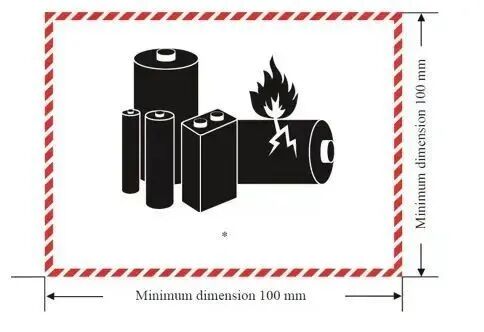
- Either a Class 9 hazard label OR the lithium battery handling mark, as required by the specific packing instruction.
5. Port Entry/Exit Declaration Process
The shipper or their authorized agent is responsible for making a dangerous goods declaration to the maritime authorities. Required documentation typically includes:
- Dangerous Goods Declaration (Declaration for Safe Transport of Dangerous Goods by Sea).
- Container Packing Certificate, signed by a certified container packing checker.
- Certificate of approval for the packaging used (if applicable).
- Power of Attorney and identification documents (if using an agent).
Conclusion
The safe and efficient transport of lithium batteries hinges on strict adherence to international regulations, meticulous classification, robust packaging, clear communication through markings, and accurate documentation. Partners throughout the supply chain—from manufacturers and freight forwarders to carriers and consignees—must collaborate to ensure these requirements are met, thereby protecting personnel, assets, and the environment while facilitating the global trade of these essential products.
Dangerous Goods Declaration (DGD)
Dangerous Goods Declaration (DGD) is a core document in the transportation of dangerous goods, completed and submitted by the shipper to the carrier. It serves as the formal declaration of the hazardous nature of the consignment and provides instructions for its safe transport.
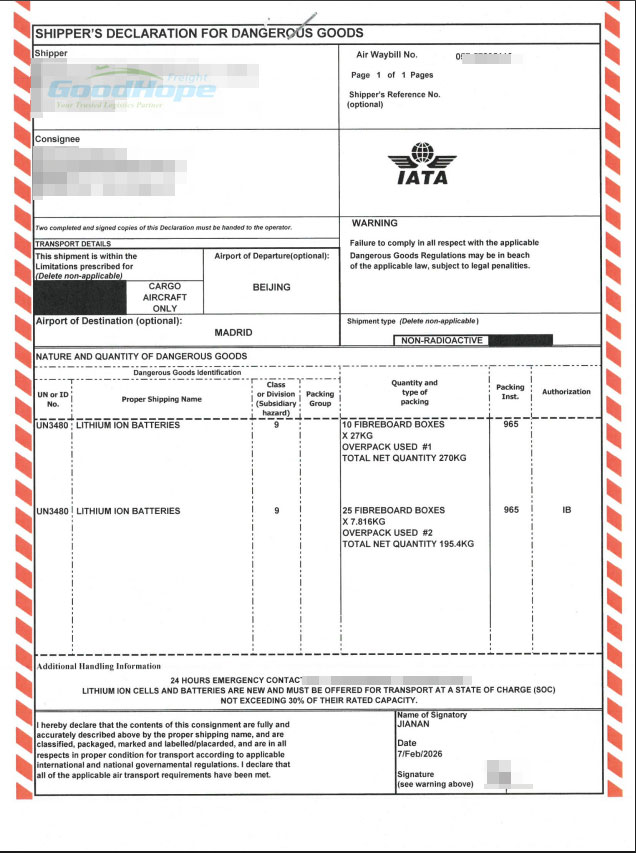
Dangerous Goods Declaration Form (DGD): A formal declaration document submitted by the shipper to the airline. It must include detailed information such as the UN number, packaging description, and SOC value. The form must be stamped with the official seal of the declaring entity, and the information must be completely consistent with the bill of lading and the actual goods.
| Item | Description |
|---|---|
| Purpose | To provide the carrier (airline, shipping line, etc.) with complete and accurate transport information about the dangerous goods. It is the primary document used by operational and safety personnel for handling, storage, and emergency response. |
| Issued By | The shipper (or their designated, qualified agent) is responsible for completing, signing, and assuming legal liability. All information must precisely match the actual goods, packaging, and markings. |
| When Used | Must be completed and submitted before the goods are handed over to the carrier for transport. For example, it must be submitted to the airline before aircraft loading and to the shipping line before vessel loading. |
- Legal Document: The DGD is a legally binding declaration; the shipper is fully responsible for the accuracy of its contents.
- Information Source: The data entered is based primarily on the test results from the Dangerous Goods Transport Identification Report.
- Accompanying Document: The DGD must accompany the shipment so that all parties in the transport chain have access to critical safety information.
SHIPPER'S DECLARATION FOR DANGEROUS GOODS
Additional Handling Information:
LITHIUM ION CELLS AND BATTERIES ARE NEW AND MUST BE OFFERED FOR TRANSPORT AT A STATE OF CHARGE (SOC) NOT EXCEEDING 30% OF THEIR RATED CAPACITY.
I hereby declare that the contents of this consignment are fully and accurately described above by the proper shipping name, and are classified, packaged, marked, labelled, placarded, and are in all respects in proper condition for transport according to applicable international and national governmental regulations. I declare that all air transport requirements have been met.
Some Chinese airports require airlines to provide DGD (Dangerous Goods Declaration) documentation when transporting dangerous goods, such as Beijing Daxing International Airport, Chengdu Shuangliu International Airport, Xi'an Xianyang International Airport, Zhengzhou Xinzheng International Airport, and Changsha Huanghua International Airport.