
Since 2012 NVOCC GD20230925153335 24h Response
+86 13392162503 sales8015@goodhopefreight.com Login
Goodhope Freight

Dangerous Goods Packaging Certificate (Dangerous Goods Appraisal) – Air Cargo

Overview

For international air freight, all dangerous goods packagings—including UN-certified boxes—must undergo rigorous performance testing. Each packaging must strictly conform to the applicable Packing Instructions (e.g., PI965, PI966, PI967) and must demonstrate its ability to withstand a 1.2-meter drop test without sustaining any damage or failure.

In China, compliance with these requirements is evidenced by the Usage Appraisal Result Sheet for Packaging of Exported Dangerous Goods, commonly known as the "Packaging Certificate." This certificate constitutes a critical legal document and is mandatory for the air transport of hazardous materials.

Core Information Summary
Item Description
Purpose 1. Proof of Compliance: Certifies that containers (e.g., steel cylinders, cartons) meet IATA DGR and Chinese national standards.

2. Mandatory Clearance: Required for airline booking, DGD submission, and Customs declaration. Without it, dangerous goods cannot be accepted for transport.
Issuing Authority Issued exclusively by Local Customs Technical Centers (formerly the Entry-Exit Inspection and Quarantine Bureaus) under the General Administration of Customs of China (GACC), following on-site inspection.
Timeline Must be obtained after the goods are packaged but before delivery to the airport and Customs declaration. It is recommended to apply immediately after the goods are prepared.
Applicability Required for all items listed in the Dangerous Goods Regulations (DGR) that use standard DG packaging (excluding Limited or Excepted Quantities). Common examples: lithium batteries, chemicals, and fuel-containing equipment.
Fees Costs are variable based on:

1. Type of goods and packaging materials.

2. Local inspection agency fee schedules.

3. Expedited processing requirements.
The "Three-Pillar" Documentation Chain

To successfully transport dangerous goods by air, a complete chain of documentation is required. These three documents work together to ensure safety:
  1. Identification Report: Focuses on the nature of the goods (determines the hazard class and UN number).
  2. Packaging Certificate: Focuses on the safety of the container (proves the packaging is qualified and tested).
  3. Shipper's Declaration for Dangerous Goods (DGD): The master operational document completed by the shipper, synthesizing information from the two reports above.

Note: These three documents must be prepared simultaneously, as they are all essential for a successful booking and shipment.

Official Document Name (Bilingual Reference)

People's Republic of China Entry-Exit Inspection and Quarantine: Result Sheet for Usage Appraisal of Transport Packaging of Exported Dangerous Goods
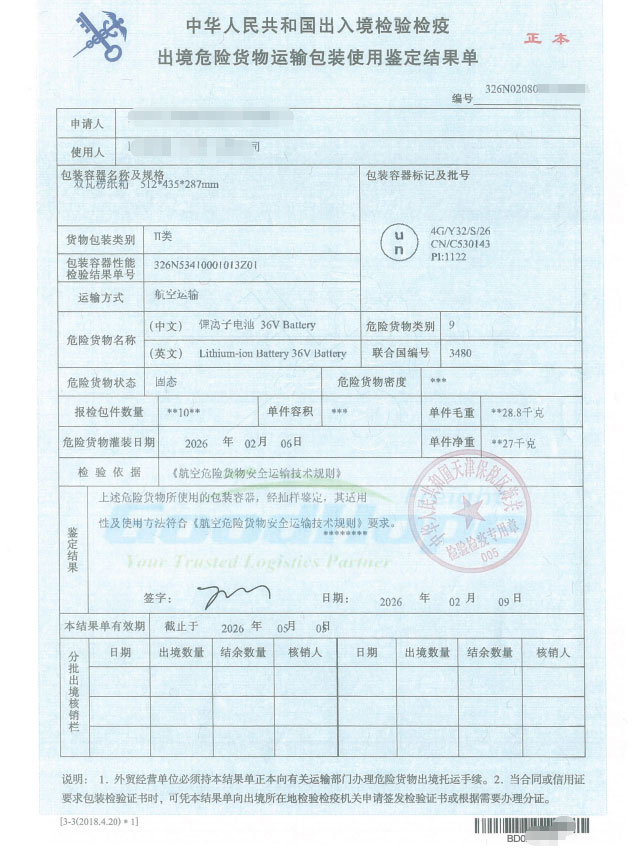
Dangerous Goods Packaging Certificate (MAD) -Air Cargo

Frequently asked questions about shipping Dangerous Goods Packaging Certificate (MAD) -Air Cargo

Which rule set applies when shipping Mad from China?
The mode decides the rule set: the IMDG Code for sea, the IATA DGR for air, and the ADR or local road rules for the inland leg. Each set carries its own entries, packing instructions and labels, so a product accepted by one mode can be refused by another. The page explains how the classification is reached, and the shipper confirms the current edition before booking.
Which documents must accompany a dangerous goods shipment of Mad?
For Mad the core set is a shipper declaration for dangerous goods, a safety data sheet for the current formulation, and packing certificates for the packaging used. Sea freight adds the container packing certificate, and air freight adds the signed 24-hour emergency contact on the declaration. Inconsistent paperwork is the usual reason a booked DG consignment is refused at the gate, so the documents are checked before the cut-off rather than after.
What packaging does Mad require?
Packaging follows the packing instruction for the entry, which sets the package type, the quantity limits per inner and outer package and the tests behind the UN mark. Combination packaging covers most small-lot exports, while IBCs and tank containers carry bulk volume. A package without a valid UN specification mark is refused regardless of what it contains.
Can Mad go by sea, by air, or both?
The air side is the stricter one: acceptance depends on the IATA DGR entry, the net quantity limit per package and the operator variations on the route. Many classes are capped at a few kilograms per package by air, and some operators refuse them outright. Where the volume grows, sea freight carries the same product under IMDG rules at a much lower unit cost.
Can the cargo move as LCL, or does it need a full container?
Low-hazard classes can move LCL where the co-loading warehouse and the carrier both accept them, provided the consolidation stays compatible. Classes that react with one another, or that need segregated stowage, are pushed to FCL so the container stays dedicated. In practice volume and class decide it: a few pallets of a low-hazard product usually go LCL, while reactive or high-hazard cargo goes FCL.
Which labels and marks are required on the packages?
Each package carries the hazard label for its class, the subsidiary risk label where the entry requires one, plus the UN number and the proper shipping name. Overpacks and containers take the matching placards, and a container gets them on both sides and both ends. Labels are checked at the gate and at the terminal, and a missing or mismatched label stops the shipment where it stands.
How much lead time should I allow for a DG booking?
The booking goes in with the product name, UN number, class, packing group, weight and package type, and the carrier confirms acceptance before the cut-off. Allow several working days beyond a general cargo booking, because the DG desk reviews the declaration and the route restrictions separately. Vessels and aircraft cap how much of each class they carry, so a late request can miss the sailing even where space exists.
How long does the shipment from China take?
Transit depends on the routing and on how quickly the carrier accepts the DG booking, so it is quoted with the sailing or flight rather than from a table. DG review, screening and clearance sit outside the pure transit time.
How should the cargo be stored and handled before loading?
Storage follows the class: flammable entries stay clear of ignition sources and oxidisers, and reactive entries are kept dry and segregated. The warehouse needs the safety data sheet before the cargo arrives so the receiving staff can place it correctly. Damaged or leaking packages are quarantined rather than loaded, because one leak inside a shared container turns into a carrier claim.
What information do you need in order to quote this shipment?
Send the product name and UN number, the class and packing group, the package type and count, the gross weight and CBM, and both addresses. The safety data sheet speeds up the review, and an existing declaration or a previous shipment reference helps match the entry. With those in hand the mode, the route and the DG surcharge can be priced rather than guessed.

Ready to Ship from China?

Planning a shipment or just comparing options? Contact our freight experts to get a tailored rate within 24 hours.

Get A Quote