
Excepted Quantities (EQ) in Dangerous Goods: A Brief Guide
The transportation of dangerous goods is governed by stringent international regulations. However, for minimal quantities, frameworks like the Excepted Quantities (EQ) system offer a simplified alternative. This article explains the EQ provisions for air and ocean freight, detailing eligibility, limits, and marking requirements.
1. The EQ Concept
EQ is a regulatory provision that exempts very small quantities of dangerous goods from many standard transportation rules when packed in extremely durable, tested inner packagings within a combination package. This simplifies shipping for low-volume hazardous materials like lab chemicals or samples.
2. Determining Eligibility
Not all dangerous goods qualify for EQ shipment. Eligibility is determined by the substance's UN Number and its listing in governing regulations.
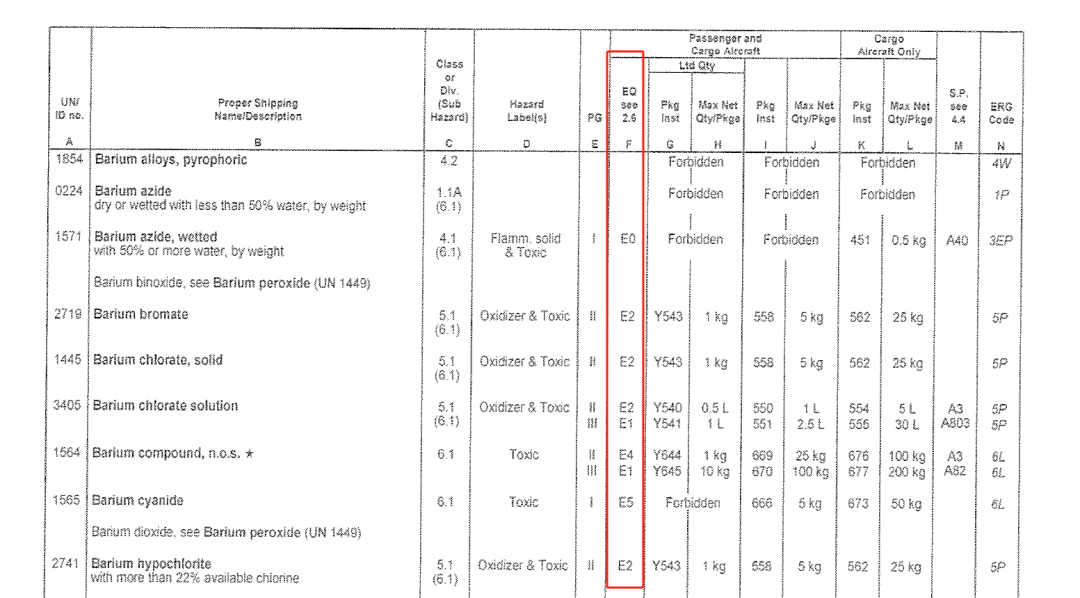
- Air Transport (IATA DGR): Refer to Column F of the List of Dangerous Goods (Section 4.2). Codes E1 through E5 indicate eligibility with specific limits; E0 means "forbidden."
- Examples of Eligible Goods (IATA): Include certain non-toxic gases (Division 2.2), many Class 3 flammable liquids (Packing Group II & III), and some Class 8 corrosives (Packing Group II & III). Specific exclusions apply (e.g., UN 1774, UN 2794).
3. Quantity Limits & Codes
The EQ code (E1-E5) specifies the maximum net quantity allowed per inner and outer package.
| EQ Code | Max. per Inner Packaging | Max. per Outer Packaging |
|---|---|---|
| E0 | Not permitted | Not permitted |
| E1 | 30 g or mL | 1 kg or L |
| E2 | 30 g or mL | 500 g or mL |
| E3 | 30 g or mL | 300 g or mL |
| E4 | 1 g or mL | 500 g or mL |
| E5 | 1 g or mL | 300 g or mL |
Example: Barium bromate (UN 2719) with code E2 means each inner package ≤ 30g/mL and each outer package ≤ 500g/mL.
4. Mandatory Package Marking
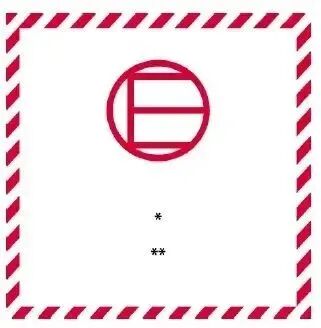
Every outer package must display the Excepted Quantity mark. This square mark must be at least 100mm x 100mm, in red or black on a contrasting background, and placed on one side without folding.
5. Performance Testing Requirements
The complete, filled package must pass two key tests without leakage of inner receptacles:
- Drop Test: A 1.8-meter drop onto a hard, flat surface in specified orientations (for boxes: bottom, top, sides, corners; for drums: on chime and side).
- Stacking Test: A force equivalent to the weight of a 3-meter-high stack must be applied to the top surface for 24 hours.