
Understanding Organic Peroxides: Critical Insights for Safe International Chemical Logistics
Dear Valued Clients and Partners in Global Supply Chains,
As a leading international freight forwarder based in Shenzhen, China, we recognize that safety is the cornerstone of reliable global trade. Many products sourced from China, especially in industries like plastics, rubber, pharmaceuticals, and textiles, may involve materials classified as organic peroxides. These substances are vital as initiators, curing agents, and bleaching agents but pose significant hidden risks if mishandled during logistics.
This article provides essential knowledge on organic peroxide transportation, aligning with global regulations to ensure your supply chain’s safety and compliance.
What Are Organic Peroxides & Why Are They Hazardous?
Organic peroxides are chemical compounds containing an unstable -O-O- (peroxy) group. Their inherent instability makes them highly reactive. Under specific conditions like heat, friction, or contamination, they can undergo self-accelerating decomposition, releasing immense heat and leading to fire or explosion.
Real-world incidents underscore this danger:
- A 2019 warehouse fire in Guangzhou, linked to tert-butyl peroxybenzoate, resulted in fatalities due to thermal decomposition and improper handling.
- A 2020 explosion at a Chinese factory, occurring during the loading of Benzoyl Peroxide (BPO), caused multiple deaths.
Global Regulatory Framework: The TDG Mandate
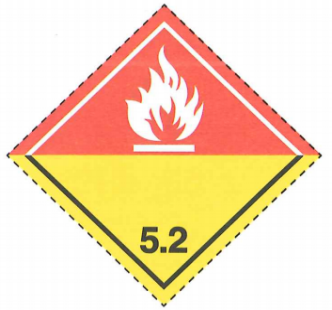
The transport of organic peroxides is strictly governed by the United Nations Model Regulations on the Transport of Dangerous Goods (UN TDG). Under this system, most organic peroxides are classified as Class 5.2 Dangerous Goods.
Key Regulatory Concepts for Shippers:
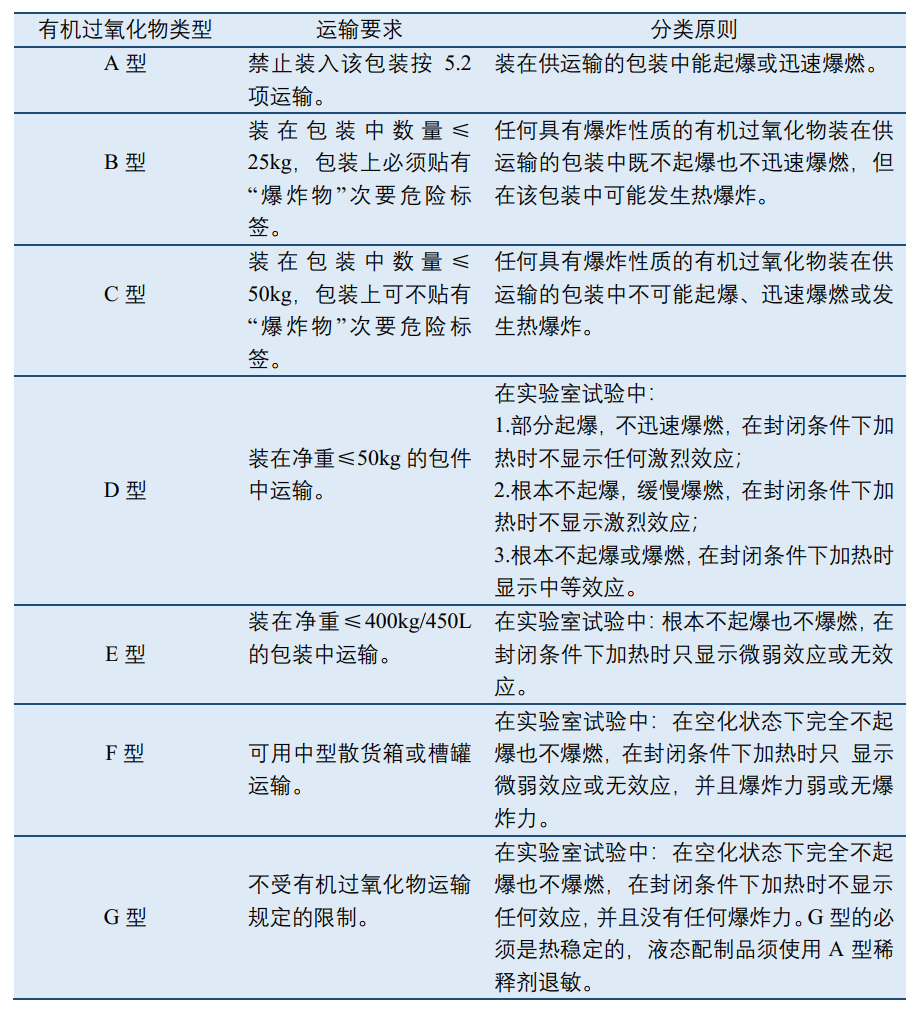
- Classification (Types A-G): Organic peroxides are assigned a type from A (forbidden for transport) to G (exempt from most 5.2 regulations), based on laboratory tests of their explosive properties and thermal stability. Types B through F have specific packaging and quantity limits.
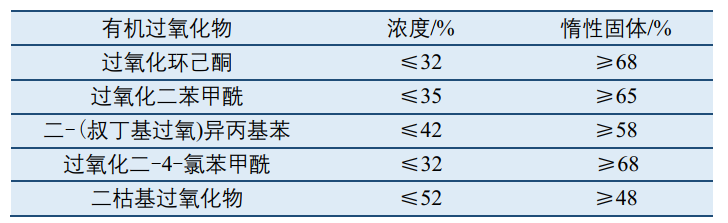
- Exemptions: A product may be exempt from Class 5.2 if it meets strict criteria, such as having a low active oxygen content or being desensitized by a sufficient proportion of inert solid or liquid (a principle known as "inhibiting" or "phlegmatization").
- Desensitization: Safety during transport is often achieved by adding diluents (Type A or B), water, or inert solids to reduce the hazardous properties.
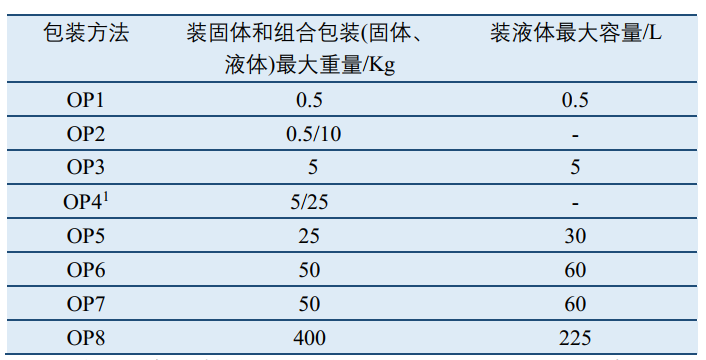
- Packaging Instructions (OP Codes): The permitted maximum net quantity per package is defined by OP1 to OP8 packaging codes. Higher hazard materials (e.g., Type B) have stricter limits (e.g., OP1 allows only 0.5kg).
- UN Identification & Temperature Control:
- UN 3101 ~ UN 3110: For organic peroxides not requiring temperature control during transport.
- UN 3111 ~ UN 3120: For organic peroxides that require temperature control during transport.
Our Role as Your Logistics Partner
Navigating these complex rules requires expertise. We ensure:
- Accurate Classification & Documentation: Determining the correct UN number, proper shipping name, hazard class (5.2), and subsidiary risks.
- Packaging Compliance: Selecting and certifying packaging that meets the precise OP code requirements for your specific organic peroxide formulation.
- Regulatory Alignment: Preparing all necessary transport documents, declarations, and safety data sheets (SDS) in full compliance with TDG, IMDG Code (sea), and IATA DGR (air).
- Carrier Coordination: Booking with carriers approved and equipped to handle dangerous goods, ensuring all stowage and segregation rules are followed.
The safe transport of organic peroxides is non-negotiable. Understanding their properties and the strict regulatory landscape is the first step. By partnering with a knowledgeable freight forwarder, you transform a potential supply chain risk into a managed, compliant, and safe process.
💡 For a safe and seamless journey of your chemical shipments from China to the world, consult with our dangerous goods specialists.