Since 2012 NVOCC GD20230925153335 24h Response
+86 13392162503 sales8015@goodhopefreight.com Login
Goodhope Freight

A Professional Guide for International Shippers: Transporting Class 3 Dangerous Goods (Flammable Liquids)

This article serves as a professional reference for international purchasers and stakeholders involved in shipping chemicals and dangerous goods from China, particularly via air or sea freight. It focuses on the critical aspects of handling Class 3 Dangerous Goods: Flammable Liquids.

1. Definition and Regulatory Basis

According to the United Nations Model Regulations on the Transport of Dangerous Goods (UN TDG), Class 3 Flammable Liquids are substances that emit flammable vapors at or below specific temperatures, measured as a flash point. The key technical thresholds are:

  • A closed-cup flash point not exceeding 60°C, or
  • An open-cup flash point not exceeding 65.6°C.

This class encompasses not only pure liquids and mixtures but also liquids containing solids in solution or suspension (e.g., paints, varnishes). Crucially, it also includes:

  • Liquids offered for transport at temperatures at or above their flash point.
  • Substances transported in a liquid state at elevated temperatures that emit flammable vapors at or below the maximum transport temperature.

A related sub-category is Liquid Desensitized Explosives, which are explosive substances dissolved or suspended in a liquid to suppress their explosive properties.

2. Primary Hazards and Risk Management in Transit

Understanding the inherent risks of flammable liquids is paramount for safe logistics planning:

  • Flammability & Explosivity: Combustion occurs when vapor mixes with air within an explosive range. Higher volatility increases the risk of explosion during handling or in case of a spill.
  • Thermal Expansion: These liquids expand when heated. In sealed containers, this can create excessive pressure, leading to container failure or rupture—a significant risk during long-haul transport or storage in varying climates.
  • Fluidity: Their liquid state means any leakage can spread rapidly, increasing the evaporation surface area and the potential for a large, fast-moving fire, complicating emergency response.
  • Electrostatic Charging: Transfer operations like filling, pumping, or spraying can generate static electricity, posing an ignition risk.
  • Toxicity: Many flammable liquids or their vapors are toxic and can pose health hazards through inhalation or skin contact, adding another layer of risk for personnel.

3. Packaging, Marking, and Labeling Requirements

Compliance with specific packaging and labeling standards is non-negotiable for regulatory approval and safety.

  • Packaging: The required packaging type (UN specification packaging) is determined by the UN Number (e.g., UN 1090 for Acetone), Proper Shipping Name, and mode of transport. The relevant Packing Instruction (PI) in regulations like the IATA DGR (for air) or IMDG Code (for sea) must be strictly followed.
  • Hazard Labels: A Class 3 Flammable Liquid label is mandatory. The diamond-shaped label must have a red background, a black or white flame symbol, and a minimum size of 100mm x 100mm.
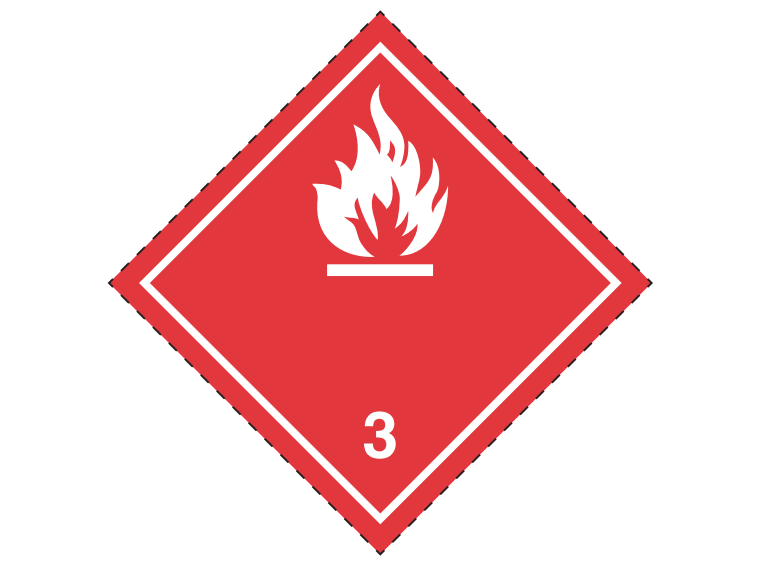
Class 3 flammable liquid hazard label - red diamond with flame symbol
Class 3 Flammable Liquid Hazard Label
Class 3 flammable liquid hazard label - red diamond with flame symbol
Class 3 Flammable Liquid Hazard Label
  • Handling Labels: Packages containing liquids must bear at least two Orientation (UP) labels on opposite sides, with a minimum size of 74mm x 105mm. Labels should be red or black on a high-contrast background.
  • Additional Labels: If the substance possesses subsidiary risks (e.g., toxicity, corrosivity), corresponding secondary risk labels must also be applied.

Orientation label - UP arrow for liquid packages
Orientation (UP) Label for Liquid Packages

4. Documentation for International Shipments

Accurate and complete documentation is essential for customs clearance and carrier acceptance. Key documents include:

  • Shipper's Declaration for Dangerous Goods (Mandatory for air freight).
  • Air Waybill (for air) or Bill of Lading (for sea), with dangerous goods details properly declared.
  • Material Safety Data Sheet (MSDS/SDS).
  • Dangerous Goods Classification Report (often required as proof of classification).
  • Other customs and transport documents as per origin/destination country regulations.

5. Case in Point: Alcoholic Beverages as Dangerous Goods

Alcoholic beverages are a common example. Their classification depends on alcohol concentration by volume:

  • 70% alcohol: Class 3, UN 3065, Packing Group (PG) II (Medium danger).
  • 24% and ≤ 70% alcohol: Class 3, UN 3065, Packing Group (PG) III (Low danger).

Alcoholic beverage products shipped as Class 3 dangerous goods
Alcoholic Beverages: Common Example of Class 3 Dangerous Goods

Important Exemptions (Special Provisions):

  • UN TDG Special Provision 144: Solutions with ≤ 24% alcohol by volume are not subject to dangerous goods regulations.
  • UN TDG Special Provision 145: For transport modes other than air, PG III alcoholic beverages in receptacles not exceeding 250 liters are exempt.
  • IATA Special Provision A9: For air transport, PG III alcoholic beverages (≤ 70% alcohol) in inner packagings not exceeding 5 liters are exempt when transported as cargo.

Note: It is critical to distinguish between dangerous chemicals (a HSSE term) and dangerous goods (a transport regulatory term). Not all hazardous chemicals are regulated as dangerous goods for transport.

6. Fire Emergency Response Guidelines

Fires involving flammable liquids can escalate quickly. Initial response should consider the liquid's properties:

  • For water-immiscible liquids lighter than water (e.g., gasoline, ether, benzene): Use dry chemical powder or CO₂. DO NOT USE WATER, as it will spread the fire.
  • For water-immiscible liquids heavier than water (e.g., carbon disulfide): Water spray or fog can be used to form a covering layer to smother the fire.
  • For water-miscible liquids (e.g., methanol, acetone): Alcohol-resistant foam, dry chemical powder, CO₂, or halon alternatives can be effective.
Disclaimer: This guide provides a general overview based on international model regulations. Specific requirements may vary by carrier, country, and the exact substance. It is the shipper's responsibility to ensure full compliance with all applicable regulations (IATA DGR, IMDG Code, national laws) for each shipment. Consulting with a professional dangerous goods safety advisor or a qualified third-party logistics provider is strongly recommended.

Frequently asked questions about shipping Class 3 Dangerous Goods

Which rule set applies when shipping Class Flammable Liquids from China?
The mode decides the rule set: the IMDG Code for sea, the IATA DGR for air, and the ADR or local road rules for the inland leg. Each set carries its own entries, packing instructions and labels, so a product accepted by one mode can be refused by another. The page explains how the classification is reached, and the shipper confirms the current edition before booking.
Which documents must accompany a dangerous goods shipment of Class Flammable Liquids?
For Class Flammable Liquids the core set is a shipper declaration for dangerous goods, a safety data sheet for the current formulation, and packing certificates for the packaging used. Sea freight adds the container packing certificate, and air freight adds the signed 24-hour emergency contact on the declaration. Inconsistent paperwork is the usual reason a booked DG consignment is refused at the gate, so the documents are checked before the cut-off rather than after.
What packaging does Class Flammable Liquids require?
Packaging follows the packing instruction for the entry, which sets the package type, the quantity limits per inner and outer package and the tests behind the UN mark. Combination packaging covers most small-lot exports, while IBCs and tank containers carry bulk volume. A package without a valid UN specification mark is refused regardless of what it contains.
Can Class Flammable Liquids go by sea, by air, or both?
Sea freight carries most DG volume under the IMDG Code, with the class, packing group and stowage category deciding where the container sits on board. Air is possible for smaller quantities where the IATA DGR entry and operator variations allow, but the per-package limits are far tighter. Rail and road follow their own rule sets, so a mode change means a fresh check rather than a re-used declaration.
Can the cargo move as LCL, or does it need a full container?
Low-hazard classes can move LCL where the co-loading warehouse and the carrier both accept them, provided the consolidation stays compatible. Classes that react with one another, or that need segregated stowage, are pushed to FCL so the container stays dedicated. In practice volume and class decide it: a few pallets of a low-hazard product usually go LCL, while reactive or high-hazard cargo goes FCL.
Which labels and marks are required on the packages?
Each package carries the hazard label for its class, the subsidiary risk label where the entry requires one, plus the UN number and the proper shipping name. Overpacks and containers take the matching placards, and a container gets them on both sides and both ends. Labels are checked at the gate and at the terminal, and a missing or mismatched label stops the shipment where it stands.
How much lead time should I allow for a DG booking?
The booking goes in with the product name, UN number, class, packing group, weight and package type, and the carrier confirms acceptance before the cut-off. Allow several working days beyond a general cargo booking, because the DG desk reviews the declaration and the route restrictions separately. Vessels and aircraft cap how much of each class they carry, so a late request can miss the sailing even where space exists.
How long does the shipment from China take?
Transit depends on the routing and on how quickly the carrier accepts the DG booking, so it is quoted with the sailing or flight rather than from a table. DG review, screening and clearance sit outside the pure transit time.
How should the cargo be stored and handled before loading?
Storage follows the class: flammable entries stay clear of ignition sources and oxidisers, and reactive entries are kept dry and segregated. The warehouse needs the safety data sheet before the cargo arrives so the receiving staff can place it correctly. Damaged or leaking packages are quarantined rather than loaded, because one leak inside a shared container turns into a carrier claim.
What information do you need in order to quote this shipment?
Send the product name and UN number, the class and packing group, the package type and count, the gross weight and CBM, and both addresses. The safety data sheet speeds up the review, and an existing declaration or a previous shipment reference helps match the entry. With those in hand the mode, the route and the DG surcharge can be priced rather than guessed.

Ready to Ship from China?

Planning a shipment or just comparing options? Contact our freight experts to get a tailored rate within 24 hours.

Get A Quote